When a particle with charge q moves across a magnetic field ofmagnitude B, it experiences...
When a particle with charge q moves across a magnetic field of magnitude B, it experiences a force to the side. If the proper electric field E⃗ is simultaneously applied, the electric force on the charge will be in such a direction as to cancel the magnetic force with the result that the particle will travel in a straight line. The balancing condition provides a relationship involving the velocity v⃗ of the particle. In this problem you will figure out how to arrange the fields to create this balance and then determine this relationship. Figure1 of 2The ion source on the left and two horizontal plates spaced a distance d apart on the right are shown in xy plane. The upper plate has a 0 potential, and the lower plate has a potential equal to the product module E by module d. The vertical screen with a slit in its center is placed to the right from the plates. The x-axis points to the right, and the y-axis points upward.
Now find the magnitude of the magnetic field that will cause the charge to travel in a straight line under the combined action of electric and magnetic fields. (Figure 2) Express the magnetic field Bbal that will just balance the applied electric field in terms of some or all of the variables q, v, and E. |

Homework Answers

Add Answer to:
When a particle with charge q moves across a magnetic field ofmagnitude B, it experiences...
1. A particle with a charge of +4.20 nC is in a uniform electric field E⃗ directed...
1. A particle with a charge of +4.20 nC is in a uniform electric field E⃗ directed to the negative x direction. It is released from rest, and after it has moved 6.00 cm , its kinetic energy is found to be 1.50×10⁻⁶ J . a. What work was done by the electric force? b. What was the change in electric potential over the distance that the charge moved? c. What is the magnitude of E? d. What was the change...
(1 point) d A particle is shot into a magnetic field region as shown in the...
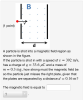 (1 point) d A particle is shot into a magnetic field region as shown in the figure. If the particle is shot in with a speed of u = 392 m/s has a charge of q = 33.6 uC and a mass of m = 0.3 mg, how strong must the magnetic field be so the particle just misses the right plate, given that the plates are separated by a distance d = 0.16 m? The magnetic field is equal...
A particle has a charge of q = +4.7 μC and is located at the origin....
A particle has a charge of q = +4.7 μC and is located at the origin. As the drawing shows, an electric field of Ex = +232 N/C exists along the +x axis. A magnetic field also exists, and its x and y components are Bx = +1.7 T and By = +1.6 T. Calculate the force (magnitude and direction) exerted on the particle by each of the three fields when it is (a) stationary, (b) moving along the +x...
A uniform magnetic field exists in a circular area. A particle carrying charge q = 8.0...
A uniform magnetic field exists in a circular area. A particle carrying charge q = 8.0 mC is placed in the field a distance rp = 20 mm from the center of the circular area. If the particle experiences a force that has magnitude F = 4.00 μN and is perpendicular to the direction of the magnetic field, what is the magnitude of the rate at which the magnetic field is changing?
A particle has a charge of q = +5.5 pC and is located at the origin....
 A particle has a charge of q = +5.5 pC and is located at the origin. As the drawing shows, an electric field of Ex-+214 N/C exists along the +χ axis. A magnetic field also exists, and its χ and y components are B*-+1.3 T and By +1.9 T. Calculate the force (magnitude and direction) exerted on the particle by each of the three fields when it is (a) stationary, (b) moving along the +χ axis at a speed of...
A point charge q = +39.0 µC moves from A to B separated by a distance...
A point charge q = +39.0 µC moves from A to B separated by a distance d = 0.184 m in the presence of an external electric field E with arrow of magnitude 295 N/C directed toward the right as in the following figure. A positive point charge q is initially at point A, then moves a distance d to the right to point B. Electric field vector E points to the right. (a) Find the electric force exerted on...
A point charge q = +41.0 µC moves from A to B separated by a distance...
A point charge q = +41.0 µC moves from A to B separated by a distance d = 0.167 m in the presence of an external electric field E with arrow of magnitude 265 N/C directed toward the right as in the following figure. A positive point charge q is initially at point A, then moves a distance d to the right to point B. Electric field vector E points to the right. (a) Find the electric force exerted on...
2.53A charged particle of mass m and positive charge q moves in uniform electric and magnetic...
 2.53A charged particle of mass m and positive charge q moves in uniform electric and magnetic fields. E and B, both pointing in the z direction. The net force on the particle is F = q (E + v x B). Write down the equation of motion for the particle and resolve it into its three components. Solve the equations and describe the particle's motion.
A particle has a charge of q = +5.1 ?C and is located at the origin....
 A particle has a charge of q = +5.1 ?C and is located
at the origin. As the drawing shows, an electric field of
Ex = +232 N/C exists along the +x
axis. A magnetic field also exists, and its x and
ycomponents are Bx = +1.5 T and
By = +1.0 T. Calculate the force (magnitude and
direction) exerted on the particle by each of the three fields when
it is (a) stationary, (b) moving
along the +x axis...
A particle has a charge of q = +5.1 ?C and is located
at the origin. As the drawing shows, an electric field of
Ex = +232 N/C exists along the +x
axis. A magnetic field also exists, and its x and
ycomponents are Bx = +1.5 T and
By = +1.0 T. Calculate the force (magnitude and
direction) exerted on the particle by each of the three fields when
it is (a) stationary, (b) moving
along the +x axis...
A charge particle enters a uniform magnetic field and follows the circular path shown in the...
 A charge particle enters a uniform magnetic field and follows the circular path shown in the drawing. f (a) Is the particle positively or negatively charged? O positive O negative O electrically neutral Why? This answer has not been graded yet (b) The particle's speed is 110 m/s, the magnitude of the magnetic field is 0.46 T, and the radius of the path is 960 m. Determine the mass of the particle, given that its charge has a magnitude of...
 (1 point) d A particle is shot into a magnetic field region as shown in the figure. If the particle is shot in with a speed of u = 392 m/s has a charge of q = 33.6 uC and a mass of m = 0.3 mg, how strong must the magnetic field be so the particle just misses the right plate, given that the plates are separated by a distance d = 0.16 m? The magnetic field is equal...
 A particle has a charge of q = +5.5 pC and is located at the origin. As the drawing shows, an electric field of Ex-+214 N/C exists along the +χ axis. A magnetic field also exists, and its χ and y components are B*-+1.3 T and By +1.9 T. Calculate the force (magnitude and direction) exerted on the particle by each of the three fields when it is (a) stationary, (b) moving along the +χ axis at a speed of...
 2.53A charged particle of mass m and positive charge q moves in uniform electric and magnetic fields. E and B, both pointing in the z direction. The net force on the particle is F = q (E + v x B). Write down the equation of motion for the particle and resolve it into its three components. Solve the equations and describe the particle's motion.
 A particle has a charge of q = +5.1 ?C and is located
at the origin. As the drawing shows, an electric field of
Ex = +232 N/C exists along the +x
axis. A magnetic field also exists, and its x and
ycomponents are Bx = +1.5 T and
By = +1.0 T. Calculate the force (magnitude and
direction) exerted on the particle by each of the three fields when
it is (a) stationary, (b) moving
along the +x axis...
A particle has a charge of q = +5.1 ?C and is located
at the origin. As the drawing shows, an electric field of
Ex = +232 N/C exists along the +x
axis. A magnetic field also exists, and its x and
ycomponents are Bx = +1.5 T and
By = +1.0 T. Calculate the force (magnitude and
direction) exerted on the particle by each of the three fields when
it is (a) stationary, (b) moving
along the +x axis...
 A charge particle enters a uniform magnetic field and follows the circular path shown in the drawing. f (a) Is the particle positively or negatively charged? O positive O negative O electrically neutral Why? This answer has not been graded yet (b) The particle's speed is 110 m/s, the magnitude of the magnetic field is 0.46 T, and the radius of the path is 960 m. Determine the mass of the particle, given that its charge has a magnitude of...
Most questions answered within 3 hours.
-
Where is the error in this code sequence?
String s1 = "Hello";
String s2 = "ello";...
asked 10 months ago -
Financial data for Joel de Paris, Inc., for last year
follow:
Joel de Paris, Inc.
Balance...
asked 10 months ago -
Consider this reaction:
Al2(SO4)3 (aq)+ BaCl3
(aq) Al2Cl6 (aq)- +
3BaSO4(s) . What is the...
asked 10 months ago -
Suppose that Savneet is considering increasing her
recent random sample from 20 car rentals to 40...
asked 10 months ago -
Trucks arrive at an unloading terminal at an average rate of 120
per hour.
Trucks arrive...
asked 10 months ago -
Why are methanol and ethanol completely soluble in water while
octanol is not very little soluble....
asked 10 months ago -
A facilities manager at a university reads in a research report
that the mean amount of...
asked 10 months ago -
When the CuSO4 is rehydrated by adding water to the anhydrous
compound, is this an endothermic...
asked 10 months ago -
A ray of sunlight is passing from diamond into crown glass; the
angle of incidence is...
asked 10 months ago -
A block of mass 0.249 kg is placed on top of a light, vertical
spring of...
asked 10 months ago -
how do the kidneys compensate in the presences of acidosis
a) trigger hyperventilate
b) reserve acid...
asked 10 months ago -
Question 501 pts
The rental rate of capital to the firm increases. Which of the
following...
asked 10 months ago