J. J. Thomson is best known for his discoveries about the nature of cathode rays.
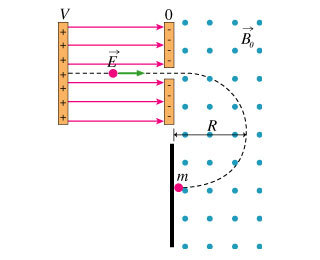
Mass Spectrometer J. J. Thomson is best known for his discoveries about the nature of cathode rays. Another important contribution of his was the invention, together with one of his students, of the mass spectrometer. The ratio of mass m to (positive) charge q of an ion may be accurately determined in a mass spectrometer. In essence, the spectrometer consists of two regions: one that accelerates the ion through a potential difference V and a second that measures its radius of curvature in a perpendicular magnetic field. (Figure 1)The ion begins at potential V and is accelerated toward zero potential. When the particle exits the region with the electric field it will have obtained a speed u. |
Part A With what speed u does the ion exit the acceleration region? Find the speed in terms of m, q, V, and any constants. u =Part B After being accelerated, the particle enters a uniform magnetic field of strength B0 and travels in a circle of radius R (determined by observing where it hits on a screen--as shown in the figure). The results of this experiment allow one to findm/q in terms of the experimentally measured quantities such as the particle radius, the magnetic field, and the applied voltage. Express m/q in terms of B0,V, R, and any necessary constants. m/q =
|
Homework Answers
Its given that,
mass of the particle \(=\mathrm{m}\), Charge \(=\mathrm{q}\) and Potential \(=\mathrm{V}\)
Mag field \(=\mathrm{B} 0\) and its travelling in the circular path of radius \(=\mathrm{R}\)
Part (A)With what speed u does the ion exit the acceleration region?
Let E1 be the intial energy of the particle which is actually electirc potential energy and given by
\(E 1=q V\)
When the particle is moving its energy gets converted into \(\mathrm{KE}\) and eguals to
\(\mathrm{E} 2=1 / 2 \mathrm{~m} \mathrm{u}^{2}\)
Using conservation of energy, we get
\(q V=1 / 2 m u^{2}\) this will give us
\(\mathrm{u}=\sqrt{(2 q V) / m}\)
\(\operatorname{Part}(B)\)
The cyclotron frequency, which is the (angular) frequency of the orbital motion of the ion in the magnetic field. Its given by
\(\omega=q \mathrm{BO} / \mathrm{m}\)
By the defination og angular speed we know that,
\(\mathrm{u}=\mathrm{R} \omega \mathrm{So} \omega=\mathrm{u} / \mathrm{R}\)
Equating the two diff expressions of \(\omega\), we get
q \(\mathrm{BO} / \mathrm{m}=\mathrm{u} / \mathrm{R}\)
Putting the value of \(\mathrm{u}\), we have obtained in Part (a)
q \(\mathrm{BO} / \mathrm{m}=\sqrt{(2 q V) / m} / \mathrm{R}\)
Squaring both th sides we get,
\(q^{2} B 0^{2} / m^{2}=(2 q V / m) / R^{2}\)
Hence we get, \(m / q=R^{2} B 0^{2} /(2 V)\)
 b)Now when the the ion enters into the magnetic field then itfollows the circular path of radius(R), its formula is


Add Answer to:
J. J. Thomson is best known for his discoveries about the nature of cathode rays.
After being accelerated to a speed of 1.11x10 m/s, the particle enters a uniform magnetic field of strength 0.700 T
 J.J. Thomson is best known for his discoveries about the nature of cathode rays. His other important contribution was the invention, together with one of his students, of the mass spectrometer, a device that measures the ratio of mass m to positive) charge q of an ion. The spectrometer consists of two regions as shown in the figure. (Figure 1) In the first region an electric field accelerates the ion and in the second the ion follows a circular are in...
10) Mass Spectrometer: (14 pts) A charged nucleus of mass m and charge q is accelerated...
 10) Mass Spectrometer: (14 pts) A charged nucleus of mass m
and charge q is accelerated through a constant potential V and
enters a region of constant magnetic field B. The nucleus then
undergoes circular motion before hitting a detector.
10) Mass Spectrometer: (14 pts) A charged nucleus of mass m and charge q is accelerated through a constant potential V and enters a region of constant magnetic field B. The nucleus then undergoes circular motion before hitting a detector....
10) Mass Spectrometer: (14 pts) A charged nucleus of mass m
and charge q is accelerated through a constant potential V and
enters a region of constant magnetic field B. The nucleus then
undergoes circular motion before hitting a detector.
10) Mass Spectrometer: (14 pts) A charged nucleus of mass m and charge q is accelerated through a constant potential V and enters a region of constant magnetic field B. The nucleus then undergoes circular motion before hitting a detector....
someone please help with this physics question! 1. A mass spectrometer is a device for measuring...
 someone please help with this physics question!
1. A mass spectrometer is a device for measuring the mass of charged ions that are first accelerated by an electric field, and then travel in circular orbits in a uniform magnetic field. Let's assume the chamber at the lower left contains hydrogen gas, but may have some contaminants. The gas is ionized in positively charged atomic ions that are accelerated through a voltage drop V. The ions then enter a region with...
someone please help with this physics question!
1. A mass spectrometer is a device for measuring the mass of charged ions that are first accelerated by an electric field, and then travel in circular orbits in a uniform magnetic field. Let's assume the chamber at the lower left contains hydrogen gas, but may have some contaminants. The gas is ionized in positively charged atomic ions that are accelerated through a voltage drop V. The ions then enter a region with...
1a) A charged particle with a charge-to-mass ratio of |q|/m = 5.7 × 10⁸ C/kg travels...
1a) A charged particle with a charge-to-mass ratio of |q|/m = 5.7 × 10⁸ C/kg travels on a circular path that is perpendicular to a magnetic field whose magnitude is 0.55 T. How much time does it take for the particle to complete one revolution? 1b) Suppose that an ion source in a mass spectrometer produces doubly ionized gold ions (Au2+), each with a mass of 3.27 × 10⁻²⁵ kg. The ions are accelerated from rest through a potential difference...
Consider the mass spectrometer shown schematically in the figure below. The electric field between the plates...
Consider the mass spectrometer shown schematically in the figure below. The electric field between the plates of the velocity selector is 940 V/m, and the magnetic fields in both the velocity selector and the deflection chamber have magnitudes of 0.920 T. Calculate the radius r of the path for a singly charged ion with mass m = 2.30 ✕ 10−26 kg. ..... mm A singly charged positive ion has a mass of 2.60 ✕ 10−26 kg. After being accelerated through...
Problem 4 (25 points) The figure below shows a mass spectrometer, a device used to measure...
 Problem 4 (25 points) The figure below shows a mass spectrometer, a device used to measure the masses of ions. Consider a positive ion of unknown mass m and charge q = 3.2 x 10⁻¹⁹ C. The ion is first accelerated from rest through a potential difference of magnitude 1v1 = 750 V inside a source. After leaving the source, it travels upward at constant speed and enters a region of uniform magnetic field B = 2.5 T directed out...
A proton enters a region of constant magnetic field, perpendicular to the fie and after being...
 A proton enters a region of constant magnetic field, perpendicular to the fie and after being accelerated from rest by an electric field through an electric potential difference of - 350 V. Determine the magnitude of the magnetic field, if the proton travels in a circular path with a radius of 21 cm. mt As shown in the figure below, when a charged particle enters a region of magnetic field traveling in a direction perpendicular to the field, it will...
An alpha particle can be produced in certain radioactive decays of nuclei and consists of two...
An alpha particle can be produced in certain radioactive decays of nuclei and consists of two protons and two neutrons. The particle has a charge of q = +2e and a mass of 4.00 u, where u is the atomic mass unit, with 1 u = 1.661 ✕ 10−27 kg. Suppose an alpha particle travels in a circular path of radius 4.60 cm in a uniform magnetic field with B= 1.70 T. Calculate the following values. (a) its speed m/s...
As shown in the figure, an electron is fired with a speed of 3.73 x 10...
 As shown in the figure, an electron is fired with a speed of 3.73 x 10 m/s through a hole in one of the two parallel plates and into the region between the plates separated by a distance of 0.24 m. There is a magnetic field in the region between the plates and, as shown, it is directed into the plane of the page (perpendicular to the velocity of the electron). Determine the magnitude of the magnetic field so that...
This is what I did. r = (m*v) / (qB) To find v, v= sqrt( 2*q*V/m)...
 This is what I did.
r = (m*v) / (qB)
To find v, v= sqrt( 2*q*V/m) = 37013.9
and I put this number and the given numbers to find 'r', but I
got it wrong. What did I do wrong?
I. Suppose that an ion source in a mass spectrometer produces doubly ionized gold ions (Au2+), each with a mass of 3.27 × 10⁻²⁵ kg The ions are accelerated from rest through a potential difference of 1.40 kV. Then, a...
This is what I did.
r = (m*v) / (qB)
To find v, v= sqrt( 2*q*V/m) = 37013.9
and I put this number and the given numbers to find 'r', but I
got it wrong. What did I do wrong?
I. Suppose that an ion source in a mass spectrometer produces doubly ionized gold ions (Au2+), each with a mass of 3.27 × 10⁻²⁵ kg The ions are accelerated from rest through a potential difference of 1.40 kV. Then, a...
 10) Mass Spectrometer: (14 pts) A charged nucleus of mass m
and charge q is accelerated through a constant potential V and
enters a region of constant magnetic field B. The nucleus then
undergoes circular motion before hitting a detector.
10) Mass Spectrometer: (14 pts) A charged nucleus of mass m and charge q is accelerated through a constant potential V and enters a region of constant magnetic field B. The nucleus then undergoes circular motion before hitting a detector....
10) Mass Spectrometer: (14 pts) A charged nucleus of mass m
and charge q is accelerated through a constant potential V and
enters a region of constant magnetic field B. The nucleus then
undergoes circular motion before hitting a detector.
10) Mass Spectrometer: (14 pts) A charged nucleus of mass m and charge q is accelerated through a constant potential V and enters a region of constant magnetic field B. The nucleus then undergoes circular motion before hitting a detector....
 someone please help with this physics question!
1. A mass spectrometer is a device for measuring the mass of charged ions that are first accelerated by an electric field, and then travel in circular orbits in a uniform magnetic field. Let's assume the chamber at the lower left contains hydrogen gas, but may have some contaminants. The gas is ionized in positively charged atomic ions that are accelerated through a voltage drop V. The ions then enter a region with...
someone please help with this physics question!
1. A mass spectrometer is a device for measuring the mass of charged ions that are first accelerated by an electric field, and then travel in circular orbits in a uniform magnetic field. Let's assume the chamber at the lower left contains hydrogen gas, but may have some contaminants. The gas is ionized in positively charged atomic ions that are accelerated through a voltage drop V. The ions then enter a region with...
 Problem 4 (25 points) The figure below shows a mass spectrometer, a device used to measure the masses of ions. Consider a positive ion of unknown mass m and charge q = 3.2 x 10⁻¹⁹ C. The ion is first accelerated from rest through a potential difference of magnitude 1v1 = 750 V inside a source. After leaving the source, it travels upward at constant speed and enters a region of uniform magnetic field B = 2.5 T directed out...
 A proton enters a region of constant magnetic field, perpendicular to the fie and after being accelerated from rest by an electric field through an electric potential difference of - 350 V. Determine the magnitude of the magnetic field, if the proton travels in a circular path with a radius of 21 cm. mt As shown in the figure below, when a charged particle enters a region of magnetic field traveling in a direction perpendicular to the field, it will...
 As shown in the figure, an electron is fired with a speed of 3.73 x 10 m/s through a hole in one of the two parallel plates and into the region between the plates separated by a distance of 0.24 m. There is a magnetic field in the region between the plates and, as shown, it is directed into the plane of the page (perpendicular to the velocity of the electron). Determine the magnitude of the magnetic field so that...
 This is what I did.
r = (m*v) / (qB)
To find v, v= sqrt( 2*q*V/m) = 37013.9
and I put this number and the given numbers to find 'r', but I
got it wrong. What did I do wrong?
I. Suppose that an ion source in a mass spectrometer produces doubly ionized gold ions (Au2+), each with a mass of 3.27 × 10⁻²⁵ kg The ions are accelerated from rest through a potential difference of 1.40 kV. Then, a...
This is what I did.
r = (m*v) / (qB)
To find v, v= sqrt( 2*q*V/m) = 37013.9
and I put this number and the given numbers to find 'r', but I
got it wrong. What did I do wrong?
I. Suppose that an ion source in a mass spectrometer produces doubly ionized gold ions (Au2+), each with a mass of 3.27 × 10⁻²⁵ kg The ions are accelerated from rest through a potential difference of 1.40 kV. Then, a...
Most questions answered within 3 hours.
-
Where is the error in this code sequence?
String s1 = "Hello";
String s2 = "ello";...
asked 11 months ago -
Financial data for Joel de Paris, Inc., for last year
follow:
Joel de Paris, Inc.
Balance...
asked 11 months ago -
Consider this reaction:
Al2(SO4)3 (aq)+ BaCl3
(aq) Al2Cl6 (aq)- +
3BaSO4(s) . What is the...
asked 11 months ago -
Suppose that Savneet is considering increasing her
recent random sample from 20 car rentals to 40...
asked 11 months ago -
Trucks arrive at an unloading terminal at an average rate of 120
per hour.
Trucks arrive...
asked 11 months ago -
Why are methanol and ethanol completely soluble in water while
octanol is not very little soluble....
asked 11 months ago -
A facilities manager at a university reads in a research report
that the mean amount of...
asked 11 months ago -
When the CuSO4 is rehydrated by adding water to the anhydrous
compound, is this an endothermic...
asked 11 months ago -
A ray of sunlight is passing from diamond into crown glass; the
angle of incidence is...
asked 11 months ago -
A block of mass 0.249 kg is placed on top of a light, vertical
spring of...
asked 11 months ago -
how do the kidneys compensate in the presences of acidosis
a) trigger hyperventilate
b) reserve acid...
asked 11 months ago -
Question 501 pts
The rental rate of capital to the firm increases. Which of the
following...
asked 11 months ago
> PartB
m/q =(R*Bsub0)^2/2V
Egg Head Mon, Oct 18, 2021 5:28 PM