What is the moment of inertia I of this assembly about the axis through which it is pivoted? Express the moment of...
Homework Answers
The concept used in calculating Moment of inertia of discrete and continuous mass distribution.
First, find the moment of inertia of the given system about the axis. The sum of these moments of inertia will be the total moment of inertia of the system.
The moment of inertia is always defined with respect to the axis of rotation.
Moment of inertia of point particle with mass is given by the product of its mass and the square of its distance from the axis.
Here, is the distance of the point from the axis of rotation.
Moment of inertia for continuous mass systems is found out by integrating the mass:
If the moment of inertia for components of a system is respectively then the total moment of inertia of the system is given by their sum:
Moment of inertia of a rod of mass and length about its center is given by:
Substitute for and for:
...
Moment of inertia of mass , distance from the axis:
...
Moment of inertia of mass , distance from the axis:
...
The total moment of inertia of the system is given by:
Substitute from to the above relation:
Ans:
The moment of inertia of the assembly is .
Add Answer to:
What is the moment of inertia I of this
assembly about the axis through which it is pivoted?
Express the moment of...
What is the moment of inertia I of this assembly about the axis through which it is pivoted? Express the moment of...
 What is the moment of inertia I of this assembly about the axis through which it
is pivoted?
Express the moment of inertia in terms of
mr, m1, m2, and x.
Keep in mind that the length of the rod is 2x
not x.
What is the moment of inertia I of this assembly about the axis through which it is pivoted? Express the moment of inertia in terms of mr, m1, m2, and x. Keep in mind that the...
What is the moment of inertia I of this assembly about the axis through which it
is pivoted?
Express the moment of inertia in terms of
mr, m1, m2, and x.
Keep in mind that the length of the rod is 2x
not x.
What is the moment of inertia I of this assembly about the axis through which it is pivoted? Express the moment of inertia in terms of mr, m1, m2, and x. Keep in mind that the...
What is the moment of inertia I of this assembly about the axis through which it is pivoted? Express the moment of...
 What is the moment of inertia I of this assembly about the
axis through which it is pivoted?
Express the moment of inertia in terms of mr(mass of rod),
m1,m2, and x. Keep in mind the length of the rod is 2x, not
x.
What is the moment of inertia I of this assembly about the
axis through which it is pivoted?
Express the moment of inertia in terms of mr(mass of rod),
m1,m2, and x. Keep in mind the length of the rod is 2x, not
x.
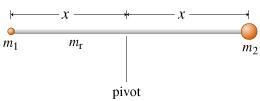
(Figure 1)The figure shows a simple model of a seesaw These consist of a plank/rod of mass mr and length 2x allowed to pivot freely about its center (or central axis), as shown in the diagram.
 (Figure 1)The figure shows a simple model of a seesaw These consist of a plank/rod of mass mr and length 2x allowed to pivot freely about its center (or central axis), as shown in the diagram. A small sphere of mass m1 is attached to the left end of the rod, and a small sphere of mass m2 is attached to the right end. The spheres are small enough that they can be considered point particles. The gravitational force acts...
(Figure 1) The figure shows a simple model of a seesaw. These consist of a plank/rod of mass mr and length 2x allowed t...
(Figure 1) The figure shows a simple model of a seesaw. These consist of a plank/rod of mass mr and length 2x allowed to pivot freely about its center (or central axis), as shown in the diagram. A small sphere of mass m1 is attached to the left end of the rod, and a small sphere of mass m2 is attached to the right end. The spheres are small enough that they can be considered point particles. The gravitational force...
(Figure 1) A thin rod of mass mr and length 2L is allowed to pivot freely about its center, as shown in the diagram.
 Pivoted Rod with Unequal Masses (Figure 1) A thin rod of mass mr and length 2L is allowed to pivot freely about its center, as shown in the diagram. A small sphere of mass m1 is attached to the left end of the rod, and a small sphere of mass m2 is attached to the right end. The spheres are small enough that they can be considered point particles. The gravitational force acts downward, with the magnitude of the gravitational acceleration...
Appendix B, Problem B/044 The welded assembly shown is made from a steel rod which weighs 0.530 lb per foot of length. Calculate the moment of inertia of the assembly about the x-x axis. 6.5" 6.5...
 Appendix B, Problem B/044 The welded assembly shown is made from a steel rod which weighs 0.530 lb per foot of length. Calculate the moment of inertia of the assembly about the x-x axis. 6.5" 6.5 6.5" 6.5" 6.5" Answer: 1xx- Ib-in.-sec The number of significant digits is set to 3; the tolerance is +/-1 in the 3rd significant digit
Appendix B, Problem B/044 The welded assembly shown is made from a steel rod which weighs 0.530 lb per foot...
Appendix B, Problem B/044 The welded assembly shown is made from a steel rod which weighs 0.530 lb per foot of length. Calculate the moment of inertia of the assembly about the x-x axis. 6.5" 6.5 6.5" 6.5" 6.5" Answer: 1xx- Ib-in.-sec The number of significant digits is set to 3; the tolerance is +/-1 in the 3rd significant digit
Appendix B, Problem B/044 The welded assembly shown is made from a steel rod which weighs 0.530 lb per foot...
The Parallel-Axis Theorem allows one to find the moment of inertia of an object if the...
The Parallel-Axis Theorem allows one to find the moment of inertia of an object if the moment of inertia through the center of mass (c.o.m.) is known and the second axis is parallel to the axis through the c.o.m.. The equation is given by I= Icom +md2, where Icom is the moment of inertia about an axis through the c.o.m., m is the mass of the object, d is the perpendicular distance from the axis through the c.o.m. to the...
question: The moment of inertia of a uniform rod about an axis through its center is...
question: The moment of inertia of a uniform rod about an axis through its center is 1/12mL^2. The moment of inertia about an axis at one end is 1/3mL^2. Why is the moment of inertia is larger when rotating about the end of the rod than when rotating about the center of the rod? A. When rotating about the end of the rod, it will be unbalanced and wobble. B. When rotating about the end of the rod, more mass...
Moment of inertia of a 200.0cm rod about its central axis is 1.25 kg.m2. Find moment...
Moment of inertia of a 200.0cm rod about its central axis is 1.25 kg.m2. Find moment of inertia of this rod about axis at 25.0 cm form one end. Moment of inertia of rod about central axis is: I= 1/12ML2
Calculate by direct integration the moment of inertia for a thin rod of mass M and length L about an axis located distance d from one end.
Calculate by direct integration the moment of inertia for a thin rod of mass M and length L about an axis located distance d from one end. Express your answer in terms of the given quantities. I = ________________________
 What is the moment of inertia I of this assembly about the axis through which it
is pivoted?
Express the moment of inertia in terms of
mr, m1, m2, and x.
Keep in mind that the length of the rod is 2x
not x.
What is the moment of inertia I of this assembly about the axis through which it is pivoted? Express the moment of inertia in terms of mr, m1, m2, and x. Keep in mind that the...
What is the moment of inertia I of this assembly about the axis through which it
is pivoted?
Express the moment of inertia in terms of
mr, m1, m2, and x.
Keep in mind that the length of the rod is 2x
not x.
What is the moment of inertia I of this assembly about the axis through which it is pivoted? Express the moment of inertia in terms of mr, m1, m2, and x. Keep in mind that the...
 What is the moment of inertia I of this assembly about the
axis through which it is pivoted?
Express the moment of inertia in terms of mr(mass of rod),
m1,m2, and x. Keep in mind the length of the rod is 2x, not
x.
What is the moment of inertia I of this assembly about the
axis through which it is pivoted?
Express the moment of inertia in terms of mr(mass of rod),
m1,m2, and x. Keep in mind the length of the rod is 2x, not
x.
 Appendix B, Problem B/044 The welded assembly shown is made from a steel rod which weighs 0.530 lb per foot of length. Calculate the moment of inertia of the assembly about the x-x axis. 6.5" 6.5 6.5" 6.5" 6.5" Answer: 1xx- Ib-in.-sec The number of significant digits is set to 3; the tolerance is +/-1 in the 3rd significant digit
Appendix B, Problem B/044 The welded assembly shown is made from a steel rod which weighs 0.530 lb per foot...
Appendix B, Problem B/044 The welded assembly shown is made from a steel rod which weighs 0.530 lb per foot of length. Calculate the moment of inertia of the assembly about the x-x axis. 6.5" 6.5 6.5" 6.5" 6.5" Answer: 1xx- Ib-in.-sec The number of significant digits is set to 3; the tolerance is +/-1 in the 3rd significant digit
Appendix B, Problem B/044 The welded assembly shown is made from a steel rod which weighs 0.530 lb per foot...
Most questions answered within 3 hours.
-
Where is the error in this code sequence?
String s1 = "Hello";
String s2 = "ello";...
asked 11 months ago -
Financial data for Joel de Paris, Inc., for last year
follow:
Joel de Paris, Inc.
Balance...
asked 11 months ago -
Consider this reaction:
Al2(SO4)3 (aq)+ BaCl3
(aq) Al2Cl6 (aq)- +
3BaSO4(s) . What is the...
asked 11 months ago -
Suppose that Savneet is considering increasing her
recent random sample from 20 car rentals to 40...
asked 11 months ago -
Trucks arrive at an unloading terminal at an average rate of 120
per hour.
Trucks arrive...
asked 11 months ago -
Why are methanol and ethanol completely soluble in water while
octanol is not very little soluble....
asked 11 months ago -
A facilities manager at a university reads in a research report
that the mean amount of...
asked 11 months ago -
When the CuSO4 is rehydrated by adding water to the anhydrous
compound, is this an endothermic...
asked 11 months ago -
A ray of sunlight is passing from diamond into crown glass; the
angle of incidence is...
asked 11 months ago -
A block of mass 0.249 kg is placed on top of a light, vertical
spring of...
asked 11 months ago -
how do the kidneys compensate in the presences of acidosis
a) trigger hyperventilate
b) reserve acid...
asked 11 months ago -
Question 501 pts
The rental rate of capital to the firm increases. Which of the
following...
asked 11 months ago