Consider a uniformly charged ring in the xy plane,centered at the origin. The ring has radius...
Consider a uniformly charged ring in the xy plane, centered
at the origin. The ring has radius a and positive charge q distributed evenly along its circumference. 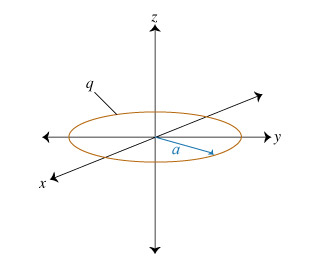
PartA
What is the direction of the electric fieldat any point on the z axis?
| parallel to the x axis | |
| parallel to the y axis | |
| parallel to the z axis | |
| in a circle parallel to the xy plane |
PartB
What is the magnitude of the electric fieldalong the positive z axis?
Use k in your answer, where  .
.
| E(z) = | ||
PartC
Imagine a small metal ball of mass m and negative charge -q0. The ball is released from rest at the point(0,0,d) and constrained to movealong thez axis, with no damping. If 0<d≤a, what will be theball's subsequent trajectory?
| repelled from the origin | |
| attracted toward the origin and coming to rest | |
| oscillating along the z axis between z=d and z=-d | |
| circling around the z axis at z=d |
Homework Answers
The concept used to solve this problem is electric field.
Initially calculate the direction of electric field at any point on the z-axis. After that calculate the magnitude of the electric field along positive z axis. Finally, calculate the ball’s subsequent trajectory.
The expression for electric field is,
Here, is an electrostatic constant, is the vacuum permittivity, is the charge, and is the distance between the charge and point of observation of electric field.
The magnitude of force on a charge in electric field is,
Here, is the charge on the particle in the electric field, and is the electric field.
The projection of any vector along the axis is,
Here, is the magnitude of vector , and is the angle the vector makes counterclockwise from the axis.
The Newton’s second law can be expressed as,
Here, is the vector sum of all the forces acting on the object, is the mass, and is the acceleration of object.
The acceleration along axis is,
Here, is the positions coordinate of the object, and is the time.
The equation of motion of a simple harmonic oscillation along axis is,
Here, is the angular frequency.
In a right-angled triangle, the cosine function is,
Pythagoras theorem gives the hypotenuse of right angled triangle as,
(A)
Draw the diagram of the electric field due to a charge on the uniformly charged ring with a radius and positive charge distributed evenly along its circumference. The magnitude of electric field is . The position coordinate of any arbitrary point on axis is . The angle of electric field makes with axis in counterclockwise direction is . The tangent to a circle is perpendicular to the radius of the circle.
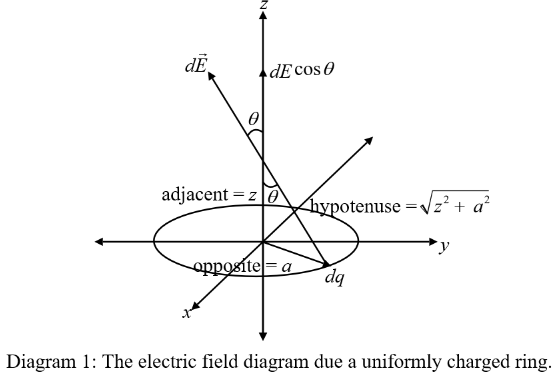
Substitute for , and for in the cosine function equation and solve for .
…… (1)
Substitute for , and for in the equation to get the electric field along axis.
…… (2)
Here, is the electric field along axis.
Use the electric field equation.
Substitute for in the above equation and solve for the magnitude of the electric field due to the uniformly charged ring.
Integrate the equation (2) to solve for the magnitude of electric field due to complete ring.
Here, is the electric field along direction.
Substitute for from equation (1), and for from the equation (3) in the above equation .
(B)
Use the electrostatic force equation.
Here, is the charge on the ball, and is the magnitude of electric field along axis.
Substitute for in the above equation from the part (1).
…… (4)
Substitute for to find the force at any end point of the oscillations in the equation (4).
.
Use the approximation as in the above equation.
Therefore, force at any point along the axis can be approximated from the above result. Substitute for in the above expression to solve for the force along axis.
Use the Newton’s second law to solve for the acceleration of the ball.
Here, is the force acting on the ball, is the mass of the ball, and is the acceleration of the ball.
Substitute for , and for in the above equation and solve for the equation of motion.
Compare this equation of motion with equation of motion of the simple harmonic motion to solve for the angular frequency.
Ans:
The direction of electric field at any point on the z axis is parallel to the z axis.
Add Answer to:
Consider a uniformly charged ring in the xy plane,centered at the origin. The ring has radius...
Charged Ring
 Consider a uniformly charged ring in the xy plane, centered at the origin. The ring has radius a and positive charge q distributed evenly along its circumference.What is the magnitude of the electric field along the positive z axis? Use k in your answer, where .
A ring with radius R and a uniformly distributed total charge Q lies in the xy plane, centered at the origin. (Figure 1)
 A ring with radius R and a uniformly distributed total charge Q lies in the xy plane, centered at the origin. (Figure 1) Part B What is the magnitude of the electric field E on the z axis as a function of z, for z >0?
A uniform circular ring of charge Q and radius r in the xy-plane is centered at the origin.
 A uniform circular ring of charge Q and radius r in the xy-plane is centered at the origin. (a) Derive a formula for the (z-directed) electric field E(z) at any point on the +z-axis, and graph this for-∞ < z < ∞ (indicate direction as ±; note E(-z) =-E(z). (b) At what value of z is E(z) maximal, and what is this maximum? (c) Sketch the field lines-note the bottleneck!
A charged disk and a charged ring are centered at the origin in the free space...
 A charged disk and a charged ring are centered at the origin in the free space as shown in figure 4. Bothe changed elements exists in the xy plane. The disk has a radius a and carries a uniform surface charge density of Ps. The ring has a radius 2a and carries a uniform line charge density Pe. Find the following: a) The electric field intensity on z-axis and determine where the electric field is zero b) The electric potential...
A circular loop of wire, centered at the origin, lies in the xy plane. The loop has a radius of 1...
 A circular loop of wire, centered at the origin, lies in the xy plane. The loop has a radius of 10.0cm. A cylindrical magnet (radius 0.5 cm and length-5 cm) starts out at rest with its primary axis along the z-axis. The bottom tip of the magnet is a north-pole and is situated at z 8 cm. The magnet is dropped straight down so that it falls north- pole down and it goes straight through the center of the loop....
Problem 3.28 A circular ring in the xy plane (radius R, centered at the origin) carries...
 Problem 3.28 A circular ring in the xy plane (radius R, centered at the origin) carries a uniform line charge λ. Find the first three terms (n-0, 1, 2) in the multipole expansion for V(r, θ).
potential of a charged ring
A ring with radius and a uniformlydistributed total charge lies inthe xy plane, centered at the origin.What is the potential due to the ring on the z axis as a function of ?Express your answer in terms of , , , and or .What is the magnitude of the electric field on the z axis as a function of , for ?Express your answer in terms of , , , and or .
There is a grounded conducting plane on the xy plane and a grounded hemisphere of radius...
There is a grounded conducting plane on the xy plane and a grounded hemisphere of radius R, in the positive z-axis, centered at the origin. We put a point charge +Q on the z-axis, and its distance from the origin is S. Find the force on the point charge.
Problem 6 Charge Q is uniformly distributed over a circular ring on the xy plane with...
 Problem 6 Charge Q is uniformly distributed over a circular ring on the xy plane with an inner and outer radius a and b, respectively. Calculate the electric field at any point on the z axis by using Coulomb's law. Then, calculate the electric potential on the z axis and use this expression to find the z component of the electric field. Check that the electric field calculated through the potential is the same as the one calculated by using...
A uniformly distributed annular disk of charge lies in the z=0 plane, centered at the origin...
A uniformly distributed annular disk of charge lies in the z=0 plane, centered at the origin and with inner and outer radii of a and b. Find the electric field intensity along the z-axis.
 Consider a uniformly charged ring in the xy plane, centered at the origin. The ring has radius a and positive charge q distributed evenly along its circumference.What is the magnitude of the electric field along the positive z axis? Use k in your answer, where .
 A charged disk and a charged ring are centered at the origin in the free space as shown in figure 4. Bothe changed elements exists in the xy plane. The disk has a radius a and carries a uniform surface charge density of Ps. The ring has a radius 2a and carries a uniform line charge density Pe. Find the following: a) The electric field intensity on z-axis and determine where the electric field is zero b) The electric potential...
 A circular loop of wire, centered at the origin, lies in the xy plane. The loop has a radius of 10.0cm. A cylindrical magnet (radius 0.5 cm and length-5 cm) starts out at rest with its primary axis along the z-axis. The bottom tip of the magnet is a north-pole and is situated at z 8 cm. The magnet is dropped straight down so that it falls north- pole down and it goes straight through the center of the loop....
 Problem 3.28 A circular ring in the xy plane (radius R, centered at the origin) carries a uniform line charge λ. Find the first three terms (n-0, 1, 2) in the multipole expansion for V(r, θ).
 Problem 6 Charge Q is uniformly distributed over a circular ring on the xy plane with an inner and outer radius a and b, respectively. Calculate the electric field at any point on the z axis by using Coulomb's law. Then, calculate the electric potential on the z axis and use this expression to find the z component of the electric field. Check that the electric field calculated through the potential is the same as the one calculated by using...
Most questions answered within 3 hours.
-
Where is the error in this code sequence?
String s1 = "Hello";
String s2 = "ello";...
asked 10 months ago -
Financial data for Joel de Paris, Inc., for last year
follow:
Joel de Paris, Inc.
Balance...
asked 10 months ago -
Consider this reaction:
Al2(SO4)3 (aq)+ BaCl3
(aq) Al2Cl6 (aq)- +
3BaSO4(s) . What is the...
asked 10 months ago -
Suppose that Savneet is considering increasing her
recent random sample from 20 car rentals to 40...
asked 10 months ago -
Trucks arrive at an unloading terminal at an average rate of 120
per hour.
Trucks arrive...
asked 10 months ago -
Why are methanol and ethanol completely soluble in water while
octanol is not very little soluble....
asked 10 months ago -
A facilities manager at a university reads in a research report
that the mean amount of...
asked 10 months ago -
When the CuSO4 is rehydrated by adding water to the anhydrous
compound, is this an endothermic...
asked 10 months ago -
A ray of sunlight is passing from diamond into crown glass; the
angle of incidence is...
asked 10 months ago -
A block of mass 0.249 kg is placed on top of a light, vertical
spring of...
asked 10 months ago -
how do the kidneys compensate in the presences of acidosis
a) trigger hyperventilate
b) reserve acid...
asked 10 months ago -
Question 501 pts
The rental rate of capital to the firm increases. Which of the
following...
asked 10 months ago