A small plastic ball is connected to a lightweight cord of length L-1.40 m that is tied to a point P, as shown in the figure.
A small plastic ball is connected to a lightweight cord of length L-1.40 m that is tied to a point P, as shown in the figure.
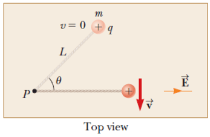
The ball string and point all lie on a frictionless, horizontal table. The ball has a mass m = 0.0100kg, a charge q = +2.10 C and is released from rest when the string makes an arigle θ = 60.0° with a uniform
electric field of magnitude E= 350 V/m. Determine the speed (in m/s) of the ball when the string is parallel to the electric fleld.
Homework Answers
Concept: here we use work energy theorem to
find the final speed of the particle in the electric field. Work is
done by the force of the electric field,  ***************************************************************************************************
Check the answer and let me know immediately if you
find something wrong... I will rectify the mistakes asap if
any
Add Answer to:
A small plastic ball is connected to a lightweight cord of length L-1.40 m that is tied to a point P, as shown in the figure.
A particle having charge q = +1.90 pC and mass m = 0.010 O kg is...
 A particle having charge q = +1.90 pC and mass m = 0.010 O kg is connected to a string that is L = 2.00 m long and tied to the pivot point P in the figure below. The particle, string, and pivot point all lle on a frictionless, horizontal table. The particle is released from rest when the string makes an angle θ 60.0° with a uniform electric field of magnitude E = 350 V/m. Determine the speed of...
m u= 0 + 9 Given a particle having charge q = +1.90 PC and mass m, = 100 mg is connected to a string that is L = 1.10 m...
 m u= 0 + 9 Given a particle having charge q = +1.90 PC and mass m, = 100 mg is connected to a string that is L = 1.10 m long and tied to the pivot point P in the figure below. The particle, string, and pivot point all lie on a horizontal table. The particle is released from rest when the string makes an angle = 75.0° with a uniform electric field of magnitude E = 700 v/m....
thanks you so much for your help in advance, if you could do both that would...
 thanks you so much for your help in advance, if you could do
both that would be so helpful as i am out of questions, thank you
ill be sure to rate
My Notes 4. -/1 points SERPSE 10 24.1.OP.005.MI. An electron moving parallel to the x axis has an initial speed of 4.14 x 10 m/s at the origin. Its speed is reduced to 1.50 x 10 m/s at the point x = 2.00 cm. (a) Calculate the electric...
thanks you so much for your help in advance, if you could do
both that would be so helpful as i am out of questions, thank you
ill be sure to rate
My Notes 4. -/1 points SERPSE 10 24.1.OP.005.MI. An electron moving parallel to the x axis has an initial speed of 4.14 x 10 m/s at the origin. Its speed is reduced to 1.50 x 10 m/s at the point x = 2.00 cm. (a) Calculate the electric...
A small m=1.81E-3kg plastic ball is suspended by a l=20.0cm long string in a uniform electric...
A small m=1.81E-3kg plastic ball is suspended by a l=20.0cm long string in a uniform electric field, as shown below. If the ball is in equilibrium when the string makes a θ=12.8deg angle with the vertical, what is the net charge on the ball? Take E=1.84E+3iN/C.
A small 1.45 g plastic ball that has a charge q of 1.75 C is suspended by a string that has a length L of 1.00 m in a uniform electric field
 A small 1.45 g plastic ball that has a charge q of 1.75 C is suspended by a string that has a length L of 1.00 m in a uniform electric field, as shown in the figure. If the ball is in equilibrium when the string makes a 9.80 angle with the vertical as indicated by θ, what is the electric field strength E?
A small 12.6 g plastic ball is tied to a very light 28.6 cm string that...
A small 12.6 g plastic ball is tied to a very light 28.6 cm string that is attached to vertical wall of room (see figure). A uniform horizontal electric field exists in this room. When the ball has been given an excess charge of - 1.33 μC, you observe that it remains suspended, with the string making an angle of 17.4° with the wall. Find the magnitude of the electric field in the room.
m Given a particle having charge q = +1.90 C and mass m = 100 mg...
 m Given a particle having charge q = +1.90 C and mass m = 100 mg is connected to a string that is L = 1.10 m long and tied to the pivot point P in the figure below. The particle, string, and pivot point all lie on a horizontal table. The particle is released from rest when the string makes an angle @= 75.0° with a uniform electric field of magnitude E = 700 V/m. u= 0 + 9...
A small m = 2.00 g plastic ball is suspended by a L = 16.0 cm...
 A small m = 2.00 g plastic ball is suspended by a L = 16.0 cm
long string in a uniform electric field, as shown in Figure P15.50.
If the ball is in equilibrium when the string makes a 16.0° angle
with the vertical as indicated, what is the net charge on the
ball?
__µC
Figure P15.50
E=1.00×10³ N/C
A small m = 2.00 g plastic ball is suspended by a L = 16.0 cm
long string in a uniform electric field, as shown in Figure P15.50.
If the ball is in equilibrium when the string makes a 16.0° angle
with the vertical as indicated, what is the net charge on the
ball?
__µC
Figure P15.50
E=1.00×10³ N/C
A small 12.6 g plastic ball is tied to a very light 28.4 cm string that is attached to the vertical wall of a room.
 A small 12.6 g plastic ball is tied to a very light 28.4 cm string that is attached to the vertical wall of a room. (See the figure (Figure 1).) A uniform horizontal electric field exists in this room. When the ball has been given an excess charge of -1.10μC , you observe that it remains suspended, with the string making an angle of 17.4° with the wall. Part A Find the magnitude of the electric field in the room. Part B Find the...
Problem 5: A cord with length L 2 m has a ball of mass m 1...
 Problem 5: A cord with length L 2 m has a ball of mass m 1 kg attached to the end. The ball is released from rest, when the cord makes an angle of 30° with the vertical. 1) How much work does the gravitational force do on the ball from A to B? 2) What is the speed of the ball at point B? 3) What is the tension in the cord at point B? 4) What initial velocity...
 A particle having charge q = +1.90 pC and mass m = 0.010 O kg is connected to a string that is L = 2.00 m long and tied to the pivot point P in the figure below. The particle, string, and pivot point all lle on a frictionless, horizontal table. The particle is released from rest when the string makes an angle θ 60.0° with a uniform electric field of magnitude E = 350 V/m. Determine the speed of...
 m u= 0 + 9 Given a particle having charge q = +1.90 PC and mass m, = 100 mg is connected to a string that is L = 1.10 m long and tied to the pivot point P in the figure below. The particle, string, and pivot point all lie on a horizontal table. The particle is released from rest when the string makes an angle = 75.0° with a uniform electric field of magnitude E = 700 v/m....
 thanks you so much for your help in advance, if you could do
both that would be so helpful as i am out of questions, thank you
ill be sure to rate
My Notes 4. -/1 points SERPSE 10 24.1.OP.005.MI. An electron moving parallel to the x axis has an initial speed of 4.14 x 10 m/s at the origin. Its speed is reduced to 1.50 x 10 m/s at the point x = 2.00 cm. (a) Calculate the electric...
thanks you so much for your help in advance, if you could do
both that would be so helpful as i am out of questions, thank you
ill be sure to rate
My Notes 4. -/1 points SERPSE 10 24.1.OP.005.MI. An electron moving parallel to the x axis has an initial speed of 4.14 x 10 m/s at the origin. Its speed is reduced to 1.50 x 10 m/s at the point x = 2.00 cm. (a) Calculate the electric...
 m Given a particle having charge q = +1.90 C and mass m = 100 mg is connected to a string that is L = 1.10 m long and tied to the pivot point P in the figure below. The particle, string, and pivot point all lie on a horizontal table. The particle is released from rest when the string makes an angle @= 75.0° with a uniform electric field of magnitude E = 700 V/m. u= 0 + 9...
 A small m = 2.00 g plastic ball is suspended by a L = 16.0 cm
long string in a uniform electric field, as shown in Figure P15.50.
If the ball is in equilibrium when the string makes a 16.0° angle
with the vertical as indicated, what is the net charge on the
ball?
__µC
Figure P15.50
E=1.00×10³ N/C
A small m = 2.00 g plastic ball is suspended by a L = 16.0 cm
long string in a uniform electric field, as shown in Figure P15.50.
If the ball is in equilibrium when the string makes a 16.0° angle
with the vertical as indicated, what is the net charge on the
ball?
__µC
Figure P15.50
E=1.00×10³ N/C
 Problem 5: A cord with length L 2 m has a ball of mass m 1 kg attached to the end. The ball is released from rest, when the cord makes an angle of 30° with the vertical. 1) How much work does the gravitational force do on the ball from A to B? 2) What is the speed of the ball at point B? 3) What is the tension in the cord at point B? 4) What initial velocity...
Most questions answered within 3 hours.
-
Where is the error in this code sequence?
String s1 = "Hello";
String s2 = "ello";...
asked 10 months ago -
Financial data for Joel de Paris, Inc., for last year
follow:
Joel de Paris, Inc.
Balance...
asked 10 months ago -
Consider this reaction:
Al2(SO4)3 (aq)+ BaCl3
(aq) Al2Cl6 (aq)- +
3BaSO4(s) . What is the...
asked 10 months ago -
Suppose that Savneet is considering increasing her
recent random sample from 20 car rentals to 40...
asked 10 months ago -
Trucks arrive at an unloading terminal at an average rate of 120
per hour.
Trucks arrive...
asked 10 months ago -
Why are methanol and ethanol completely soluble in water while
octanol is not very little soluble....
asked 10 months ago -
A facilities manager at a university reads in a research report
that the mean amount of...
asked 10 months ago -
When the CuSO4 is rehydrated by adding water to the anhydrous
compound, is this an endothermic...
asked 10 months ago -
A ray of sunlight is passing from diamond into crown glass; the
angle of incidence is...
asked 10 months ago -
A block of mass 0.249 kg is placed on top of a light, vertical
spring of...
asked 10 months ago -
how do the kidneys compensate in the presences of acidosis
a) trigger hyperventilate
b) reserve acid...
asked 10 months ago -
Question 501 pts
The rental rate of capital to the firm increases. Which of the
following...
asked 10 months ago