The two sides of the DNA double helix are connected by pairs of bases (adenine, thymine,...
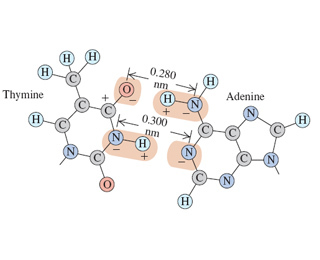
The two sides of the DNA double helix are connected by pairs of bases (adenine, thymine, cytosine, and guanine). Because of the geometric shape of these molecules, adenine bonds with thymine and cytosine bonds with guanine. The figure (Figure 1) shows the thymine-adenine bond. Each charge shown is ±e, and the H−N distance is 0.110 nm.
A) Calculate the net force that thymine exerts on adenine. To keep the calculations fairly simple, yet reasonable, consider only the forces due to the O−H−N and the N−H−N combinations, assuming that these two combinations are parallel to each other. Remember, however, that in the O−H−N set, the O− exerts a force on both the H+ and the N−, and likewise along the N−H−N set.
B) Is the net force attractive or repulsive?
C) Calculate the force on the electron in the hydrogen atom, which is 5.29×10⁻² nm from the proton.
D) Compare the strength of the bonding force of the electron in hydrogen with the bonding force of the adenine-thymine molecules.
Homework Answers
First calculate the potential energy of the bond O-H-N and then potential energy of bond N-H-N by using the expression for potential energy.
Secondly, find the net force by using the fact that the like charges repel each other and unlike charge attract each other’s.
Finally, calculate the potential energy of electron proton in hydrogen atom and then compare it with the net potential energy calculated in the first step.
The expression to calculate the electric potential energy of two charges is,
Here, k is the constant, q is the charge 1, Q is the charge 2, r is the distance between these two charges, and U is the electric potential energy.
The total energy is calculated as follows:
Here, is the potential energy due to the bond N-H-N, is the potential energy due to the bond O-H-N, and U is the total electric potential energy of the adenine and thymine bond.
The potential energy of electron proton in hydrogen atom is calculated as follows:
Here, k is the constant, is the charge of electron, is the charge on proton, r is the distance between the electron and proton, and is the potential energy of electron-proton system.
(a)
The expression to calculate the electric potential energy of two charges is,
Here, k is the constant, q is the charge 1, Q is the charge 2, r is the distance between these two charges, and U is the electric potential energy.
The expression to calculate the potential energy of O-H-N bond is,
Substitute for , for , for k, for , and for .
The expression to calculate the potential energy of N-H-N bond is,
Substitute for , for , for k, for , and for .
The total potential energy is calculated as follows:
Here, is the potential energy due to the bond N-H-N, is the potential energy due to the bond O-H-N, and U is the total electric potential energy of the adenine and thymine bond.
Substitute for and for in expression .
(b)
The potential energy of electron proton in hydrogen atom is calculated as follows:
Here, k is the constant, is the charge of electron, is the charge on proton, r is the distance between the electron and proton, and is the potential energy of electron-proton system.
Substitute for r, for , is for , and for k.
Calculate the ratio .
Substitute for U and for in expression and solve for U.
From the above ratio, It is clear that the electric potential energy between the adenine-thymine bonds is 0.22 times the electric potential energy of the electron-proton in hydrogen atom.
Ans: Part aThe electric potential energy of the adenine-thymine bond is .
Part bThe electric potential energy between the adenine-thymine bonds is 0.22 times the electric potential energy of the electron -proton in hydrogen atom.
Add Answer to:
The two sides of the DNA double helix are connected by pairs of bases (adenine, thymine,...
Exercise 23.6 The two sides of the DNA double helix are connected by pairs of bases...
 Exercise 23.6 The two sides of the DNA double helix are connected by pairs of bases (adenine, thymine, cytosine, and guanine). Because of the geometric shape of these molecules, adenine bonds with thymine and cytosine bonds with guanine. The figure shows the thymine- adenine bond. Each charge shown is te and the H N distance is 0.110 nm. (Figure 1) Figure 1 of 1 > k 0.280 Onm Thymine Adenine k 0300 N) Part B Compare this energy with the...
Problem Solving:(Show all work in every problem) (10 points) The figure shows the bonding of cytosine...
 Problem Solving:(Show all work in every problem) (10 points) The figure shows the bonding of cytosine and guanine. The O-H and H-N distances are each 0.110 nm. In this case, assume that the bonding is due only to the forces along the O-H-O, N-H-N, and O-H-N combinations, and assume also that these three combinations are parallel to each other. (NOTE: Use k =9.00 x 10° Nm2/C) 1. Calculate the net force that cytosine exerts on guanine due to the preceding...
In the DNA double helix, 2 strands of DNA are joined together through the hydrogen bonding...
In the DNA double helix, 2 strands of DNA are joined together through the hydrogen bonding of the individual base pairs. The base Guanine bonds to which other base. Answers: a. uracil b. cytosine c. thymine d. adenine
2) Draw the two base-pairs, A-T and G-C, depicting the nitrogen-containing bases attached to the deoxyribose-phosphate...
 2) Draw the two base-pairs, A-T and G-C, depicting the nitrogen-containing bases attached to the deoxyribose-phosphate backbone of DNA. Include the hydrogen bonding sites. (Hint: Look at Figure 12.7, Chemistry in Context 7h Edition). A-T base-pairing (show the Hydrogen bonding): G-C base-pairing (show the Hydrogen bonding): 101 Oy. The process CH3 thymine 0----H-N HC adenine N- To deoxyribose and DNA chain To deoxyribose and DNA chain N -H cytosine HC-C guanine HC N To deoxyribose and DNA chain To deoxyribose...
1. List all the bases (Cytosine, Adenine, Thymine, Guanine and Uracil) pairs in DNA paired by...
 1. List all the bases (Cytosine, Adenine, Thymine, Guanine and Uracil) pairs in DNA paired by hydrogen bonding? 2. What is the transfer DNA anticodon for the messenger DNA codon, A-G-C? a) U-C-G b) G-U-T c) G-C-A d) T-C-G 3. What is the transfer RNA anticodon for the messenger RNA codon, A-G-C? a) U-C-G b) G-U-T c) G-C-A d) T-C-G
Adenine 0-P=0 Thymine Lo O=r-o Sugar-phosphate backbone Sugar-phosphate backbone Cytosine O-P=0 Guanine 0 NH O=P-O 0--...
 Adenine 0-P=0 Thymine Lo O=r-o Sugar-phosphate backbone Sugar-phosphate backbone Cytosine O-P=0 Guanine 0 NH O=P-O 0-- Nitrogenous bases Where are the hydrogen bonds found in this DNA molecule? between C and H in the nucleotide cytosine between H in cytosine and O in guanine between N and H in the nucleotide containing guanine between H in guanine and N in cytosine
The figure shows the bonding of the cytosine and guanine molecules.
The figure shows the bonding of the cytosine and guanine molecules. The O - H and H - N distances are each 0.110nm. In this case, assume that the bonding is due only to the forces along the O - H - O, N - H - N and O -H- N combinations, and assume also that these three combinations are parallel to each other.Calculate the net force that cytosine exerts on guanine due to the preceding three combinations.
Below are bases used in nucleic acids. (a) why are they called bases-what allows them to act as a base? (b) the two str...
 Below are bases used in nucleic acids. (a) why are they called bases-what allows them to act as a base? (b) the two strands of DNA are held together in the double helix form by hydrogen bonds between complementary base pairs. What is a hydrogen bond? (c) Suppose a new disease appears that creates covalent, rather than hydrogen, bonds between the two strands of DNA (this is VERY unlikely!). If you had to design a drug to combat the disease,...
Question 14: The answers on 14 and 9 are incorrect. Answer the question 14 and question...
 Question 14:
The answers on 14 and 9 are incorrect.
Answer the question 14 and question 9 plz, thanks a lot.
Helicase strand Refer to the above diagrams and match the components of the replisome with the description of their function A Extends an Okazaki fragment Single-stranded binding Holds DNA polymerase in place proteins (SSBPs) during strand extension H Topoisomerase Catalyzes the breaking of hydrogen bonds between base pairs to open Primase - leading strand the double helix D. Catalyzes...
Question 14:
The answers on 14 and 9 are incorrect.
Answer the question 14 and question 9 plz, thanks a lot.
Helicase strand Refer to the above diagrams and match the components of the replisome with the description of their function A Extends an Okazaki fragment Single-stranded binding Holds DNA polymerase in place proteins (SSBPs) during strand extension H Topoisomerase Catalyzes the breaking of hydrogen bonds between base pairs to open Primase - leading strand the double helix D. Catalyzes...
 Exercise 23.6 The two sides of the DNA double helix are connected by pairs of bases (adenine, thymine, cytosine, and guanine). Because of the geometric shape of these molecules, adenine bonds with thymine and cytosine bonds with guanine. The figure shows the thymine- adenine bond. Each charge shown is te and the H N distance is 0.110 nm. (Figure 1) Figure 1 of 1 > k 0.280 Onm Thymine Adenine k 0300 N) Part B Compare this energy with the...
 Problem Solving:(Show all work in every problem) (10 points) The figure shows the bonding of cytosine and guanine. The O-H and H-N distances are each 0.110 nm. In this case, assume that the bonding is due only to the forces along the O-H-O, N-H-N, and O-H-N combinations, and assume also that these three combinations are parallel to each other. (NOTE: Use k =9.00 x 10° Nm2/C) 1. Calculate the net force that cytosine exerts on guanine due to the preceding...
 2) Draw the two base-pairs, A-T and G-C, depicting the nitrogen-containing bases attached to the deoxyribose-phosphate backbone of DNA. Include the hydrogen bonding sites. (Hint: Look at Figure 12.7, Chemistry in Context 7h Edition). A-T base-pairing (show the Hydrogen bonding): G-C base-pairing (show the Hydrogen bonding): 101 Oy. The process CH3 thymine 0----H-N HC adenine N- To deoxyribose and DNA chain To deoxyribose and DNA chain N -H cytosine HC-C guanine HC N To deoxyribose and DNA chain To deoxyribose...
 1. List all the bases (Cytosine, Adenine, Thymine, Guanine and Uracil) pairs in DNA paired by hydrogen bonding? 2. What is the transfer DNA anticodon for the messenger DNA codon, A-G-C? a) U-C-G b) G-U-T c) G-C-A d) T-C-G 3. What is the transfer RNA anticodon for the messenger RNA codon, A-G-C? a) U-C-G b) G-U-T c) G-C-A d) T-C-G
 Adenine 0-P=0 Thymine Lo O=r-o Sugar-phosphate backbone Sugar-phosphate backbone Cytosine O-P=0 Guanine 0 NH O=P-O 0-- Nitrogenous bases Where are the hydrogen bonds found in this DNA molecule? between C and H in the nucleotide cytosine between H in cytosine and O in guanine between N and H in the nucleotide containing guanine between H in guanine and N in cytosine
 Below are bases used in nucleic acids. (a) why are they called bases-what allows them to act as a base? (b) the two strands of DNA are held together in the double helix form by hydrogen bonds between complementary base pairs. What is a hydrogen bond? (c) Suppose a new disease appears that creates covalent, rather than hydrogen, bonds between the two strands of DNA (this is VERY unlikely!). If you had to design a drug to combat the disease,...
 Question 14:
The answers on 14 and 9 are incorrect.
Answer the question 14 and question 9 plz, thanks a lot.
Helicase strand Refer to the above diagrams and match the components of the replisome with the description of their function A Extends an Okazaki fragment Single-stranded binding Holds DNA polymerase in place proteins (SSBPs) during strand extension H Topoisomerase Catalyzes the breaking of hydrogen bonds between base pairs to open Primase - leading strand the double helix D. Catalyzes...
Question 14:
The answers on 14 and 9 are incorrect.
Answer the question 14 and question 9 plz, thanks a lot.
Helicase strand Refer to the above diagrams and match the components of the replisome with the description of their function A Extends an Okazaki fragment Single-stranded binding Holds DNA polymerase in place proteins (SSBPs) during strand extension H Topoisomerase Catalyzes the breaking of hydrogen bonds between base pairs to open Primase - leading strand the double helix D. Catalyzes...
Most questions answered within 3 hours.
-
Where is the error in this code sequence?
String s1 = "Hello";
String s2 = "ello";...
asked 11 months ago -
Financial data for Joel de Paris, Inc., for last year
follow:
Joel de Paris, Inc.
Balance...
asked 11 months ago -
Consider this reaction:
Al2(SO4)3 (aq)+ BaCl3
(aq) Al2Cl6 (aq)- +
3BaSO4(s) . What is the...
asked 11 months ago -
Suppose that Savneet is considering increasing her
recent random sample from 20 car rentals to 40...
asked 11 months ago -
Trucks arrive at an unloading terminal at an average rate of 120
per hour.
Trucks arrive...
asked 11 months ago -
Why are methanol and ethanol completely soluble in water while
octanol is not very little soluble....
asked 11 months ago -
A facilities manager at a university reads in a research report
that the mean amount of...
asked 11 months ago -
When the CuSO4 is rehydrated by adding water to the anhydrous
compound, is this an endothermic...
asked 11 months ago -
A ray of sunlight is passing from diamond into crown glass; the
angle of incidence is...
asked 11 months ago -
A block of mass 0.249 kg is placed on top of a light, vertical
spring of...
asked 11 months ago -
how do the kidneys compensate in the presences of acidosis
a) trigger hyperventilate
b) reserve acid...
asked 11 months ago -
Question 501 pts
The rental rate of capital to the firm increases. Which of the
following...
asked 11 months ago