A.) If two electrons are each 2.50×10⁻¹⁰ from a proton, as shown in thefigure, find...
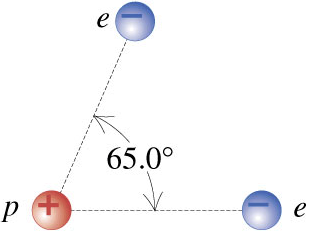
A.) If two electrons are each 2.50×10⁻¹⁰ m from a proton, as shown in the figure, find the magnitude and of the net electrical force they will exert on the proton.
B.) Find the direction of the net electrical force electrons will exert on the proton.
Homework Answers
The concept used to solve the problem is Coulomb’s law.
The magnitude of the net electrical force that will be exert on the proton can be calculated by using the Coulomb’s law. The magnitude of the net electric force can be calculated by using the relationship among the charges, force constant and the inverse of the square of the distance between the charges.
The x and y components of the force exerted on the proton can be calculated by using the vector resolution method.
The net force exerted on the proton can be calculated by using the Pythagoras theorem.
The direction of the net force exerted on the proton can be calculated by using the arctan of the ration of y- component of force to the x-component of force.
Coulomb’s Law: The magnitude of net electrical force between charges is directly proportional to the product of charges and inversely proportional to the square of the distance between charges.
The magnitude of the net electrical force between charges is calculated as follows,
Here, k is the force constant, q1 is the charge of proton, q2 is the charge of electron on the x-axis, and r is the distance between the charges.
The direction of the net force vector can be calculated as follows:
Here, Fy is the component of force in y-direction and Fx is the component of force in x-direction.
(A)
Consider the formula for calculating the magnitude of force acting on the proton.
The formula for calculating the magnitude of force acting on the proton from electron lies in the x direction as follows:
Here, k is the force constant, q1 is the charge of proton, q2 is the charge of electron on the x-axis, F21 is the force acting on proton due to electron lying on x-axis, and r is the distance between the charges.
Substitute for k, for q1, and for q2 in equation as follows:
Find the magnitude of force acting on the proton from electron which is placed at .
The formula for calculating the magnitude of force acting on the proton from electron lies at :
Here, k is the force constant, q1 is the charge of proton, q3 is the charge of electron lies at , F31 is the force acting on proton due to electron, and r is the distance between the charges.
Substitute for k, for q1, and for q2 in equation as follows:
Find the x component of forces exerted on the proton by the vector resolution method.
The x component of force exerted on the proton by the electron placed at is,
Here, is the x-component of force exerted on the proton by the electron placed at and F31 is the force exerted on the proton by the electron.
Substitute for and for in equation as follows:
Find the y component of force acting on the proton by using vector resolution method.
The y-component of force exerted on the proton by the electron placed at is,
Here, is the y-component of force exerted on the proton by the electron placed at and F31 is the force exerted on the proton by the electron.
Substitute for and for in equation as follows:
Find the x component of force acting on the proton by using vector resolution method.
The x-component of force exerted on the proton by the electron placed along x-axis is as follows:
Here, is the force exerted on the proton due to electron placed along x axis.
Substitute in above equation,
The y component of force exerted on the proton by the electron placed along x-axis is as follows:
Calculate the x and y components of the net force exerted on the proton.
The magnitude of the net force exerted on the proton in the x direction is calculated as follows:
Here, is the magnitude of total force exerted on the proton in the x direction, is the magnitude of total force exerted on the proton by the electron placed at , and is the magnitude of force exerted on the proton by the electron placed along x axis.
Substitute for and for as follows:
The magnitude of the y components of the net force exerted on the proton is calculated as follows:
Here, is the magnitude of total force exerted on the proton in the y direction, is the magnitude of total force exerted on the proton by the electron placed at , and is the magnitude of force exerted on the proton by the electron placed along y axis.
Substitute for and for as follows:
Calculate the magnitude of net force exerted on the proton.
The magnitude of net force exerted on the proton by using Pythagoras theorem is,
Here, is the magnitude of total force exerted on the proton in the x direction and is the magnitude of total force exerted on the proton in the y direction.
Substitute for and for as follows,
(b)
Calculate the direction of net force exerted on the proton.
The direction of net force exerted on the proton is calculated by dividing the y- component of net force to the x- component of net force.
The direction of net force is,
Here, is the magnitude of net force exerted on the proton in y direction and is the magnitude of net force exerted on the proton in the x-direction.
Substitute for and for as follows,
Ans: Part a
The magnitude of the net electrical force that will be exerted on the proton is .
Part bThe direction of the net force exerted on the proton is .
Add Answer to:
A.) If two electrons are each 2.50×10⁻¹⁰ from a proton, as shown in thefigure, find...
If two electrons are each 1.60x10⁻¹⁰m from a proton
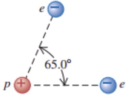 If two electrons are each 1.60x10⁻¹⁰m from a proton, as shown in find the magnitude and direction of the net electrical force they will exert on the proton. A. Express the magnitude of the force in newtons to three significant figures B. Express the direction as an angle to three significant figures
1. If two electrons are each 1.50X10^10m from a proton,find the magnitude and direction of the...
1. If two electrons are each 1.50X10^10m from a proton,find the magnitude and direction of the net electrical force theywill exert on the proton.
An electron and a proton are each moving at 845 km/s in perpendicular paths as shown in the figure(Figure 1)
 An electron and a proton are each moving at 845 km/s in perpendicular paths as shown in the figure(Figure 1) .
At the instant they are at the positions shown in the figure. (A)
Find the magnitude of the total magnetic field they produce at the
origin. (B) Find the direction of the total magnetic field they
produce at the origin. (C) Find the magnitude of the magnetic field
the electron produces at the location of the proton. (D)Find the
direction of the magnetic field...
An electron and a proton are each moving at 845 km/s in perpendicular paths as shown in the figure(Figure 1) .
At the instant they are at the positions shown in the figure. (A)
Find the magnitude of the total magnetic field they produce at the
origin. (B) Find the direction of the total magnetic field they
produce at the origin. (C) Find the magnitude of the magnetic field
the electron produces at the location of the proton. (D)Find the
direction of the magnetic field...
2. -5.00 cm from rest in a constant electric field with magnitude 2.50 x10³ N/C pointing A proton is released at...
 2. -5.00 cm from rest in a constant electric field with magnitude 2.50 x10³ N/C pointing A proton is released at in the positive y-direction. a. Determine the change in electrical potential energy of the proton when is it at x-2.60 cm. Did the proton gain or lose potential energy? b. Find the final speed of the proton at x 2.60 cm. [mass of proton 1.67 x 1027kg; charge of proton +1.60 x 10¹⁹C]
2. -5.00 cm from rest in...
2. -5.00 cm from rest in a constant electric field with magnitude 2.50 x10³ N/C pointing A proton is released at in the positive y-direction. a. Determine the change in electrical potential energy of the proton when is it at x-2.60 cm. Did the proton gain or lose potential energy? b. Find the final speed of the proton at x 2.60 cm. [mass of proton 1.67 x 1027kg; charge of proton +1.60 x 10¹⁹C]
2. -5.00 cm from rest in...
Two uncharged spheres are separated by 2.20 m. f 4.80x 10¹² electrons are removed from one...
 Two uncharged spheres are separated by 2.20 m. f 4.80x 10¹² electrons are removed from one sphere and placed on the other, determine the magnitude of the Coulomb force (in N) on one of the spheres, treating the spheres as point charges. HINT Need Help?WatchI +/2 points | Previcus Answers SerCP11 15.2.P011.M My Notes Ask Your Teach Three charges are arranged as shown in the figure below. Find the magnitude and direction of the electrostatic force on the charge q...
Two electrons (e1 and e2) and a proton (p) lie on a straight line, as shown....
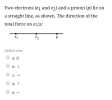 Two electrons (e1 and e2) and a proton (p) lie on a straight line, as shown. The direction of the total force on ep,is: ei P Select one: a. O b. C. → d. 1 e.
A proton moving at v0 = 1.70 ✕ 106 m/s enters the region between two parallel...
 A proton moving at v0 = 1.70 ✕
106 m/s enters the region between two parallel plates
with charge densities of magnitude σ = 2.60 ✕
10−9 C/m2 (see the figure below).
A uniform electric field is produced by two charged horizontal
plates, each of length d, where the positive plate is
above the negative plate. The leftmost side of each plate is at
horizontal position x = 0. The upper plate has charge
density +σ and the lower plate...
A proton moving at v0 = 1.70 ✕
106 m/s enters the region between two parallel plates
with charge densities of magnitude σ = 2.60 ✕
10−9 C/m2 (see the figure below).
A uniform electric field is produced by two charged horizontal
plates, each of length d, where the positive plate is
above the negative plate. The leftmost side of each plate is at
horizontal position x = 0. The upper plate has charge
density +σ and the lower plate...
When at rest, a proton experiences a net electromagnetic force of magnitude 8.6×10⁻¹³ N pointing in...
When at rest, a proton experiences a net electromagnetic force of magnitude 8.6×10⁻¹³ N pointing in the positive x direction. When the proton moves with a speed of 1.6×10⁶ m/s in the positive y direction, the net electromagnetic force on it decreases in magnitude to 7.3×10⁻¹³ N , still pointing in the positive x direction. A. Find the magnitude of the electric field. B. Find the direction of the electric field. C. Find the magnitude of the magnetic field. D....
A proton moves to the right with a speed of 4.44 middot 10^6 m/s into a...
 A proton moves to the right with a speed of 4.44 middot 10^6 m/s into a region of constant magnetic field as shown in the figure below. The magnitude of the magnetic field is 2.94 middot 10^-2 T and the direction of the field is out of the page. When the proton initially enters the magnetic field, the magnitude of the force on the proton (in N) is When the proton initially enters the magnetic field, the direction of the...
When at rest, a proton experiences a net electromagnetic force of magnitude 9.0×10⁻¹³ N pointing in...
When at rest, a proton experiences a net electromagnetic force of magnitude 9.0×10⁻¹³ N pointing in the positive x direction. When the proton moves with a speed of 1.3×10⁶ m/s in the positive y direction, the net electromagnetic force on it decreases in magnitude to 7.2×10⁻¹³ N , still pointing in the positive x direction Part A Find the magnitude of the electric field. Part B Find the magnitude of the magnetic field
 An electron and a proton are each moving at 845 km/s in perpendicular paths as shown in the figure(Figure 1) .
At the instant they are at the positions shown in the figure. (A)
Find the magnitude of the total magnetic field they produce at the
origin. (B) Find the direction of the total magnetic field they
produce at the origin. (C) Find the magnitude of the magnetic field
the electron produces at the location of the proton. (D)Find the
direction of the magnetic field...
An electron and a proton are each moving at 845 km/s in perpendicular paths as shown in the figure(Figure 1) .
At the instant they are at the positions shown in the figure. (A)
Find the magnitude of the total magnetic field they produce at the
origin. (B) Find the direction of the total magnetic field they
produce at the origin. (C) Find the magnitude of the magnetic field
the electron produces at the location of the proton. (D)Find the
direction of the magnetic field...
 2. -5.00 cm from rest in a constant electric field with magnitude 2.50 x10³ N/C pointing A proton is released at in the positive y-direction. a. Determine the change in electrical potential energy of the proton when is it at x-2.60 cm. Did the proton gain or lose potential energy? b. Find the final speed of the proton at x 2.60 cm. [mass of proton 1.67 x 1027kg; charge of proton +1.60 x 10¹⁹C]
2. -5.00 cm from rest in...
2. -5.00 cm from rest in a constant electric field with magnitude 2.50 x10³ N/C pointing A proton is released at in the positive y-direction. a. Determine the change in electrical potential energy of the proton when is it at x-2.60 cm. Did the proton gain or lose potential energy? b. Find the final speed of the proton at x 2.60 cm. [mass of proton 1.67 x 1027kg; charge of proton +1.60 x 10¹⁹C]
2. -5.00 cm from rest in...
 Two uncharged spheres are separated by 2.20 m. f 4.80x 10¹² electrons are removed from one sphere and placed on the other, determine the magnitude of the Coulomb force (in N) on one of the spheres, treating the spheres as point charges. HINT Need Help?WatchI +/2 points | Previcus Answers SerCP11 15.2.P011.M My Notes Ask Your Teach Three charges are arranged as shown in the figure below. Find the magnitude and direction of the electrostatic force on the charge q...
 Two electrons (e1 and e2) and a proton (p) lie on a straight line, as shown. The direction of the total force on ep,is: ei P Select one: a. O b. C. → d. 1 e.
 A proton moving at v0 = 1.70 ✕
106 m/s enters the region between two parallel plates
with charge densities of magnitude σ = 2.60 ✕
10−9 C/m2 (see the figure below).
A uniform electric field is produced by two charged horizontal
plates, each of length d, where the positive plate is
above the negative plate. The leftmost side of each plate is at
horizontal position x = 0. The upper plate has charge
density +σ and the lower plate...
A proton moving at v0 = 1.70 ✕
106 m/s enters the region between two parallel plates
with charge densities of magnitude σ = 2.60 ✕
10−9 C/m2 (see the figure below).
A uniform electric field is produced by two charged horizontal
plates, each of length d, where the positive plate is
above the negative plate. The leftmost side of each plate is at
horizontal position x = 0. The upper plate has charge
density +σ and the lower plate...
 A proton moves to the right with a speed of 4.44 middot 10^6 m/s into a region of constant magnetic field as shown in the figure below. The magnitude of the magnetic field is 2.94 middot 10^-2 T and the direction of the field is out of the page. When the proton initially enters the magnetic field, the magnitude of the force on the proton (in N) is When the proton initially enters the magnetic field, the direction of the...
Most questions answered within 3 hours.
-
Where is the error in this code sequence?
String s1 = "Hello";
String s2 = "ello";...
asked 10 months ago -
Financial data for Joel de Paris, Inc., for last year
follow:
Joel de Paris, Inc.
Balance...
asked 10 months ago -
Consider this reaction:
Al2(SO4)3 (aq)+ BaCl3
(aq) Al2Cl6 (aq)- +
3BaSO4(s) . What is the...
asked 10 months ago -
Suppose that Savneet is considering increasing her
recent random sample from 20 car rentals to 40...
asked 10 months ago -
Trucks arrive at an unloading terminal at an average rate of 120
per hour.
Trucks arrive...
asked 10 months ago -
Why are methanol and ethanol completely soluble in water while
octanol is not very little soluble....
asked 10 months ago -
A facilities manager at a university reads in a research report
that the mean amount of...
asked 10 months ago -
When the CuSO4 is rehydrated by adding water to the anhydrous
compound, is this an endothermic...
asked 10 months ago -
A ray of sunlight is passing from diamond into crown glass; the
angle of incidence is...
asked 10 months ago -
A block of mass 0.249 kg is placed on top of a light, vertical
spring of...
asked 10 months ago -
how do the kidneys compensate in the presences of acidosis
a) trigger hyperventilate
b) reserve acid...
asked 10 months ago -
Question 501 pts
The rental rate of capital to the firm increases. Which of the
following...
asked 10 months ago