Homework Answers
The internal energy of the system is a state property, which only depends on end states, and is independent of the path of the process.
Answer: (D)
Add Answer to:
The
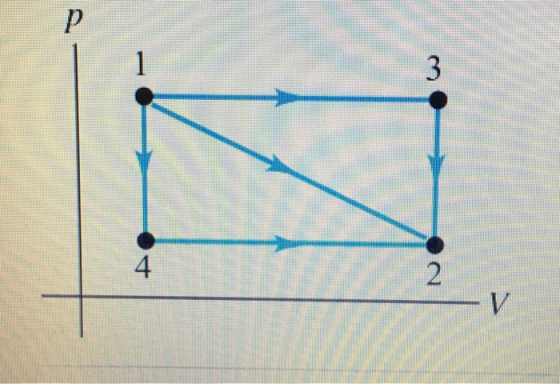
pV diagram shows three possible paths for changing a system from an
initial state, represented...
Is it 1-->3---->2?WIll rate asap! A explanation is appreciated. This pV diagram shows three possible paths...
 Is
it 1-->3---->2?WIll rate asap! A explanation is
appreciated.
This pV diagram shows three possible paths for changing a system from an initial state, represented by point 1. to a final state, represented by point 2. For which path is the work done by the system the greatest? p O path 1->2 O path 1->3->2 O path 1-4->2
Is
it 1-->3---->2?WIll rate asap! A explanation is
appreciated.
This pV diagram shows three possible paths for changing a system from an initial state, represented by point 1. to a final state, represented by point 2. For which path is the work done by the system the greatest? p O path 1->2 O path 1->3->2 O path 1-4->2
The state of an ideal gas can be represented by a point on a PV(pressure-volume)...
The state of an ideal gas can be represented by a point on a PV (pressure-volume) diagram. If you know the quantity of gas, n, a unique point in pressure (P) and volume (V) can be used to determine a temperature (T). Each point on a PV diagram also has a single internal energy (U) assigned to it. If a process starts at a point and returns to that same point on a PV diagram, it returns to the same...
Consider the following closed system PV diagram for an ideal gas. This plot shows two isotherms...
 Consider the following closed system PV diagram for an ideal
gas. This plot shows two isotherms and five different paths: 1 –
5.( The arrows indicates the direction each path follows).
1. Consider the following closed system PV diagram for an ideal gas. This plot shows two isotherms and five different paths: 1- 5The arrows indicates the direction each path follows). Pressure (atm) 3 T. 2 Volume (m3) Match EACH path 1-5 with one of the following descriptions and explain/jiustify...
Consider the following closed system PV diagram for an ideal
gas. This plot shows two isotherms and five different paths: 1 –
5.( The arrows indicates the direction each path follows).
1. Consider the following closed system PV diagram for an ideal gas. This plot shows two isotherms and five different paths: 1- 5The arrows indicates the direction each path follows). Pressure (atm) 3 T. 2 Volume (m3) Match EACH path 1-5 with one of the following descriptions and explain/jiustify...
V. PV diagrams Ideal gas processes are often represented graphically. For instance, a PV diagram is...
 V. PV diagrams Ideal gas processes are often represented graphically. For instance, a PV diagram is a graph of pressure versus volume for a given sample of gas. A single point on the graph represents simultancously measured values of pressure and volume These values define a state of the gas A. Sketch the process described in section III on the PV diagram provided to the right Label the initial and final states of the gas. This type of process is...
The PV diagram below represents 3.21 mol of an ideal monatomic gas. The gas is initially at point A. The paths AD and B...
 The PV diagram below represents 3.21 mol of an ideal monatomic gas. The gas is initially at point A. The paths AD and BC represent isothermal changes. If the system is brought to point C along the path ABC, find the following: Р, atm 4.0 1.0 200 VL 4.01 (a) the initial and final temperatures of the gas initial 60.9 final 75.9 (b) the work done by the gas kJ (c) the heat absorbed by the gas kJ
The PV...
The PV diagram below represents 3.21 mol of an ideal monatomic gas. The gas is initially at point A. The paths AD and BC represent isothermal changes. If the system is brought to point C along the path ABC, find the following: Р, atm 4.0 1.0 200 VL 4.01 (a) the initial and final temperatures of the gas initial 60.9 final 75.9 (b) the work done by the gas kJ (c) the heat absorbed by the gas kJ
The PV...
The PV diagram below represents 2.79 mol of an ideal monatomic gas. The gas is initially at point A. The paths AD and B...
 The PV diagram below represents 2.79 mol of an ideal monatomic gas. The gas is initially at point A. The paths AD and BC represent isothermal changes. If the system is brought to point C along the path ABC, find the following: P atm 4.0 1.0 4.01 20.0 V.L (a) the initial and final temperatures of the gas initia final b) the work done by the gas (c) the heat absorbed by the gas eBook
The PV diagram below represents...
The PV diagram below represents 2.79 mol of an ideal monatomic gas. The gas is initially at point A. The paths AD and BC represent isothermal changes. If the system is brought to point C along the path ABC, find the following: P atm 4.0 1.0 4.01 20.0 V.L (a) the initial and final temperatures of the gas initia final b) the work done by the gas (c) the heat absorbed by the gas eBook
The PV diagram below represents...
TB4 The PV diagram in the figure is for n moles of an ideal monatomic gas. The gas is initially at point A. The paths AD and BC represent isothermal changes. R is the universal gas constant. Let the...
 TB4 The PV diagram in the figure is for n moles of an ideal monatomic gas. The gas is initially at point A. The paths AD and BC represent isothermal changes. R is the universal gas constant. Let the pressures, volumes, and temperatures at the labeled points be denoted as PA , PB, etc., and VA , VB, etc., and TA, TB, etc., respectively. If the system is brought to point C along th<e path A-»E->C, what is the heat...
The state of an ideal gas can be represented by a point on a PV (pressure-volume)...
 The state of an ideal gas can be represented by a point on a PV
(pressure-volume) diagram. If you know the quantity of gas, n, a
unique point in pressure (P) and volume (V) can be used to
determine a temperature (T). Each point on a PV diagram also has a
single internal energy (U) assigned to it. If a process starts at a
point and returns to that same point on a PV diagram, it returns to
the same...
The state of an ideal gas can be represented by a point on a PV
(pressure-volume) diagram. If you know the quantity of gas, n, a
unique point in pressure (P) and volume (V) can be used to
determine a temperature (T). Each point on a PV diagram also has a
single internal energy (U) assigned to it. If a process starts at a
point and returns to that same point on a PV diagram, it returns to
the same...
4 points In the pV diagram below, an ideal gas returns to its initial state after...
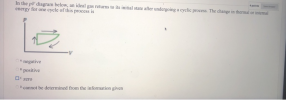 4 points In the pV diagram below, an ideal gas returns to its initial state after undergoing a cyclic process. The change in thermal or internal energy for one cycle of this process is A negative positive Ozero D.cannot be determined from the information given
When a gas follows path 123 on the PV diagram in the figure below, 419 J...
 When a gas follows path 123 on the PV diagram in the
figure below, 419 J of energy flows into the system by heat and
−171 J of work is done on the gas.
A rectangular path is plotted on a PV diagram that has
a horizontal axis labeled V, and a vertical axis labeled
P. The vertices of the rectangle, starting from the
bottom-left corner and continuing clockwise, are labeled in the
following order: 1, 2, 3, 4. The...
When a gas follows path 123 on the PV diagram in the
figure below, 419 J of energy flows into the system by heat and
−171 J of work is done on the gas.
A rectangular path is plotted on a PV diagram that has
a horizontal axis labeled V, and a vertical axis labeled
P. The vertices of the rectangle, starting from the
bottom-left corner and continuing clockwise, are labeled in the
following order: 1, 2, 3, 4. The...
 Is
it 1-->3---->2?WIll rate asap! A explanation is
appreciated.
This pV diagram shows three possible paths for changing a system from an initial state, represented by point 1. to a final state, represented by point 2. For which path is the work done by the system the greatest? p O path 1->2 O path 1->3->2 O path 1-4->2
Is
it 1-->3---->2?WIll rate asap! A explanation is
appreciated.
This pV diagram shows three possible paths for changing a system from an initial state, represented by point 1. to a final state, represented by point 2. For which path is the work done by the system the greatest? p O path 1->2 O path 1->3->2 O path 1-4->2
 Consider the following closed system PV diagram for an ideal
gas. This plot shows two isotherms and five different paths: 1 –
5.( The arrows indicates the direction each path follows).
1. Consider the following closed system PV diagram for an ideal gas. This plot shows two isotherms and five different paths: 1- 5The arrows indicates the direction each path follows). Pressure (atm) 3 T. 2 Volume (m3) Match EACH path 1-5 with one of the following descriptions and explain/jiustify...
Consider the following closed system PV diagram for an ideal
gas. This plot shows two isotherms and five different paths: 1 –
5.( The arrows indicates the direction each path follows).
1. Consider the following closed system PV diagram for an ideal gas. This plot shows two isotherms and five different paths: 1- 5The arrows indicates the direction each path follows). Pressure (atm) 3 T. 2 Volume (m3) Match EACH path 1-5 with one of the following descriptions and explain/jiustify...
 V. PV diagrams Ideal gas processes are often represented graphically. For instance, a PV diagram is a graph of pressure versus volume for a given sample of gas. A single point on the graph represents simultancously measured values of pressure and volume These values define a state of the gas A. Sketch the process described in section III on the PV diagram provided to the right Label the initial and final states of the gas. This type of process is...
 The PV diagram below represents 3.21 mol of an ideal monatomic gas. The gas is initially at point A. The paths AD and BC represent isothermal changes. If the system is brought to point C along the path ABC, find the following: Р, atm 4.0 1.0 200 VL 4.01 (a) the initial and final temperatures of the gas initial 60.9 final 75.9 (b) the work done by the gas kJ (c) the heat absorbed by the gas kJ
The PV...
The PV diagram below represents 3.21 mol of an ideal monatomic gas. The gas is initially at point A. The paths AD and BC represent isothermal changes. If the system is brought to point C along the path ABC, find the following: Р, atm 4.0 1.0 200 VL 4.01 (a) the initial and final temperatures of the gas initial 60.9 final 75.9 (b) the work done by the gas kJ (c) the heat absorbed by the gas kJ
The PV...
 The PV diagram below represents 2.79 mol of an ideal monatomic gas. The gas is initially at point A. The paths AD and BC represent isothermal changes. If the system is brought to point C along the path ABC, find the following: P atm 4.0 1.0 4.01 20.0 V.L (a) the initial and final temperatures of the gas initia final b) the work done by the gas (c) the heat absorbed by the gas eBook
The PV diagram below represents...
The PV diagram below represents 2.79 mol of an ideal monatomic gas. The gas is initially at point A. The paths AD and BC represent isothermal changes. If the system is brought to point C along the path ABC, find the following: P atm 4.0 1.0 4.01 20.0 V.L (a) the initial and final temperatures of the gas initia final b) the work done by the gas (c) the heat absorbed by the gas eBook
The PV diagram below represents...
 TB4 The PV diagram in the figure is for n moles of an ideal monatomic gas. The gas is initially at point A. The paths AD and BC represent isothermal changes. R is the universal gas constant. Let the pressures, volumes, and temperatures at the labeled points be denoted as PA , PB, etc., and VA , VB, etc., and TA, TB, etc., respectively. If the system is brought to point C along th<e path A-»E->C, what is the heat...
 The state of an ideal gas can be represented by a point on a PV
(pressure-volume) diagram. If you know the quantity of gas, n, a
unique point in pressure (P) and volume (V) can be used to
determine a temperature (T). Each point on a PV diagram also has a
single internal energy (U) assigned to it. If a process starts at a
point and returns to that same point on a PV diagram, it returns to
the same...
The state of an ideal gas can be represented by a point on a PV
(pressure-volume) diagram. If you know the quantity of gas, n, a
unique point in pressure (P) and volume (V) can be used to
determine a temperature (T). Each point on a PV diagram also has a
single internal energy (U) assigned to it. If a process starts at a
point and returns to that same point on a PV diagram, it returns to
the same...
 4 points In the pV diagram below, an ideal gas returns to its initial state after undergoing a cyclic process. The change in thermal or internal energy for one cycle of this process is A negative positive Ozero D.cannot be determined from the information given
 When a gas follows path 123 on the PV diagram in the
figure below, 419 J of energy flows into the system by heat and
−171 J of work is done on the gas.
A rectangular path is plotted on a PV diagram that has
a horizontal axis labeled V, and a vertical axis labeled
P. The vertices of the rectangle, starting from the
bottom-left corner and continuing clockwise, are labeled in the
following order: 1, 2, 3, 4. The...
When a gas follows path 123 on the PV diagram in the
figure below, 419 J of energy flows into the system by heat and
−171 J of work is done on the gas.
A rectangular path is plotted on a PV diagram that has
a horizontal axis labeled V, and a vertical axis labeled
P. The vertices of the rectangle, starting from the
bottom-left corner and continuing clockwise, are labeled in the
following order: 1, 2, 3, 4. The...
Most questions answered within 3 hours.
-
Where is the error in this code sequence?
String s1 = "Hello";
String s2 = "ello";...
asked 10 months ago -
Financial data for Joel de Paris, Inc., for last year
follow:
Joel de Paris, Inc.
Balance...
asked 10 months ago -
Consider this reaction:
Al2(SO4)3 (aq)+ BaCl3
(aq) Al2Cl6 (aq)- +
3BaSO4(s) . What is the...
asked 10 months ago -
Suppose that Savneet is considering increasing her
recent random sample from 20 car rentals to 40...
asked 10 months ago -
Trucks arrive at an unloading terminal at an average rate of 120
per hour.
Trucks arrive...
asked 10 months ago -
Why are methanol and ethanol completely soluble in water while
octanol is not very little soluble....
asked 10 months ago -
A facilities manager at a university reads in a research report
that the mean amount of...
asked 10 months ago -
When the CuSO4 is rehydrated by adding water to the anhydrous
compound, is this an endothermic...
asked 10 months ago -
A ray of sunlight is passing from diamond into crown glass; the
angle of incidence is...
asked 10 months ago -
A block of mass 0.249 kg is placed on top of a light, vertical
spring of...
asked 10 months ago -
how do the kidneys compensate in the presences of acidosis
a) trigger hyperventilate
b) reserve acid...
asked 10 months ago -
Question 501 pts
The rental rate of capital to the firm increases. Which of the
following...
asked 10 months ago