Two long thin parallel wires 13.0cmapart carry 35 A
currents in the same direction.Determine the magnetic field vector at a point 10.0 cmfrom one wire and 6.0 cmfrom the other.
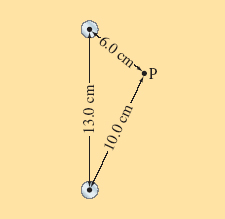
13.0 cm 10,0 cm 10.0 cm +
Homework Answers
Use the expression for the magnetic field due to wire to calculate the magnetic field at point P.

Here, is the permeability of free space, I is the current passing through the wire, and r is the distance from the wire to the point P.
The following figure shows the magnetic fields produced by the two wires at point P.

Here,  is the current produced by the wire 1,
  is the current produced by the wire 2,
  is the magnetic field due to wire 1,
  is the magnetic field due to wire 2,
  is the angle made by the magnetic field
  with the line joining the two wires, and
  is the angle made by the magnetic field
  with the line joining the two wires.
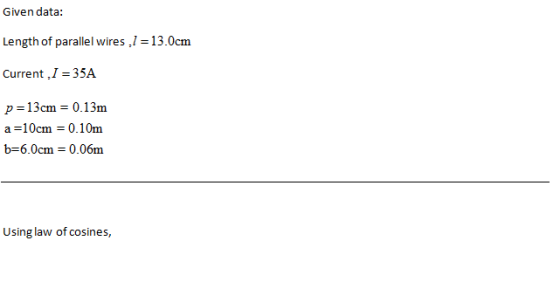
According to law of cosines, the cosine of the angle made by the magnetic field vector produced by the wire 1 is given by,

Here,  is the distance between the two wires,
  is the distance from the wire 1 to the point P, and
  is the distance from the wire 2 to the point P.
Substitute 13 cm for  , 10 cm for
  , and 6 cm for
  in above equation and solve it as follows:

According to law of cosines, the cosine of the angle made by the magnetic field vector produced by the wire 2 is given by,

Here,  is the distance between the two wires,
  is the distance from the wire 1 to the point P, and
  is the distance from the wire 2 to the point P.
Substitute 13 cm for  , 10 cm for
  , and 6 cm for
  in above equation and solve it as follows:

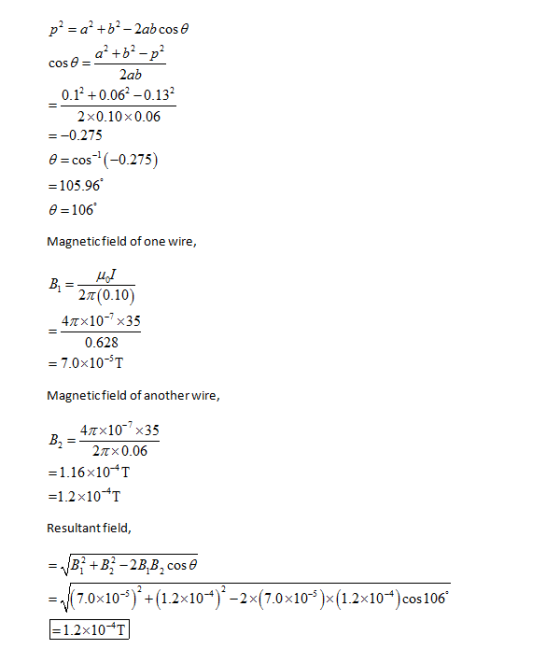
The magnetic field due to wire 1 is given by,

Substitute  for
for  , 35 A for
  , and 10 cm for
  in above equation as follows:

The magnetic field vector due to wire 1 is given by,

Substitute
 for
for  and
and  for
for  in above equation as follows:
The magnetic field due to wire 2 is given by,

Substitute  for
for  , 35 A for
  , and 6 cm for
  in above equation as follows:

The magnetic field vector due to wire 2 is given by,

Substitute  for
for  and
and  for
for  in above equation as follows:

The net magnetic field at point P is given by,

Substitute  for
for  and
and  for
for  in above equation as follows:

Therefore, the magnetic field vector is  .
.
The magnitude of the net magnetic field is given by,

Here,  is the x component of the magnetic field and
  is the y- component of the magnetic field.
Substitute  for
for  and
and  for
for  in above equation as follows:

Therefore, the magnitude of the magnetic field at point P is  .
.
The direction of the magnetic field is given by,

Substitute  for
for  and
and  for
for  in above equation as follows:

Therefore, the magnitude of the magnetic field at a point P is  and is directed at an angle of
  above the horizontal.
Add Answer to:
Two long thin parallel wires 13.0cmapart carry 35 Acurrents in the same direction....
Two long thin parallel wires 13.0 cm apart carry 29-A currents in the same direction. 1)...
 Two long thin parallel wires 13.0 cm apart carry 29-A currents
in the same direction.
1) Determine the magnitude of the magnetic field vector at a
point 10.0 cm from one wire and 6.0 cm from the other
2) Determine the direction of the magnetic field vector at that
point. Example: θ= ... degrees, measured counterclockwise from the
positive x axis
13.0 cm 10.0 cm $6.0 cm
Two long thin parallel wires 13.0 cm apart carry 29-A currents
in the same direction.
1) Determine the magnitude of the magnetic field vector at a
point 10.0 cm from one wire and 6.0 cm from the other
2) Determine the direction of the magnetic field vector at that
point. Example: θ= ... degrees, measured counterclockwise from the
positive x axis
13.0 cm 10.0 cm $6.0 cm
Part A Periodic Table Constants Two long thin parallel wires 13.0 cm apart carry 35 A currents in the same direction. D...
 Part A Periodic Table Constants Two long thin parallel wires 13.0 cm apart carry 35 A currents in the same direction. Determine the magnitude of the magnetic field vector at a point 10.0 cm from one wire and 6.0 cm from the other (see the figure(Figure 1)). Express your answer using two significant figures. nνα ΑΣφ T Bi Request Answer Submit Part B 1 of 1 Figure Determine the direction of the magnetic field vector at a point 10.0 cm...
Two long thin parallel wires 13.0 cm apart carry 24-Acurrents in the same direction. Part A:...
 Two long thin parallel wires 13.0 cm apart carry 24-Acurrents in
the same direction.
Part A:
Determine the magnitude of the magnetic field vector at a point
10.0 cm from one wire and 6.0 cm from the other (Figure 1) .
Part B:
Determine the direction of the magnetic field vector at that
point.
degrees, measured counterclockwise from the positive x
axis
Two long thin parallel wires 13.0 cm apart carry 24-Acurrents in
the same direction.
Part A:
Determine the magnitude of the magnetic field vector at a point
10.0 cm from one wire and 6.0 cm from the other (Figure 1) .
Part B:
Determine the direction of the magnetic field vector at that
point.
degrees, measured counterclockwise from the positive x
axis
Two long thin parallel wires 15.0 cm apart carry 31 A currents in the same directions....
 Two long thin parallel wires 15.0 cm apart carry 31 A currents in the same directions. Determine the magnetic field vector at a point 11.0 cm from one wire and 6.0 cm from the other (see figure). |° (counterclockwise from horizontal to the right) 0-15.0 cm
Two long, parallel wires carry a current of 5.00 A in a direction that is out...
 Two long, parallel wires carry a current of 5.00 A in a direction that is out of the page. The wires are 10.0 cm apart. Determine the the net magnetic field vector at a point that is 10.0 cm above one of the wires as shown. 1.
Two long, thin parallel wires are placed 12.0 cm apart, as shown below. Each wire carries...
Two long, thin parallel wires are placed 12.0 cm apart, as shown below. Each wire carries a 28 A current, but the currents are flowing in opposite directions. Determine the magnetic field vector at the point P, which is 10.4 cm from one wire, and 6.0 cm from the other. Please help me find the magnitude and the direction (θ).
Two long, straight wires carry equal currents of 0.56 A. The two wires are parallel to...
Two long, straight wires carry equal currents of 0.56 A. The two wires are parallel to each other and carry parallel currents. What is the magnetic field at a midpoint between the two wires, if the wires are 0.5 cm apart? The magnetic field of a long, straight wire is: B=(μ_0 i)/2πr What is the force per unit length of one of the wires in number 2 on the other?
Two long, straight, parallel wires carry currents of 6 A and 8 A in the same...
Two long, straight, parallel wires carry currents of 6 A and 8 A in the same direction. If the two wires are 5 cm apart, what is the distance from the 6 A wire to the point where the magnetic field is zero?
Two long parallel wires 8.20 cm apart carry the same current (given below) in the same...
 Two long parallel wires 8.20 cm apart carry the same current (given below) in the same direction, out of the screen. Determine the magnetic field at a point P, 12.0 cm from one wire and 13.0 cm from the other. Give (a) the magnitude, and (b) the angle from the negative x-axis (dotted line) The current is 16.816 A
Two long, straight wires carry equal currents of 0.56 A. The two wires are parallel to...
Two long, straight wires carry equal currents of 0.56 A. The two wires are parallel to each other and carry parallel currents. What is the magnetic field at a midpoint between the two wires, if the wires are 0.5 cm apart? The magnetic field of a long, straight wire is: B=(μ_0 i)/2πr What is the force per unit length of one of the wires in number 2 on the other? Please show the derivation for the second equation used (u0*i1*i2/2pir)
 Two long thin parallel wires 13.0 cm apart carry 29-A currents
in the same direction.
1) Determine the magnitude of the magnetic field vector at a
point 10.0 cm from one wire and 6.0 cm from the other
2) Determine the direction of the magnetic field vector at that
point. Example: θ= ... degrees, measured counterclockwise from the
positive x axis
13.0 cm 10.0 cm $6.0 cm
Two long thin parallel wires 13.0 cm apart carry 29-A currents
in the same direction.
1) Determine the magnitude of the magnetic field vector at a
point 10.0 cm from one wire and 6.0 cm from the other
2) Determine the direction of the magnetic field vector at that
point. Example: θ= ... degrees, measured counterclockwise from the
positive x axis
13.0 cm 10.0 cm $6.0 cm
 Part A Periodic Table Constants Two long thin parallel wires 13.0 cm apart carry 35 A currents in the same direction. Determine the magnitude of the magnetic field vector at a point 10.0 cm from one wire and 6.0 cm from the other (see the figure(Figure 1)). Express your answer using two significant figures. nνα ΑΣφ T Bi Request Answer Submit Part B 1 of 1 Figure Determine the direction of the magnetic field vector at a point 10.0 cm...
 Two long thin parallel wires 13.0 cm apart carry 24-Acurrents in
the same direction.
Part A:
Determine the magnitude of the magnetic field vector at a point
10.0 cm from one wire and 6.0 cm from the other (Figure 1) .
Part B:
Determine the direction of the magnetic field vector at that
point.
degrees, measured counterclockwise from the positive x
axis
Two long thin parallel wires 13.0 cm apart carry 24-Acurrents in
the same direction.
Part A:
Determine the magnitude of the magnetic field vector at a point
10.0 cm from one wire and 6.0 cm from the other (Figure 1) .
Part B:
Determine the direction of the magnetic field vector at that
point.
degrees, measured counterclockwise from the positive x
axis
 Two long thin parallel wires 15.0 cm apart carry 31 A currents in the same directions. Determine the magnetic field vector at a point 11.0 cm from one wire and 6.0 cm from the other (see figure). |° (counterclockwise from horizontal to the right) 0-15.0 cm
 Two long, parallel wires carry a current of 5.00 A in a direction that is out of the page. The wires are 10.0 cm apart. Determine the the net magnetic field vector at a point that is 10.0 cm above one of the wires as shown. 1.
 Two long parallel wires 8.20 cm apart carry the same current (given below) in the same direction, out of the screen. Determine the magnetic field at a point P, 12.0 cm from one wire and 13.0 cm from the other. Give (a) the magnitude, and (b) the angle from the negative x-axis (dotted line) The current is 16.816 A
Most questions answered within 3 hours.
-
Where is the error in this code sequence?
String s1 = "Hello";
String s2 = "ello";...
asked 10 months ago -
Financial data for Joel de Paris, Inc., for last year
follow:
Joel de Paris, Inc.
Balance...
asked 10 months ago -
Consider this reaction:
Al2(SO4)3 (aq)+ BaCl3
(aq) Al2Cl6 (aq)- +
3BaSO4(s) . What is the...
asked 10 months ago -
Suppose that Savneet is considering increasing her
recent random sample from 20 car rentals to 40...
asked 10 months ago -
Trucks arrive at an unloading terminal at an average rate of 120
per hour.
Trucks arrive...
asked 10 months ago -
Why are methanol and ethanol completely soluble in water while
octanol is not very little soluble....
asked 10 months ago -
A facilities manager at a university reads in a research report
that the mean amount of...
asked 10 months ago -
When the CuSO4 is rehydrated by adding water to the anhydrous
compound, is this an endothermic...
asked 10 months ago -
A ray of sunlight is passing from diamond into crown glass; the
angle of incidence is...
asked 10 months ago -
A block of mass 0.249 kg is placed on top of a light, vertical
spring of...
asked 10 months ago -
how do the kidneys compensate in the presences of acidosis
a) trigger hyperventilate
b) reserve acid...
asked 10 months ago -
Question 501 pts
The rental rate of capital to the firm increases. Which of the
following...
asked 10 months ago