
Homework Answers
Add Answer to:
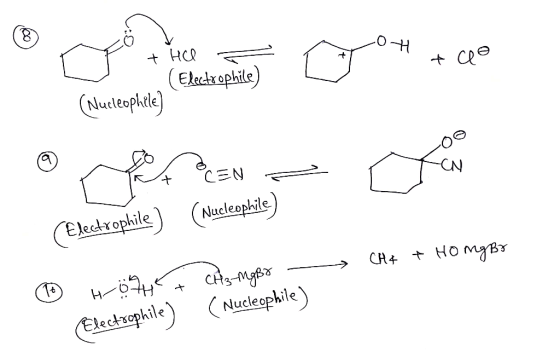
Identify the nucleophile and electrophile in each reaction below and label them. 8 н ст Н—С1...
Please explain and show arrows if possible! Thank you! Q1) Identify the nucleophile and electrophile i...
 Please explain and show arrows if possible! Thank you!
Q1) Identify the nucleophile and electrophile i ction below and label them. (10 poin + H-C + CT 3 points 'О CN 2. 3 points 3. 4 points
Please explain and show arrows if possible! Thank you!
Q1) Identify the nucleophile and electrophile i ction below and label them. (10 poin + H-C + CT 3 points 'О CN 2. 3 points 3. 4 points
Classify each structure below as a nucleophile or electrophile, and briefly explain your choice Identify and...
 Classify each structure below as a nucleophile or electrophile, and briefly explain your choice Identify and label the nucleophile and electrophile in each reaction below. Then add curved arrows to indicate the flow of electrons in each.
For each reaction on the following slides: a- Identify the nucleophile and electrophile b- use curved...
 For each reaction on the following slides: a- Identify the nucleophile and electrophile b- use curved arrow to show the formation of the substitution products reaction via an S2 mechanism CH,CH,Br + NaCN
Write a balanced chemical reaction identify and label (or name) the base/nucleophile, the electrophile, and the...
Write a balanced chemical reaction identify and label (or name) the base/nucleophile, the electrophile, and the leaving group. Decide whether the reaction is a substitution or an elimination,, label the reaction as E or S. 2-chloro-3-methylbutane (15.0 mmol) was added to a solution of sodium ethoxide (15.0 mmol) in ethanol (50.0 mL) and heated to reflux for 1 h. The mixture was then cooled to room temperature, neutralized with saturated aqueous sodium bicarbonate (a weak base). 2-methyl-2-butene was isolated by...
H 9. For each molecule: 1) Identify all possible enantiomers and distinguish those that are enantiomers, diastereomers...
 H 9. For each molecule: 1) Identify all possible enantiomers and distinguish those that are enantiomers, diastereomers and meso compounds. II) Assign the absolute configuration of chiral carbons in each molecule OCH3 HO+Br HS+CN H2N-CH3 HOSH Он HO+CH3 н OCH3 Сн, ососна Br +D HOCH HC-BrHN+Br CH 8. For the following compounds, assign the absolute configuration for those with chiral carbons and identify those that are NOT enantiomers HO C-C-OHY -CCIN 13CH3 HAN CH3 CH3 осі H-CH3 H2N+CH H O+COOH...
Predict the product of the reaction mechanisms. Identify the electrophile and nucleophile in each reaction. Propose...
 Predict the product of the reaction mechanisms. Identify the electrophile and nucleophile in each reaction. Propose a mechanism for each reaction below. This means show curved arrows. You may want to fill in any nonbonding electrons. Show an example of each of the following types of reactions and explain why it is that type: Addition elimination Rearrangement Substitution
4. (4 pts) Label the nucleophile and electrophile and draw the products of the following Si2 reaction. Be sure to i...
 4. (4 pts) Label the nucleophile and electrophile and draw the products of the following Si2 reaction. Be sure to indicate the appropriate stereochemistry. acetone N3 (2 pts) Would the reaction above be faster or slower if each of the following substrates were used instead of trans-1-iodo-4-methylcyclohexane? 5. a. iodoethane FASTER SLOWER b. trans-1-chloro-4-methylcyclohexane FASTER SLOWER
Supply the arrows for each of the following reactions. Identify the nucleophile/base and the electrophile/acid (when...
 Supply the arrows for each of the following reactions. Identify the nucleophile/base and the electrophile/acid (when possible). Calcualte AH for each reaction. Estimate Keq (>1 or <1) for each reaction. Is the reaction exothermic or endothermic? You must answer all of the questions to receive full credit. Use the bond strength chart provided for bond dissociation energies. Upload answers (with your name clearly shown) as WORD, PDF or JPEG] Reaction 1 | 16-H 1 + + :NH, NH3 Reaction 2...
(a.) For each of the following reactions, identify the nucleophile and electrophile and draw the electron...
 (a.) For each of the following reactions, identify the
nucleophile and electrophile and draw the electron motion arrows
required to generate the product given.
(b.) The spectrum above was measured on a sample with
molecular formula C4H7ClO2. In the box in the middle of the
spectrum, draw the structure of a conpound with this formula that
is consistent with the spectrum above (there are wuite a few
structures that woukd fit). Do not attempt to match the fingerprint
region.
(c.)...
(a.) For each of the following reactions, identify the
nucleophile and electrophile and draw the electron motion arrows
required to generate the product given.
(b.) The spectrum above was measured on a sample with
molecular formula C4H7ClO2. In the box in the middle of the
spectrum, draw the structure of a conpound with this formula that
is consistent with the spectrum above (there are wuite a few
structures that woukd fit). Do not attempt to match the fingerprint
region.
(c.)...
Carbohydrates 1. Label each of the monosaccharides shown below as a triose, tetrose, pentoso, or hexose....
 Carbohydrates 1. Label each of the monosaccharides shown below as a triose, tetrose, pentoso, or hexose. но CH OH HT -он - он Н - ОН но -н но -Н но -н нон сньон он но -н НОН CH OH нон нон нон снон CH OH сон сон H- OH H- -он OH cң, он н-с-он Сн,он снон 2. Label each of the monosaccharides shown above as a ketose or aldose. 3. Identify all of the chiral carbons in the...
 Please explain and show arrows if possible! Thank you!
Q1) Identify the nucleophile and electrophile i ction below and label them. (10 poin + H-C + CT 3 points 'О CN 2. 3 points 3. 4 points
Please explain and show arrows if possible! Thank you!
Q1) Identify the nucleophile and electrophile i ction below and label them. (10 poin + H-C + CT 3 points 'О CN 2. 3 points 3. 4 points
 Classify each structure below as a nucleophile or electrophile, and briefly explain your choice Identify and label the nucleophile and electrophile in each reaction below. Then add curved arrows to indicate the flow of electrons in each.
 For each reaction on the following slides: a- Identify the nucleophile and electrophile b- use curved arrow to show the formation of the substitution products reaction via an S2 mechanism CH,CH,Br + NaCN
 H 9. For each molecule: 1) Identify all possible enantiomers and distinguish those that are enantiomers, diastereomers and meso compounds. II) Assign the absolute configuration of chiral carbons in each molecule OCH3 HO+Br HS+CN H2N-CH3 HOSH Он HO+CH3 н OCH3 Сн, ососна Br +D HOCH HC-BrHN+Br CH 8. For the following compounds, assign the absolute configuration for those with chiral carbons and identify those that are NOT enantiomers HO C-C-OHY -CCIN 13CH3 HAN CH3 CH3 осі H-CH3 H2N+CH H O+COOH...
 Predict the product of the reaction mechanisms. Identify the electrophile and nucleophile in each reaction. Propose a mechanism for each reaction below. This means show curved arrows. You may want to fill in any nonbonding electrons. Show an example of each of the following types of reactions and explain why it is that type: Addition elimination Rearrangement Substitution
 4. (4 pts) Label the nucleophile and electrophile and draw the products of the following Si2 reaction. Be sure to indicate the appropriate stereochemistry. acetone N3 (2 pts) Would the reaction above be faster or slower if each of the following substrates were used instead of trans-1-iodo-4-methylcyclohexane? 5. a. iodoethane FASTER SLOWER b. trans-1-chloro-4-methylcyclohexane FASTER SLOWER
 Supply the arrows for each of the following reactions. Identify the nucleophile/base and the electrophile/acid (when possible). Calcualte AH for each reaction. Estimate Keq (>1 or <1) for each reaction. Is the reaction exothermic or endothermic? You must answer all of the questions to receive full credit. Use the bond strength chart provided for bond dissociation energies. Upload answers (with your name clearly shown) as WORD, PDF or JPEG] Reaction 1 | 16-H 1 + + :NH, NH3 Reaction 2...
 (a.) For each of the following reactions, identify the
nucleophile and electrophile and draw the electron motion arrows
required to generate the product given.
(b.) The spectrum above was measured on a sample with
molecular formula C4H7ClO2. In the box in the middle of the
spectrum, draw the structure of a conpound with this formula that
is consistent with the spectrum above (there are wuite a few
structures that woukd fit). Do not attempt to match the fingerprint
region.
(c.)...
(a.) For each of the following reactions, identify the
nucleophile and electrophile and draw the electron motion arrows
required to generate the product given.
(b.) The spectrum above was measured on a sample with
molecular formula C4H7ClO2. In the box in the middle of the
spectrum, draw the structure of a conpound with this formula that
is consistent with the spectrum above (there are wuite a few
structures that woukd fit). Do not attempt to match the fingerprint
region.
(c.)...
 Carbohydrates 1. Label each of the monosaccharides shown below as a triose, tetrose, pentoso, or hexose. но CH OH HT -он - он Н - ОН но -н но -Н но -н нон сньон он но -н НОН CH OH нон нон нон снон CH OH сон сон H- OH H- -он OH cң, он н-с-он Сн,он снон 2. Label each of the monosaccharides shown above as a ketose or aldose. 3. Identify all of the chiral carbons in the...
Most questions answered within 3 hours.
-
Where is the error in this code sequence?
String s1 = "Hello";
String s2 = "ello";...
asked 10 months ago -
Financial data for Joel de Paris, Inc., for last year
follow:
Joel de Paris, Inc.
Balance...
asked 10 months ago -
Consider this reaction:
Al2(SO4)3 (aq)+ BaCl3
(aq) Al2Cl6 (aq)- +
3BaSO4(s) . What is the...
asked 10 months ago -
Suppose that Savneet is considering increasing her
recent random sample from 20 car rentals to 40...
asked 10 months ago -
Trucks arrive at an unloading terminal at an average rate of 120
per hour.
Trucks arrive...
asked 10 months ago -
Why are methanol and ethanol completely soluble in water while
octanol is not very little soluble....
asked 10 months ago -
A facilities manager at a university reads in a research report
that the mean amount of...
asked 10 months ago -
When the CuSO4 is rehydrated by adding water to the anhydrous
compound, is this an endothermic...
asked 10 months ago -
A ray of sunlight is passing from diamond into crown glass; the
angle of incidence is...
asked 10 months ago -
A block of mass 0.249 kg is placed on top of a light, vertical
spring of...
asked 10 months ago -
how do the kidneys compensate in the presences of acidosis
a) trigger hyperventilate
b) reserve acid...
asked 10 months ago -
Question 501 pts
The rental rate of capital to the firm increases. Which of the
following...
asked 10 months ago