
Homework Answers
electrophile means electron seeking species , nucleophile means nucleus seeking species
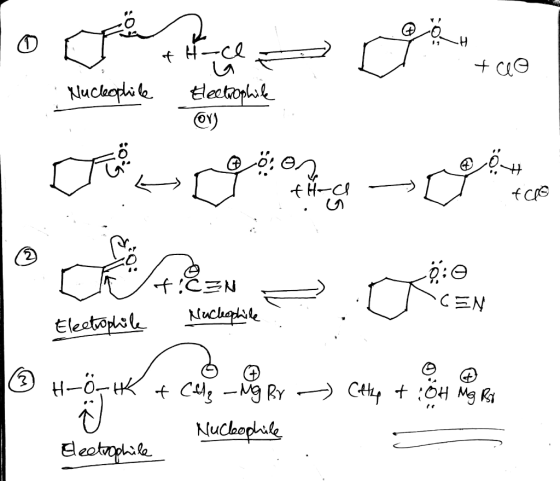
1) the pi bond electrons are nucleophilic in nature and acts as base so oxygen lone pair of electrons are attacks on proton in HCl and forms the product ketone -> nucleoephile , HCl -> electrophile
2) the cn- is more basic so it attacks on the unsatturated system due to electromeric effect forms the product,cn- -> nucleoephile , ketone -> electrophile
3) ch3mgbr is grignard reagent in this ch3 having the -ve charge then it attacks water molecule it removes the proton and forms the product , ch3mgbr -> nucleoephile , H2O -> electrophile
Add Answer to:
Please explain and show arrows if possible! Thank you!
Q1) Identify the nucleophile and electrophile i...
Classify each structure below as a nucleophile or electrophile, and briefly explain your choice Identify and...
 Classify each structure below as a nucleophile or electrophile, and briefly explain your choice Identify and label the nucleophile and electrophile in each reaction below. Then add curved arrows to indicate the flow of electrons in each.
Identify the nucleophile and electrophile in each reaction below and label them. 8 н ст Н—С1...
 Identify the nucleophile and electrophile in each reaction below and label them. 8 н ст Н—С1 + (2pts.) dld ad 9. +:CEN CN (2 pts.) (2 pts) CH+HO: MgBr + HC—MеBr 10. Н—О—н frlectrons in
Draw reaction mechanism using arrows. Please indicate nucleophile, electrophile, products, show intermediate structure a...
Draw reaction mechanism using arrows. Please indicate nucleophile, electrophile, products, show intermediate structure and name (please show which carbon carriers charges if possible), if anti/syn chemistry is involved, please indicate “anti” or “syn” at the end of the reaction equation. Please name the product. Please indicate “follow Markovnikov’s rule” or “not follow Markovnikov’s rule”. (If hydride shift is possible, please consider it and show it in your reaction) 1) pent-1-ene ( or 1-methylcyclohexene) reacts with Br2
Draw reaction mechanism using arrows. Please indicate nucleophile, electrophile, products, show intermediate structure a...
 Draw reaction mechanism using arrows.
Please indicate nucleophile, electrophile, products, show
intermediate structure and name (please show which carbon carriers
charges if possible), if anti/syn chemistry is involved
please indicate “anti” or “syn” at the end of the reaction
equation.
Please name the product.
53) Reaction of the following with HBr in electrophilic addition
reactions
Please indicate “follow Markovnikov’s rule” or “not follow
Markovnikov’s rule”. (If hydride shift is possible, please consider
it and show it in your reaction)
yo...
Draw reaction mechanism using arrows.
Please indicate nucleophile, electrophile, products, show
intermediate structure and name (please show which carbon carriers
charges if possible), if anti/syn chemistry is involved
please indicate “anti” or “syn” at the end of the reaction
equation.
Please name the product.
53) Reaction of the following with HBr in electrophilic addition
reactions
Please indicate “follow Markovnikov’s rule” or “not follow
Markovnikov’s rule”. (If hydride shift is possible, please consider
it and show it in your reaction)
yo...
Predict the product of the reaction mechanisms. Identify the electrophile and nucleophile in each reaction. Propose...
 Predict the product of the reaction mechanisms. Identify the electrophile and nucleophile in each reaction. Propose a mechanism for each reaction below. This means show curved arrows. You may want to fill in any nonbonding electrons. Show an example of each of the following types of reactions and explain why it is that type: Addition elimination Rearrangement Substitution
Supply the arrows for each of the following reactions. Identify the nucleophile/base and the electrophile/acid (when...
 Supply the arrows for each of the following reactions. Identify the nucleophile/base and the electrophile/acid (when possible). Calcualte AH for each reaction. Estimate Keq (>1 or <1) for each reaction. Is the reaction exothermic or endothermic? You must answer all of the questions to receive full credit. Use the bond strength chart provided for bond dissociation energies. Upload answers (with your name clearly shown) as WORD, PDF or JPEG] Reaction 1 | 16-H 1 + + :NH, NH3 Reaction 2...
(a.) For each of the following reactions, identify the nucleophile and electrophile and draw the electron...
 (a.) For each of the following reactions, identify the
nucleophile and electrophile and draw the electron motion arrows
required to generate the product given.
(b.) The spectrum above was measured on a sample with
molecular formula C4H7ClO2. In the box in the middle of the
spectrum, draw the structure of a conpound with this formula that
is consistent with the spectrum above (there are wuite a few
structures that woukd fit). Do not attempt to match the fingerprint
region.
(c.)...
(a.) For each of the following reactions, identify the
nucleophile and electrophile and draw the electron motion arrows
required to generate the product given.
(b.) The spectrum above was measured on a sample with
molecular formula C4H7ClO2. In the box in the middle of the
spectrum, draw the structure of a conpound with this formula that
is consistent with the spectrum above (there are wuite a few
structures that woukd fit). Do not attempt to match the fingerprint
region.
(c.)...
please show all steps with necessary mechanism arrows 1. Provide the starting specific nucleophile and electrophile...
 please show all steps with necessary mechanism arrows
1. Provide the starting specific nucleophile and electrophile that would result in each of the following molecules using an SN2 reaction. Do consider the ABC and provide the specific reagent necessary. (2 points) Me HH MeMe Me I wyn Me Me 2. Provide a detailed retrosynthesis and synthesis of the following compound from the indicated starting material. All atoms of the target must come from the indicated starting materials. You may use...
please show all steps with necessary mechanism arrows
1. Provide the starting specific nucleophile and electrophile that would result in each of the following molecules using an SN2 reaction. Do consider the ABC and provide the specific reagent necessary. (2 points) Me HH MeMe Me I wyn Me Me 2. Provide a detailed retrosynthesis and synthesis of the following compound from the indicated starting material. All atoms of the target must come from the indicated starting materials. You may use...
Need some help with these two questions. Thank you! 8. The bond indicated in the molecule...
 Need some help with these two questions. Thank you!
8. The bond indicated in the molecule below can undergo homolytic and heterolytic cleavage. Draw the products for both pathways. Show correct mechanism arrows and label each pathway. (10 points) (ainoabstelle adoloso w olt. HM o bagnsballbunari arwoled slusalomat bosta 9. Arrange the leaving groups in the molecules below from best leaving group to worst leaving group. Assume CN is the nucleophile. Explain your ordering. (5 points)
Need some help with these two questions. Thank you!
8. The bond indicated in the molecule below can undergo homolytic and heterolytic cleavage. Draw the products for both pathways. Show correct mechanism arrows and label each pathway. (10 points) (ainoabstelle adoloso w olt. HM o bagnsballbunari arwoled slusalomat bosta 9. Arrange the leaving groups in the molecules below from best leaving group to worst leaving group. Assume CN is the nucleophile. Explain your ordering. (5 points)
please answer all bullet points. explain and rewrite labeled mechanism for clarity. thank you Sulfonction of...
 please answer all bullet points. explain and rewrite labeled
mechanism for clarity. thank you
Sulfonction of benzaldehyde RX. 0 0000 1 'S-00 o= 999 TIPI O= + H₂O S-OH = Diease label • Supply Curly arrows to complete Mechanism for this label nucleopoiled electrophile Write ROS, rate determining Site, over the Rx arrow that is the slowest step of this RX What is the special name for the species in the bracket?
please answer all bullet points. explain and rewrite labeled
mechanism for clarity. thank you
Sulfonction of benzaldehyde RX. 0 0000 1 'S-00 o= 999 TIPI O= + H₂O S-OH = Diease label • Supply Curly arrows to complete Mechanism for this label nucleopoiled electrophile Write ROS, rate determining Site, over the Rx arrow that is the slowest step of this RX What is the special name for the species in the bracket?
 Classify each structure below as a nucleophile or electrophile, and briefly explain your choice Identify and label the nucleophile and electrophile in each reaction below. Then add curved arrows to indicate the flow of electrons in each.
 Identify the nucleophile and electrophile in each reaction below and label them. 8 н ст Н—С1 + (2pts.) dld ad 9. +:CEN CN (2 pts.) (2 pts) CH+HO: MgBr + HC—MеBr 10. Н—О—н frlectrons in
 Draw reaction mechanism using arrows.
Please indicate nucleophile, electrophile, products, show
intermediate structure and name (please show which carbon carriers
charges if possible), if anti/syn chemistry is involved
please indicate “anti” or “syn” at the end of the reaction
equation.
Please name the product.
53) Reaction of the following with HBr in electrophilic addition
reactions
Please indicate “follow Markovnikov’s rule” or “not follow
Markovnikov’s rule”. (If hydride shift is possible, please consider
it and show it in your reaction)
yo...
Draw reaction mechanism using arrows.
Please indicate nucleophile, electrophile, products, show
intermediate structure and name (please show which carbon carriers
charges if possible), if anti/syn chemistry is involved
please indicate “anti” or “syn” at the end of the reaction
equation.
Please name the product.
53) Reaction of the following with HBr in electrophilic addition
reactions
Please indicate “follow Markovnikov’s rule” or “not follow
Markovnikov’s rule”. (If hydride shift is possible, please consider
it and show it in your reaction)
yo...
 Predict the product of the reaction mechanisms. Identify the electrophile and nucleophile in each reaction. Propose a mechanism for each reaction below. This means show curved arrows. You may want to fill in any nonbonding electrons. Show an example of each of the following types of reactions and explain why it is that type: Addition elimination Rearrangement Substitution
 Supply the arrows for each of the following reactions. Identify the nucleophile/base and the electrophile/acid (when possible). Calcualte AH for each reaction. Estimate Keq (>1 or <1) for each reaction. Is the reaction exothermic or endothermic? You must answer all of the questions to receive full credit. Use the bond strength chart provided for bond dissociation energies. Upload answers (with your name clearly shown) as WORD, PDF or JPEG] Reaction 1 | 16-H 1 + + :NH, NH3 Reaction 2...
 (a.) For each of the following reactions, identify the
nucleophile and electrophile and draw the electron motion arrows
required to generate the product given.
(b.) The spectrum above was measured on a sample with
molecular formula C4H7ClO2. In the box in the middle of the
spectrum, draw the structure of a conpound with this formula that
is consistent with the spectrum above (there are wuite a few
structures that woukd fit). Do not attempt to match the fingerprint
region.
(c.)...
(a.) For each of the following reactions, identify the
nucleophile and electrophile and draw the electron motion arrows
required to generate the product given.
(b.) The spectrum above was measured on a sample with
molecular formula C4H7ClO2. In the box in the middle of the
spectrum, draw the structure of a conpound with this formula that
is consistent with the spectrum above (there are wuite a few
structures that woukd fit). Do not attempt to match the fingerprint
region.
(c.)...
 please show all steps with necessary mechanism arrows
1. Provide the starting specific nucleophile and electrophile that would result in each of the following molecules using an SN2 reaction. Do consider the ABC and provide the specific reagent necessary. (2 points) Me HH MeMe Me I wyn Me Me 2. Provide a detailed retrosynthesis and synthesis of the following compound from the indicated starting material. All atoms of the target must come from the indicated starting materials. You may use...
please show all steps with necessary mechanism arrows
1. Provide the starting specific nucleophile and electrophile that would result in each of the following molecules using an SN2 reaction. Do consider the ABC and provide the specific reagent necessary. (2 points) Me HH MeMe Me I wyn Me Me 2. Provide a detailed retrosynthesis and synthesis of the following compound from the indicated starting material. All atoms of the target must come from the indicated starting materials. You may use...
 Need some help with these two questions. Thank you!
8. The bond indicated in the molecule below can undergo homolytic and heterolytic cleavage. Draw the products for both pathways. Show correct mechanism arrows and label each pathway. (10 points) (ainoabstelle adoloso w olt. HM o bagnsballbunari arwoled slusalomat bosta 9. Arrange the leaving groups in the molecules below from best leaving group to worst leaving group. Assume CN is the nucleophile. Explain your ordering. (5 points)
Need some help with these two questions. Thank you!
8. The bond indicated in the molecule below can undergo homolytic and heterolytic cleavage. Draw the products for both pathways. Show correct mechanism arrows and label each pathway. (10 points) (ainoabstelle adoloso w olt. HM o bagnsballbunari arwoled slusalomat bosta 9. Arrange the leaving groups in the molecules below from best leaving group to worst leaving group. Assume CN is the nucleophile. Explain your ordering. (5 points)
 please answer all bullet points. explain and rewrite labeled
mechanism for clarity. thank you
Sulfonction of benzaldehyde RX. 0 0000 1 'S-00 o= 999 TIPI O= + H₂O S-OH = Diease label • Supply Curly arrows to complete Mechanism for this label nucleopoiled electrophile Write ROS, rate determining Site, over the Rx arrow that is the slowest step of this RX What is the special name for the species in the bracket?
please answer all bullet points. explain and rewrite labeled
mechanism for clarity. thank you
Sulfonction of benzaldehyde RX. 0 0000 1 'S-00 o= 999 TIPI O= + H₂O S-OH = Diease label • Supply Curly arrows to complete Mechanism for this label nucleopoiled electrophile Write ROS, rate determining Site, over the Rx arrow that is the slowest step of this RX What is the special name for the species in the bracket?
Most questions answered within 3 hours.
-
Where is the error in this code sequence?
String s1 = "Hello";
String s2 = "ello";...
asked 10 months ago -
Financial data for Joel de Paris, Inc., for last year
follow:
Joel de Paris, Inc.
Balance...
asked 10 months ago -
Consider this reaction:
Al2(SO4)3 (aq)+ BaCl3
(aq) Al2Cl6 (aq)- +
3BaSO4(s) . What is the...
asked 10 months ago -
Suppose that Savneet is considering increasing her
recent random sample from 20 car rentals to 40...
asked 10 months ago -
Trucks arrive at an unloading terminal at an average rate of 120
per hour.
Trucks arrive...
asked 10 months ago -
Why are methanol and ethanol completely soluble in water while
octanol is not very little soluble....
asked 10 months ago -
A facilities manager at a university reads in a research report
that the mean amount of...
asked 10 months ago -
When the CuSO4 is rehydrated by adding water to the anhydrous
compound, is this an endothermic...
asked 10 months ago -
A ray of sunlight is passing from diamond into crown glass; the
angle of incidence is...
asked 10 months ago -
A block of mass 0.249 kg is placed on top of a light, vertical
spring of...
asked 10 months ago -
how do the kidneys compensate in the presences of acidosis
a) trigger hyperventilate
b) reserve acid...
asked 10 months ago -
Question 501 pts
The rental rate of capital to the firm increases. Which of the
following...
asked 10 months ago