
Homework Answers
Add Answer to:
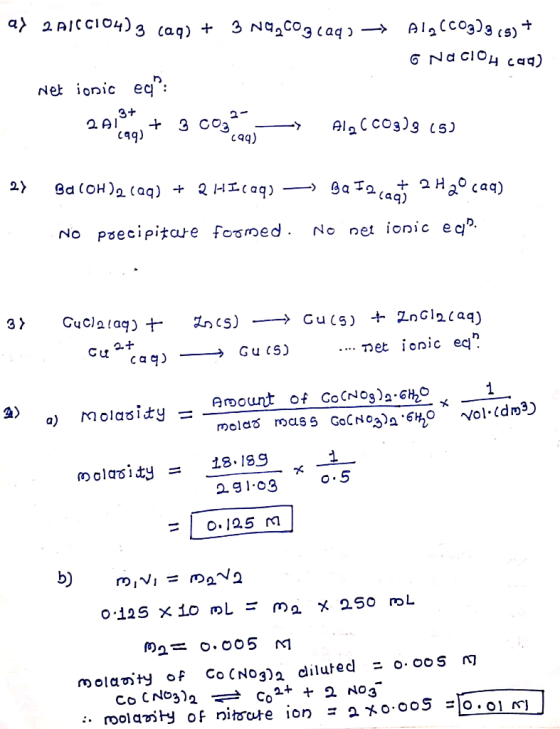
a. b. Complete and balance the following molecular equations. Write the net ionic equations. To receive...
0.3926 g of salicylic acid is dissolved in water and made up to 250.0 mL in a volumetric flask. Then, 4.00 mL of th...
 0.3926 g of salicylic acid is dissolved in water and made up to 250.0 mL in a volumetric flask. Then, 4.00 mL of this solution is pipetted into a 50.0 mL volumetric flask and diluted with water to the mark. What is the final salicylic acid concentration?
0.3856 g of salicylic acid is dissolved in water and made up to 250.0 mL in a volumetric flask. Then, 3.00 mL of th...
 0.3856 g of salicylic acid is dissolved in water and made up to 250.0 mL in a volumetric flask. Then, 3.00 mL of this solution is pipetted into a 50.0 mL volumetric flask and diluted with water to the mark. What is the final salicylic acid concentration?
3. (5 pts) A solution was prepared by transferring 0.661 g of KSO to a 250.0-ml...
 3. (5 pts) A solution was prepared by transferring 0.661 g of KSO to a 250.0-ml volumetric flask (container 1) and adding water to the mark. A sample of this solution of volume 1.000 ml was transferred to a 500.0-ml volumetric flask (container 2) and diluted to the mark with water. Then 10.0 mL of the diluted solution was transferred to a 250.0-ml flask (container 3) and diluted to the mark with water. What is the final concentration of K2SO4...
The recommended procedure for preparing a very dilute solution is not to weigh out a very...
The recommended procedure for preparing a very dilute solution is not to weigh out a very small mass or measure a very small volume of stock solution. Instead, it is done by a series of dilutions. A sample of 0.8521 g of KMnO4 was dissolved in water and made up to the volume in a 500.0−mL volumetric flask. A 2.000−mL sample of this solution was transferred to a 1000−mL volumetric flask and diluted to the mark with water. Next, 10.00...
Which of the following best describes what you will do in this lab? Question 1 options:...
Which of the following best describes what you will do in this lab? Question 1 options: determine the concentration of nickel ions in an unknown solution. Construct a calibration curve. Be able to use a spectrophotometer. determine the concentration of nickel ions in a known solid. Be able to apply beer's law in order to observe how spectrophotometry works Be able to derive beer's law carry out solution preparation and dilutions. Question 2 (1 point) Which of the following best...
4.3b) Write a net ionic equation for the overall reaction that occurs when aqueous solutions of...
4.3b) Write a net ionic equation for the overall reaction that occurs when aqueous solutions of potassium hydroxide and carbonic acid (H2CO3) are combined. Assume excess base. Use the pull-down boxes to specify states such as (aq) or (s) 4.3c) Write a net ionic equation for the reaction that occurs when solid zinc carbonate is combined with excess aqueous hydroiodic acid. Use the pull-down boxes to specify states such as (aq) or (s). If a box is not needed leave...
1A)The compound magnesium bromide is a strong electrolyte. Write the reaction when solid magnesium bromide is...
1A)The compound magnesium bromide is a strong electrolyte. Write the reaction when solid magnesium bromide is put into water: 1B)The compound zinc sulfate is a strong electrolyte. Write the reaction when solid zinc sulfate is put into water 1C)The compound cobalt(II) chloride is a strong electrolyte. Write the reaction when solid cobalt(II) chlorideis put into water: 1D)You need to make an aqueous solution of 0.171 M potassium iodide for an experiment in lab, using a 300 mL volumetric flask. How...
Please complete the following reactions, and show the balanced molecular, complete ionic, and net ionic equations:...
 Please complete the following reactions, and show the balanced molecular, complete ionic, and net ionic equations: 1. K3PO4 (aq) + Al(NO3)3 (aq) 2. Bel2 (aq) Cu2SO4 (aq) 3. Ni(NO3)3 (aq) + KBr (aq) 4. cobalt(lll)bromide potassium sulfide 5. barium nitrate ammonium phosphate 6. calcium hydroxide iron(Il)chloride 7. rubidium fluoride + copper(II)sulfate Use solubility rules from your periodic table and mention them for precipitates as well as aqueous solutions Return to TOC
Write the complete ionic and net ionic equations for each of the following reactions: To write...
Write the complete ionic and net ionic equations for each of the following reactions: To write complete ionic equations and net ionic equations follow the steps below: (I) Write the molecular equation and balance it. (II) Determine the state of each substance(gas, liquid, solid, aqueous). Use the solubility rules! (III) Write the ionic equation by breaking all the soluble ionic compounds (those marked with an (aq) into their respective ions. (IV) Write the net ionic equation by removing the spectator...
The formate ion, (CHO2-), is related to the acetate ion and forms ionic salts with many...
The formate ion, (CHO2-), is related to the acetate ion and forms ionic salts with many metal ions. Assume that 11.874 g of M(CHO2)2 (where M represents the atomic symbol for a particular metal) are dissolved in water. When a solution of 0.300 M sodium sulfate is added, a white precipitate forms. The sodium sulfate solution is added until no more precipitate forms, then a few excess milliliters are added. The precipitate is filtered, washed, and dried. It has a...
 0.3926 g of salicylic acid is dissolved in water and made up to 250.0 mL in a volumetric flask. Then, 4.00 mL of this solution is pipetted into a 50.0 mL volumetric flask and diluted with water to the mark. What is the final salicylic acid concentration?
 0.3856 g of salicylic acid is dissolved in water and made up to 250.0 mL in a volumetric flask. Then, 3.00 mL of this solution is pipetted into a 50.0 mL volumetric flask and diluted with water to the mark. What is the final salicylic acid concentration?
 3. (5 pts) A solution was prepared by transferring 0.661 g of KSO to a 250.0-ml volumetric flask (container 1) and adding water to the mark. A sample of this solution of volume 1.000 ml was transferred to a 500.0-ml volumetric flask (container 2) and diluted to the mark with water. Then 10.0 mL of the diluted solution was transferred to a 250.0-ml flask (container 3) and diluted to the mark with water. What is the final concentration of K2SO4...
 Please complete the following reactions, and show the balanced molecular, complete ionic, and net ionic equations: 1. K3PO4 (aq) + Al(NO3)3 (aq) 2. Bel2 (aq) Cu2SO4 (aq) 3. Ni(NO3)3 (aq) + KBr (aq) 4. cobalt(lll)bromide potassium sulfide 5. barium nitrate ammonium phosphate 6. calcium hydroxide iron(Il)chloride 7. rubidium fluoride + copper(II)sulfate Use solubility rules from your periodic table and mention them for precipitates as well as aqueous solutions Return to TOC
Most questions answered within 3 hours.
-
Where is the error in this code sequence?
String s1 = "Hello";
String s2 = "ello";...
asked 10 months ago -
Financial data for Joel de Paris, Inc., for last year
follow:
Joel de Paris, Inc.
Balance...
asked 10 months ago -
Consider this reaction:
Al2(SO4)3 (aq)+ BaCl3
(aq) Al2Cl6 (aq)- +
3BaSO4(s) . What is the...
asked 10 months ago -
Suppose that Savneet is considering increasing her
recent random sample from 20 car rentals to 40...
asked 10 months ago -
Trucks arrive at an unloading terminal at an average rate of 120
per hour.
Trucks arrive...
asked 10 months ago -
Why are methanol and ethanol completely soluble in water while
octanol is not very little soluble....
asked 10 months ago -
A facilities manager at a university reads in a research report
that the mean amount of...
asked 10 months ago -
When the CuSO4 is rehydrated by adding water to the anhydrous
compound, is this an endothermic...
asked 10 months ago -
A ray of sunlight is passing from diamond into crown glass; the
angle of incidence is...
asked 10 months ago -
A block of mass 0.249 kg is placed on top of a light, vertical
spring of...
asked 10 months ago -
how do the kidneys compensate in the presences of acidosis
a) trigger hyperventilate
b) reserve acid...
asked 10 months ago -
Question 501 pts
The rental rate of capital to the firm increases. Which of the
following...
asked 10 months ago