
Homework Answers
Add Answer to:
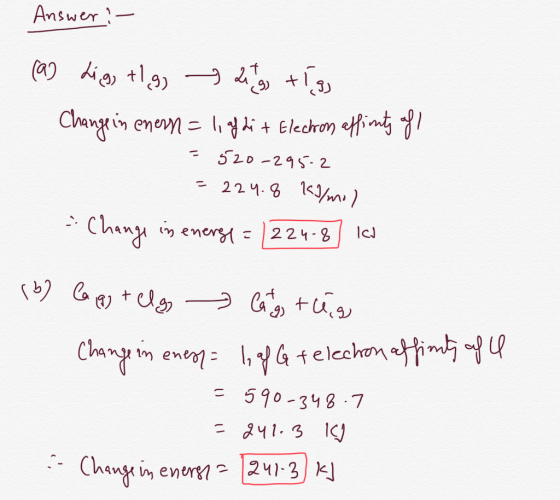
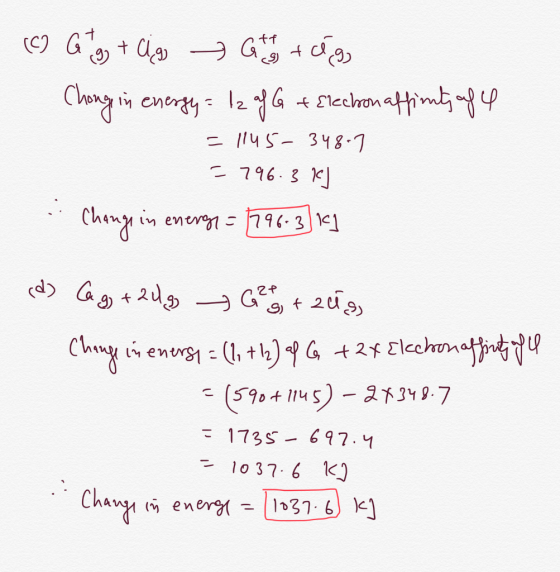
Using the data below, calculate the change in energy expected for each of the following processes....
Use bond energies, values of electron affinities, and the ionization energy of hydrogen (1312 kJ/mol) to...
 Use bond energies, values of electron affinities, and the ionization energy of hydrogen (1312 kJ/mol) to estimate AH for the following reaction Bond Energies Electron Affinities H-F (565 kJ/mol) F() (-328 kJ/mol) H-CI (427 kJ/mol) C1(9) (-349 kJ/mol) -(295 kJ/mol) 1(9) (-295 kJ/mol) 0_H(467 kJ mol) OH(g) (-180. kJ/mol) H2O(g) + H+ (g) + OH (9) AHL b HCI(g) + H+ (g) + CI" (9) AH = kJ
Using the appropriate electron affinities and ionization energies, estimate the enthalpy of reaction for the following...
 Using the appropriate electron affinities and ionization energies, estimate the enthalpy of reaction for the following reactions and state which one is most exothermic a) Na(g) + O(g) - Nat(g) + O-(g) b) Li(g) + Cl(g) — Lit(g) + Cl-(g) Using electron configuration of the atom or ion undergoing the addition of an electron, predict whether the EA will be positive or negative for the following reactions. Ne C Li Ca 1
Calculate the lattice energy of CaCl2 given the following thermodynamic data: Reactions  
Calculate the lattice energy of CaCl2 given the following thermodynamic data: Reactions Energies (kJ/mol) Ca (s) --> Ca (g) 178.0 Ca (g) --> Ca+ (g) + e- 590.0 Ca+ (g) --> Ca2+ (g) + e- 1145 Cl2 (g) --> 2 Cl (g) 242.6 Cl (g) + e- --> Cl- (g) -348.7 Ca (s) + Cl2 --> CaCl (s) ΔHof = -795.0
Calculate the lattice energy for LiF(s) given the following: sublimation energy for Li(s) = +166 KJ/mol...
Calculate the lattice energy for LiF(s) given the following: sublimation energy for Li(s) = +166 KJ/mol delta Hf for F(g) = +77 KJ/mol first ionization energy of Li(g) = +520 KJ/mol electron affinity of F(g) = -328 KJ/mol enthalpy of formation of LiF(s) = -617 KJ/mol
Calculate the lattice energy of LiBr(s) using the following thermodynamic data (all data is in kJ/mol). Note that the data given has been perturbed, so looking up the answer is probably not a good id...
 Calculate the lattice energy of LiBr(s) using the following thermodynamic data (all data is in kJ/mol). Note that the data given has been perturbed, so looking up the answer is probably not a good idea. Li(s) AHgublimation 139 kJ/mol Li(g Ionization energy-500 kJ/mol Br-Brig Bond energy 173 kJ/mol Br(g) Electron affinity 345 kJ/mol LiBr(s) AH°f-371 kJ/mol kJ/mol Submit Answer Retry Entire Group 8 more group attempts remaining
Calculate the lattice energy of LiBr(s) using the following thermodynamic data (all data...
Calculate the lattice energy of LiBr(s) using the following thermodynamic data (all data is in kJ/mol). Note that the data given has been perturbed, so looking up the answer is probably not a good idea. Li(s) AHgublimation 139 kJ/mol Li(g Ionization energy-500 kJ/mol Br-Brig Bond energy 173 kJ/mol Br(g) Electron affinity 345 kJ/mol LiBr(s) AH°f-371 kJ/mol kJ/mol Submit Answer Retry Entire Group 8 more group attempts remaining
Calculate the lattice energy of LiBr(s) using the following thermodynamic data (all data...
This question has multiple parts. Work all the parts to get the most points. Use bond...
 This question has multiple parts. Work all the parts to get the most points. Use bond energies, values of electron affinities, and the ionization energy of hydrogen (1312 kJ/mol) to estimate AH for the following reaction. Bond Energies Electron Affinities H-F (565 kJ/mol) F(9) (-328 kJ/mol) H-CI (427 kJ/mol) C1(9) (-349 kJ mol) H-I (295 kJ/mol) [(9) (-295 kJ/mol) 0-H (467 kJ/mol) OH(9) (-180. kJ/mol) a H20(g) → H*(g) + OH (9) AH = kJ 6 HC1(9) + H*(9) +...
A. Calculate the lattice energy of NaI(s) using the following thermodynamic data (all data is in...
A. Calculate the lattice energy of NaI(s) using the following thermodynamic data (all data is in kJ/mol). Note that the data given has been perturbed, so looking up the answer is probably not a good idea. Na(s) ΔHsublimation = 88 kJ/mol Na(g) Ionization energy = 476 kJ/mol I-I(g) Bond energy = 131 kJ/mol I(g) Electron affinity = -315 kJ/mol NaI(s) ΔH°f = -308 kJ/mol kJ/mol Do you expect this value to be larger or smaller than the lattice energy of...
Calculate the lattice energy of CaBr2. The standard heat of formation of CaBr2 is -675 kJ/mol....
Calculate the lattice energy of CaBr2. The standard heat of formation of CaBr2 is -675 kJ/mol. The first ionization energy of Ca is 590 kJ/mol and its second ionization energy is 1145 kJ/mol. The heat of sublimation of Ca[Ca(s)→Ca(g)] is 178 kJ/mol. The bond energy of Br2 is 193 kJ/mol, the heat of vaporization of Br2(l) is 31 kJ/mol, and the electron affinity of Br is -325 kJ/mol.
Calculate the lattice energy of RbH(s) using the following thermodynamic data (all data is in kJ/mol)....
 Calculate the lattice energy of RbH(s) using the following thermodynamic data (all data is in kJ/mol). Rb(s) AHŞublimation = 61 kJ/mol Rb(g) Ionization energy = 383 kJ/mol H-H(g) Bond energy = 416 kJ/mol Hg) Electron affinity = -93 kJ/mol RbH) AHºr= -72 kJ/mol kJ/mol
 Use bond energies, values of electron affinities, and the ionization energy of hydrogen (1312 kJ/mol) to estimate AH for the following reaction Bond Energies Electron Affinities H-F (565 kJ/mol) F() (-328 kJ/mol) H-CI (427 kJ/mol) C1(9) (-349 kJ/mol) -(295 kJ/mol) 1(9) (-295 kJ/mol) 0_H(467 kJ mol) OH(g) (-180. kJ/mol) H2O(g) + H+ (g) + OH (9) AHL b HCI(g) + H+ (g) + CI" (9) AH = kJ
 Using the appropriate electron affinities and ionization energies, estimate the enthalpy of reaction for the following reactions and state which one is most exothermic a) Na(g) + O(g) - Nat(g) + O-(g) b) Li(g) + Cl(g) — Lit(g) + Cl-(g) Using electron configuration of the atom or ion undergoing the addition of an electron, predict whether the EA will be positive or negative for the following reactions. Ne C Li Ca 1
 Calculate the lattice energy of LiBr(s) using the following thermodynamic data (all data is in kJ/mol). Note that the data given has been perturbed, so looking up the answer is probably not a good idea. Li(s) AHgublimation 139 kJ/mol Li(g Ionization energy-500 kJ/mol Br-Brig Bond energy 173 kJ/mol Br(g) Electron affinity 345 kJ/mol LiBr(s) AH°f-371 kJ/mol kJ/mol Submit Answer Retry Entire Group 8 more group attempts remaining
Calculate the lattice energy of LiBr(s) using the following thermodynamic data (all data...
Calculate the lattice energy of LiBr(s) using the following thermodynamic data (all data is in kJ/mol). Note that the data given has been perturbed, so looking up the answer is probably not a good idea. Li(s) AHgublimation 139 kJ/mol Li(g Ionization energy-500 kJ/mol Br-Brig Bond energy 173 kJ/mol Br(g) Electron affinity 345 kJ/mol LiBr(s) AH°f-371 kJ/mol kJ/mol Submit Answer Retry Entire Group 8 more group attempts remaining
Calculate the lattice energy of LiBr(s) using the following thermodynamic data (all data...
 This question has multiple parts. Work all the parts to get the most points. Use bond energies, values of electron affinities, and the ionization energy of hydrogen (1312 kJ/mol) to estimate AH for the following reaction. Bond Energies Electron Affinities H-F (565 kJ/mol) F(9) (-328 kJ/mol) H-CI (427 kJ/mol) C1(9) (-349 kJ mol) H-I (295 kJ/mol) [(9) (-295 kJ/mol) 0-H (467 kJ/mol) OH(9) (-180. kJ/mol) a H20(g) → H*(g) + OH (9) AH = kJ 6 HC1(9) + H*(9) +...
 Calculate the lattice energy of RbH(s) using the following thermodynamic data (all data is in kJ/mol). Rb(s) AHŞublimation = 61 kJ/mol Rb(g) Ionization energy = 383 kJ/mol H-H(g) Bond energy = 416 kJ/mol Hg) Electron affinity = -93 kJ/mol RbH) AHºr= -72 kJ/mol kJ/mol
Most questions answered within 3 hours.
-
Where is the error in this code sequence?
String s1 = "Hello";
String s2 = "ello";...
asked 10 months ago -
Financial data for Joel de Paris, Inc., for last year
follow:
Joel de Paris, Inc.
Balance...
asked 10 months ago -
Consider this reaction:
Al2(SO4)3 (aq)+ BaCl3
(aq) Al2Cl6 (aq)- +
3BaSO4(s) . What is the...
asked 10 months ago -
Suppose that Savneet is considering increasing her
recent random sample from 20 car rentals to 40...
asked 10 months ago -
Trucks arrive at an unloading terminal at an average rate of 120
per hour.
Trucks arrive...
asked 10 months ago -
Why are methanol and ethanol completely soluble in water while
octanol is not very little soluble....
asked 10 months ago -
A facilities manager at a university reads in a research report
that the mean amount of...
asked 10 months ago -
When the CuSO4 is rehydrated by adding water to the anhydrous
compound, is this an endothermic...
asked 10 months ago -
A ray of sunlight is passing from diamond into crown glass; the
angle of incidence is...
asked 10 months ago -
A block of mass 0.249 kg is placed on top of a light, vertical
spring of...
asked 10 months ago -
how do the kidneys compensate in the presences of acidosis
a) trigger hyperventilate
b) reserve acid...
asked 10 months ago -
Question 501 pts
The rental rate of capital to the firm increases. Which of the
following...
asked 10 months ago