
Homework Answers
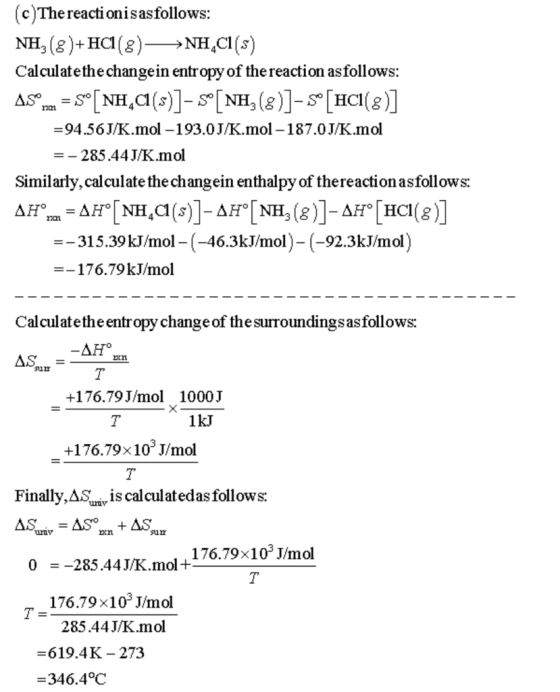
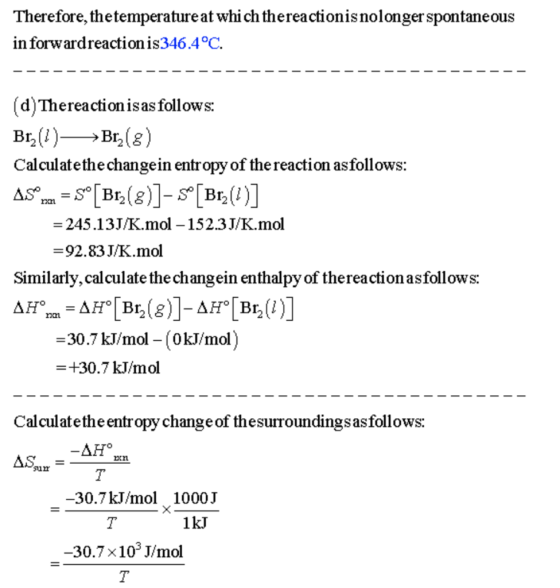
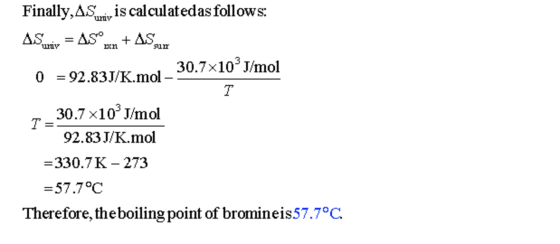
![(a Thereactionisas follows: H,02(1)–>H,02(8) Calculatethechangein entropy of the reaction as follows: AS men = 5° [H,02(8)]-5](http://img.homeworklib.com/questions/cf210240-6e58-11ea-8320-95be23bda9b1.png?x-oss-process=image/resize,w_560)
Add Answer to:
Be sure to answer all parts. Take all the thermodynamic data from your textbook. Assume the...
3 attempts left Check my work Be sure to answer all parts. From the values of...
 3 attempts left Check my work Be sure to answer all parts. From the values of AH and AS, predict which of the following reactions would be spontaneous at 24°C: reaction A: AH = 10.5 kJ/mol, AS = 30.0 J/K mol: spontaneous nonspontaneous impossible to tell mol, reaction B: AH=1.8 kJ/mol, AS = -113 J/ K O spontaneous nonspontaneous impossible to tell If either of the reactions is nonspontaneous, can it(they) become spontaneous? yes, reaction A can become spontaneous yes,...
A.) For the decomposition of barium carbonate, consider the following thermodynamic data (Due to variations in thermody...
A.) For the decomposition of barium carbonate, consider the following thermodynamic data (Due to variations in thermodynamic values for different sources, be sure to use the given values in calculating your answer.): ΔH∘rxn 243.5kJ/mol ΔS∘rxn 172.0J/(mol⋅K) Calculate the temperature in kelvins above which this reaction is spontaneous. B.) The thermodynamic values from part A will be useful as you work through part B ΔH∘rxn243.5kJ/mol ΔS∘rxn172.0J/(mol⋅K) Calculate the equilibrium constant for the following reaction at room temperature, 25 ∘C: BaCO3(s)→BaO(s)+CO2(g)
Be sure to answer all parts. Enter your answer in scientific notation. = 212 kJ/mol for...
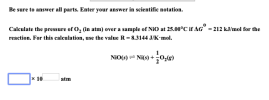 Be sure to answer all parts. Enter your answer in scientific notation. = 212 kJ/mol for the Calculate the pressure of o, in atm) over a sample of NiO at 25.00°C if AG reaction. For this calculation, use the value R= 8.3144 J/K'mol. Nio(s) = Ni(9) +-026) * 10 atm
Enter your answer in the provided box. Given the reaction: H2(g) + I2(g) ⇌ 2HI(g) ΔG...
Enter your answer in the provided box. Given the reaction: H2(g) + I2(g) ⇌ 2HI(g) ΔG o for the reaction is 2.60 kJ/mol at 25degree C. What is the minimum partial pressure of I2 required for the reaction to be spontaneous in the forward direction at 2degrees C if the partial pressures of H2 and HI are 3.5 and 1.75 atm, respectively?
For the reaction of oxygen and nitrogen to form nitric oxide, consider the following thermodynamic data...
For the reaction of oxygen and nitrogen to form nitric oxide, consider the following thermodynamic data (Due to variations in thermodynamic values for different sources, be sure to use the given values in calculating your answer.): ΔH∘rxn 179.97 kJ/mol ΔS∘rxn 22.99 J/(mol⋅K) Calculate the equilibrium constant for the following reaction at room temperature, 295.9 K: Whatever answer you get multiply by 1x1031 and enter that number to 4 decimal places.
Be sure to answer all parts. Enter your answer in scientific notation. Calculate the pressure of...
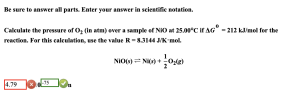 Be sure to answer all parts. Enter your answer in scientific notation. Calculate the pressure of O2 (in atm) over a sample of NiO at 25.00°C if AGⓇ = 212 kJ/mol for the reaction. For this calculation, use the value R= 8.3144 J/K•mol. NiO(s) = Ni(s) + - 026) 4.79 01-75
Enter your answer in the provided box. A reaction vessel contains NH3, N2, and H, at...
 Enter your answer in the provided box. A reaction vessel contains NH3, N2, and H, at equilibrium at a certain temperature. The equilibrium concentrations are [N21 -0.66 M, [12= 1.16 M, and (NH31 -0.70 M. Calculate the equilibrium constant, K, if the reaction is represented as H2(g) = NH3(g)
Be sure to answer all parts. Report problem Styrene is produced by catalytic dehydrogenation of ethylbenzene...
 Be sure to answer all parts. Report problem Styrene is produced by catalytic dehydrogenation of ethylbenzene at high temperature in the presence of superheated steam. Guided Solution (a) Given these data, find A , ?G , and AS at 298 K: rxn rxn 0 ?? AG (kJ/mol) (kJ/o) J/mol K) Ethylbenzene, CgHs CH2CH3 12.5 119.7255 Styrene, C,H5CH-CH2 103.8 202.5 238 0 AG rxn rxn rxn J/K (b) At what temperature is the reaction spontaneous? (c) What are AGand K at...
help! Be sure to answer all parts. Enter a net ionic equation for the following reaction...
 help!
Be sure to answer all parts. Enter a net ionic equation for the following reaction (including states of matter): CaCl2(aq) + MnSO4(aq) → Write the net ionic equation (including physical states) for the reaction of NaBr(ag) with AgNO3(aq). Click in the answer box to activate the palette. Be sure to answer all parts. Calculate the number of g of o, that will react with 6.28 mol of CzHg. Enter your answer in scientific notation. The balanced equation is: C3Hg(8)...
help!
Be sure to answer all parts. Enter a net ionic equation for the following reaction (including states of matter): CaCl2(aq) + MnSO4(aq) → Write the net ionic equation (including physical states) for the reaction of NaBr(ag) with AgNO3(aq). Click in the answer box to activate the palette. Be sure to answer all parts. Calculate the number of g of o, that will react with 6.28 mol of CzHg. Enter your answer in scientific notation. The balanced equation is: C3Hg(8)...
Be sure to answer all parts Consider the reaction A+B-> Products From the following data obtained...
 Be sure to answer all parts Consider the reaction A+B-> Products From the following data obtained at a certain temperature, determine the order of the reaction. Enter the order with respect to A, the order with respect to B, and the overall reaction order [A] (M) B] (M) Rate (M/s) 1.50 1.503.20 x 10-1 1.502.503.20 x 10-1 3.001.506.40 x 10-1 Reaction
 3 attempts left Check my work Be sure to answer all parts. From the values of AH and AS, predict which of the following reactions would be spontaneous at 24°C: reaction A: AH = 10.5 kJ/mol, AS = 30.0 J/K mol: spontaneous nonspontaneous impossible to tell mol, reaction B: AH=1.8 kJ/mol, AS = -113 J/ K O spontaneous nonspontaneous impossible to tell If either of the reactions is nonspontaneous, can it(they) become spontaneous? yes, reaction A can become spontaneous yes,...
 Be sure to answer all parts. Enter your answer in scientific notation. = 212 kJ/mol for the Calculate the pressure of o, in atm) over a sample of NiO at 25.00°C if AG reaction. For this calculation, use the value R= 8.3144 J/K'mol. Nio(s) = Ni(9) +-026) * 10 atm
 Be sure to answer all parts. Enter your answer in scientific notation. Calculate the pressure of O2 (in atm) over a sample of NiO at 25.00°C if AGⓇ = 212 kJ/mol for the reaction. For this calculation, use the value R= 8.3144 J/K•mol. NiO(s) = Ni(s) + - 026) 4.79 01-75
 Enter your answer in the provided box. A reaction vessel contains NH3, N2, and H, at equilibrium at a certain temperature. The equilibrium concentrations are [N21 -0.66 M, [12= 1.16 M, and (NH31 -0.70 M. Calculate the equilibrium constant, K, if the reaction is represented as H2(g) = NH3(g)
 Be sure to answer all parts. Report problem Styrene is produced by catalytic dehydrogenation of ethylbenzene at high temperature in the presence of superheated steam. Guided Solution (a) Given these data, find A , ?G , and AS at 298 K: rxn rxn 0 ?? AG (kJ/mol) (kJ/o) J/mol K) Ethylbenzene, CgHs CH2CH3 12.5 119.7255 Styrene, C,H5CH-CH2 103.8 202.5 238 0 AG rxn rxn rxn J/K (b) At what temperature is the reaction spontaneous? (c) What are AGand K at...
 help!
Be sure to answer all parts. Enter a net ionic equation for the following reaction (including states of matter): CaCl2(aq) + MnSO4(aq) → Write the net ionic equation (including physical states) for the reaction of NaBr(ag) with AgNO3(aq). Click in the answer box to activate the palette. Be sure to answer all parts. Calculate the number of g of o, that will react with 6.28 mol of CzHg. Enter your answer in scientific notation. The balanced equation is: C3Hg(8)...
help!
Be sure to answer all parts. Enter a net ionic equation for the following reaction (including states of matter): CaCl2(aq) + MnSO4(aq) → Write the net ionic equation (including physical states) for the reaction of NaBr(ag) with AgNO3(aq). Click in the answer box to activate the palette. Be sure to answer all parts. Calculate the number of g of o, that will react with 6.28 mol of CzHg. Enter your answer in scientific notation. The balanced equation is: C3Hg(8)...
 Be sure to answer all parts Consider the reaction A+B-> Products From the following data obtained at a certain temperature, determine the order of the reaction. Enter the order with respect to A, the order with respect to B, and the overall reaction order [A] (M) B] (M) Rate (M/s) 1.50 1.503.20 x 10-1 1.502.503.20 x 10-1 3.001.506.40 x 10-1 Reaction
Most questions answered within 3 hours.
-
Where is the error in this code sequence?
String s1 = "Hello";
String s2 = "ello";...
asked 10 months ago -
Financial data for Joel de Paris, Inc., for last year
follow:
Joel de Paris, Inc.
Balance...
asked 10 months ago -
Consider this reaction:
Al2(SO4)3 (aq)+ BaCl3
(aq) Al2Cl6 (aq)- +
3BaSO4(s) . What is the...
asked 10 months ago -
Suppose that Savneet is considering increasing her
recent random sample from 20 car rentals to 40...
asked 10 months ago -
Trucks arrive at an unloading terminal at an average rate of 120
per hour.
Trucks arrive...
asked 10 months ago -
Why are methanol and ethanol completely soluble in water while
octanol is not very little soluble....
asked 10 months ago -
A facilities manager at a university reads in a research report
that the mean amount of...
asked 10 months ago -
When the CuSO4 is rehydrated by adding water to the anhydrous
compound, is this an endothermic...
asked 10 months ago -
A ray of sunlight is passing from diamond into crown glass; the
angle of incidence is...
asked 10 months ago -
A block of mass 0.249 kg is placed on top of a light, vertical
spring of...
asked 10 months ago -
how do the kidneys compensate in the presences of acidosis
a) trigger hyperventilate
b) reserve acid...
asked 10 months ago -
Question 501 pts
The rental rate of capital to the firm increases. Which of the
following...
asked 10 months ago