The major products of 1) 1-bromohexane + sodium ethoxide in ethanol 2) 2-chlorohexane + NaOCH3 in...
The major products of
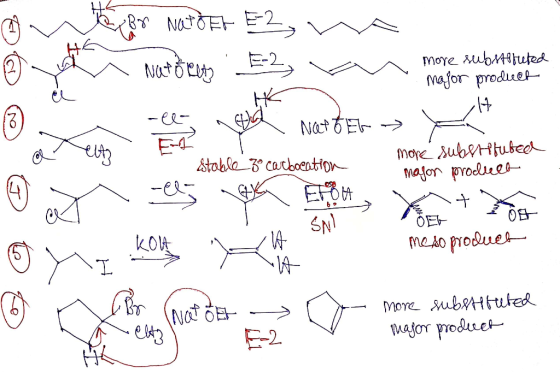
1) 1-bromohexane + sodium ethoxide in ethanol
2) 2-chlorohexane + NaOCH3 in methanol
3) 2-chloro-2-methylbutane + NaOCH2CH3 in ethanol
4) 2-chloro-2-methylbutane heated in ethanol
5) isobutyl iodide + KOH in ethanol/water
6) 1-bromo1-methylcyclopentane + NaOEt in ethanol
Homework Answers
Add Answer to:
The major products of
1) 1-bromohexane + sodium ethoxide in ethanol
2) 2-chlorohexane + NaOCH3 in...
Predict the products and mechanisms of the following reactions. When more than one product or mechanism...
Predict the products and mechanisms of the following reactions. When more than one product or mechanism is possible, explain which are most likely. (a) 1-bromohexane + sodium ethoxide in ethanol (b) 2-chlorohexane + NaOCH3 in methanol (c) 2-chloro-2-methylbutane + NaOCH CH in ethanol 23 (d) 2-chloro-2-methylbutane heated in ethanol (e) isobutyl iodide + KOH in ethanol>water (f) isobutyl chloride + AgNO3 in ethanol>water (g) 1@bromo@1@methylcyclopentane + NaOEt in ethanol (h) 1-bromo-1-methylcyclopentane heated in methanol
3a) (5 pts) When 1,2-epoxypropane is treated with sodium ethoxide in ethanol, 1-ethoxy-2-propanol is the major...
 3a) (5 pts) When 1,2-epoxypropane is treated with sodium ethoxide in ethanol, 1-ethoxy-2-propanol is the major product while only a trace amount of 2-ethoxy-1-propanol is produced. Propose a mechanism for the major product and explain the results based on the mechanism. OH NaOCH2CH3 OH EtOH trace major Hoc
PROBLEM 7-33 Predict the products and mechanisms of the following reactions. When more than one product...
 PROBLEM 7-33 Predict the products and mechanisms of the following reactions. When more than one product or mechanism is possible, explain which are most likely. (a) 1-bromohexane + sodium ethoxide in ethanol (b) 2-chlorohexane + NaOCH, in methanol
Predict the substitution product(s) for each of the following reactions and mechanisms by which they are...
 Predict the substitution product(s) for each of the following reactions and mechanisms by which they are formed. If no reaction is expected, write no (a) (R)-2-bromobutane with sodium iodide in acetone (b) (R)-3-bromo-3-methylhexane with H20 (c) trans-1-bromo-2-ethylcyclopentane with potassium ethoxide in ethanol (d) trans-1-bromo-3-methylcyclopentane with Nal in acetone 5. For the following set of compounds, predict the order of reactivity with sodium iodide in acetone solution (list them in increasing order of reactivity). C. D. 2-bromobutane 1-chlorobutane 2-chloro-3-methylbutane 2-bromo-2-methylpropane 1-bromobutane...
help me please! Which reagent is necessary for this transformation? for Joomom o sodium ethoxide potassium...
 help me please!
Which reagent is necessary for this transformation? for Joomom o sodium ethoxide potassium hydroxide ethanol ethyl bromide Question 11 4 pts Predict the starting material for this reaction. H.S OSH (18,3S)-3-methylcyclopentane-1-thiol (15,3S)-1-lodo-3-methylcyclopentane (1R 3R)-1-iodo-3-methylcyclopentane (18.35)-1-lodo-3-methylcyclopentane (15,3R) - 1-iodo-3-methylcyclopentane D Question 12 5 pts Predict the major product of this reaction. OTS NaOH D os Naoh Corco O O O O Question 13 Predict the major product(s) of this reaction (select all that apply)
help me please!
Which reagent is necessary for this transformation? for Joomom o sodium ethoxide potassium hydroxide ethanol ethyl bromide Question 11 4 pts Predict the starting material for this reaction. H.S OSH (18,3S)-3-methylcyclopentane-1-thiol (15,3S)-1-lodo-3-methylcyclopentane (1R 3R)-1-iodo-3-methylcyclopentane (18.35)-1-lodo-3-methylcyclopentane (15,3R) - 1-iodo-3-methylcyclopentane D Question 12 5 pts Predict the major product of this reaction. OTS NaOH D os Naoh Corco O O O O Question 13 Predict the major product(s) of this reaction (select all that apply)
(R)–3-chloro-2-methylhexane may undergo a nucleophilic substitution reaction in the presence of sodium ethoxide and ethanol. Complete...
 (R)–3-chloro-2-methylhexane may undergo a nucleophilic
substitution reaction in the presence of sodium ethoxide and
ethanol. Complete the mechanism and draw the products of the
reaction.
<Chapter 7 SN2 and E2 Reactions of Alkyl Halides DOCH: FU MacBook Air
(R)–3-chloro-2-methylhexane may undergo a nucleophilic
substitution reaction in the presence of sodium ethoxide and
ethanol. Complete the mechanism and draw the products of the
reaction.
<Chapter 7 SN2 and E2 Reactions of Alkyl Halides DOCH: FU MacBook Air
Following are two diastereomers of 3-bromo-3, 4-dimethylhexane. On treatment with sodium ethoxide in ethanol, each gives...
 Following are two diastereomers of 3-bromo-3, 4-dimethylhexane. On treatment with sodium ethoxide in ethanol, each gives 3, 4-dimethyl-3-hexene as the major product. One diastereomer gives the E alkene, and the other gives the Z alkene. Which diastereomer gives the E alkene? Following are two diastereomers of 3-bromo-2, 3, 4-trimethylhexane. On treatment with sodium ethoxide in ethanol, each gives 23, 4-trimethyl-3-hexene as the major product. One diastereomer gives the E alkene, and the other gives the Z alkene. Which diastereomer gives...
Draw and name the SN2 major product formed when (2R,5S)-2-bromo-5-chlorohexane is treated with sodium iodide in...
Draw and name the SN2 major product formed when (2R,5S)-2-bromo-5-chlorohexane is treated with sodium iodide in acetone. (Use only one equivalent of NaI.)
3. for each of the following, choose the reaction that would proceed more rapidly and give...
 3. for each of the following, choose the reaction that would proceed more rapidly and give an explanation for your choice: (a) iodomethane or bromomethane with aqueous KOH (b) iodomethane or iodoethane with aqueous KOH (c) methanol or bromomethane with Nal dissolved in acetone (d) 2-bromopropane or 1-bromopropane with Nal dissolved in acetone (e) 2-bromo-2-methylbutane or 2-bromo-3-methylbutane with ethanol (f) aqueous KBr or aqueous HBr with butanol (g) 2-chloro-3,3-dimethylbutane or 2-chloro-3-methylbutane with potassium tert- butoxide (h) 1:1 or 1:4 by...
5. Draw the major products of the following reactions: a) (S)-2-Iodopentane + KCN in methanol. b)...
 5. Draw the major products of the following reactions: a) (S)-2-Iodopentane + KCN in methanol. b) 2-bromo-2-methylpropane + LIN(CH(CH,),), in THF. c) 2-Chloro-1-ethanol + potassium tert-butoxide (KO'Bu). d) Cis-2-methyl-1-chlorocyclohexane + methanol. e) Potassium tert-butoxide (KO'Bu) and methyl iodide in THF. f) Draw a detailed curved arrow pushing mechanism for reaction 5d above. Draw the reactants cis-2- methyl-1-chlorocyclohexane + methanol, and show each and every electron flow that converts them into the major products.
 3a) (5 pts) When 1,2-epoxypropane is treated with sodium ethoxide in ethanol, 1-ethoxy-2-propanol is the major product while only a trace amount of 2-ethoxy-1-propanol is produced. Propose a mechanism for the major product and explain the results based on the mechanism. OH NaOCH2CH3 OH EtOH trace major Hoc
 PROBLEM 7-33 Predict the products and mechanisms of the following reactions. When more than one product or mechanism is possible, explain which are most likely. (a) 1-bromohexane + sodium ethoxide in ethanol (b) 2-chlorohexane + NaOCH, in methanol
 Predict the substitution product(s) for each of the following reactions and mechanisms by which they are formed. If no reaction is expected, write no (a) (R)-2-bromobutane with sodium iodide in acetone (b) (R)-3-bromo-3-methylhexane with H20 (c) trans-1-bromo-2-ethylcyclopentane with potassium ethoxide in ethanol (d) trans-1-bromo-3-methylcyclopentane with Nal in acetone 5. For the following set of compounds, predict the order of reactivity with sodium iodide in acetone solution (list them in increasing order of reactivity). C. D. 2-bromobutane 1-chlorobutane 2-chloro-3-methylbutane 2-bromo-2-methylpropane 1-bromobutane...
 help me please!
Which reagent is necessary for this transformation? for Joomom o sodium ethoxide potassium hydroxide ethanol ethyl bromide Question 11 4 pts Predict the starting material for this reaction. H.S OSH (18,3S)-3-methylcyclopentane-1-thiol (15,3S)-1-lodo-3-methylcyclopentane (1R 3R)-1-iodo-3-methylcyclopentane (18.35)-1-lodo-3-methylcyclopentane (15,3R) - 1-iodo-3-methylcyclopentane D Question 12 5 pts Predict the major product of this reaction. OTS NaOH D os Naoh Corco O O O O Question 13 Predict the major product(s) of this reaction (select all that apply)
help me please!
Which reagent is necessary for this transformation? for Joomom o sodium ethoxide potassium hydroxide ethanol ethyl bromide Question 11 4 pts Predict the starting material for this reaction. H.S OSH (18,3S)-3-methylcyclopentane-1-thiol (15,3S)-1-lodo-3-methylcyclopentane (1R 3R)-1-iodo-3-methylcyclopentane (18.35)-1-lodo-3-methylcyclopentane (15,3R) - 1-iodo-3-methylcyclopentane D Question 12 5 pts Predict the major product of this reaction. OTS NaOH D os Naoh Corco O O O O Question 13 Predict the major product(s) of this reaction (select all that apply)
 (R)–3-chloro-2-methylhexane may undergo a nucleophilic
substitution reaction in the presence of sodium ethoxide and
ethanol. Complete the mechanism and draw the products of the
reaction.
<Chapter 7 SN2 and E2 Reactions of Alkyl Halides DOCH: FU MacBook Air
(R)–3-chloro-2-methylhexane may undergo a nucleophilic
substitution reaction in the presence of sodium ethoxide and
ethanol. Complete the mechanism and draw the products of the
reaction.
<Chapter 7 SN2 and E2 Reactions of Alkyl Halides DOCH: FU MacBook Air
 Following are two diastereomers of 3-bromo-3, 4-dimethylhexane. On treatment with sodium ethoxide in ethanol, each gives 3, 4-dimethyl-3-hexene as the major product. One diastereomer gives the E alkene, and the other gives the Z alkene. Which diastereomer gives the E alkene? Following are two diastereomers of 3-bromo-2, 3, 4-trimethylhexane. On treatment with sodium ethoxide in ethanol, each gives 23, 4-trimethyl-3-hexene as the major product. One diastereomer gives the E alkene, and the other gives the Z alkene. Which diastereomer gives...
 3. for each of the following, choose the reaction that would proceed more rapidly and give an explanation for your choice: (a) iodomethane or bromomethane with aqueous KOH (b) iodomethane or iodoethane with aqueous KOH (c) methanol or bromomethane with Nal dissolved in acetone (d) 2-bromopropane or 1-bromopropane with Nal dissolved in acetone (e) 2-bromo-2-methylbutane or 2-bromo-3-methylbutane with ethanol (f) aqueous KBr or aqueous HBr with butanol (g) 2-chloro-3,3-dimethylbutane or 2-chloro-3-methylbutane with potassium tert- butoxide (h) 1:1 or 1:4 by...
 5. Draw the major products of the following reactions: a) (S)-2-Iodopentane + KCN in methanol. b) 2-bromo-2-methylpropane + LIN(CH(CH,),), in THF. c) 2-Chloro-1-ethanol + potassium tert-butoxide (KO'Bu). d) Cis-2-methyl-1-chlorocyclohexane + methanol. e) Potassium tert-butoxide (KO'Bu) and methyl iodide in THF. f) Draw a detailed curved arrow pushing mechanism for reaction 5d above. Draw the reactants cis-2- methyl-1-chlorocyclohexane + methanol, and show each and every electron flow that converts them into the major products.
Most questions answered within 3 hours.
-
Where is the error in this code sequence?
String s1 = "Hello";
String s2 = "ello";...
asked 11 months ago -
Financial data for Joel de Paris, Inc., for last year
follow:
Joel de Paris, Inc.
Balance...
asked 11 months ago -
Consider this reaction:
Al2(SO4)3 (aq)+ BaCl3
(aq) Al2Cl6 (aq)- +
3BaSO4(s) . What is the...
asked 11 months ago -
Suppose that Savneet is considering increasing her
recent random sample from 20 car rentals to 40...
asked 11 months ago -
Trucks arrive at an unloading terminal at an average rate of 120
per hour.
Trucks arrive...
asked 11 months ago -
Why are methanol and ethanol completely soluble in water while
octanol is not very little soluble....
asked 11 months ago -
A facilities manager at a university reads in a research report
that the mean amount of...
asked 11 months ago -
When the CuSO4 is rehydrated by adding water to the anhydrous
compound, is this an endothermic...
asked 11 months ago -
A ray of sunlight is passing from diamond into crown glass; the
angle of incidence is...
asked 11 months ago -
A block of mass 0.249 kg is placed on top of a light, vertical
spring of...
asked 11 months ago -
how do the kidneys compensate in the presences of acidosis
a) trigger hyperventilate
b) reserve acid...
asked 11 months ago -
Question 501 pts
The rental rate of capital to the firm increases. Which of the
following...
asked 11 months ago