
Homework Answers
Add Answer to:
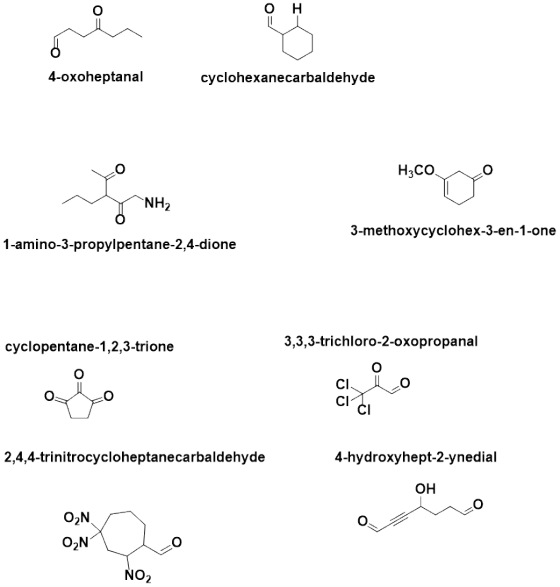
that contains both aldehydeC-O group fequired for the ethylsubstituent, but not the aldehyde C O groups,...
4.) Cyclic ethers can be named in the IUPAC system using specific IUPAC names for each...
 4.) Cyclic ethers can be named in the IUPAC system using
specific IUPAC names for each ring size (oxirane, oxetane, oxolane
and oxane for the first 4 cyclic ethers) or they can be named using
the epoxy designation to the root name. An additional IUPAC method
uses oxa to designate that a carbon in a cycloalkane has been
replaced with oxygen. Using the oxacycloalkane naming method,
select the correct IUPAC name for the following molecule:
3.) An acceptable IUPAC name...
4.) Cyclic ethers can be named in the IUPAC system using
specific IUPAC names for each ring size (oxirane, oxetane, oxolane
and oxane for the first 4 cyclic ethers) or they can be named using
the epoxy designation to the root name. An additional IUPAC method
uses oxa to designate that a carbon in a cycloalkane has been
replaced with oxygen. Using the oxacycloalkane naming method,
select the correct IUPAC name for the following molecule:
3.) An acceptable IUPAC name...
I has the R configuration and the on chemical designations and their locator beginning of the...
 I has the R configuration and the on chemical designations and their locator beginning of the name. mg of the name in increasing order of the Hilarly, in the second molecule, the carbon attaches Bhations and their locators are enclosed in parentheses as the S. Again, these ste- din parentheses at the very PROBLEM E.14 Write the IUPAC name for including stereochemical designations. O IUPAC name for each of the following compounds, HO OH OCH, (b) PROBLEM E. 15 Draw...
Chapters 21 and 22: 1. Consider the structure shown on the right and answer the following questio...
 Chapters 21 and 22: 1. Consider the structure shown on the right and answer the following questions about it (ill in blanks or cirele proper choice) (4 a. Its molecular formula is G ,H( )0( , and so it fits the CHOH , general formula for a carbohydrate, which is b. Specifically, this structure is (a D/ an L) (aldo/keto) (pent/hex) (aselose) c. Will it be optically active? d. If the top carbon was converted to a CH,OH, would it...
Page C 1) What functional group is NOT present in the structure below? a. alkyne b....
 Page C 1) What functional group is NOT present in the structure below? a. alkyne b. alkene c. ether d. aldehyde e. amine 2) What is the correct IUPAC name for the molecule below? a. 3-tert-butyl-4-methylhexane b. 3-tert-butyl-4-methylpentane c. neononane d. 3.ethyl-2,2,4-trimethylpentane e. 1-ethyl-1-isopropyl-tert-butane 3) Which molecule will have the highest boiling point? tinio 4) How many different constitutional isomers may be formed upon monochlorination with Cly/light of the alkane shown below? 5) How many secondary hydrogen atoms are present...
Question 2* Consider th following twelve diagrams A,... , L C: G: I: K: (a) Each diagram represents a simple graph of o...
 Question 2* Consider th following twelve diagrams A,... , L C: G: I: K: (a) Each diagram represents a simple graph of order 6 with exactly one circuit, but not all graphs are different. When X, Y represent the same graph we write XY. For example, A B. Partition the set {A, B,, Ly using the equivalence relation. (b) Any hydrocarbon molecule consists of joined-up carbon and hydrogen atoms, and can be represented by a connected graph in which each...
organic chemistry A carbonyl group, C=O, and an alkene, C=C, double bonds, are both sp2 hybridized....
 organic chemistry
A carbonyl group, C=O, and an alkene, C=C, double bonds, are both sp2 hybridized. However, the chemistry of these two functional groups is very different. This can be explained by which of the following statements? a. The bond angle of the carbonyl is larger than the bond angle of the alkene. b. The electronegative oxygen of the C=O group makes this bond polar. d. There is more steric crowding in the carbonyl than in the alkene. Which, if...
organic chemistry
A carbonyl group, C=O, and an alkene, C=C, double bonds, are both sp2 hybridized. However, the chemistry of these two functional groups is very different. This can be explained by which of the following statements? a. The bond angle of the carbonyl is larger than the bond angle of the alkene. b. The electronegative oxygen of the C=O group makes this bond polar. d. There is more steric crowding in the carbonyl than in the alkene. Which, if...
Questions 7-15 The molecule is ethane 71 2 O ACTIVITY 1.2.1 Biological Macromolecules in 3-D 7....
 Questions 7-15 The molecule is ethane
71 2 O ACTIVITY 1.2.1 Biological Macromolecules in 3-D 7. Orient the two molecules so that portions of the mo lecules that would normally form intermolecular bonds lie next to each other. In this activity, you will build molecular models of biologically important molecules using ball-and-spring molecular model 1) What intermolecular forces help to hold these mo- building kits and then you will view these and other molecules lecules together! of interest using computer-generated...
Questions 7-15 The molecule is ethane
71 2 O ACTIVITY 1.2.1 Biological Macromolecules in 3-D 7. Orient the two molecules so that portions of the mo lecules that would normally form intermolecular bonds lie next to each other. In this activity, you will build molecular models of biologically important molecules using ball-and-spring molecular model 1) What intermolecular forces help to hold these mo- building kits and then you will view these and other molecules lecules together! of interest using computer-generated...
NAME! Select the best answer and bubble it in on your blue scantron. 1. Where would...
 NAME! Select the best answer and bubble it in on your blue scantron. 1. Where would be the absorption peak of a carbonyl, C-0, stretching in IR? a) around 3300 cm b) around 2980 cm" c) around 1700 cm d) around 1200 cm 2. What is the Grignard reagent in nucleophilic addition reaction considered? a) b) 0 c) H d) all the above 3. What a cynaohydrin contains? a) CN and NH. b) N, and OH. c) CN and OH....
Week 10- Constitutional isomers Constitutional isomers have the same molecular formula, but their atoms are bonded...
 Week 10- Constitutional isomers Constitutional isomers have the same molecular formula, but their atoms are bonded in different orders. These may be further distinguished as chain isomers, which differ only in hydrocarbon chain structure, positional isomers, which differ in the location of a functional group, and functional group isomers which differ in the nature of their functional groups. Typically chain and position isomers show only modest differences in their physical and chemical properties, while functional group isomers differ greatly from...
____ 1. The diagram below represents serine, a polar, uncharged amino acid. Which functional group gives...
 ____ 1. The diagram below represents serine, a polar, uncharged
amino acid. Which functional group gives serine its
distinct property?
a. H3
b. CH2OH
c. –H
d. COO–
____ 2. The monomers shown below are monomers for which of the
following natural polymers?
a. polysaccharides
b. plastics
c. DNA
d. proteins
____ 3. Which of the following processes illustrates the production
of a protein?
a. specific code for amino acids --> amino acid chain -->
gene --> DNA --> specific...
____ 1. The diagram below represents serine, a polar, uncharged
amino acid. Which functional group gives serine its
distinct property?
a. H3
b. CH2OH
c. –H
d. COO–
____ 2. The monomers shown below are monomers for which of the
following natural polymers?
a. polysaccharides
b. plastics
c. DNA
d. proteins
____ 3. Which of the following processes illustrates the production
of a protein?
a. specific code for amino acids --> amino acid chain -->
gene --> DNA --> specific...
 4.) Cyclic ethers can be named in the IUPAC system using
specific IUPAC names for each ring size (oxirane, oxetane, oxolane
and oxane for the first 4 cyclic ethers) or they can be named using
the epoxy designation to the root name. An additional IUPAC method
uses oxa to designate that a carbon in a cycloalkane has been
replaced with oxygen. Using the oxacycloalkane naming method,
select the correct IUPAC name for the following molecule:
3.) An acceptable IUPAC name...
4.) Cyclic ethers can be named in the IUPAC system using
specific IUPAC names for each ring size (oxirane, oxetane, oxolane
and oxane for the first 4 cyclic ethers) or they can be named using
the epoxy designation to the root name. An additional IUPAC method
uses oxa to designate that a carbon in a cycloalkane has been
replaced with oxygen. Using the oxacycloalkane naming method,
select the correct IUPAC name for the following molecule:
3.) An acceptable IUPAC name...
 I has the R configuration and the on chemical designations and their locator beginning of the name. mg of the name in increasing order of the Hilarly, in the second molecule, the carbon attaches Bhations and their locators are enclosed in parentheses as the S. Again, these ste- din parentheses at the very PROBLEM E.14 Write the IUPAC name for including stereochemical designations. O IUPAC name for each of the following compounds, HO OH OCH, (b) PROBLEM E. 15 Draw...
 Chapters 21 and 22: 1. Consider the structure shown on the right and answer the following questions about it (ill in blanks or cirele proper choice) (4 a. Its molecular formula is G ,H( )0( , and so it fits the CHOH , general formula for a carbohydrate, which is b. Specifically, this structure is (a D/ an L) (aldo/keto) (pent/hex) (aselose) c. Will it be optically active? d. If the top carbon was converted to a CH,OH, would it...
 Page C 1) What functional group is NOT present in the structure below? a. alkyne b. alkene c. ether d. aldehyde e. amine 2) What is the correct IUPAC name for the molecule below? a. 3-tert-butyl-4-methylhexane b. 3-tert-butyl-4-methylpentane c. neononane d. 3.ethyl-2,2,4-trimethylpentane e. 1-ethyl-1-isopropyl-tert-butane 3) Which molecule will have the highest boiling point? tinio 4) How many different constitutional isomers may be formed upon monochlorination with Cly/light of the alkane shown below? 5) How many secondary hydrogen atoms are present...
 Question 2* Consider th following twelve diagrams A,... , L C: G: I: K: (a) Each diagram represents a simple graph of order 6 with exactly one circuit, but not all graphs are different. When X, Y represent the same graph we write XY. For example, A B. Partition the set {A, B,, Ly using the equivalence relation. (b) Any hydrocarbon molecule consists of joined-up carbon and hydrogen atoms, and can be represented by a connected graph in which each...
 organic chemistry
A carbonyl group, C=O, and an alkene, C=C, double bonds, are both sp2 hybridized. However, the chemistry of these two functional groups is very different. This can be explained by which of the following statements? a. The bond angle of the carbonyl is larger than the bond angle of the alkene. b. The electronegative oxygen of the C=O group makes this bond polar. d. There is more steric crowding in the carbonyl than in the alkene. Which, if...
organic chemistry
A carbonyl group, C=O, and an alkene, C=C, double bonds, are both sp2 hybridized. However, the chemistry of these two functional groups is very different. This can be explained by which of the following statements? a. The bond angle of the carbonyl is larger than the bond angle of the alkene. b. The electronegative oxygen of the C=O group makes this bond polar. d. There is more steric crowding in the carbonyl than in the alkene. Which, if...
 Questions 7-15 The molecule is ethane
71 2 O ACTIVITY 1.2.1 Biological Macromolecules in 3-D 7. Orient the two molecules so that portions of the mo lecules that would normally form intermolecular bonds lie next to each other. In this activity, you will build molecular models of biologically important molecules using ball-and-spring molecular model 1) What intermolecular forces help to hold these mo- building kits and then you will view these and other molecules lecules together! of interest using computer-generated...
Questions 7-15 The molecule is ethane
71 2 O ACTIVITY 1.2.1 Biological Macromolecules in 3-D 7. Orient the two molecules so that portions of the mo lecules that would normally form intermolecular bonds lie next to each other. In this activity, you will build molecular models of biologically important molecules using ball-and-spring molecular model 1) What intermolecular forces help to hold these mo- building kits and then you will view these and other molecules lecules together! of interest using computer-generated...
 NAME! Select the best answer and bubble it in on your blue scantron. 1. Where would be the absorption peak of a carbonyl, C-0, stretching in IR? a) around 3300 cm b) around 2980 cm" c) around 1700 cm d) around 1200 cm 2. What is the Grignard reagent in nucleophilic addition reaction considered? a) b) 0 c) H d) all the above 3. What a cynaohydrin contains? a) CN and NH. b) N, and OH. c) CN and OH....
 Week 10- Constitutional isomers Constitutional isomers have the same molecular formula, but their atoms are bonded in different orders. These may be further distinguished as chain isomers, which differ only in hydrocarbon chain structure, positional isomers, which differ in the location of a functional group, and functional group isomers which differ in the nature of their functional groups. Typically chain and position isomers show only modest differences in their physical and chemical properties, while functional group isomers differ greatly from...
 ____ 1. The diagram below represents serine, a polar, uncharged
amino acid. Which functional group gives serine its
distinct property?
a. H3
b. CH2OH
c. –H
d. COO–
____ 2. The monomers shown below are monomers for which of the
following natural polymers?
a. polysaccharides
b. plastics
c. DNA
d. proteins
____ 3. Which of the following processes illustrates the production
of a protein?
a. specific code for amino acids --> amino acid chain -->
gene --> DNA --> specific...
____ 1. The diagram below represents serine, a polar, uncharged
amino acid. Which functional group gives serine its
distinct property?
a. H3
b. CH2OH
c. –H
d. COO–
____ 2. The monomers shown below are monomers for which of the
following natural polymers?
a. polysaccharides
b. plastics
c. DNA
d. proteins
____ 3. Which of the following processes illustrates the production
of a protein?
a. specific code for amino acids --> amino acid chain -->
gene --> DNA --> specific...
Most questions answered within 3 hours.
-
Where is the error in this code sequence?
String s1 = "Hello";
String s2 = "ello";...
asked 10 months ago -
Financial data for Joel de Paris, Inc., for last year
follow:
Joel de Paris, Inc.
Balance...
asked 10 months ago -
Consider this reaction:
Al2(SO4)3 (aq)+ BaCl3
(aq) Al2Cl6 (aq)- +
3BaSO4(s) . What is the...
asked 10 months ago -
Suppose that Savneet is considering increasing her
recent random sample from 20 car rentals to 40...
asked 10 months ago -
Trucks arrive at an unloading terminal at an average rate of 120
per hour.
Trucks arrive...
asked 10 months ago -
Why are methanol and ethanol completely soluble in water while
octanol is not very little soluble....
asked 10 months ago -
A facilities manager at a university reads in a research report
that the mean amount of...
asked 10 months ago -
When the CuSO4 is rehydrated by adding water to the anhydrous
compound, is this an endothermic...
asked 10 months ago -
A ray of sunlight is passing from diamond into crown glass; the
angle of incidence is...
asked 10 months ago -
A block of mass 0.249 kg is placed on top of a light, vertical
spring of...
asked 10 months ago -
how do the kidneys compensate in the presences of acidosis
a) trigger hyperventilate
b) reserve acid...
asked 10 months ago -
Question 501 pts
The rental rate of capital to the firm increases. Which of the
following...
asked 10 months ago