
Homework Answers
![17 Co ] )1 си си, си, си, - ои Ch, cu cug - c - и 18 ои B 2 3 6 би](http://img.homeworklib.com/questions/91a2d560-6e61-11ea-82b5-633550e111c4.png?x-oss-process=image/resize,w_560)
Add Answer to:
17) Consider the conversion of 1-butanol to each of the compounds shown below. In which conversion...
17) - 17) Consider the conversion of 1-butanol to each of the compounds shown below. In...
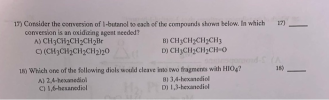 17) - 17) Consider the conversion of 1-butanol to each of the compounds shown below. In which conversion is an oxidizing agent needed? A) CH3CH2CH2CH2Br B) CH3CH2CH2CH3 C) (CH3CH2CH2CH2)20 D) CH3CH2CH2CH=0 18) 18) Which one of the following diols would cleave into two fragments with HIO4? A) 2,4-hexanediol B) 3,4-hexanediol C) 1,6-hexanediol D) 1,3-hexanediol
17) Consider the conversion of 1-butanol to each of the compounds shown below. In which conversion is an oxidizing a...
 17) Consider the conversion of 1-butanol to each of the compounds shown below. In which conversion is an oxidizing agent needed? A) CH3CH2CH2CH2Br B) CH3CH2CH2CH3 C) (CH3CH2CH2CH2)20 D) CH3CH2CH2CH=0 le 18) Which one of the following diols would cleave into two fragments with HIO4? A) 2,4-hexanediol B) 3,4-hexanediol C) 1,6-hexanediol D) 1,3-hexanediol 19) What is the product of the following reaction? lab (1) LIAH (2) H20 OH ОН i uw A) B) B) D D ) A ta C) B...
Match the compounds (1-5) below with the correct IUPAC name (A-E) on the right. Use the...
 Match the compounds (1-5) below with the correct IUPAC name
(A-E) on the right. Use the dropdown menus to select the
answer.
Match the compounds (1-5) below with the correct IUPAC name (A-E) on the right. Use the dropdown menus to select the answer. Compound 1 Br Compound 2 Br A. 2,2-dibromo-3,4-dimethylpentane B. 1,3-dibromo-2-methylcyclohexane Compound 3 Br Br C. 1,5-dibromoheptane es D. 3,5-dibromo-2-methylhexane E. 2,4-dibromo-3-ethylpentane Compound 4 Compound 2 Br A. 2,2-dibromo-3,4-dimethylpentane Compound 3 Br Br B. 1,3-dibromo-2-methylcyclohexane C. 1,5-dibromoheptane...
Match the compounds (1-5) below with the correct IUPAC name
(A-E) on the right. Use the dropdown menus to select the
answer.
Match the compounds (1-5) below with the correct IUPAC name (A-E) on the right. Use the dropdown menus to select the answer. Compound 1 Br Compound 2 Br A. 2,2-dibromo-3,4-dimethylpentane B. 1,3-dibromo-2-methylcyclohexane Compound 3 Br Br C. 1,5-dibromoheptane es D. 3,5-dibromo-2-methylhexane E. 2,4-dibromo-3-ethylpentane Compound 4 Compound 2 Br A. 2,2-dibromo-3,4-dimethylpentane Compound 3 Br Br B. 1,3-dibromo-2-methylcyclohexane C. 1,5-dibromoheptane...
Oxygen-containing Compounds 1. Which of the following will NOT convert 1-butanol into 1-chlorobutane in one step?...
 Oxygen-containing Compounds 1. Which of the following will NOT convert 1-butanol into 1-chlorobutane in one step? a. SOCI2 b. PCl3 c. HCI d. CCl4
12. Which compound is the strongest acid? 11. Which compound is the strongest base? (A) benzoic a...
 12. Which compound is the strongest acid? 11. Which compound is the strongest base? (A) benzoic acid (B) 4-amino-2-methylbenzoic acid ©p-nitrobenzoic acid (A) m-nitroaniline (B) aniline 4-methylaniline 3-bromo-5-nitroaniline 24-dimethylaniline po 13. Which of the following compounds E)3.S-dinitrobenzoic acid is has the 4.ow many Ha atoms are in the compound: 14 cyclohexane-1,3-dione? (A) 2 (B) 4 (C)5 highest number of alpha hydrogen? (A) 2,4-dimethyl-3-hexanone (B) cyclohexanone C) benzaldehyde D) 2-heptanone (E) propanone IS. Which of the following compounds has the16. Which...
17) Which of the following ions gives a peak in the mass spectrum of 1-butanol? A)...
 17) Which of the following ions gives a peak in the mass spectrum of 1-butanol? A) o CH3CH2CH=CHA B) CH3CH2CH=CH: C) CH, CH2CH=CHE D) CH3CH2CH=CHE E) none of the above
1. Provide the oxidation number for each of the underlined elements in following compounds or ions:...
 1. Provide the oxidation number for each of the underlined elements in following compounds or ions: (6) a) H3AsO3 b) d) H4P207 C202² KCIO4 N2H4 2. Which one of the following is not a oxidation-reduction reaction? (2) A) 2H2(g) + O2(g) → 2H2O(1) B) Zn(s) + H2SO4(aq) → ZnSO4(aq) + H2(g) C) H2O(l) + NH3(g) → NH(aq) + OH(aq) D) FeSO4(aq) + K2Cr2OH(aq) + 7H2SO4(aq) → Cr2(SO4)3(aq) + 3Fe2(SO4)3(aq) + K2SO4(aq) + 7H2O(1) E) Cl2(g) +2KBr(aq) + Bra(l) + 2KCl(aq)...
a) tert 14. Which of any alcohol upon reaction with methylmagnesium Which of the following compounds...
 a) tert 14. Which of any alcohol upon reaction with methylmagnesium Which of the following compounds does NOT give a tertiary bromide? CH, HC CH₂ D - Η Β) 10. Which of the following compounds is NOT oxidized by pyridinium chlorochromate (PCC)? a) 2-methyl-2-butanol b) 1-pentanol c) 2-pentanol D) 1,3-propanediol 11. What is the complete systematic IUPAC name for the following compound? A) 4-(1-methylethoxy)-4-isopropyl-4-methylpent-2-cne B) 4-isopropyl-2,4-dimethylhept-5-en-3-ol C) isopropyl-(4-isopropyl-4-methylbut-2-enyl) ether D) 4 isopropoxy-4,5-dimethylhex-2-ene E) 4-isopropyl-4-methylbut-2-en-isopropyl ether 12. Which of the following...
4. Which of the following compounds would form in the reaction shown below? Check all that...
 4. Which of the following compounds would form in the reaction shown below? Check all that apply H30+ но он vi 5. Predict the final product for the following sequence of reactions. Mg, ether PCC 2. H3O+ CH2Cl2 A. 6,7-dimethylnonan-3-ol B. 6,7-dimethylnonan-3-one C. 6,7-dimethylnonan-3-al D. 3,4-dimethylnonan-7-ol E. 3,4-dimethylnonan-7-one
CHEM2033 EXAMINATIO .2 (atomic numbers: C-6, Н-1,0-8. C-17, Br-35 ) 1. The IUPAC name of the...
 CHEM2033 EXAMINATIO .2 (atomic numbers: C-6, Н-1,0-8. C-17, Br-35 ) 1. The IUPAC name of the compound Test/28 (A) 2-methyl, 4-ethyl pentane B) 2-ethyl, 4-methyl hexne (E) 2,4-dimethyl hexane (4ethyl, 2-methylI hexane 2. Which of the following compound has no chiral center 3. The bond angles in methane and ethyne are 4. The most unstable 1,4-dimethyl cyclohexane conformation (D) 3-ethyl,5-methyl hexane (A) 2-butanol (B) 2-chloro butane (C) 1,2-dichloro butane (D) 1,3-dichloro butane (E) 1.,4-dichloro butane (A) 109.5° and 120 (B)...
 17) - 17) Consider the conversion of 1-butanol to each of the compounds shown below. In which conversion is an oxidizing agent needed? A) CH3CH2CH2CH2Br B) CH3CH2CH2CH3 C) (CH3CH2CH2CH2)20 D) CH3CH2CH2CH=0 18) 18) Which one of the following diols would cleave into two fragments with HIO4? A) 2,4-hexanediol B) 3,4-hexanediol C) 1,6-hexanediol D) 1,3-hexanediol
 17) Consider the conversion of 1-butanol to each of the compounds shown below. In which conversion is an oxidizing agent needed? A) CH3CH2CH2CH2Br B) CH3CH2CH2CH3 C) (CH3CH2CH2CH2)20 D) CH3CH2CH2CH=0 le 18) Which one of the following diols would cleave into two fragments with HIO4? A) 2,4-hexanediol B) 3,4-hexanediol C) 1,6-hexanediol D) 1,3-hexanediol 19) What is the product of the following reaction? lab (1) LIAH (2) H20 OH ОН i uw A) B) B) D D ) A ta C) B...
 Match the compounds (1-5) below with the correct IUPAC name
(A-E) on the right. Use the dropdown menus to select the
answer.
Match the compounds (1-5) below with the correct IUPAC name (A-E) on the right. Use the dropdown menus to select the answer. Compound 1 Br Compound 2 Br A. 2,2-dibromo-3,4-dimethylpentane B. 1,3-dibromo-2-methylcyclohexane Compound 3 Br Br C. 1,5-dibromoheptane es D. 3,5-dibromo-2-methylhexane E. 2,4-dibromo-3-ethylpentane Compound 4 Compound 2 Br A. 2,2-dibromo-3,4-dimethylpentane Compound 3 Br Br B. 1,3-dibromo-2-methylcyclohexane C. 1,5-dibromoheptane...
Match the compounds (1-5) below with the correct IUPAC name
(A-E) on the right. Use the dropdown menus to select the
answer.
Match the compounds (1-5) below with the correct IUPAC name (A-E) on the right. Use the dropdown menus to select the answer. Compound 1 Br Compound 2 Br A. 2,2-dibromo-3,4-dimethylpentane B. 1,3-dibromo-2-methylcyclohexane Compound 3 Br Br C. 1,5-dibromoheptane es D. 3,5-dibromo-2-methylhexane E. 2,4-dibromo-3-ethylpentane Compound 4 Compound 2 Br A. 2,2-dibromo-3,4-dimethylpentane Compound 3 Br Br B. 1,3-dibromo-2-methylcyclohexane C. 1,5-dibromoheptane...
 Oxygen-containing Compounds 1. Which of the following will NOT convert 1-butanol into 1-chlorobutane in one step? a. SOCI2 b. PCl3 c. HCI d. CCl4
 12. Which compound is the strongest acid? 11. Which compound is the strongest base? (A) benzoic acid (B) 4-amino-2-methylbenzoic acid ©p-nitrobenzoic acid (A) m-nitroaniline (B) aniline 4-methylaniline 3-bromo-5-nitroaniline 24-dimethylaniline po 13. Which of the following compounds E)3.S-dinitrobenzoic acid is has the 4.ow many Ha atoms are in the compound: 14 cyclohexane-1,3-dione? (A) 2 (B) 4 (C)5 highest number of alpha hydrogen? (A) 2,4-dimethyl-3-hexanone (B) cyclohexanone C) benzaldehyde D) 2-heptanone (E) propanone IS. Which of the following compounds has the16. Which...
 17) Which of the following ions gives a peak in the mass spectrum of 1-butanol? A) o CH3CH2CH=CHA B) CH3CH2CH=CH: C) CH, CH2CH=CHE D) CH3CH2CH=CHE E) none of the above
 1. Provide the oxidation number for each of the underlined elements in following compounds or ions: (6) a) H3AsO3 b) d) H4P207 C202² KCIO4 N2H4 2. Which one of the following is not a oxidation-reduction reaction? (2) A) 2H2(g) + O2(g) → 2H2O(1) B) Zn(s) + H2SO4(aq) → ZnSO4(aq) + H2(g) C) H2O(l) + NH3(g) → NH(aq) + OH(aq) D) FeSO4(aq) + K2Cr2OH(aq) + 7H2SO4(aq) → Cr2(SO4)3(aq) + 3Fe2(SO4)3(aq) + K2SO4(aq) + 7H2O(1) E) Cl2(g) +2KBr(aq) + Bra(l) + 2KCl(aq)...
 a) tert 14. Which of any alcohol upon reaction with methylmagnesium Which of the following compounds does NOT give a tertiary bromide? CH, HC CH₂ D - Η Β) 10. Which of the following compounds is NOT oxidized by pyridinium chlorochromate (PCC)? a) 2-methyl-2-butanol b) 1-pentanol c) 2-pentanol D) 1,3-propanediol 11. What is the complete systematic IUPAC name for the following compound? A) 4-(1-methylethoxy)-4-isopropyl-4-methylpent-2-cne B) 4-isopropyl-2,4-dimethylhept-5-en-3-ol C) isopropyl-(4-isopropyl-4-methylbut-2-enyl) ether D) 4 isopropoxy-4,5-dimethylhex-2-ene E) 4-isopropyl-4-methylbut-2-en-isopropyl ether 12. Which of the following...
 4. Which of the following compounds would form in the reaction shown below? Check all that apply H30+ но он vi 5. Predict the final product for the following sequence of reactions. Mg, ether PCC 2. H3O+ CH2Cl2 A. 6,7-dimethylnonan-3-ol B. 6,7-dimethylnonan-3-one C. 6,7-dimethylnonan-3-al D. 3,4-dimethylnonan-7-ol E. 3,4-dimethylnonan-7-one
 CHEM2033 EXAMINATIO .2 (atomic numbers: C-6, Н-1,0-8. C-17, Br-35 ) 1. The IUPAC name of the compound Test/28 (A) 2-methyl, 4-ethyl pentane B) 2-ethyl, 4-methyl hexne (E) 2,4-dimethyl hexane (4ethyl, 2-methylI hexane 2. Which of the following compound has no chiral center 3. The bond angles in methane and ethyne are 4. The most unstable 1,4-dimethyl cyclohexane conformation (D) 3-ethyl,5-methyl hexane (A) 2-butanol (B) 2-chloro butane (C) 1,2-dichloro butane (D) 1,3-dichloro butane (E) 1.,4-dichloro butane (A) 109.5° and 120 (B)...
Most questions answered within 3 hours.
-
Where is the error in this code sequence?
String s1 = "Hello";
String s2 = "ello";...
asked 10 months ago -
Financial data for Joel de Paris, Inc., for last year
follow:
Joel de Paris, Inc.
Balance...
asked 10 months ago -
Consider this reaction:
Al2(SO4)3 (aq)+ BaCl3
(aq) Al2Cl6 (aq)- +
3BaSO4(s) . What is the...
asked 10 months ago -
Suppose that Savneet is considering increasing her
recent random sample from 20 car rentals to 40...
asked 10 months ago -
Trucks arrive at an unloading terminal at an average rate of 120
per hour.
Trucks arrive...
asked 10 months ago -
Why are methanol and ethanol completely soluble in water while
octanol is not very little soluble....
asked 10 months ago -
A facilities manager at a university reads in a research report
that the mean amount of...
asked 10 months ago -
When the CuSO4 is rehydrated by adding water to the anhydrous
compound, is this an endothermic...
asked 10 months ago -
A ray of sunlight is passing from diamond into crown glass; the
angle of incidence is...
asked 10 months ago -
A block of mass 0.249 kg is placed on top of a light, vertical
spring of...
asked 10 months ago -
how do the kidneys compensate in the presences of acidosis
a) trigger hyperventilate
b) reserve acid...
asked 10 months ago -
Question 501 pts
The rental rate of capital to the firm increases. Which of the
following...
asked 10 months ago