In Figure (1), a 3.50 g bullet is fired horizontally at two blocks at rest on...
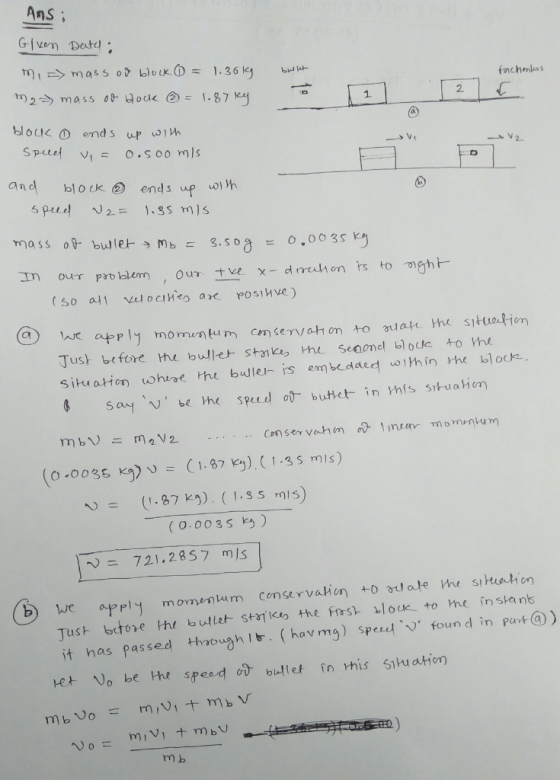
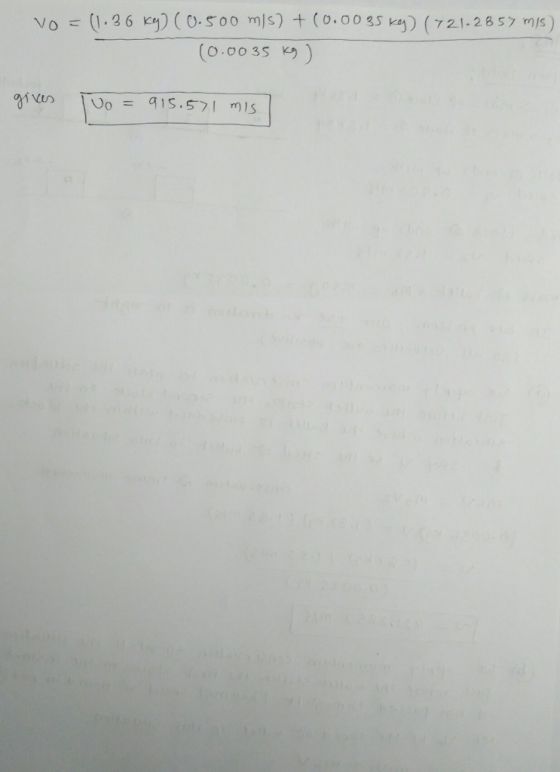
In Figure (1), a 3.50 g bullet is fired horizontally at two blocks at rest on a frictionless table. The bullet passes through block 1 (mass 1.36 kg) and embeds itself in block 2 (mass 1.87 kg). The blocks end up with speeds v1 = 0.500 m/s and v2 = 1.35 m/s (see Figure (2)). Neglecting the material removed from block 1 by the bullet, find the speed of the bullet as it (a) leaves and (b) enters block 1.

Homework Answers
Add Answer to:
In Figure (1), a 3.50 g bullet is fired horizontally at two
blocks at rest on...
In Figure (1), a 3.50 g bullet is fired horizontally at two blocks at rest on...
 In Figure (1), a 3.50 g bullet is fired horizontally at two
blocks at rest on a frictionless table. The bullet passes through
block 1 (mass 1.20 kg) and embeds itself in block 2 (mass 1.85 kg).
The blocks end up with speeds v1 = 0.510 m/s and v2 = 1.38 m/s (see
Figure (2)). Neglecting the material removed from block 1 by the
bullet, find the speed of the bullet as it (a) leaves and (b)
enters block 1....
In Figure (1), a 3.50 g bullet is fired horizontally at two
blocks at rest on a frictionless table. The bullet passes through
block 1 (mass 1.20 kg) and embeds itself in block 2 (mass 1.85 kg).
The blocks end up with speeds v1 = 0.510 m/s and v2 = 1.38 m/s (see
Figure (2)). Neglecting the material removed from block 1 by the
bullet, find the speed of the bullet as it (a) leaves and (b)
enters block 1....
In Figure (1), a 3.50 g bullet is fired horizontally at two blocks at rest on...
 In Figure (1), a 3.50 g bullet is fired horizontally at two
blocks at rest on a frictionless table. The bullet passes through
block 1 (mass 1.04 kg) and embeds itself in block 2 (mass 1.69 kg).
The blocks end up with speeds v1 = 0.550 m/s and v2 = 1.40 m/s (see
Figure (2)). Neglecting the material removed from block 1 by the
bullet, find the speed of the bullet as it (a) leaves and (b)
enters block 1....
In Figure (1), a 3.50 g bullet is fired horizontally at two
blocks at rest on a frictionless table. The bullet passes through
block 1 (mass 1.04 kg) and embeds itself in block 2 (mass 1.69 kg).
The blocks end up with speeds v1 = 0.550 m/s and v2 = 1.40 m/s (see
Figure (2)). Neglecting the material removed from block 1 by the
bullet, find the speed of the bullet as it (a) leaves and (b)
enters block 1....
In Figure (1), a 3.50 g bullet is fired horizontally at two blocks at rest on...
 In Figure (1), a 3.50 g bullet is fired horizontally at two blocks at rest on a frictionless table. The bullet passes through block 1 (mass 1.13 kg) and embeds itself in block 2 (mass 1.65 kg). The blocks end up with speeds V1 = 0.550 m/s and v2 = 1.45 m/s (see Figure (2)). Neglecting the material removed from block 1 by the bullet, find the speed of the bullet as it (a) leaves and (b) enters block 1....
In Figure (1), a 3.50 g bullet is fired horizontally at two blocks at rest on...
 In Figure (1), a 3.50 g bullet is fired horizontally at two blocks at rest on a frictionless table. The bullet passes through block 1 (mass 1.33 kg) and embeds itself in block 2 (mass 1.89 kg). The blocks end up with speeds V1 = 0.560 m/s and v2 = 1.42 m/s (see Figure (2)). Neglecting the material removed from block 1 by the bullet, find the speed of the bullet as it (a) leaves and (b) enters block 1....
In Figure (1), a 3.50 g bullet is fired horizontally at two blocks at rest on...
 In Figure (1), a 3.50 g bullet is fired horizontally at two blocks at rest on a frictionless table. The bullet passes through block 1 (mass 1.37 kg) and embeds itself in block 2 (mass 2.01 kg). The blocks end up with speeds v_1 = 0.600 m/s and v_2 = 1.45 m/s (see Figure (2)). Neglecting the material removed from block 1 by the bullet, find the speed of the bullet as it (a) leaves and (b) enters block 1....
A bullet with a mass of 1.60 g is fired horizontally at two blocks resting on...
 A bullet with a mass of 1.60 g is fired horizontally at two
blocks resting on a smooth and frictionless table top as shown in
the Figure. The bullet passes trhough the first 1.60 kg block, and
embeds itself in a second 1.80 kg block. Speeds v1 = 1.60 m/s and
v2 = 4.60 m/s, are thereby imparted on the blocks. The mass removed
from the first block by the bullet can be neglected. Find the speed
of the bullet...
A bullet with a mass of 1.60 g is fired horizontally at two
blocks resting on a smooth and frictionless table top as shown in
the Figure. The bullet passes trhough the first 1.60 kg block, and
embeds itself in a second 1.80 kg block. Speeds v1 = 1.60 m/s and
v2 = 4.60 m/s, are thereby imparted on the blocks. The mass removed
from the first block by the bullet can be neglected. Find the speed
of the bullet...
If you don't answer all of it then youll receive bad rate and ill check if...
 If you don't answer all of it then youll receive bad rate and
ill check if answer is right or not
In Figure (1), a 3.50 q bullet is fired horizontally at two blocks at rest on a frictionless table. The bullet passes through block 1 (mass 1.13 kg) and embeds itself in block 2 (mass 1.65 kg). The blocks end up with speeds v1 = 0.550 m/s and v2 = 1.45 m/s (see Figure (2)). Neglecting the material removed...
If you don't answer all of it then youll receive bad rate and
ill check if answer is right or not
In Figure (1), a 3.50 q bullet is fired horizontally at two blocks at rest on a frictionless table. The bullet passes through block 1 (mass 1.13 kg) and embeds itself in block 2 (mass 1.65 kg). The blocks end up with speeds v1 = 0.550 m/s and v2 = 1.45 m/s (see Figure (2)). Neglecting the material removed...
elastic or inelastic? (Only one try on FND_AY 20 MP2_WADE 11/23/2019 7. /16 pointsRW_Ed. Che P531dinelasticcollisions...
 elastic or inelastic? (Only one try on FND_AY 20 MP2_WADE 11/23/2019 7. /16 pointsRW_Ed. Che P531dinelasticcollisions Chuck Norris shoots a 4.50 9 bullet horizontally att picture labeled (a) below). The bullet passes through (mass 2.00 kg). The blocks end up with speeds vi 0. labeled (b) below). Neglect the mass removed from the first block by the 9 bullet horizontally at two blocks at rest on a frictionless tabletop in the w). The bullet passes through block 1 (mass 1.40...
A 5.63-g bullet is moving horizontally with a velocity of +361 m/s, where the sign +...
A 5.63-g bullet is moving horizontally with a velocity of +361 m/s, where the sign + indicates that it is moving to the right (see part a of the drawing). The bullet is approaching two blocks resting on a horizontal frictionless surface. Air resistance is negligible. The bullet passes completely through the first block (an inelastic collision) and embeds itself in the second one, as indicated in part b. Note that both blocks are moving after the collision with the...
A 4.87-g bullet is moving horizontally with a velocity of +358 m/s, where the sign +...
A 4.87-g bullet is moving horizontally with a velocity of +358 m/s, where the sign + indicates that it is moving to the right (see part a of the drawing). The bullet is approaching two blocks resting on a horizontal frictionless surface. Air resistance is negligible. The bullet passes completely through the first block (an inelastic collision) and embeds itself in the second one, as indicated in part b. Note that both blocks are moving after the collision with the...
 In Figure (1), a 3.50 g bullet is fired horizontally at two
blocks at rest on a frictionless table. The bullet passes through
block 1 (mass 1.20 kg) and embeds itself in block 2 (mass 1.85 kg).
The blocks end up with speeds v1 = 0.510 m/s and v2 = 1.38 m/s (see
Figure (2)). Neglecting the material removed from block 1 by the
bullet, find the speed of the bullet as it (a) leaves and (b)
enters block 1....
In Figure (1), a 3.50 g bullet is fired horizontally at two
blocks at rest on a frictionless table. The bullet passes through
block 1 (mass 1.20 kg) and embeds itself in block 2 (mass 1.85 kg).
The blocks end up with speeds v1 = 0.510 m/s and v2 = 1.38 m/s (see
Figure (2)). Neglecting the material removed from block 1 by the
bullet, find the speed of the bullet as it (a) leaves and (b)
enters block 1....
 In Figure (1), a 3.50 g bullet is fired horizontally at two
blocks at rest on a frictionless table. The bullet passes through
block 1 (mass 1.04 kg) and embeds itself in block 2 (mass 1.69 kg).
The blocks end up with speeds v1 = 0.550 m/s and v2 = 1.40 m/s (see
Figure (2)). Neglecting the material removed from block 1 by the
bullet, find the speed of the bullet as it (a) leaves and (b)
enters block 1....
In Figure (1), a 3.50 g bullet is fired horizontally at two
blocks at rest on a frictionless table. The bullet passes through
block 1 (mass 1.04 kg) and embeds itself in block 2 (mass 1.69 kg).
The blocks end up with speeds v1 = 0.550 m/s and v2 = 1.40 m/s (see
Figure (2)). Neglecting the material removed from block 1 by the
bullet, find the speed of the bullet as it (a) leaves and (b)
enters block 1....
 In Figure (1), a 3.50 g bullet is fired horizontally at two blocks at rest on a frictionless table. The bullet passes through block 1 (mass 1.13 kg) and embeds itself in block 2 (mass 1.65 kg). The blocks end up with speeds V1 = 0.550 m/s and v2 = 1.45 m/s (see Figure (2)). Neglecting the material removed from block 1 by the bullet, find the speed of the bullet as it (a) leaves and (b) enters block 1....
 In Figure (1), a 3.50 g bullet is fired horizontally at two blocks at rest on a frictionless table. The bullet passes through block 1 (mass 1.33 kg) and embeds itself in block 2 (mass 1.89 kg). The blocks end up with speeds V1 = 0.560 m/s and v2 = 1.42 m/s (see Figure (2)). Neglecting the material removed from block 1 by the bullet, find the speed of the bullet as it (a) leaves and (b) enters block 1....
 In Figure (1), a 3.50 g bullet is fired horizontally at two blocks at rest on a frictionless table. The bullet passes through block 1 (mass 1.37 kg) and embeds itself in block 2 (mass 2.01 kg). The blocks end up with speeds v_1 = 0.600 m/s and v_2 = 1.45 m/s (see Figure (2)). Neglecting the material removed from block 1 by the bullet, find the speed of the bullet as it (a) leaves and (b) enters block 1....
 A bullet with a mass of 1.60 g is fired horizontally at two
blocks resting on a smooth and frictionless table top as shown in
the Figure. The bullet passes trhough the first 1.60 kg block, and
embeds itself in a second 1.80 kg block. Speeds v1 = 1.60 m/s and
v2 = 4.60 m/s, are thereby imparted on the blocks. The mass removed
from the first block by the bullet can be neglected. Find the speed
of the bullet...
A bullet with a mass of 1.60 g is fired horizontally at two
blocks resting on a smooth and frictionless table top as shown in
the Figure. The bullet passes trhough the first 1.60 kg block, and
embeds itself in a second 1.80 kg block. Speeds v1 = 1.60 m/s and
v2 = 4.60 m/s, are thereby imparted on the blocks. The mass removed
from the first block by the bullet can be neglected. Find the speed
of the bullet...
 If you don't answer all of it then youll receive bad rate and
ill check if answer is right or not
In Figure (1), a 3.50 q bullet is fired horizontally at two blocks at rest on a frictionless table. The bullet passes through block 1 (mass 1.13 kg) and embeds itself in block 2 (mass 1.65 kg). The blocks end up with speeds v1 = 0.550 m/s and v2 = 1.45 m/s (see Figure (2)). Neglecting the material removed...
If you don't answer all of it then youll receive bad rate and
ill check if answer is right or not
In Figure (1), a 3.50 q bullet is fired horizontally at two blocks at rest on a frictionless table. The bullet passes through block 1 (mass 1.13 kg) and embeds itself in block 2 (mass 1.65 kg). The blocks end up with speeds v1 = 0.550 m/s and v2 = 1.45 m/s (see Figure (2)). Neglecting the material removed...
 elastic or inelastic? (Only one try on FND_AY 20 MP2_WADE 11/23/2019 7. /16 pointsRW_Ed. Che P531dinelasticcollisions Chuck Norris shoots a 4.50 9 bullet horizontally att picture labeled (a) below). The bullet passes through (mass 2.00 kg). The blocks end up with speeds vi 0. labeled (b) below). Neglect the mass removed from the first block by the 9 bullet horizontally at two blocks at rest on a frictionless tabletop in the w). The bullet passes through block 1 (mass 1.40...
Most questions answered within 3 hours.
-
Where is the error in this code sequence?
String s1 = "Hello";
String s2 = "ello";...
asked 11 months ago -
Financial data for Joel de Paris, Inc., for last year
follow:
Joel de Paris, Inc.
Balance...
asked 11 months ago -
Consider this reaction:
Al2(SO4)3 (aq)+ BaCl3
(aq) Al2Cl6 (aq)- +
3BaSO4(s) . What is the...
asked 11 months ago -
Suppose that Savneet is considering increasing her
recent random sample from 20 car rentals to 40...
asked 11 months ago -
Trucks arrive at an unloading terminal at an average rate of 120
per hour.
Trucks arrive...
asked 11 months ago -
Why are methanol and ethanol completely soluble in water while
octanol is not very little soluble....
asked 11 months ago -
A facilities manager at a university reads in a research report
that the mean amount of...
asked 11 months ago -
When the CuSO4 is rehydrated by adding water to the anhydrous
compound, is this an endothermic...
asked 11 months ago -
A ray of sunlight is passing from diamond into crown glass; the
angle of incidence is...
asked 11 months ago -
A block of mass 0.249 kg is placed on top of a light, vertical
spring of...
asked 11 months ago -
how do the kidneys compensate in the presences of acidosis
a) trigger hyperventilate
b) reserve acid...
asked 11 months ago -
Question 501 pts
The rental rate of capital to the firm increases. Which of the
following...
asked 11 months ago