
Homework Answers

Add Answer to:
A dentist's mirror is designed to magnify a tooth by a factor of +5 when the...
It is to a dentist's benefit to see an enlarged, upright image of any patient's tooth...
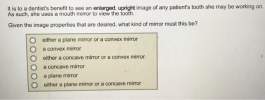 It is to a dentist's benefit to see an enlarged, upright image of any patient's tooth she may be working on. As such, she uses a mouth mirror to view the tooth. Given the image properties that are desired, what kind of mirror must this be? O either a plane mirror or a convex mirror O a convex mirror O either a concave mirror or a convex mirror O a concave mirror O a plane mirror O either a plane...
7. A 6.2 ft tall mage in the mirror appears to be only 6.6in tall. a....
 7. A 6.2 ft tall mage in the mirror appears to be only 6.6in tall. a. Is the shopper's image upright or inverted? b. What is the mirrors radius of curvature? store is 17ft from a convex security mirror. The shopper notices that his ou place an object in front of a concave mirror with focal length f so that the image is upright Express your answer as a multiple of the focal length,f and thrice the size of the...
5. A dentist uses a spherical mirror to produce an upright image of a patient's tooth...
 5. A dentist uses a spherical mirror to produce an upright image of a patient's tooth which is magnified by a factor of 4 when placed 2 cm from the tooth. (a) What type of mirror - concave or convex - is being used? (b) What is the focal length of the mirror?
You are given a spherical mirror and wish to determine its properties. You place an object...
You are given a spherical mirror and wish to determine its properties. You place an object on its axis, 45.9 cm in front of it, and discover that the mirror creates a virtual image located 16.1 cm from the mirror. Find the mirror's focal length. focal length: cm Calculate the mirror's radius of curvature. radius of curvature: cm If it can be determined, is the mirror concave or convex? cannot be determined convex concave
FULL SCREEN BACK NEXT CES Chapter 25, Problem 30 GO A dentist's mirror is placed 2.8...
 FULL SCREEN BACK NEXT CES Chapter 25, Problem 30 GO A dentist's mirror is placed 2.8 cm from a tooth. The enlarged image is located 5.6 cm behind the mirror a what kind of minor plane concave, or convex is being used? b) Determine the focal length of the mirror. (c) What is the magnification? (d) How is the image oriented relative to the object? (a) The midor must be (b) Number (c) Number (d) The image is Units Units...
A dentist uses a mirror to examine a tooth. The tooth is 1.05 cm in front...
A dentist uses a mirror to examine a tooth. The tooth is 1.05 cm in front of the mirror, and the image is formed 12.5 cm behind the mirror. 1.Determine the mirror's radius of curvature. 2. Calculate the magnification of the image.
A dentist uses a spherical mirror to examine a tooth. The tooth is 1.06 cm in...
 A dentist uses a spherical mirror to examine a tooth. The tooth is 1.06 cm in front of the mirror, and the image is formed 10.6 cm behind the mirror. (a) Determine the mirror's radius of curvature. cm (b) Determine the magnification of the image.
A concave (converging) dentist's mirror, with a radius of curvature of 20 cm, is held inside...
A concave (converging) dentist's mirror, with a radius of curvature of 20 cm, is held inside a patient's mouth at a distance 5 cm from a cavity in the number 18 molar. The cavity is 0.8mm across. a) Where will the image of the cavity appear, relative to the position of the mirror, and will it be real or virtual? b) How big will the cavity appear in the image, and will it be erect or inverted?
A dentist uses a mirror to examine a tooth that is 1.00 cm in front of...
A dentist uses a mirror to examine a tooth that is 1.00 cm in front of the mirror. The image of the tooth is formed 8.0 cm behind the mirror. Determine the mirror's radius of curvature. ___ cm Determine the magnification of the image. _____ x
A dentist uses a mirror to examine a tooth that is 0.75 cm in front of...
A dentist uses a mirror to examine a tooth that is 0.75 cm in front of the mirror. The image of the tooth is formed 6.0 cm behind the mirror. (a) Determine the mirror's radius of curvature. cm (b) Determine the magnification of the image.
 It is to a dentist's benefit to see an enlarged, upright image of any patient's tooth she may be working on. As such, she uses a mouth mirror to view the tooth. Given the image properties that are desired, what kind of mirror must this be? O either a plane mirror or a convex mirror O a convex mirror O either a concave mirror or a convex mirror O a concave mirror O a plane mirror O either a plane...
 7. A 6.2 ft tall mage in the mirror appears to be only 6.6in tall. a. Is the shopper's image upright or inverted? b. What is the mirrors radius of curvature? store is 17ft from a convex security mirror. The shopper notices that his ou place an object in front of a concave mirror with focal length f so that the image is upright Express your answer as a multiple of the focal length,f and thrice the size of the...
 5. A dentist uses a spherical mirror to produce an upright image of a patient's tooth which is magnified by a factor of 4 when placed 2 cm from the tooth. (a) What type of mirror - concave or convex - is being used? (b) What is the focal length of the mirror?
 FULL SCREEN BACK NEXT CES Chapter 25, Problem 30 GO A dentist's mirror is placed 2.8 cm from a tooth. The enlarged image is located 5.6 cm behind the mirror a what kind of minor plane concave, or convex is being used? b) Determine the focal length of the mirror. (c) What is the magnification? (d) How is the image oriented relative to the object? (a) The midor must be (b) Number (c) Number (d) The image is Units Units...
 A dentist uses a spherical mirror to examine a tooth. The tooth is 1.06 cm in front of the mirror, and the image is formed 10.6 cm behind the mirror. (a) Determine the mirror's radius of curvature. cm (b) Determine the magnification of the image.
Most questions answered within 3 hours.
-
Where is the error in this code sequence?
String s1 = "Hello";
String s2 = "ello";...
asked 10 months ago -
Financial data for Joel de Paris, Inc., for last year
follow:
Joel de Paris, Inc.
Balance...
asked 10 months ago -
Consider this reaction:
Al2(SO4)3 (aq)+ BaCl3
(aq) Al2Cl6 (aq)- +
3BaSO4(s) . What is the...
asked 10 months ago -
Suppose that Savneet is considering increasing her
recent random sample from 20 car rentals to 40...
asked 10 months ago -
Trucks arrive at an unloading terminal at an average rate of 120
per hour.
Trucks arrive...
asked 10 months ago -
Why are methanol and ethanol completely soluble in water while
octanol is not very little soluble....
asked 10 months ago -
A facilities manager at a university reads in a research report
that the mean amount of...
asked 10 months ago -
When the CuSO4 is rehydrated by adding water to the anhydrous
compound, is this an endothermic...
asked 10 months ago -
A ray of sunlight is passing from diamond into crown glass; the
angle of incidence is...
asked 10 months ago -
A block of mass 0.249 kg is placed on top of a light, vertical
spring of...
asked 10 months ago -
how do the kidneys compensate in the presences of acidosis
a) trigger hyperventilate
b) reserve acid...
asked 10 months ago -
Question 501 pts
The rental rate of capital to the firm increases. Which of the
following...
asked 10 months ago