
Homework Answers
Add Answer to:
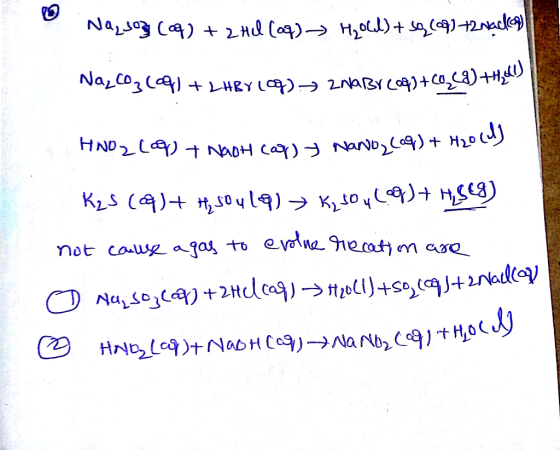
Which of the following reactions will not cause a gas to evolve? O Na2Sº3(aq) + 2...
1. Na2CO3(aq) + Ni(NO3)2(aq) 2. NaCl(aq) + AgNO3(aq) 3. Na2CO3(aq) + HCl(aq) Select Select precipitate gas...
 1. Na2CO3(aq) + Ni(NO3)2(aq) 2. NaCl(aq) + AgNO3(aq) 3. Na2CO3(aq) + HCl(aq) Select Select precipitate gas hot test tube cool test tube color change NR 4. NaOH(aq) + HCl(aq) 5. Kl(aq) + Pb(NO3)2(aq) Select Select 6. Na2CO3(aq) + CaCl2(aq) 7. BaCl2(aq) + H2SO4(aq) 8. CuSO4(aq) + NaOH(aq) 9. Zn(s) + H2SO4(aq) 10. Zn(s) + CuSO4(aq) 11. Ni(NO3)2(aq) + NaOH(aq) 12. NaOH(aq) + FeCl3(aq) Select Select Select Select 13. Mg(s) + HCl(aq) Select
8. Which of the following reactants, when mixed, would evolve a gas. a) Li2S(aq) + 2HCl(aq)...
 8. Which of the following reactants, when mixed, would evolve a gas. a) Li2S(aq) + 2HCl(aq) → b) Na2SO3(aq) + HNO3(aq) → c) K2CO3(aq) + 2HCl(aq) → d) All of the above. e) Only b and c. 9. Which of the following samples has the fewest moles of gas? a) 1.00 L of CH4 at 10°C and 1.00 atm b) 1.00 L of NH3 at 10°C and 1.00 atm 1.00 L of HCl at 20°C and 1.00 atm a) 1.00...
Double Displacement -- Complete and balance the following reactions 1. AgNO3 (aq) + HCl (aq) --------------->...
Double Displacement -- Complete and balance the following reactions 1. AgNO3 (aq) + HCl (aq) ---------------> 2. Cu(NO3)2 (aq) + NaOH (aq) ---------> 3. Fe(NO3)3 (aq) + Cd(OH)2 (aq) -------> 4. Pb(NO3)2 (aq) + H2SO4 (aq) ----------> 5. Hg2(NO3)2 (aq) + Na2CO3 (aq) ------->
Which of the following reactions will not form a precipitate? A) K2C2O4(aq)+Ba(OH)2(aq)→ B) Pb(NO3)2(aq)+H2SO4(aq)→ C) CaCO3(s)+H2SO4(aq)→...
Which of the following reactions will not form a precipitate? A) K2C2O4(aq)+Ba(OH)2(aq)→ B) Pb(NO3)2(aq)+H2SO4(aq)→ C) CaCO3(s)+H2SO4(aq)→ incorrect D) AgNO3(aq)+NaI(aq)→ E) Na2CO3(aq)+HCl(aq)→
4. Indicate which of the following reactions results in a positive AS. a. Ba(NO3)2(aq) + Na...
 4. Indicate which of the following reactions results in a positive AS. a. Ba(NO3)2(aq) + Na So. (aq) = BaSO (s) + 2 NaNO,(aq) b. 4 Fe(s) +3 0,(g) = 2 Fe 0,(s) c. 2 Hg) +0,(g)52 H0g) d. Zn(s) + 2 HCl(aq) = ZnCl(aq) +H. (g) e. 2 Na(s)+Cl2(g) = NaCl(s)
Which of the following is so oxidation-reduction reaction? A) Cu (s) + 2AgNO_3(aq) rightarrow 2Ag (s)...
 Which of the following is so oxidation-reduction reaction? A) Cu (s) + 2AgNO_3(aq) rightarrow 2Ag (s) + Cu(NO_3)_2 (aq) B) HCl(aq) + NaOH(aq) rightarrow H_2O (l) + NaCl(aq) C) AgNO_3(aq) + HCl (aq) rightarrow AgCl (s) + N\HNO_3(aq) E) H_2CO_3(aQ) + Ca(NO_3)_2 (aq) rightarrow 2HNO_3(aq) + CaCO_3(s) How many moles of K^+ are present in 343 mL of a 1.27 M solution of K_3PO_4? A) 0.436 B) 1.31 C) 0.145 D) 3.70 E) 11.1 What is the concentration (M) of...
Equations for Double Replacement Reactions Name Step 2. State the driving force (DF) that made each...
 Equations for Double Replacement Reactions
Name Step 2. State the driving force (DF) that made each reaction 'go":(ppt, gas, H,0) Note: (a) When lonic compounds dissolve, they separate completely into individual ions. Ionic compounds that do not dissolve are written without ions, for example: AgCl(s)- (1) As a general rule, all sodium, potassium, and ammonium compounds are soluble in water (they do not form precipitates). The same is true for all nitrates. A set of solubility rules is provided for...
Equations for Double Replacement Reactions
Name Step 2. State the driving force (DF) that made each reaction 'go":(ppt, gas, H,0) Note: (a) When lonic compounds dissolve, they separate completely into individual ions. Ionic compounds that do not dissolve are written without ions, for example: AgCl(s)- (1) As a general rule, all sodium, potassium, and ammonium compounds are soluble in water (they do not form precipitates). The same is true for all nitrates. A set of solubility rules is provided for...
5. Show the expected products for the following reactions: (2 pts each, 16 pts total) 0...
 5. Show the expected products for the following reactions: (2 pts each, 16 pts total) 0 O NH 1) Conc, KMnO4, NaOH 2) H20+ 3) xs PhMgCI 4) H20" 1) KCN, HCl 2) PCC, CHCI 3) PhyP 1) dilute H2SO4 2) PCC, CH.CL 3) NH w 1) SOCI 2) EtMgBr 3) H.O ОН 1) KCN, HCl 2) H0 3) SOCI, 4) i 1) HCI | 2) HENNH. [H] 3) KOH,H,O, heat 1) RCO,H 2) LAIH 3) H.O 4) H NET,...
5,6,7,8th please 5. Show the expected products for the following reactions: (2 pts each, 16 pts...
 5,6,7,8th please
5. Show the expected products for the following reactions: (2 pts each, 16 pts total) 0 O NH 1) Conc, KMnO4, NaOH 2) H20+ 3) xs PhMgCI 4) H20" 1) KCN, HCl 2) PCC, CHCI 3) PhyP 1) dilute H2SO4 2) PCC, CH.CL 3) NH w 1) SOCI 2) EtMgBr 3) H.O ОН 1) KCN, HCl 2) H0 3) SOCI, 4) i 1) HCI | 2) HENNH. [H] 3) KOH,H,O, heat 1) RCO,H 2) LAIH 3) H.O 4)...
5,6,7,8th please
5. Show the expected products for the following reactions: (2 pts each, 16 pts total) 0 O NH 1) Conc, KMnO4, NaOH 2) H20+ 3) xs PhMgCI 4) H20" 1) KCN, HCl 2) PCC, CHCI 3) PhyP 1) dilute H2SO4 2) PCC, CH.CL 3) NH w 1) SOCI 2) EtMgBr 3) H.O ОН 1) KCN, HCl 2) H0 3) SOCI, 4) i 1) HCI | 2) HENNH. [H] 3) KOH,H,O, heat 1) RCO,H 2) LAIH 3) H.O 4)...
Can you please show how to do the calculations I sent for run 2. al values ofc where the o the maxi...
 Can you please show how to do the calculations I sent
for run 2.
al values ofc where the o the maximum ot minim changes? lluirate by ggh ily gven by the oquatice lcrmining the transinoal f inflection poses change abe famly to see whas shand oonal value of c at whi unges. Try to discover i a have discoveed anomials given by the oqu Er what values of c does Exp Background Information We A chemical reaction involves breaking,...
Can you please show how to do the calculations I sent
for run 2.
al values ofc where the o the maximum ot minim changes? lluirate by ggh ily gven by the oquatice lcrmining the transinoal f inflection poses change abe famly to see whas shand oonal value of c at whi unges. Try to discover i a have discoveed anomials given by the oqu Er what values of c does Exp Background Information We A chemical reaction involves breaking,...
 1. Na2CO3(aq) + Ni(NO3)2(aq) 2. NaCl(aq) + AgNO3(aq) 3. Na2CO3(aq) + HCl(aq) Select Select precipitate gas hot test tube cool test tube color change NR 4. NaOH(aq) + HCl(aq) 5. Kl(aq) + Pb(NO3)2(aq) Select Select 6. Na2CO3(aq) + CaCl2(aq) 7. BaCl2(aq) + H2SO4(aq) 8. CuSO4(aq) + NaOH(aq) 9. Zn(s) + H2SO4(aq) 10. Zn(s) + CuSO4(aq) 11. Ni(NO3)2(aq) + NaOH(aq) 12. NaOH(aq) + FeCl3(aq) Select Select Select Select 13. Mg(s) + HCl(aq) Select
 8. Which of the following reactants, when mixed, would evolve a gas. a) Li2S(aq) + 2HCl(aq) → b) Na2SO3(aq) + HNO3(aq) → c) K2CO3(aq) + 2HCl(aq) → d) All of the above. e) Only b and c. 9. Which of the following samples has the fewest moles of gas? a) 1.00 L of CH4 at 10°C and 1.00 atm b) 1.00 L of NH3 at 10°C and 1.00 atm 1.00 L of HCl at 20°C and 1.00 atm a) 1.00...
 4. Indicate which of the following reactions results in a positive AS. a. Ba(NO3)2(aq) + Na So. (aq) = BaSO (s) + 2 NaNO,(aq) b. 4 Fe(s) +3 0,(g) = 2 Fe 0,(s) c. 2 Hg) +0,(g)52 H0g) d. Zn(s) + 2 HCl(aq) = ZnCl(aq) +H. (g) e. 2 Na(s)+Cl2(g) = NaCl(s)
 Which of the following is so oxidation-reduction reaction? A) Cu (s) + 2AgNO_3(aq) rightarrow 2Ag (s) + Cu(NO_3)_2 (aq) B) HCl(aq) + NaOH(aq) rightarrow H_2O (l) + NaCl(aq) C) AgNO_3(aq) + HCl (aq) rightarrow AgCl (s) + N\HNO_3(aq) E) H_2CO_3(aQ) + Ca(NO_3)_2 (aq) rightarrow 2HNO_3(aq) + CaCO_3(s) How many moles of K^+ are present in 343 mL of a 1.27 M solution of K_3PO_4? A) 0.436 B) 1.31 C) 0.145 D) 3.70 E) 11.1 What is the concentration (M) of...
 Equations for Double Replacement Reactions
Name Step 2. State the driving force (DF) that made each reaction 'go":(ppt, gas, H,0) Note: (a) When lonic compounds dissolve, they separate completely into individual ions. Ionic compounds that do not dissolve are written without ions, for example: AgCl(s)- (1) As a general rule, all sodium, potassium, and ammonium compounds are soluble in water (they do not form precipitates). The same is true for all nitrates. A set of solubility rules is provided for...
Equations for Double Replacement Reactions
Name Step 2. State the driving force (DF) that made each reaction 'go":(ppt, gas, H,0) Note: (a) When lonic compounds dissolve, they separate completely into individual ions. Ionic compounds that do not dissolve are written without ions, for example: AgCl(s)- (1) As a general rule, all sodium, potassium, and ammonium compounds are soluble in water (they do not form precipitates). The same is true for all nitrates. A set of solubility rules is provided for...
 5. Show the expected products for the following reactions: (2 pts each, 16 pts total) 0 O NH 1) Conc, KMnO4, NaOH 2) H20+ 3) xs PhMgCI 4) H20" 1) KCN, HCl 2) PCC, CHCI 3) PhyP 1) dilute H2SO4 2) PCC, CH.CL 3) NH w 1) SOCI 2) EtMgBr 3) H.O ОН 1) KCN, HCl 2) H0 3) SOCI, 4) i 1) HCI | 2) HENNH. [H] 3) KOH,H,O, heat 1) RCO,H 2) LAIH 3) H.O 4) H NET,...
 5,6,7,8th please
5. Show the expected products for the following reactions: (2 pts each, 16 pts total) 0 O NH 1) Conc, KMnO4, NaOH 2) H20+ 3) xs PhMgCI 4) H20" 1) KCN, HCl 2) PCC, CHCI 3) PhyP 1) dilute H2SO4 2) PCC, CH.CL 3) NH w 1) SOCI 2) EtMgBr 3) H.O ОН 1) KCN, HCl 2) H0 3) SOCI, 4) i 1) HCI | 2) HENNH. [H] 3) KOH,H,O, heat 1) RCO,H 2) LAIH 3) H.O 4)...
5,6,7,8th please
5. Show the expected products for the following reactions: (2 pts each, 16 pts total) 0 O NH 1) Conc, KMnO4, NaOH 2) H20+ 3) xs PhMgCI 4) H20" 1) KCN, HCl 2) PCC, CHCI 3) PhyP 1) dilute H2SO4 2) PCC, CH.CL 3) NH w 1) SOCI 2) EtMgBr 3) H.O ОН 1) KCN, HCl 2) H0 3) SOCI, 4) i 1) HCI | 2) HENNH. [H] 3) KOH,H,O, heat 1) RCO,H 2) LAIH 3) H.O 4)...
 Can you please show how to do the calculations I sent
for run 2.
al values ofc where the o the maximum ot minim changes? lluirate by ggh ily gven by the oquatice lcrmining the transinoal f inflection poses change abe famly to see whas shand oonal value of c at whi unges. Try to discover i a have discoveed anomials given by the oqu Er what values of c does Exp Background Information We A chemical reaction involves breaking,...
Can you please show how to do the calculations I sent
for run 2.
al values ofc where the o the maximum ot minim changes? lluirate by ggh ily gven by the oquatice lcrmining the transinoal f inflection poses change abe famly to see whas shand oonal value of c at whi unges. Try to discover i a have discoveed anomials given by the oqu Er what values of c does Exp Background Information We A chemical reaction involves breaking,...
Most questions answered within 3 hours.
-
Where is the error in this code sequence?
String s1 = "Hello";
String s2 = "ello";...
asked 11 months ago -
Financial data for Joel de Paris, Inc., for last year
follow:
Joel de Paris, Inc.
Balance...
asked 11 months ago -
Consider this reaction:
Al2(SO4)3 (aq)+ BaCl3
(aq) Al2Cl6 (aq)- +
3BaSO4(s) . What is the...
asked 11 months ago -
Suppose that Savneet is considering increasing her
recent random sample from 20 car rentals to 40...
asked 11 months ago -
Trucks arrive at an unloading terminal at an average rate of 120
per hour.
Trucks arrive...
asked 11 months ago -
Why are methanol and ethanol completely soluble in water while
octanol is not very little soluble....
asked 11 months ago -
A facilities manager at a university reads in a research report
that the mean amount of...
asked 11 months ago -
When the CuSO4 is rehydrated by adding water to the anhydrous
compound, is this an endothermic...
asked 11 months ago -
A ray of sunlight is passing from diamond into crown glass; the
angle of incidence is...
asked 11 months ago -
A block of mass 0.249 kg is placed on top of a light, vertical
spring of...
asked 11 months ago -
how do the kidneys compensate in the presences of acidosis
a) trigger hyperventilate
b) reserve acid...
asked 11 months ago -
Question 501 pts
The rental rate of capital to the firm increases. Which of the
following...
asked 11 months ago