Spartan Chemicals manufactures G-1, G-2, and G-3 from a joint process. Each gas can be liquified...
Spartan Chemicals manufactures G-1, G-2, and G-3 from a joint process. Each gas can be liquified and sold for a higher price. Data on the process are as follows:
Required:
Determine the value of the missed item. (Do not round intermediate calculations.)
|
The joint costs of $62,000 for G-1 is the portion of the total joint cost of $124,000 that had been allocated to G-1.
Homework Answers
| Products | Sales value at split-off | % of Sales value at split-off | Allocation of joint costs |
| G1 | 302,000 | 302,000/604,000 = 50% | 124,000 x 50% = 62,000 |
| G2 | 211,400 | 211,400/604,000 = 35% | 124,000 x 35% = 43,400 |
| G3 | 90,600 | 90,600/602,000 = 15% | 124,000 x 15% = 18,600 |
| $604,000 | $124,000 |
From the facts of the question, it is clear that joints costs have been allocated on the basis of Sales value at split-off. Out of $124,000 of the joint costs, joint costs allocated to product G1 is $62,000, which represents 50% of the joint costs. On this basis, Sales value at split-off of product G1 must be $302,000 i.e. 50% of total sales value at split-off.
Sales value at split off of product G2 = Total Sales value at split-off - Sales value at split off of product G1 - Sales value at split off of product G3
= 604,000 - 302,000 - 90,600
= $211,400
Kindly give a positive rating if you are satisfied with the answer. Feel free to ask if you have any doubt. Thanks.
Add Answer to:
Spartan Chemicals manufactures G-1, G-2, and G-3 from a joint
process. Each gas can be liquified...
Arkansas Corporation manufactures liquid chemicals A and B from a joint process. It allocates joint costs...
Arkansas Corporation manufactures liquid chemicals A and B from a joint process. It allocates joint costs on the basis of sales value at split-off. Processing 5,500 gallons of product A and 1,000 gallons of product B to the split-off point costs $6,400. The sales value at split-off is $3.00 per gallon for product A and $38.50 for product B. Product B requires an additional separable process beyond split-off at a cost of $3.00 per gallon before it can be sold....
Arkansas Corporation manufactures liquid chemicals A and B from a joint process. It allocates joint costs...
 Arkansas Corporation manufactures liquid chemicals A and B from a joint process. It allocates joint costs on the basis of sales value at split-off. Processing 6,500 gallons of product A and 1,300 gallons of product B to the split-off point costs $6,100. The sales value at split-off is $2.40 per gallon for product A and $28.00 per gallon for product B. Product B requires additional separable processing beyond the split-off point at a cost of $2.70 per gallon before it...
Arkansas Corporation manufactures liquid chemicals A and B from a joint process. It allocates joint costs...
 Arkansas Corporation manufactures liquid chemicals A and B from a joint process. It allocates joint costs on the basis of sales value at split-off. Processing 4,300 gallons of product A and 1,400 gallons of product B to the split-off point costs $5,200. The sales value at split-off is $3.00 per gallon for product A and $21.50 per gallon for product B. Product B requires additional separable processing beyond the split-off point at a cost of $2.80 per gallon before it...
Snake River Sawmill manufactures two lumber products from a joint milling process. The two products developed...
Snake River Sawmill manufactures two lumber products from a joint milling process. The two products developed are mine support braces (MSB) and unseasoned commercial building lumber (CBL). A standard production run incurs joint costs of $320,000 and results in 62,000 units of MSB and 92,000 units of CBL. Each MSB sells for $4, and each unit of CBL sells for $6. 1. Calculate the amount of joint cost allocated to commercial building lumber (CBL) on a physical-units basis. 2. Calculate...
Marin Products produces three products — DBB-1, DBB-2, and DBB-3 from a joint process. Each product...
Marin Products produces three products — DBB-1, DBB-2, and DBB-3 from a joint process. Each product may be sold at the split-off point or processed further. Additional processing requires no special facilities, and production costs of further processing are entirely variable and traceable to the products involved. Key information about Marin's production, sales, and costs follows. DBB-1 DBB-2 DBB-3 Total Units Sold 17,000 26,000 38,000 81,000 Price (after addt’l processing) $ 25 $ 10 $ 35 Separable Processing cost $...
Marin Products produces three products — DBB-1, DBB-2, and DBB-3 from a joint process. Each product...
Marin Products produces three products — DBB-1, DBB-2, and DBB-3 from a joint process. Each product may be sold at the split-off point or processed further. Additional processing requires no special facilities, and production costs of further processing are entirely variable and traceable to the products involved. Key information about Marin's production, sales, and costs follows. DBB-1 DBB-2 DBB-3 Total Units Sold 16,000 24,000 36,000 76,000 Price (after addt’l processing) $ 65 $ 50 $ 75 Separable Processing cost $...
Marin Products produces three products — DBB-1, DBB-2, and DBB-3 from a joint process. Each product...
Marin Products produces three products — DBB-1, DBB-2, and DBB-3 from a joint process. Each product may be sold at the split-off point or processed further. Additional processing requires no special facilities, and production costs of further processing are entirely variable and traceable to the products involved. Key information about Marin's production, sales, and costs follows. DBB-1 DBB-2 DBB-3 Total Units Sold 14,000 23,000 30,000 67,000 Price (after addt’l processing) $ 75 $ 60 $ 85 Separable Processing cost $...
Marin Products produces three products — DBB-1, DBB-2, and DBB-3 from a joint process. Each product...
Marin Products produces three products — DBB-1, DBB-2, and DBB-3 from a joint process. Each product may be sold at the split-off point or processed further. Additional processing requires no special facilities, and production costs of further processing are entirely variable and traceable to the products involved. Key information about Marin's production, sales, and costs follows. DBB-1 DBB-2 DBB-3 Total Units Sold 14,000 22,000 30,000 66,000 Price (after addt’l processing) $ 30 $ 15 $ 40 Separable Processing cost $...
Question 2 (17 marks) CA firm in country X manufactures 3 products through a joint-production process...
 Question 2 (17 marks) CA firm in country X manufactures 3 products through a joint-production process A. Raw materials, labors, and overheads are put into the process A which generates 3 outputs: CA-1, CA- 2, CA-3. Output CA-1 can be immediately sold at the split-off point, with no further processing. Output CA-2 and CA-3 require further processing before they are sold. CA-2 is processed in process B, and output CA-3 is processed in process C, respectively. The firm uses the...
Problem 2 Cotton Elle Inc. produces three varieties of cotton, Grade 1, Grade 2, & Grade 3 from a joint process...
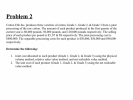 Problem 2 Cotton Elle Inc. produces three varieties of cotton, Grade 1, Grade 2, & Grade 3 from a joint processing of the raw cotton. The amount of each product produced in the first quarter of the current year is 80,000 pounds, 50,000 pounds, and 120,000 pounds respectively. The selling price of each product per pound is $5, $7 & $8 respectively. The joint processing cost is $400,000. The separable processing costs for each product is $30,000, $50,000 and $90,000...
 Arkansas Corporation manufactures liquid chemicals A and B from a joint process. It allocates joint costs on the basis of sales value at split-off. Processing 6,500 gallons of product A and 1,300 gallons of product B to the split-off point costs $6,100. The sales value at split-off is $2.40 per gallon for product A and $28.00 per gallon for product B. Product B requires additional separable processing beyond the split-off point at a cost of $2.70 per gallon before it...
 Arkansas Corporation manufactures liquid chemicals A and B from a joint process. It allocates joint costs on the basis of sales value at split-off. Processing 4,300 gallons of product A and 1,400 gallons of product B to the split-off point costs $5,200. The sales value at split-off is $3.00 per gallon for product A and $21.50 per gallon for product B. Product B requires additional separable processing beyond the split-off point at a cost of $2.80 per gallon before it...
 Question 2 (17 marks) CA firm in country X manufactures 3 products through a joint-production process A. Raw materials, labors, and overheads are put into the process A which generates 3 outputs: CA-1, CA- 2, CA-3. Output CA-1 can be immediately sold at the split-off point, with no further processing. Output CA-2 and CA-3 require further processing before they are sold. CA-2 is processed in process B, and output CA-3 is processed in process C, respectively. The firm uses the...
 Problem 2 Cotton Elle Inc. produces three varieties of cotton, Grade 1, Grade 2, & Grade 3 from a joint processing of the raw cotton. The amount of each product produced in the first quarter of the current year is 80,000 pounds, 50,000 pounds, and 120,000 pounds respectively. The selling price of each product per pound is $5, $7 & $8 respectively. The joint processing cost is $400,000. The separable processing costs for each product is $30,000, $50,000 and $90,000...
Most questions answered within 3 hours.
-
Where is the error in this code sequence?
String s1 = "Hello";
String s2 = "ello";...
asked 11 months ago -
Financial data for Joel de Paris, Inc., for last year
follow:
Joel de Paris, Inc.
Balance...
asked 11 months ago -
Consider this reaction:
Al2(SO4)3 (aq)+ BaCl3
(aq) Al2Cl6 (aq)- +
3BaSO4(s) . What is the...
asked 11 months ago -
Suppose that Savneet is considering increasing her
recent random sample from 20 car rentals to 40...
asked 11 months ago -
Trucks arrive at an unloading terminal at an average rate of 120
per hour.
Trucks arrive...
asked 11 months ago -
Why are methanol and ethanol completely soluble in water while
octanol is not very little soluble....
asked 11 months ago -
A facilities manager at a university reads in a research report
that the mean amount of...
asked 11 months ago -
When the CuSO4 is rehydrated by adding water to the anhydrous
compound, is this an endothermic...
asked 11 months ago -
A ray of sunlight is passing from diamond into crown glass; the
angle of incidence is...
asked 11 months ago -
A block of mass 0.249 kg is placed on top of a light, vertical
spring of...
asked 11 months ago -
how do the kidneys compensate in the presences of acidosis
a) trigger hyperventilate
b) reserve acid...
asked 11 months ago -
Question 501 pts
The rental rate of capital to the firm increases. Which of the
following...
asked 11 months ago