

Homework Answers
Add Answer to:
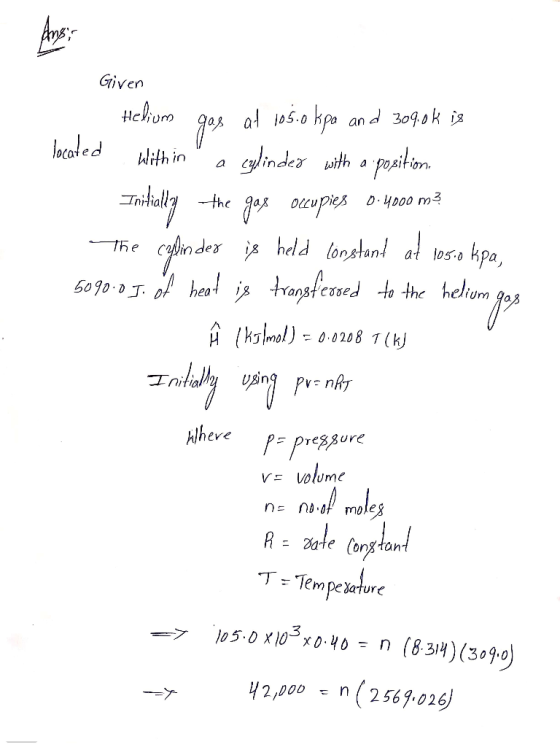
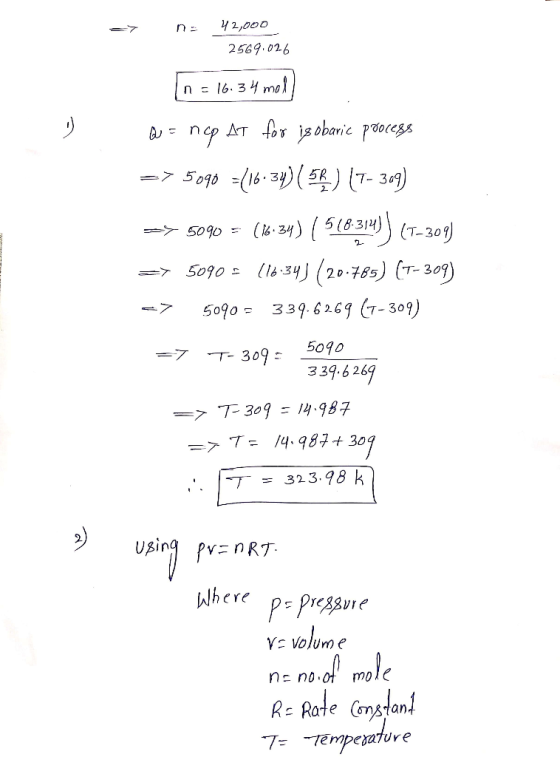
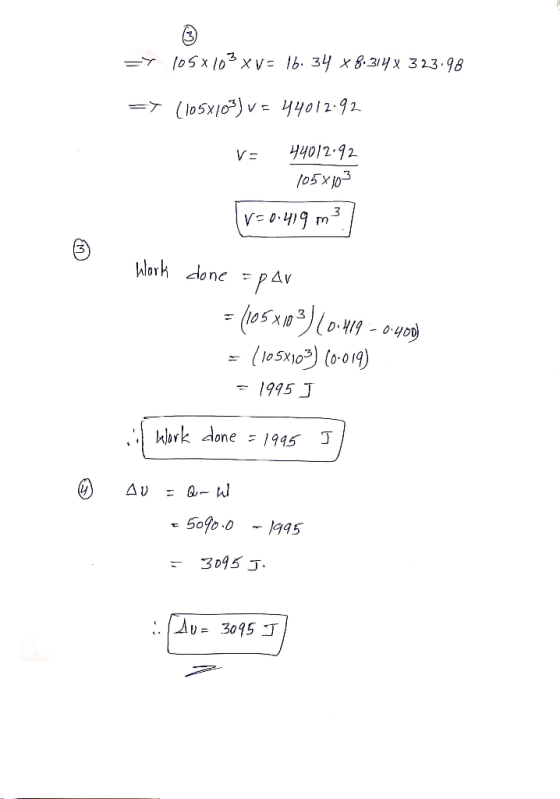
Helium gas at 105.0 kPa and 309.0K is located within a cylinder with a piston. Initially...
Helium gas at 113.0 kPa and 426.0 K is located within a cylinder with a piston....
 Helium gas at 113.0 kPa and 426.0 K is located within a cylinder with a piston. Initially the gas occupies 0.3400 m. While a constant force, F, is applied to the end of the piston so that the pressure inside the cylinder is held constant at 113.0 kPa, 7060.0 J of heat is transferred to the helium gas. The specific enthalpy of helium gas is given by the approximate relation: HkJ/mol) = 0.02087(K) Q=7060.0J > F- Final Conditions P2 =...
8. Initially, 1 mole of the real gas is contained in a thermally insulated piston-cylinder arrangement...
 8. Initially, 1 mole of the real gas is contained in a thermally insulated piston-cylinder arrangement in an initial state (T1, P1, Vi ). 1 mole of the real gas that is expressed by the following equation of state under the investigation. Now, the gas is expanded so as to fill the final state of (T2, P2, V2 ). Suppose that any possible temperature dependence of Cy is negligibly small and the molar heat capacity is approximately equal to 2"...
A cylinder of monatomic ideal gas is sealed in a cylinder by a piston. Initially, the...
A cylinder of monatomic ideal gas is sealed in a cylinder by a piston. Initially, the gas occupies a volume of 2.50 L and the pressure is initially 125 kPa. The cylinder is placed in an oven that maintains the temperature at a constant value. 80.0 J of work is then done on the piston, compressing the gas (in other words, the gas does -80 J of work). The work is done very slowly so that the gas maintains a...
A stoichiometric mixture of ethanol (C2H6O), octane (C8H18), and air initially at T1 = 300 K,...
A stoichiometric mixture of ethanol (C2H6O), octane (C8H18), and air initially at T1 = 300 K, P1 = 100 kPa, P2 =4500 kPa, and V1 = 5 liters (0.005 m3) is compressed in a piston-cylinder assembly in a polytropic process where n = 1.2 What is the final volume V2 (m3 ), the initial total volume of moles (kmol), and the final Temperature T2? NOTE: Universal gas constant: Ru = 8.314 k]/ kmolK Please show ALL steps and units with...
An insulated piston-cylinder device contains 0.1m3 of air (ideal gas) at 400 kPa and 25℃. A...
An insulated piston-cylinder device contains 0.1m3 of air (ideal gas) at 400 kPa and 25℃. A paddle wheel within the cylinder is rotated until 15 kJ of work is done on the air while the pressure is held constant. Assuming the kinetic and potential energies are negligible and the gas constant and specific heat of air are ? = 0.287 kJ kg∙K and ?? = 1.005 kJ kg∙K . Tasks: ( a ) Determine the mass of air inside the...
Air behaving like an ideal gas contained in a piston–cylinder assembly undergoes an isothermal process between...
Air behaving like an ideal gas contained in a piston–cylinder assembly undergoes an isothermal process between end states, 1 and 2, where P1 = 10 bar, V1 = 0.1 m3, T1 = 300 K and P2 = 1 bar, V2 = 1 m3, T2 = 300 K. The work done by the process is:
(10 ponts) A piston-cylinder that has a piston initially resting on top of a set of...
 (10 ponts) A piston-cylinder that has a piston initially resting on top of a set of stops initially contains 0.35 kg of hellum gas at 100 kPa and 16.8 C. A pressure of 171 kPa is required to lift the piston off the stops. Helium a) At what temperature will the piston begin to move? b) How much heat must be added before the piston starts to rise? c) If the volume of the gas inside the cylinder increases by...
As shown in the figure below, a gas contained within a piston-cylinder assembly, initially at a...
 As shown in the figure below, a gas contained within a piston-cylinder assembly, initially at a volume of 0.1 m3, undergoes a constant-pressure expansion at p 2 bar to a final volume of V2 0.2 m3, while being slowly heated through the base. The change in internal energy of the gas is 0.25 kJ. The piston and cylinder walls are fabricated from heat-resistant material, and the piston moves smoothly in the cylinder. The local atmospheric pressure is 1 bar. Piston-...
A gas undergoes a process in a piston–cylinder assembly during which the pressure-specific volume relation is...
A gas undergoes a process in a piston–cylinder assembly during which the pressure-specific volume relation is pv1.1 = constant. The mass of the gas is 0.4 lb and the following data are known: p1 = 160 lbf/in.2, V1 = 1 ft3, and p2 = 390 lbf/in.2 During the process, heat transfer from the gas is 2.1 Btu. Kinetic and potential energy effects are negligible. Determine the change in specific internal energy of the gas, in Btu/lb.
A gas undergoes a process in a piston–cylinder assembly during which the pressure-specific volume relation is...
A gas undergoes a process in a piston–cylinder assembly during which the pressure-specific volume relation is pv1.1 = constant. The mass of the gas is 0.4 lb and the following data are known: p1 = 160 lbf/in.2, V1 = 1 ft3, and p2 = 480 lbf/in.2 During the process, heat transfer from the gas is 2.1 Btu. Kinetic and potential energy effects are negligible. Determine the change in specific internal energy of the gas, in Btu/lb.
 Helium gas at 113.0 kPa and 426.0 K is located within a cylinder with a piston. Initially the gas occupies 0.3400 m. While a constant force, F, is applied to the end of the piston so that the pressure inside the cylinder is held constant at 113.0 kPa, 7060.0 J of heat is transferred to the helium gas. The specific enthalpy of helium gas is given by the approximate relation: HkJ/mol) = 0.02087(K) Q=7060.0J > F- Final Conditions P2 =...
 8. Initially, 1 mole of the real gas is contained in a thermally insulated piston-cylinder arrangement in an initial state (T1, P1, Vi ). 1 mole of the real gas that is expressed by the following equation of state under the investigation. Now, the gas is expanded so as to fill the final state of (T2, P2, V2 ). Suppose that any possible temperature dependence of Cy is negligibly small and the molar heat capacity is approximately equal to 2"...
 (10 ponts) A piston-cylinder that has a piston initially resting on top of a set of stops initially contains 0.35 kg of hellum gas at 100 kPa and 16.8 C. A pressure of 171 kPa is required to lift the piston off the stops. Helium a) At what temperature will the piston begin to move? b) How much heat must be added before the piston starts to rise? c) If the volume of the gas inside the cylinder increases by...
 As shown in the figure below, a gas contained within a piston-cylinder assembly, initially at a volume of 0.1 m3, undergoes a constant-pressure expansion at p 2 bar to a final volume of V2 0.2 m3, while being slowly heated through the base. The change in internal energy of the gas is 0.25 kJ. The piston and cylinder walls are fabricated from heat-resistant material, and the piston moves smoothly in the cylinder. The local atmospheric pressure is 1 bar. Piston-...
Most questions answered within 3 hours.
-
Where is the error in this code sequence?
String s1 = "Hello";
String s2 = "ello";...
asked 11 months ago -
Financial data for Joel de Paris, Inc., for last year
follow:
Joel de Paris, Inc.
Balance...
asked 11 months ago -
Consider this reaction:
Al2(SO4)3 (aq)+ BaCl3
(aq) Al2Cl6 (aq)- +
3BaSO4(s) . What is the...
asked 11 months ago -
Suppose that Savneet is considering increasing her
recent random sample from 20 car rentals to 40...
asked 11 months ago -
Trucks arrive at an unloading terminal at an average rate of 120
per hour.
Trucks arrive...
asked 11 months ago -
Why are methanol and ethanol completely soluble in water while
octanol is not very little soluble....
asked 11 months ago -
A facilities manager at a university reads in a research report
that the mean amount of...
asked 11 months ago -
When the CuSO4 is rehydrated by adding water to the anhydrous
compound, is this an endothermic...
asked 11 months ago -
A ray of sunlight is passing from diamond into crown glass; the
angle of incidence is...
asked 11 months ago -
A block of mass 0.249 kg is placed on top of a light, vertical
spring of...
asked 11 months ago -
how do the kidneys compensate in the presences of acidosis
a) trigger hyperventilate
b) reserve acid...
asked 11 months ago -
Question 501 pts
The rental rate of capital to the firm increases. Which of the
following...
asked 11 months ago