
Homework Answers

Add Answer to:
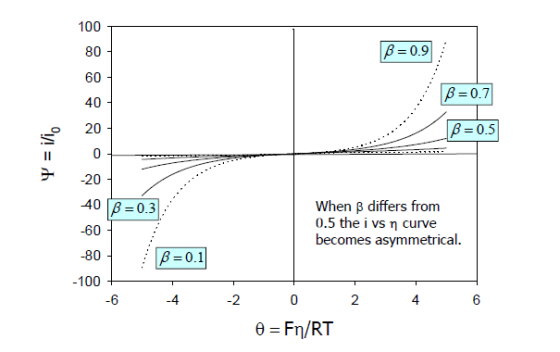
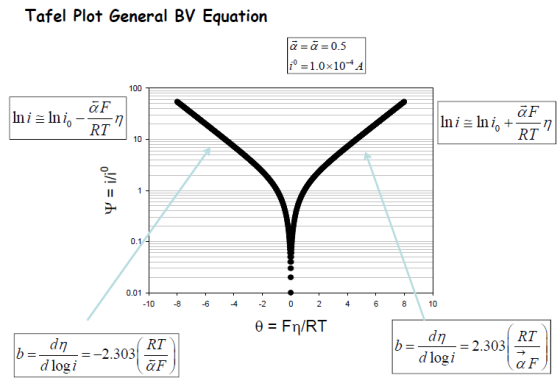
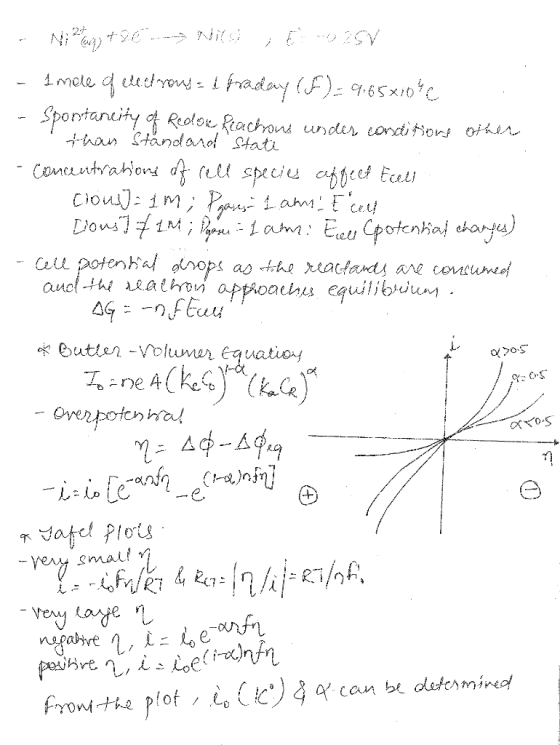
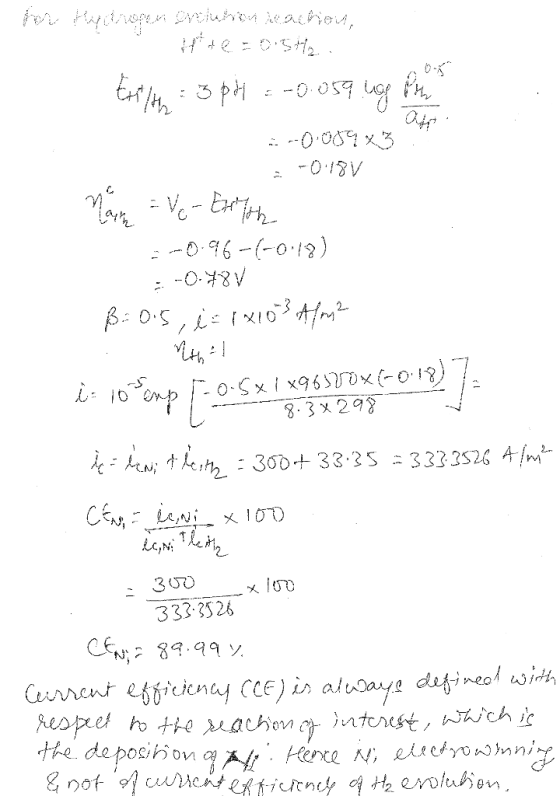
calculate the overpotential for the reduction of Ni a) at a current density of 300 A/m2...
The exchange current density and the electron transfer coefficient for the reaction Fe e Fee Pt...
 The exchange current density and the electron transfer coefficient for the reaction Fe e Fee Pt at 25 "Care 2.5 * 10 cm and 0.42, respectively. (a) Determine at what current density to obtain an overpotential of 0.25 V according to the Butler Volmer equation. (b) What will be the overpotential at the same current density according to the Tafel equation?
Consider the metal deposition reaction M+e M. Suppose the reaction is run at a current density i ...
 Consider the metal deposition reaction M+e M. Suppose the reaction is run at a current density i (A/m) that is 1000 times greater than the exchange current density for the reaction equilibrium i, at 25°C. The cathodic transfer coefficient for the reaction is 0.5 (a) Plot the concentration overpotential for the reaction as a function of(ii ) where im İs the limiting currentdensity (b) Plot the activation overpotential for the reaction as a function of (i/i.) (c) Calculate the range...
(i) Plot the current density vs. overvoltage (j vs. h) relationship – the Butler-Volmer equation –...
(i) Plot the current density vs. overvoltage (j vs. h) relationship – the Butler-Volmer equation – for this reaction in the range h = -0.5 to 0.5 V. Assume a transfer coefficient a = 0.5 and vary the exchange current density: j0 = 10-3, 10-6, 10-9 A/cm2. Define the sign conventions for current and overvoltage. (ii) Plot the j vs. h relationship for j0 = 10-6 A/cm2 and a = 0.25, 0.5 and 0.75. (iii) Plot log½j½ vs. h curves...
5. Electrodeposition of copper is carried out at a current density of 1 mA/cm² in an aqueous copper sulfate solution...
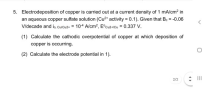 5. Electrodeposition of copper is carried out at a current density of 1 mA/cm² in an aqueous copper sulfate solution (Cu2+ activity = 0.1). Given that B = -0.06 V/decade and io, cucu2. = 10 + A/cm², E Cu2+/Cu = 0.337 V. (1) Calculate the cathodic overpotential of copper at which deposition of copper is occurring. (2) Calculate the electrode potential in 1). 212 III
Problem 1. (concept question) 1) What is the Nernst equation and how to define for the...
 Problem 1. (concept question) 1) What is the Nernst equation and how to define for the electrochemical reaction (aA bBcC dD)? 2) What is Formal potential and why it is useful? 3) What is the Faraday's law and how it is defined (i.e. its relation)? 4) What is the reference electrode and what is it used for? What is the desired characteristic of reference electrode? Show three examples of reference electrode 5) What is the electrochemical double layer and how...
3. Calculate the current needed to deposit 2. 45 grams of Ni in 3 hours and...
3. Calculate the current needed to deposit 2. 45 grams of Ni in 3 hours and 15 minutes from a Ni(NO3)2 solution. 4. Using the calculated current from question 3, What mass of Nickel would be deposited with that same current over 8 hours, if the deposition was 68% efficient? 5. In an electrolytic cell, if the anode is an active electrode, would its mass increase or decrease as the reaction progresses?
2. Consider the voltaic cell illustrated below, constructed by coupling a Ni/Ni half-cell with an Ag/Ag* half-cell a...
 2. Consider the voltaic cell illustrated below, constructed by coupling a Ni/Ni half-cell with an Ag/Ag* half-cell and allowing them to react spontaneously. Refer to the table of reduction potentials and write the half-reaction that occurs at each electrode (nickel and silver). Then combine the half-reactions into the overall reaction. a. Calculate the standard cell potential. b. Annotate the diagram below. First, randomly label one electrode as Ag and one as Ni. Then identify which is the anode and which...
Question 3 (30 zinc in a hydrochloric acid solution with a pH 5 and a Zn2...
 Question 3 (30 zinc in a hydrochloric acid solution with a pH 5 and a Zn2 concentration of 10-5 M. The cathodic (Be 0.12) V/decade and anodic Tafel slope (Po 0.15) V/decade, respectively. Corrosion potential and the corrosion current are Ecor 0.54V and Icor 1.65x10-*A/cm2, respectively. (a) Calculate the exchange current densities for the cathodic and anodic reactions are 1H2 -? and izn ?. Assume that charge-transfer kinetics controls the reaction rate and that the high-field approximation applies. (b) Evaluate...
need help with the rest of the table EXPERIMENT 10 DETERMINATION OF THE ELECTROCHEMICAL SERIES PURPOSE...
 need help with the rest of the table
EXPERIMENT 10 DETERMINATION OF THE ELECTROCHEMICAL SERIES PURPOSE To determine the standard cell potential values of several electrochemical coll INTRODUCTION The basis for an electrochemical cell is an oxidation reduction Corredor be divided into two half reactions reaction. This reaction can Oxidation half reaction Gloss of electrons) takes place at the anode, which is the positive electrode that the anions migrate to Chence the name anode) Reduction half reaction (gain of electrons)...
need help with the rest of the table
EXPERIMENT 10 DETERMINATION OF THE ELECTROCHEMICAL SERIES PURPOSE To determine the standard cell potential values of several electrochemical coll INTRODUCTION The basis for an electrochemical cell is an oxidation reduction Corredor be divided into two half reactions reaction. This reaction can Oxidation half reaction Gloss of electrons) takes place at the anode, which is the positive electrode that the anions migrate to Chence the name anode) Reduction half reaction (gain of electrons)...
Part A through H 1. [60 pts) A galvanic cell is a type of battery where...
 Part A through H
1. [60 pts) A galvanic cell is a type of battery where the electrodes are immersed in different electrolyte solutions, which are connected by an ion-conducting bridge. Consider a galvanic cell with Al and Cu electrodes. The Al electrode is immersed in a solution containing a standard concentration of Al3+ ions and the Cu electrode is immersed in a solution containing a standard concentration of Cu* ions. External Circuit The standard reduction potentials for the half...
Part A through H
1. [60 pts) A galvanic cell is a type of battery where the electrodes are immersed in different electrolyte solutions, which are connected by an ion-conducting bridge. Consider a galvanic cell with Al and Cu electrodes. The Al electrode is immersed in a solution containing a standard concentration of Al3+ ions and the Cu electrode is immersed in a solution containing a standard concentration of Cu* ions. External Circuit The standard reduction potentials for the half...
 The exchange current density and the electron transfer coefficient for the reaction Fe e Fee Pt at 25 "Care 2.5 * 10 cm and 0.42, respectively. (a) Determine at what current density to obtain an overpotential of 0.25 V according to the Butler Volmer equation. (b) What will be the overpotential at the same current density according to the Tafel equation?
 Consider the metal deposition reaction M+e M. Suppose the reaction is run at a current density i (A/m) that is 1000 times greater than the exchange current density for the reaction equilibrium i, at 25°C. The cathodic transfer coefficient for the reaction is 0.5 (a) Plot the concentration overpotential for the reaction as a function of(ii ) where im İs the limiting currentdensity (b) Plot the activation overpotential for the reaction as a function of (i/i.) (c) Calculate the range...
 5. Electrodeposition of copper is carried out at a current density of 1 mA/cm² in an aqueous copper sulfate solution (Cu2+ activity = 0.1). Given that B = -0.06 V/decade and io, cucu2. = 10 + A/cm², E Cu2+/Cu = 0.337 V. (1) Calculate the cathodic overpotential of copper at which deposition of copper is occurring. (2) Calculate the electrode potential in 1). 212 III
 Problem 1. (concept question) 1) What is the Nernst equation and how to define for the electrochemical reaction (aA bBcC dD)? 2) What is Formal potential and why it is useful? 3) What is the Faraday's law and how it is defined (i.e. its relation)? 4) What is the reference electrode and what is it used for? What is the desired characteristic of reference electrode? Show three examples of reference electrode 5) What is the electrochemical double layer and how...
 2. Consider the voltaic cell illustrated below, constructed by coupling a Ni/Ni half-cell with an Ag/Ag* half-cell and allowing them to react spontaneously. Refer to the table of reduction potentials and write the half-reaction that occurs at each electrode (nickel and silver). Then combine the half-reactions into the overall reaction. a. Calculate the standard cell potential. b. Annotate the diagram below. First, randomly label one electrode as Ag and one as Ni. Then identify which is the anode and which...
 Question 3 (30 zinc in a hydrochloric acid solution with a pH 5 and a Zn2 concentration of 10-5 M. The cathodic (Be 0.12) V/decade and anodic Tafel slope (Po 0.15) V/decade, respectively. Corrosion potential and the corrosion current are Ecor 0.54V and Icor 1.65x10-*A/cm2, respectively. (a) Calculate the exchange current densities for the cathodic and anodic reactions are 1H2 -? and izn ?. Assume that charge-transfer kinetics controls the reaction rate and that the high-field approximation applies. (b) Evaluate...
 need help with the rest of the table
EXPERIMENT 10 DETERMINATION OF THE ELECTROCHEMICAL SERIES PURPOSE To determine the standard cell potential values of several electrochemical coll INTRODUCTION The basis for an electrochemical cell is an oxidation reduction Corredor be divided into two half reactions reaction. This reaction can Oxidation half reaction Gloss of electrons) takes place at the anode, which is the positive electrode that the anions migrate to Chence the name anode) Reduction half reaction (gain of electrons)...
need help with the rest of the table
EXPERIMENT 10 DETERMINATION OF THE ELECTROCHEMICAL SERIES PURPOSE To determine the standard cell potential values of several electrochemical coll INTRODUCTION The basis for an electrochemical cell is an oxidation reduction Corredor be divided into two half reactions reaction. This reaction can Oxidation half reaction Gloss of electrons) takes place at the anode, which is the positive electrode that the anions migrate to Chence the name anode) Reduction half reaction (gain of electrons)...
 Part A through H
1. [60 pts) A galvanic cell is a type of battery where the electrodes are immersed in different electrolyte solutions, which are connected by an ion-conducting bridge. Consider a galvanic cell with Al and Cu electrodes. The Al electrode is immersed in a solution containing a standard concentration of Al3+ ions and the Cu electrode is immersed in a solution containing a standard concentration of Cu* ions. External Circuit The standard reduction potentials for the half...
Part A through H
1. [60 pts) A galvanic cell is a type of battery where the electrodes are immersed in different electrolyte solutions, which are connected by an ion-conducting bridge. Consider a galvanic cell with Al and Cu electrodes. The Al electrode is immersed in a solution containing a standard concentration of Al3+ ions and the Cu electrode is immersed in a solution containing a standard concentration of Cu* ions. External Circuit The standard reduction potentials for the half...
Most questions answered within 3 hours.
-
Where is the error in this code sequence?
String s1 = "Hello";
String s2 = "ello";...
asked 10 months ago -
Financial data for Joel de Paris, Inc., for last year
follow:
Joel de Paris, Inc.
Balance...
asked 10 months ago -
Consider this reaction:
Al2(SO4)3 (aq)+ BaCl3
(aq) Al2Cl6 (aq)- +
3BaSO4(s) . What is the...
asked 10 months ago -
Suppose that Savneet is considering increasing her
recent random sample from 20 car rentals to 40...
asked 10 months ago -
Trucks arrive at an unloading terminal at an average rate of 120
per hour.
Trucks arrive...
asked 10 months ago -
Why are methanol and ethanol completely soluble in water while
octanol is not very little soluble....
asked 10 months ago -
A facilities manager at a university reads in a research report
that the mean amount of...
asked 10 months ago -
When the CuSO4 is rehydrated by adding water to the anhydrous
compound, is this an endothermic...
asked 10 months ago -
A ray of sunlight is passing from diamond into crown glass; the
angle of incidence is...
asked 10 months ago -
A block of mass 0.249 kg is placed on top of a light, vertical
spring of...
asked 10 months ago -
how do the kidneys compensate in the presences of acidosis
a) trigger hyperventilate
b) reserve acid...
asked 10 months ago -
Question 501 pts
The rental rate of capital to the firm increases. Which of the
following...
asked 10 months ago