
Homework Answers
Add Answer to:
Pre-Lab Assignment
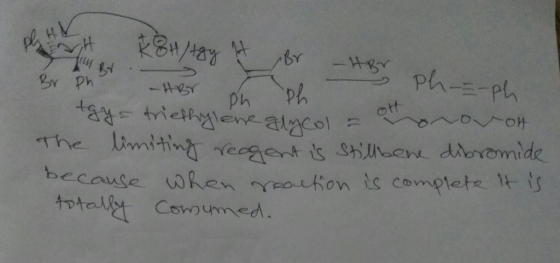
1) Draw the reaction mechanism for the reaction.
2) Determine the limiting reagent.
Procedure...
In this Diels-Alder reaction, what is the limiting reagent for this reaction? Please show work In...
 In this Diels-Alder reaction, what is the limiting reagent for
this reaction? Please show work
In this experiment, a Diels-Alder reaction will be performed to generate 4-cyclohexene- 1,2-dicarboxylic anhydride. The reaction occurs when 1,3-butadiene is combined with maleic anhydride and heated as shown below. Once the product has been isolated, the IR spectrum, melting point, and experimental yield can be determined. 5.- I111NI O Due to the inherent difficulties with the handling of gaseous 1,3-butadiene, it will be generated in...
In this Diels-Alder reaction, what is the limiting reagent for
this reaction? Please show work
In this experiment, a Diels-Alder reaction will be performed to generate 4-cyclohexene- 1,2-dicarboxylic anhydride. The reaction occurs when 1,3-butadiene is combined with maleic anhydride and heated as shown below. Once the product has been isolated, the IR spectrum, melting point, and experimental yield can be determined. 5.- I111NI O Due to the inherent difficulties with the handling of gaseous 1,3-butadiene, it will be generated in...
What is the limiting reagent in this experiment? Acetophenone or aqueous bleach? 1. Add about 1.0...
 What is the limiting reagent in this experiment? Acetophenone or
aqueous bleach?
1. Add about 1.0 g (measured accurately) of acetophenone to 40 mL of the bleach solution (5% NaCl in water - this reactant should be included in your table of reagents!) in a 100 mL round bottom flask equipped with a magnetic stirrer. Clamp the flask in the fume hood above a stir plate. 2. After the initial reaction has subsided, boil the reaction mixture gently for 5...
What is the limiting reagent in this experiment? Acetophenone or
aqueous bleach?
1. Add about 1.0 g (measured accurately) of acetophenone to 40 mL of the bleach solution (5% NaCl in water - this reactant should be included in your table of reagents!) in a 100 mL round bottom flask equipped with a magnetic stirrer. Clamp the flask in the fume hood above a stir plate. 2. After the initial reaction has subsided, boil the reaction mixture gently for 5...
R1= OCH2C6H5, R2= OCH3 Identify the limiting reagent and calculate the theoretical yield? NaOH H3C -H20...
 R1= OCH2C6H5, R2= OCH3
Identify the limiting reagent and calculate the theoretical
yield?
NaOH H3C -H20 R2 R1 Procedure: 1. Prepare a water bath for use later in the experiment by filling a pyrex dish -half full of water and heating it to 70 °C on a stirrer/hot plate. 2. Combine 3.5 mmol of your aldehyde and 3.5 mmol of your ketone with 2 mL of 95% ethanol in a 25- mL round-bottom flask and swirl the mixture briefly. 3....
R1= OCH2C6H5, R2= OCH3
Identify the limiting reagent and calculate the theoretical
yield?
NaOH H3C -H20 R2 R1 Procedure: 1. Prepare a water bath for use later in the experiment by filling a pyrex dish -half full of water and heating it to 70 °C on a stirrer/hot plate. 2. Combine 3.5 mmol of your aldehyde and 3.5 mmol of your ketone with 2 mL of 95% ethanol in a 25- mL round-bottom flask and swirl the mixture briefly. 3....
Determine the yield limiting reagent and the theoretical yield for the following multistep synthesis from the reaction of ethyl acetoacetate. Draw the chemical complete chemical reaction and mechanism...
Determine the yield limiting reagent and the theoretical yield for the following multistep synthesis from the reaction of ethyl acetoacetate. Draw the chemical complete chemical reaction and mechanism of Product C (determined to be 4-hydroxy-4 4-diphenylbutan-2-one) to Product E provided the procedure below. Procedure Step 4B [Product C to Product E] Place product [C] (0.5 g) in a 50 mL round bottomed flask, add acetone (15 mL), and concentrated HCl (2.5 mL). Boil under reflux on a water bath for...
q1.At the end of this reaction, the procedure asks you to add 10 mL of 2M...
 q1.At the end of this reaction, the procedure asks you to add 10
mL of 2M HCl, what is the purpose of this? Use reaction schemes to
illustrate your answer.
q2.As part of the workup procedure for this reaction, you are
asked to add 10 % NaOH to the aqueous phases before extracting with
ethyl acetate. What is the purpose of this? Use structures help
illustrate your answer
-NH₂ H2N -ΝΗ HN- ОН Amberlyst 15 Ethanol, NaBH4 -OH HO- R...
q1.At the end of this reaction, the procedure asks you to add 10
mL of 2M HCl, what is the purpose of this? Use reaction schemes to
illustrate your answer.
q2.As part of the workup procedure for this reaction, you are
asked to add 10 % NaOH to the aqueous phases before extracting with
ethyl acetate. What is the purpose of this? Use structures help
illustrate your answer
-NH₂ H2N -ΝΗ HN- ОН Amberlyst 15 Ethanol, NaBH4 -OH HO- R...
1 - Provide a balanced equation for this reaction 2 - Provide a mechanism for the...
 1 - Provide a balanced equation for this reaction
2 - Provide a mechanism for the transformation of cyclohexanol
into cyclohexanone
3 - Provide a flow chart for the workup procedure for isolating
cyclohexane from all the by-products, making sure to note in which
layer you expect to find your product in each extraction.
4 - Provide the theoretical yield of cyclohexane in this
experiment.
PROCEDURE OXIDATION OF CYCLOHEXANOL TO CYCLOHEXANONE Set up a water bath as the heat source...
1 - Provide a balanced equation for this reaction
2 - Provide a mechanism for the transformation of cyclohexanol
into cyclohexanone
3 - Provide a flow chart for the workup procedure for isolating
cyclohexane from all the by-products, making sure to note in which
layer you expect to find your product in each extraction.
4 - Provide the theoretical yield of cyclohexane in this
experiment.
PROCEDURE OXIDATION OF CYCLOHEXANOL TO CYCLOHEXANONE Set up a water bath as the heat source...
numbers 3-5 please Those are the three equations given to us and that is the reaction...
 numbers 3-5 please
Those are the three equations given to us and that is the reaction
mechanism as well as the procedure. there is nothing else i can
give you
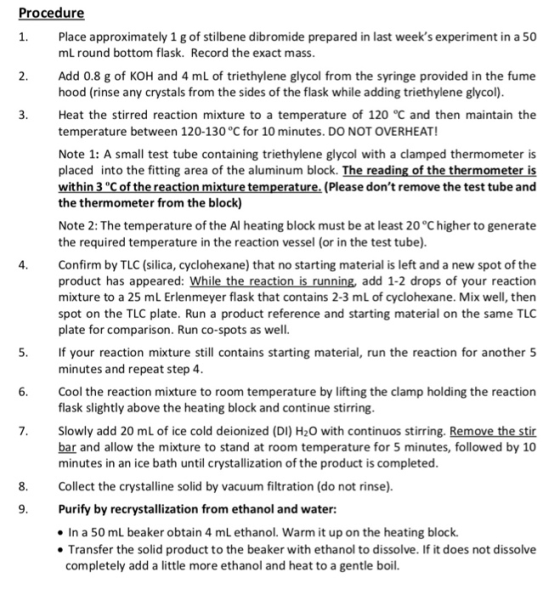
EXPERIMENT 9: SYNTHESIS OF DIPHENYLACETYLENE Objective: Complete the two-step halogenation/elimination reaction sequence that converts an alkene (trans- stilbene) to an alkyne (diphenylacetylene) 3. Why is it important that the reaction is performed in the presence of a strong base? 4. If the starting mass is 350 mg of stilbene dibromide,...
numbers 3-5 please
Those are the three equations given to us and that is the reaction
mechanism as well as the procedure. there is nothing else i can
give you
EXPERIMENT 9: SYNTHESIS OF DIPHENYLACETYLENE Objective: Complete the two-step halogenation/elimination reaction sequence that converts an alkene (trans- stilbene) to an alkyne (diphenylacetylene) 3. Why is it important that the reaction is performed in the presence of a strong base? 4. If the starting mass is 350 mg of stilbene dibromide,...
What is the mechanism (with curved arrows) for this reaction? 1. Add about 1.0 g (measured accurately) of acetophenone t...
 What is the mechanism (with
curved arrows) for this reaction?
1. Add about 1.0 g (measured accurately) of acetophenone to 40 mL of the bleach solution (5% NaCl in water - this reactant should be included in your table of reagents!) in a 100 mL round bottom flask equipped with a magnetic stirrer. Clamp the flask in the fume hood above a stir plate. 2. After the initial reaction has subsided, boil the reaction mixture gently for 5 - 10...
What is the mechanism (with
curved arrows) for this reaction?
1. Add about 1.0 g (measured accurately) of acetophenone to 40 mL of the bleach solution (5% NaCl in water - this reactant should be included in your table of reagents!) in a 100 mL round bottom flask equipped with a magnetic stirrer. Clamp the flask in the fume hood above a stir plate. 2. After the initial reaction has subsided, boil the reaction mixture gently for 5 - 10...
Calculate the quantity (mmol) of reagents to be used in the assigned experiment. Which reagent is...
 Calculate the quantity (mmol) of reagents to be used in the
assigned experiment. Which reagent is the limiting reagent? Show by
calculations.
8. n the reaction of vanillin with silver oxide, what gets oxidized and what gets reduced? Part B: Miniscale Hydrolysis of Methyl Salicylate To a 25-mL round-bottom flask containing a spin bar, add 7.5 mL of 5 M NaOH and 1.0mL. of methyl salicylate. Swirl to mix. A white solid will form, which will eventually disap- pear as...
Calculate the quantity (mmol) of reagents to be used in the
assigned experiment. Which reagent is the limiting reagent? Show by
calculations.
8. n the reaction of vanillin with silver oxide, what gets oxidized and what gets reduced? Part B: Miniscale Hydrolysis of Methyl Salicylate To a 25-mL round-bottom flask containing a spin bar, add 7.5 mL of 5 M NaOH and 1.0mL. of methyl salicylate. Swirl to mix. A white solid will form, which will eventually disap- pear as...
Draw a mechanism for the acetylation of p-methylaniline in reaction 3. Reaction 3: Acetylation NH2 NH2...
 Draw a mechanism for the acetylation of p-methylaniline
in reaction 3.
Reaction 3: Acetylation NH2 NH2 + NH2 (acetic anhydride) NH2 NH2 m-methylaniline p-methylaniline O-methylaniline m-methylaniline HN o-methylaniline O p-methylacetanilide Procedure for Reaction 3: 1) The solution of the three isomers of methylaniline in ethyl acetate was cooled to 0 °C. 2) An equimolar amount of acetic anhydride to the quantity of p-methylaniline theoretically present in the solution was added dropwise with stirring. 3) The stirring was continued for 15...
Draw a mechanism for the acetylation of p-methylaniline
in reaction 3.
Reaction 3: Acetylation NH2 NH2 + NH2 (acetic anhydride) NH2 NH2 m-methylaniline p-methylaniline O-methylaniline m-methylaniline HN o-methylaniline O p-methylacetanilide Procedure for Reaction 3: 1) The solution of the three isomers of methylaniline in ethyl acetate was cooled to 0 °C. 2) An equimolar amount of acetic anhydride to the quantity of p-methylaniline theoretically present in the solution was added dropwise with stirring. 3) The stirring was continued for 15...
 In this Diels-Alder reaction, what is the limiting reagent for
this reaction? Please show work
In this experiment, a Diels-Alder reaction will be performed to generate 4-cyclohexene- 1,2-dicarboxylic anhydride. The reaction occurs when 1,3-butadiene is combined with maleic anhydride and heated as shown below. Once the product has been isolated, the IR spectrum, melting point, and experimental yield can be determined. 5.- I111NI O Due to the inherent difficulties with the handling of gaseous 1,3-butadiene, it will be generated in...
In this Diels-Alder reaction, what is the limiting reagent for
this reaction? Please show work
In this experiment, a Diels-Alder reaction will be performed to generate 4-cyclohexene- 1,2-dicarboxylic anhydride. The reaction occurs when 1,3-butadiene is combined with maleic anhydride and heated as shown below. Once the product has been isolated, the IR spectrum, melting point, and experimental yield can be determined. 5.- I111NI O Due to the inherent difficulties with the handling of gaseous 1,3-butadiene, it will be generated in...
 What is the limiting reagent in this experiment? Acetophenone or
aqueous bleach?
1. Add about 1.0 g (measured accurately) of acetophenone to 40 mL of the bleach solution (5% NaCl in water - this reactant should be included in your table of reagents!) in a 100 mL round bottom flask equipped with a magnetic stirrer. Clamp the flask in the fume hood above a stir plate. 2. After the initial reaction has subsided, boil the reaction mixture gently for 5...
What is the limiting reagent in this experiment? Acetophenone or
aqueous bleach?
1. Add about 1.0 g (measured accurately) of acetophenone to 40 mL of the bleach solution (5% NaCl in water - this reactant should be included in your table of reagents!) in a 100 mL round bottom flask equipped with a magnetic stirrer. Clamp the flask in the fume hood above a stir plate. 2. After the initial reaction has subsided, boil the reaction mixture gently for 5...
 R1= OCH2C6H5, R2= OCH3
Identify the limiting reagent and calculate the theoretical
yield?
NaOH H3C -H20 R2 R1 Procedure: 1. Prepare a water bath for use later in the experiment by filling a pyrex dish -half full of water and heating it to 70 °C on a stirrer/hot plate. 2. Combine 3.5 mmol of your aldehyde and 3.5 mmol of your ketone with 2 mL of 95% ethanol in a 25- mL round-bottom flask and swirl the mixture briefly. 3....
R1= OCH2C6H5, R2= OCH3
Identify the limiting reagent and calculate the theoretical
yield?
NaOH H3C -H20 R2 R1 Procedure: 1. Prepare a water bath for use later in the experiment by filling a pyrex dish -half full of water and heating it to 70 °C on a stirrer/hot plate. 2. Combine 3.5 mmol of your aldehyde and 3.5 mmol of your ketone with 2 mL of 95% ethanol in a 25- mL round-bottom flask and swirl the mixture briefly. 3....
 q1.At the end of this reaction, the procedure asks you to add 10
mL of 2M HCl, what is the purpose of this? Use reaction schemes to
illustrate your answer.
q2.As part of the workup procedure for this reaction, you are
asked to add 10 % NaOH to the aqueous phases before extracting with
ethyl acetate. What is the purpose of this? Use structures help
illustrate your answer
-NH₂ H2N -ΝΗ HN- ОН Amberlyst 15 Ethanol, NaBH4 -OH HO- R...
q1.At the end of this reaction, the procedure asks you to add 10
mL of 2M HCl, what is the purpose of this? Use reaction schemes to
illustrate your answer.
q2.As part of the workup procedure for this reaction, you are
asked to add 10 % NaOH to the aqueous phases before extracting with
ethyl acetate. What is the purpose of this? Use structures help
illustrate your answer
-NH₂ H2N -ΝΗ HN- ОН Amberlyst 15 Ethanol, NaBH4 -OH HO- R...
 1 - Provide a balanced equation for this reaction
2 - Provide a mechanism for the transformation of cyclohexanol
into cyclohexanone
3 - Provide a flow chart for the workup procedure for isolating
cyclohexane from all the by-products, making sure to note in which
layer you expect to find your product in each extraction.
4 - Provide the theoretical yield of cyclohexane in this
experiment.
PROCEDURE OXIDATION OF CYCLOHEXANOL TO CYCLOHEXANONE Set up a water bath as the heat source...
1 - Provide a balanced equation for this reaction
2 - Provide a mechanism for the transformation of cyclohexanol
into cyclohexanone
3 - Provide a flow chart for the workup procedure for isolating
cyclohexane from all the by-products, making sure to note in which
layer you expect to find your product in each extraction.
4 - Provide the theoretical yield of cyclohexane in this
experiment.
PROCEDURE OXIDATION OF CYCLOHEXANOL TO CYCLOHEXANONE Set up a water bath as the heat source...
 numbers 3-5 please
Those are the three equations given to us and that is the reaction
mechanism as well as the procedure. there is nothing else i can
give you
EXPERIMENT 9: SYNTHESIS OF DIPHENYLACETYLENE Objective: Complete the two-step halogenation/elimination reaction sequence that converts an alkene (trans- stilbene) to an alkyne (diphenylacetylene) 3. Why is it important that the reaction is performed in the presence of a strong base? 4. If the starting mass is 350 mg of stilbene dibromide,...
numbers 3-5 please
Those are the three equations given to us and that is the reaction
mechanism as well as the procedure. there is nothing else i can
give you
EXPERIMENT 9: SYNTHESIS OF DIPHENYLACETYLENE Objective: Complete the two-step halogenation/elimination reaction sequence that converts an alkene (trans- stilbene) to an alkyne (diphenylacetylene) 3. Why is it important that the reaction is performed in the presence of a strong base? 4. If the starting mass is 350 mg of stilbene dibromide,...
 What is the mechanism (with
curved arrows) for this reaction?
1. Add about 1.0 g (measured accurately) of acetophenone to 40 mL of the bleach solution (5% NaCl in water - this reactant should be included in your table of reagents!) in a 100 mL round bottom flask equipped with a magnetic stirrer. Clamp the flask in the fume hood above a stir plate. 2. After the initial reaction has subsided, boil the reaction mixture gently for 5 - 10...
What is the mechanism (with
curved arrows) for this reaction?
1. Add about 1.0 g (measured accurately) of acetophenone to 40 mL of the bleach solution (5% NaCl in water - this reactant should be included in your table of reagents!) in a 100 mL round bottom flask equipped with a magnetic stirrer. Clamp the flask in the fume hood above a stir plate. 2. After the initial reaction has subsided, boil the reaction mixture gently for 5 - 10...
 Calculate the quantity (mmol) of reagents to be used in the
assigned experiment. Which reagent is the limiting reagent? Show by
calculations.
8. n the reaction of vanillin with silver oxide, what gets oxidized and what gets reduced? Part B: Miniscale Hydrolysis of Methyl Salicylate To a 25-mL round-bottom flask containing a spin bar, add 7.5 mL of 5 M NaOH and 1.0mL. of methyl salicylate. Swirl to mix. A white solid will form, which will eventually disap- pear as...
Calculate the quantity (mmol) of reagents to be used in the
assigned experiment. Which reagent is the limiting reagent? Show by
calculations.
8. n the reaction of vanillin with silver oxide, what gets oxidized and what gets reduced? Part B: Miniscale Hydrolysis of Methyl Salicylate To a 25-mL round-bottom flask containing a spin bar, add 7.5 mL of 5 M NaOH and 1.0mL. of methyl salicylate. Swirl to mix. A white solid will form, which will eventually disap- pear as...
 Draw a mechanism for the acetylation of p-methylaniline
in reaction 3.
Reaction 3: Acetylation NH2 NH2 + NH2 (acetic anhydride) NH2 NH2 m-methylaniline p-methylaniline O-methylaniline m-methylaniline HN o-methylaniline O p-methylacetanilide Procedure for Reaction 3: 1) The solution of the three isomers of methylaniline in ethyl acetate was cooled to 0 °C. 2) An equimolar amount of acetic anhydride to the quantity of p-methylaniline theoretically present in the solution was added dropwise with stirring. 3) The stirring was continued for 15...
Draw a mechanism for the acetylation of p-methylaniline
in reaction 3.
Reaction 3: Acetylation NH2 NH2 + NH2 (acetic anhydride) NH2 NH2 m-methylaniline p-methylaniline O-methylaniline m-methylaniline HN o-methylaniline O p-methylacetanilide Procedure for Reaction 3: 1) The solution of the three isomers of methylaniline in ethyl acetate was cooled to 0 °C. 2) An equimolar amount of acetic anhydride to the quantity of p-methylaniline theoretically present in the solution was added dropwise with stirring. 3) The stirring was continued for 15...
Most questions answered within 3 hours.
-
Where is the error in this code sequence?
String s1 = "Hello";
String s2 = "ello";...
asked 10 months ago -
Financial data for Joel de Paris, Inc., for last year
follow:
Joel de Paris, Inc.
Balance...
asked 10 months ago -
Consider this reaction:
Al2(SO4)3 (aq)+ BaCl3
(aq) Al2Cl6 (aq)- +
3BaSO4(s) . What is the...
asked 10 months ago -
Suppose that Savneet is considering increasing her
recent random sample from 20 car rentals to 40...
asked 10 months ago -
Trucks arrive at an unloading terminal at an average rate of 120
per hour.
Trucks arrive...
asked 10 months ago -
Why are methanol and ethanol completely soluble in water while
octanol is not very little soluble....
asked 10 months ago -
A facilities manager at a university reads in a research report
that the mean amount of...
asked 10 months ago -
When the CuSO4 is rehydrated by adding water to the anhydrous
compound, is this an endothermic...
asked 10 months ago -
A ray of sunlight is passing from diamond into crown glass; the
angle of incidence is...
asked 10 months ago -
A block of mass 0.249 kg is placed on top of a light, vertical
spring of...
asked 10 months ago -
how do the kidneys compensate in the presences of acidosis
a) trigger hyperventilate
b) reserve acid...
asked 10 months ago -
Question 501 pts
The rental rate of capital to the firm increases. Which of the
following...
asked 10 months ago