
Homework Answers
a) In order to use the electric field equation: 
# The charge is a point charge
# The charge q is fixed in place (not moving over time)
# The charge q is constant (not discharging / charging).
b)
Actually these all are the good approximations which could make our calculation of the electric field.
But in case of 'Not Necessarily Required'
# The coordinate system is set so  Points only in the +x direction.
#The charge q is point charge.
*# Hi, if you are happy and find this useful please thumbs up. In case, if you have any query regarding the solution please let me know in the comments section below. Thanks!!
Add Answer to:
Of the listed approximations and assumptions below, which MUST be made in order to use this...
n this class (and in science more generally), approximations and assumptions are very important. Often making...
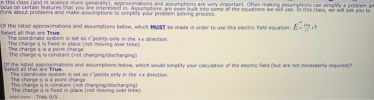 n this class (and in science more generally), approximations and assumptions are very important. Often making assumptions can simplify a problem an ocus on certain features that you are interested in. Assumptions are even built into some of the equations we will use. In this class, we will ask you to think about problems and make assumptions to simplify your problem solving process Of the listed approximations and assumptions below, which ust be made in order to use this electric...
In this class (and in science more generally), approximations and assumptions are very important. Often making...
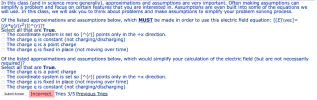 In this class (and in science more generally), approximations and assumptions are very important. Often making assumptions can simplify a problem and focus on certain features that you are interested in. Assumptions are even built into some of the equations we will usé. In this class, we will ask you to think about problems and make assumptions to simplify your problem solving process Of the listed approximations and assumptions below, which MUST be made in order to use this electric...
I only need help with parts F, G and H <Chapter 17 -Homework 29 of 33...
 I only need help with parts F, G and H
<Chapter 17 -Homework 29 of 33 Problem 17.41 -Enhanced- with Solution Part A Find the i and y components of the electric field at the origin In a rectangular coordinate system, a positive point charge q 4.00 nC is placed at the point E0.O N/O 0.150m y 0, and an identical point charge is placed at0.150m. y 0. Find the x and y components and the magnitude and direction of...
I only need help with parts F, G and H
<Chapter 17 -Homework 29 of 33 Problem 17.41 -Enhanced- with Solution Part A Find the i and y components of the electric field at the origin In a rectangular coordinate system, a positive point charge q 4.00 nC is placed at the point E0.O N/O 0.150m y 0, and an identical point charge is placed at0.150m. y 0. Find the x and y components and the magnitude and direction of...
8. Three identical +8uC point charges are located at the following coordinates: (04m,0), (0.4 m2 0.3...
 8. Three identical +8uC point charges are located at the following coordinates: (04m,0), (0.4 m2 0.3 m), (0,03 m). These charges are fixed in place so they cannot move. A) What electric field is present at the origin of the coordinate system? (8 points) C. B) What is the minimum work required by an external force to move a fourth +8uC point charge from infinity to the origin of the coordinate system? (6 points)
<Ch. 17 Problem 17.41-Enhanced-with Solution 29 of 33 > Constants Find the z and y components...
 <Ch. 17 Problem 17.41-Enhanced-with Solution 29 of 33 > Constants Find the z and y components of the electric field at z 0.300 m, y o. In a rectangular coordinate system, a positive point charge q-4.00 nC is placed at the point 0.150m,y- 0, and an identical point charge is placed at 0.150m, y 0. Find the z and y components and the magnitude and direction of the electric field at the following points ΑΣφ You may want to review...
answer all parts of both questions, please Use the following values if needed needed1.6 4 TIE...
 answer all parts of both questions, please
Use the following values if needed needed1.6 4 TIE 1. An electric charge is placed near an object whose net charge is zero. Points5) If the object is made of metal, does the charge exert a force on the object? If so, is it attractive or repulsive? If the object is made of plastic, does the charge exert a force on the object? If so, is it attractive or repulsive? а. Attractive b....
answer all parts of both questions, please
Use the following values if needed needed1.6 4 TIE 1. An electric charge is placed near an object whose net charge is zero. Points5) If the object is made of metal, does the charge exert a force on the object? If so, is it attractive or repulsive? If the object is made of plastic, does the charge exert a force on the object? If so, is it attractive or repulsive? а. Attractive b....
PLEASE HELP THX U A positive charge is placed in an electric field. It starts at...
 PLEASE HELP THX U
A positive charge is placed in an electric field. It starts at rest but is free to move. What does the test charge do? It stays at rest. It moves towards the nearest negative charge only (if there is one). It moves along electric field lines in the opposite direction the arrows point It feels a force pointing tangent to the field lines and moves according to the force. Three charges, -9, +q, and -2q are...
PLEASE HELP THX U
A positive charge is placed in an electric field. It starts at rest but is free to move. What does the test charge do? It stays at rest. It moves towards the nearest negative charge only (if there is one). It moves along electric field lines in the opposite direction the arrows point It feels a force pointing tangent to the field lines and moves according to the force. Three charges, -9, +q, and -2q are...
A perfectly spherical hollow beach ball carries a net charge of +Q evenly distributed over its...
 A perfectly spherical hollow beach ball carries a net charge of +Q evenly distributed over its thin shell of plastic, as shown in the figure below. What is the direction of the electric field at points (A), (B). (C) and (D), if there exists any electric field at those point? EXTRA CREDIT EXTRA CREDIT A) Select the correct answer (A) →, (B) no field . (C) no field . (D) ← O (A)(8) no field , (C) no field, (O)...
Which of the following statements about electric field lines are true? (choose all that are true)...
Which of the following statements about electric field lines are true? (choose all that are true) a) They are only defined for positive charges. b) They are always tangent to electric field vectors. c) They are always perpendicular to charged surfaces. d) They are a simple way to visualize the electric field vectors. e) None of the above. If a negative charge is placed in an electric field, what direction will it be accelerated? a) In the direction of the...
Three very large parallel non-conducting planes (infinte planes) have surface charge densities of sigma,-sigma a and...
 Three very large parallel non-conducting planes (infinte planes) have surface charge densities of sigma,-sigma a and -3sigma (sigma > 0). Planes are distance d apart from each other. The origin of the coordinate system was set on the first plane as shown in the figure. Planes are perpendicular to z axis. Point A is 1/2 d away from the origin while point B and P are 2 d and 4 d away from the origin respectively. a) Use Gauss's law,...
 n this class (and in science more generally), approximations and assumptions are very important. Often making assumptions can simplify a problem an ocus on certain features that you are interested in. Assumptions are even built into some of the equations we will use. In this class, we will ask you to think about problems and make assumptions to simplify your problem solving process Of the listed approximations and assumptions below, which ust be made in order to use this electric...
 In this class (and in science more generally), approximations and assumptions are very important. Often making assumptions can simplify a problem and focus on certain features that you are interested in. Assumptions are even built into some of the equations we will usé. In this class, we will ask you to think about problems and make assumptions to simplify your problem solving process Of the listed approximations and assumptions below, which MUST be made in order to use this electric...
 I only need help with parts F, G and H
<Chapter 17 -Homework 29 of 33 Problem 17.41 -Enhanced- with Solution Part A Find the i and y components of the electric field at the origin In a rectangular coordinate system, a positive point charge q 4.00 nC is placed at the point E0.O N/O 0.150m y 0, and an identical point charge is placed at0.150m. y 0. Find the x and y components and the magnitude and direction of...
I only need help with parts F, G and H
<Chapter 17 -Homework 29 of 33 Problem 17.41 -Enhanced- with Solution Part A Find the i and y components of the electric field at the origin In a rectangular coordinate system, a positive point charge q 4.00 nC is placed at the point E0.O N/O 0.150m y 0, and an identical point charge is placed at0.150m. y 0. Find the x and y components and the magnitude and direction of...
 8. Three identical +8uC point charges are located at the following coordinates: (04m,0), (0.4 m2 0.3 m), (0,03 m). These charges are fixed in place so they cannot move. A) What electric field is present at the origin of the coordinate system? (8 points) C. B) What is the minimum work required by an external force to move a fourth +8uC point charge from infinity to the origin of the coordinate system? (6 points)
 <Ch. 17 Problem 17.41-Enhanced-with Solution 29 of 33 > Constants Find the z and y components of the electric field at z 0.300 m, y o. In a rectangular coordinate system, a positive point charge q-4.00 nC is placed at the point 0.150m,y- 0, and an identical point charge is placed at 0.150m, y 0. Find the z and y components and the magnitude and direction of the electric field at the following points ΑΣφ You may want to review...
 answer all parts of both questions, please
Use the following values if needed needed1.6 4 TIE 1. An electric charge is placed near an object whose net charge is zero. Points5) If the object is made of metal, does the charge exert a force on the object? If so, is it attractive or repulsive? If the object is made of plastic, does the charge exert a force on the object? If so, is it attractive or repulsive? а. Attractive b....
answer all parts of both questions, please
Use the following values if needed needed1.6 4 TIE 1. An electric charge is placed near an object whose net charge is zero. Points5) If the object is made of metal, does the charge exert a force on the object? If so, is it attractive or repulsive? If the object is made of plastic, does the charge exert a force on the object? If so, is it attractive or repulsive? а. Attractive b....
 PLEASE HELP THX U
A positive charge is placed in an electric field. It starts at rest but is free to move. What does the test charge do? It stays at rest. It moves towards the nearest negative charge only (if there is one). It moves along electric field lines in the opposite direction the arrows point It feels a force pointing tangent to the field lines and moves according to the force. Three charges, -9, +q, and -2q are...
PLEASE HELP THX U
A positive charge is placed in an electric field. It starts at rest but is free to move. What does the test charge do? It stays at rest. It moves towards the nearest negative charge only (if there is one). It moves along electric field lines in the opposite direction the arrows point It feels a force pointing tangent to the field lines and moves according to the force. Three charges, -9, +q, and -2q are...
 A perfectly spherical hollow beach ball carries a net charge of +Q evenly distributed over its thin shell of plastic, as shown in the figure below. What is the direction of the electric field at points (A), (B). (C) and (D), if there exists any electric field at those point? EXTRA CREDIT EXTRA CREDIT A) Select the correct answer (A) →, (B) no field . (C) no field . (D) ← O (A)(8) no field , (C) no field, (O)...
 Three very large parallel non-conducting planes (infinte planes) have surface charge densities of sigma,-sigma a and -3sigma (sigma > 0). Planes are distance d apart from each other. The origin of the coordinate system was set on the first plane as shown in the figure. Planes are perpendicular to z axis. Point A is 1/2 d away from the origin while point B and P are 2 d and 4 d away from the origin respectively. a) Use Gauss's law,...
Most questions answered within 3 hours.
-
Where is the error in this code sequence?
String s1 = "Hello";
String s2 = "ello";...
asked 10 months ago -
Financial data for Joel de Paris, Inc., for last year
follow:
Joel de Paris, Inc.
Balance...
asked 10 months ago -
Consider this reaction:
Al2(SO4)3 (aq)+ BaCl3
(aq) Al2Cl6 (aq)- +
3BaSO4(s) . What is the...
asked 10 months ago -
Suppose that Savneet is considering increasing her
recent random sample from 20 car rentals to 40...
asked 10 months ago -
Trucks arrive at an unloading terminal at an average rate of 120
per hour.
Trucks arrive...
asked 10 months ago -
Why are methanol and ethanol completely soluble in water while
octanol is not very little soluble....
asked 10 months ago -
A facilities manager at a university reads in a research report
that the mean amount of...
asked 10 months ago -
When the CuSO4 is rehydrated by adding water to the anhydrous
compound, is this an endothermic...
asked 10 months ago -
A ray of sunlight is passing from diamond into crown glass; the
angle of incidence is...
asked 10 months ago -
A block of mass 0.249 kg is placed on top of a light, vertical
spring of...
asked 10 months ago -
how do the kidneys compensate in the presences of acidosis
a) trigger hyperventilate
b) reserve acid...
asked 10 months ago -
Question 501 pts
The rental rate of capital to the firm increases. Which of the
following...
asked 10 months ago