Karla treats Coke (good 1) and Pepsi (good 2) as perfect substitutes, with MRS =-1 1....
Karla treats Coke (good 1) and Pepsi (good 2) as perfect substitutes, with MRS =-1
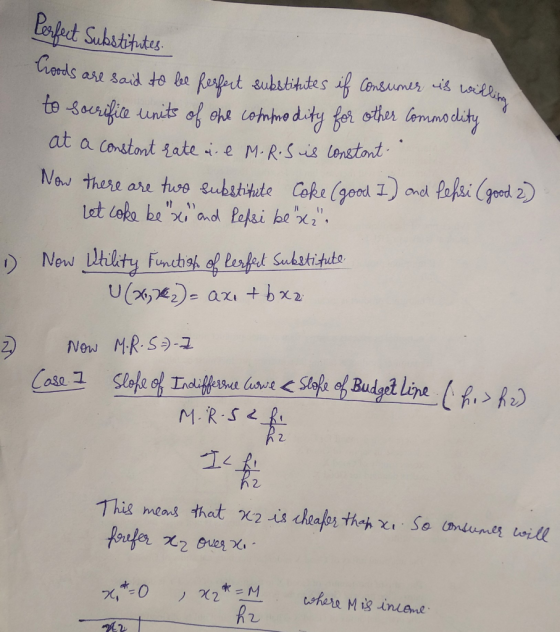
1. Write down an utility function that will represent her preferences
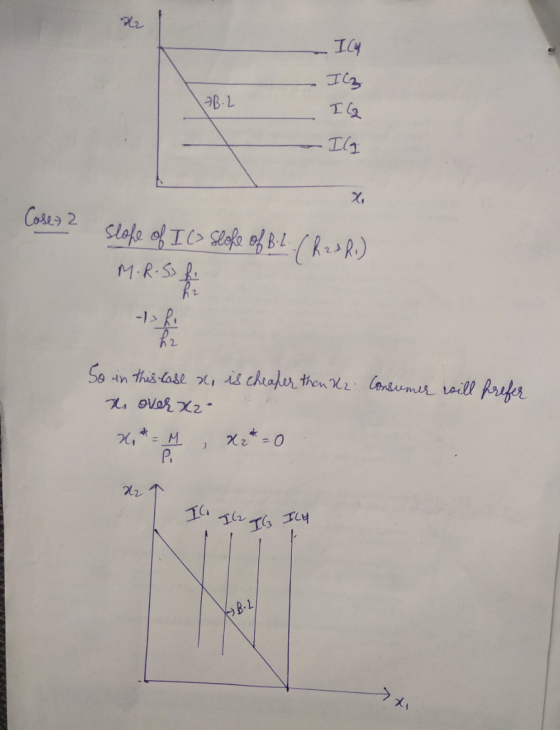
2. Derive her demand functions for the following two cases (show your argument graphically):
A. when price of Coke (p1) is greater than price of Pepsi (p2)
B. when price of Pepsi (p2) is greater than price of Coke (p1)
Homework Answers
Add Answer to:
Karla treats Coke (good 1) and Pepsi (good 2) as perfect
substitutes, with MRS =-1
1....
Question: If Coke and Pepsi are perfect substitutes for Lynn. She is always willing to substitute...
Question: If Coke and Pepsi are perfect substitutes for Lynn. She is always willing to substitute 1.1 Pepsis for 1 Coke. That is, her utility function is: U(Cokes, Pepsis)= 1.1*Cokes + Pepsis If she has an income of $100 and the price of Cokes is $1.20 and Pepsis is $1, then what is the optimal bundle that Lynn should consume?
Eugenia can consume two goods, good 1 and good 2 where xi and Xz denote the...
 Eugenia can consume two goods, good 1 and good 2 where xi and Xz denote the quantity consumed of each good. These goods sell at prices P. and P2, respectively. Eugenia's income is I and her preferences are given by: U(x1, x2) = x2x2 a) Are goods 1 and 2 perfect complements, perfect substitutes or imperfect substitutes to Eugenia? Explain. b) Derive Eugenia's demand functions for the two goods. c) Assume that p1 = P2 = $5 and 7 =...
5. Draw out examples of each of the following indifference curves: imperfect substitutes, perfect substitutes, and...
5. Draw out examples of each of the following indifference curves: imperfect substitutes, perfect substitutes, and perfect complements. 6. Jody enjoys having exactly 1 teaspoon of sugar with every cup of coffee she has. What does this say about her indifference curves between the two goods? What happens to her utility level when she is given 5 teaspoons of sugar with one coffee? (Just an explanation) 7. Jay’s Utility function is given by U(x,z) = 3x10.2 x20.8 and P1=$2 and...
1. Student A has preferences represented by U(x1,x2) = min{ax1,bx2}. Suppose good one has a special...
1. Student A has preferences represented by U(x1,x2) = min{ax1,bx2}. Suppose good one has a special tax. The government wants good one to be consumed as little as possible, so it imposes a tax on its price when more than x units are bought. Specifically, the price of good one is p1 if less than x units are bought and it is p1(1 + t) when buying more than x units (for all the units bought). Where t indicates the...
hi! how did they get the price offer and demand curves for perfect subsititutes? i dont...
 hi!
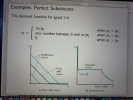
how did they get the price offer and demand curves for perfect
subsititutes? i dont get how they got these curves?
Sereenshot 2015-10-30 at 20.26.46 - Q Search Examples: Perfect Substitutes The demand function for good 1 is m/P1 any number between 0 and m/pi when P1 < P2 when P1 = P2; when pi > Indifference curves Demand curve P= P2 A Price offer curve m/p, = m/p2X1 B Demand curve ICIHAI VIC, VITIT 1 Du SuvurunaLCU LU...
hi!
how did they get the price offer and demand curves for perfect
subsititutes? i dont get how they got these curves?
Sereenshot 2015-10-30 at 20.26.46 - Q Search Examples: Perfect Substitutes The demand function for good 1 is m/P1 any number between 0 and m/pi when P1 < P2 when P1 = P2; when pi > Indifference curves Demand curve P= P2 A Price offer curve m/p, = m/p2X1 B Demand curve ICIHAI VIC, VITIT 1 Du SuvurunaLCU LU...
2*. Assume that Bob has a budget constraint p1x1 + p2x2 = m, and that his...
2*. Assume that Bob has a budget constraint p1x1 + p2x2 = m, and that his preferences are represented by the Cobb-Douglas utility function U(x1, x2) = x1 c x2 d , where c>0 and d>0. State Bob’s optimization (utility maximization) problem. a) Set up the Lagrangian function. b) Derive the necessary conditions (the first-order conditions) for an optimal interior solution. c) Show that the MRS (the slope of the indifference curve) is equal to the slope of the budget...
2*. Assume that Bob has a budget constraint p1x1 + p2x2 = m, and that his...
2*. Assume that Bob has a budget constraint p1x1 + p2x2 = m, and that his preferences are represented by the Cobb-Douglas utility function U(x1, x2) = x1 c x2 d , where c>0 and d>0. State Bob’s optimization (utility maximization) problem. a) Set up the Lagrangian function. b) Derive the necessary conditions (the first-order conditions) for an optimal interior solution. c) Show that the MRS (the slope of the indifference curve) is equal to the slope of the budget...
1. Suppose Oreos and Hydrox are perfect substitutes, one for one (Hydrox were chocolate cookies with...
1. Suppose Oreos and Hydrox are perfect substitutes, one for one (Hydrox were chocolate cookies with vanilla filling that stood up better in milk than Oreos.). If Oreos currently sell for 50 cents and Hydrox sell for 75 cents, use both graphs and words to explain income and substitution effects that occur when the price of Oreos to rise to $1. (Hint: pay attention to the shape of the indifference curve for perfect substitutes.) 2. Suppose Voodoo Donuts and Stumptown...
7. Suppose you know that a demand function of consumer for good 1 is p-, where...
 7. Suppose you know that a demand function of consumer for good 1 is p-, where pi is price of the good and xi is the quantity consumed. You know that the consumer can buy only good 1 or good 2. Her income is $2000 and the price of good 2 is P2 〉 0. (a) Find an utility function that represents the preferences of this consumer (b) Given the above utility function derive demand for good 2. (c) Suppose...
A consumer has income M, and faces prices (for goods 1 and 2) p1 and p2....
A consumer has income M, and faces prices (for goods 1 and 2) p1 and p2. For each of the following utility functions, graphically show the following: (i) the Slutsky substitution and income e⁄ects when p1 decreases. (ii) the Hicks substitution and income e⁄ects when p1 decreases. (iii) the Marshallian and Hicksian demand curves for good 1: (a) perfect complements: U(x1 , x2) = min {4x1, 5x2} (b) quasi-linear: U(x1 , x2) = x^2/3 1 + x2
 Eugenia can consume two goods, good 1 and good 2 where xi and Xz denote the quantity consumed of each good. These goods sell at prices P. and P2, respectively. Eugenia's income is I and her preferences are given by: U(x1, x2) = x2x2 a) Are goods 1 and 2 perfect complements, perfect substitutes or imperfect substitutes to Eugenia? Explain. b) Derive Eugenia's demand functions for the two goods. c) Assume that p1 = P2 = $5 and 7 =...
 hi!
how did they get the price offer and demand curves for perfect
subsititutes? i dont get how they got these curves?
Sereenshot 2015-10-30 at 20.26.46 - Q Search Examples: Perfect Substitutes The demand function for good 1 is m/P1 any number between 0 and m/pi when P1 < P2 when P1 = P2; when pi > Indifference curves Demand curve P= P2 A Price offer curve m/p, = m/p2X1 B Demand curve ICIHAI VIC, VITIT 1 Du SuvurunaLCU LU...
hi!
how did they get the price offer and demand curves for perfect
subsititutes? i dont get how they got these curves?
Sereenshot 2015-10-30 at 20.26.46 - Q Search Examples: Perfect Substitutes The demand function for good 1 is m/P1 any number between 0 and m/pi when P1 < P2 when P1 = P2; when pi > Indifference curves Demand curve P= P2 A Price offer curve m/p, = m/p2X1 B Demand curve ICIHAI VIC, VITIT 1 Du SuvurunaLCU LU...
 7. Suppose you know that a demand function of consumer for good 1 is p-, where pi is price of the good and xi is the quantity consumed. You know that the consumer can buy only good 1 or good 2. Her income is $2000 and the price of good 2 is P2 〉 0. (a) Find an utility function that represents the preferences of this consumer (b) Given the above utility function derive demand for good 2. (c) Suppose...
Most questions answered within 3 hours.
-
Where is the error in this code sequence?
String s1 = "Hello";
String s2 = "ello";...
asked 11 months ago -
Financial data for Joel de Paris, Inc., for last year
follow:
Joel de Paris, Inc.
Balance...
asked 11 months ago -
Consider this reaction:
Al2(SO4)3 (aq)+ BaCl3
(aq) Al2Cl6 (aq)- +
3BaSO4(s) . What is the...
asked 11 months ago -
Suppose that Savneet is considering increasing her
recent random sample from 20 car rentals to 40...
asked 11 months ago -
Trucks arrive at an unloading terminal at an average rate of 120
per hour.
Trucks arrive...
asked 11 months ago -
Why are methanol and ethanol completely soluble in water while
octanol is not very little soluble....
asked 11 months ago -
A facilities manager at a university reads in a research report
that the mean amount of...
asked 11 months ago -
When the CuSO4 is rehydrated by adding water to the anhydrous
compound, is this an endothermic...
asked 11 months ago -
A ray of sunlight is passing from diamond into crown glass; the
angle of incidence is...
asked 11 months ago -
A block of mass 0.249 kg is placed on top of a light, vertical
spring of...
asked 11 months ago -
how do the kidneys compensate in the presences of acidosis
a) trigger hyperventilate
b) reserve acid...
asked 11 months ago -
Question 501 pts
The rental rate of capital to the firm increases. Which of the
following...
asked 11 months ago