
Homework Answers
Let y = f(r, s, t) = srert
Then
fs =  y/s
= rert
y/s
= rert
ft =
y/t
= sr2ert
fss =
/s(y/s)
=
/s(rert)
= 0
fst =
/s(y/t)
=
/s(sr2ert)
= r2ert
frss =
/r(fss)
=
/r(0)
= 0
frst =
/r(fst)
=
/r(r2ert)
= (r2 x r x ert) + (ert x 2r) =
(r3 x ert) + (ert x
2r)
fsst =
/s(fst)
=
/s(r2ert)
= 0
In this activity, you will complete the RSS Client that connects to a UNL RSS feed,...
In this activity, you will complete the RSS Client that connects to a UNL RSS feed, processes the XML data and outputs the results to the standard output. Most of the client has been completed for you. You just Lab Handout: Structures 4 need to complete the design and implementation of a C structure that models the essential parts of an RSS item. Your structure will need to support an RSS item’s title, link, description, and publication date. As a...
Define the linear transformation T by T(x) = Ax. 32 A= (a) Find the kernel of...
 Define the linear transformation T by T(x) = Ax. 32 A= (a) Find the kernel of T. (If there are an infinite number of solutions use t as your parameter.) ker(1) (b) Find the range of T. O {(-t, t): t is any real number) OR? O {(2t, t): t is any real number) O {(t, 2t): t is any real number) OR
(1) X ∼ N(0, 1), define T = X^(−2) . Find the p.d.f. of T (2)...
(1) X ∼ N(0, 1), define T = X^(−2) . Find the p.d.f. of T (2) X ∼ N(µ, σ^2 ). Define Y = X^2/σ^2. Find the p.d.f. of Y and the m.g.f. of Y
Define the linear transformation T by T(X) = AX. 14 A= 32 (a) Find the kernel...
 Define the linear transformation T by T(X) = AX. 14 A= 32 (a) Find the kernel of T. (If there are an infinite number of solutions use t as your parameter.) ker(7) (b) Find the range of T. O {(t, 2t): t is any real number) O R2 O {(-t, t): t is any real number) OR {(2t, t): t is any real number)
Define the linear transformation T by T(x) = Ax. 1 -1 A= 0 1 (a) Find...
 Define the linear transformation T by T(x) = Ax. 1 -1 A= 0 1 (a) Find the kernel of T. (If there are an infinite number of solutions use t as your parameter.) ker(T) = = { ]} (b) Find the range of T. OR? {(3t, t): t is any real number OR {(t, 36): t is any real number} {(-t, t): t is any real number}
Define the linear transformation T:?3??4 by T(x )=Ax . Find a vector x whose image under...
 Define the linear transformation T:?3??4 by T(x )=Ax . Find a
vector x whose image under T is b
(1 pt) Let 4 5 2 -2 5 -3 2 and b-10 -7 2 1 -4 Define the linear transformation T : R3 ? R4 by T(x-Ax Find a vector x whose image under T is b. x= Is the vectorx unique? choose
Define the linear transformation T:?3??4 by T(x )=Ax . Find a
vector x whose image under T is b
(1 pt) Let 4 5 2 -2 5 -3 2 and b-10 -7 2 1 -4 Define the linear transformation T : R3 ? R4 by T(x-Ax Find a vector x whose image under T is b. x= Is the vectorx unique? choose
TL 0o Pn P, an 7-0 (a) Define T : Pl → R2 by T(ao + air) = (ao, (n). Note that T (2) L(P..R2). Fin(! (b) Define T1 R2P by T-(ao, aa. Note that TE L(R2.P). Find IT-1 TL 0o Pn P, an 7-0 (a) Define...
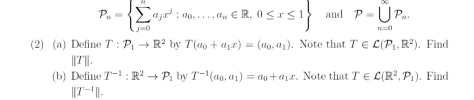 TL 0o Pn P, an 7-0 (a) Define T : Pl → R2 by T(ao + air) = (ao, (n). Note that T (2) L(P..R2). Fin(! (b) Define T1 R2P by T-(ao, aa. Note that TE L(R2.P). Find IT-1
TL 0o Pn P, an 7-0 (a) Define T : Pl → R2 by T(ao + air) = (ao, (n). Note that T (2) L(P..R2). Fin(! (b) Define T1 R2P by T-(ao, aa. Note that TE L(R2.P). Find IT-1
TL 0o Pn P, an 7-0 (a) Define T : Pl → R2 by T(ao + air) = (ao, (n). Note that T (2) L(P..R2). Fin(! (b) Define T1 R2P by T-(ao, aa. Note that TE L(R2.P). Find IT-1
Demonstrate from first principles that the least squares estimator of ?1 in the primitive model where...
Demonstrate from first principles that the least squares estimator of ?1 in the primitive model where Y consists simply of a constant plus a disturbance term, ?? = ?1 + ?? is ?̂1 = ?̅, the sample mean of Y. (First define RSS and then differentiate)
Define the linear transformation T: Rn → Rm by πν) = Av. Find the dimensions of...
 Define the linear transformation T: Rn → Rm by πν) = Av. Find the dimensions of Rn and Rm. A=12-2 24-2 1 dimension of R dimension of Rm
4. (5.A.9) Define T E L(F3) by T(21, 22, 3) (222,0, 523). Find all eigenvalues and...
 4. (5.A.9) Define T E L(F3) by T(21, 22, 3) (222,0, 523). Find all eigenvalues and eigenvectors of T
 Define the linear transformation T by T(x) = Ax. 32 A= (a) Find the kernel of T. (If there are an infinite number of solutions use t as your parameter.) ker(1) (b) Find the range of T. O {(-t, t): t is any real number) OR? O {(2t, t): t is any real number) O {(t, 2t): t is any real number) OR
 Define the linear transformation T by T(X) = AX. 14 A= 32 (a) Find the kernel of T. (If there are an infinite number of solutions use t as your parameter.) ker(7) (b) Find the range of T. O {(t, 2t): t is any real number) O R2 O {(-t, t): t is any real number) OR {(2t, t): t is any real number)
 Define the linear transformation T by T(x) = Ax. 1 -1 A= 0 1 (a) Find the kernel of T. (If there are an infinite number of solutions use t as your parameter.) ker(T) = = { ]} (b) Find the range of T. OR? {(3t, t): t is any real number OR {(t, 36): t is any real number} {(-t, t): t is any real number}
 Define the linear transformation T:?3??4 by T(x )=Ax . Find a
vector x whose image under T is b
(1 pt) Let 4 5 2 -2 5 -3 2 and b-10 -7 2 1 -4 Define the linear transformation T : R3 ? R4 by T(x-Ax Find a vector x whose image under T is b. x= Is the vectorx unique? choose
Define the linear transformation T:?3??4 by T(x )=Ax . Find a
vector x whose image under T is b
(1 pt) Let 4 5 2 -2 5 -3 2 and b-10 -7 2 1 -4 Define the linear transformation T : R3 ? R4 by T(x-Ax Find a vector x whose image under T is b. x= Is the vectorx unique? choose
 TL 0o Pn P, an 7-0 (a) Define T : Pl → R2 by T(ao + air) = (ao, (n). Note that T (2) L(P..R2). Fin(! (b) Define T1 R2P by T-(ao, aa. Note that TE L(R2.P). Find IT-1
TL 0o Pn P, an 7-0 (a) Define T : Pl → R2 by T(ao + air) = (ao, (n). Note that T (2) L(P..R2). Fin(! (b) Define T1 R2P by T-(ao, aa. Note that TE L(R2.P). Find IT-1
TL 0o Pn P, an 7-0 (a) Define T : Pl → R2 by T(ao + air) = (ao, (n). Note that T (2) L(P..R2). Fin(! (b) Define T1 R2P by T-(ao, aa. Note that TE L(R2.P). Find IT-1
 Define the linear transformation T: Rn → Rm by πν) = Av. Find the dimensions of Rn and Rm. A=12-2 24-2 1 dimension of R dimension of Rm
 4. (5.A.9) Define T E L(F3) by T(21, 22, 3) (222,0, 523). Find all eigenvalues and eigenvectors of T
Most questions answered within 3 hours.
-
Where is the error in this code sequence?
String s1 = "Hello";
String s2 = "ello";...
asked 11 months ago -
Financial data for Joel de Paris, Inc., for last year
follow:
Joel de Paris, Inc.
Balance...
asked 11 months ago -
Consider this reaction:
Al2(SO4)3 (aq)+ BaCl3
(aq) Al2Cl6 (aq)- +
3BaSO4(s) . What is the...
asked 11 months ago -
Suppose that Savneet is considering increasing her
recent random sample from 20 car rentals to 40...
asked 11 months ago -
Trucks arrive at an unloading terminal at an average rate of 120
per hour.
Trucks arrive...
asked 11 months ago -
Why are methanol and ethanol completely soluble in water while
octanol is not very little soluble....
asked 11 months ago -
A facilities manager at a university reads in a research report
that the mean amount of...
asked 11 months ago -
When the CuSO4 is rehydrated by adding water to the anhydrous
compound, is this an endothermic...
asked 11 months ago -
A ray of sunlight is passing from diamond into crown glass; the
angle of incidence is...
asked 11 months ago -
A block of mass 0.249 kg is placed on top of a light, vertical
spring of...
asked 11 months ago -
how do the kidneys compensate in the presences of acidosis
a) trigger hyperventilate
b) reserve acid...
asked 11 months ago -
Question 501 pts
The rental rate of capital to the firm increases. Which of the
following...
asked 11 months ago