Diabetic neuropathy is thought to result from
Diabetic neuropathy is thought to result from
a. elevated HbA1c
b.decreased myoinositol transport.
c. neuronal demyelination.
d. deficient neuronal insulin receptors.
Homework Answers
Ans) a. elevated HbA1c
Explaination:
- Diabetic neuropathy is damage to nerves that occurs as a result of diabetes. Diabetes is thought to damage nerves as a result of prolonged elevated levels of blood glucose. Different types of diabetic neuropathy include peripheral neuropathy, focal neuropathy, autonomic neuropathy, and proximal neuropathy.
One hundred sixty people who suffer from painful diabetic neuropathy have volunteered to participate in a...
 One hundred sixty people who suffer from painful diabetic neuropathy have volunteered to participate in a study. Eighty are selected at random and are given the drug gabapentin, which, although originally intended to prevent epileptic seizures, has properties that may make it useful to alleviate neuropathy. The remaining participants are given a placebo. A neurologist evaluates the symptoms of all volunteers after two months to determine if there has been substantial improvement in the severity of the symptoms. This study...
Which of the following conditions is not related to Type I or II diabetic disease? O...
 Which of the following conditions is not related to Type I or II diabetic disease? O A. elevated levels of blood gluco: OB. lowered production of insulin by the pancreas O C. reduced sensitivity to insulin by the body cells O D. ineffective pituitary gland O E. diet and exercise usually help to balance the blood sugar levels
Question 21 (1 point) The differential diagnosis for hyperglycemia would not include which of the following?...
 Question 21 (1 point) The differential diagnosis for hyperglycemia would not include which of the following? a) Hypothyroid b) Cushing syndrome c) Hyperinsulinism d) Hypogluconemia Question 22 (1 point) The development of metabolic acidosis in an uncontrolled diabetic is caused by the a) decreased number of insulin receptors on certain cells. b) loss of regulation of certain diabetogenes. c) elevated presence of lactic acid. d) the increased formation of b-hydroxybutyric acid (ketones)
1. Ketosis can result from A. the lack of dietary carbohydrates. B. the lack of dietary...
1. Ketosis can result from A. the lack of dietary carbohydrates. B. the lack of dietary protein. C. excess dietary protein. D. excess dietary carbohydrates. 2.Triglycerides are composed of the elements A. C and H B. O, H, and P C. C, H, O, and N D. C, H, and O 3. Which food contains the most fat per serving? A.mayonnaise B. raisins C. oatmeal D. applesauce 4.Bile can be synthesized from _____ . A. glucagon B. glycogen C. cholesterol...
1. The nurse is teaching a new diabetic patient about the signs and symptoms of hypoglycemia....
 1. The nurse is teaching a new diabetic patient about the signs and symptoms of hypoglycemia. The RN will be teaching the following are signs to monitor for: List 5 signs and symptoms 2. The Nurse understand the pathophysiology of the targeted drug receptors for the following diabetes therapy including? Match the receptor to the drug. A. GLP1 Increased hepatic glucose production B. Metformin Increased glucose reabsorption C. TZD Decreased glucose uptake D. SGLT2 Impaired insulin secretion 3. The Nurse...
2. The Nurse understand the pathophysiology of the targeted drug receptors for the following diabetes therapy...
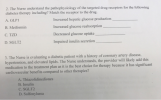 2. The Nurse understand the pathophysiology of the targeted drug receptors for the following diabetes therapy including? Match the receptor to the drug. A. GLP1 Increased hepatic glucose production B. Metformin Increased glucose reabsorption C. TZD Decreased glucose uptake D. SGLT2 Impaired insulin secretion 3. The Nurse is evaluating a diabetic patient with a history of coronary artery disease, hypertension, and elevated lipids. The Nurse understands, the provider will likely add this medication to the treatment plan as it is...
1. The nurse is teaching a new diabetic patient about the signs and symptoms of hypoglycemia....
 1. The nurse is teaching a new diabetic patient about the signs and symptoms of hypoglycemia. The RN will be teaching the following are signs to monitor for: List 5 signs and symptoms 2. The Nurse understand the pathophysiology of the targeted drug receptors for the following diabetes therapy including? Match the receptor to the drug. A. GLP1 Increased hepatic glucose production B. Metformin Increased glucose reabsorption C. TZD Decreased glucose uptake D. SGLT2 Impaired insulin secretion 3. The Nurse...
The exaggerated plumage and colors of male birds is thought to result from to different theories:...
The exaggerated plumage and colors of male birds is thought to result from to different theories: runaway selection and the handicap principal. Using an example, explain the difference between these two theories.
nursing-pharmcology 1. The nurse is teaching a new diabetic patient about the signs and symptoms of...
 nursing-pharmcology
1. The nurse is teaching a new diabetic patient about the signs and symptoms of hypoglycemia. The RN will be teaching the following are signs to monitor for: List S signs and symptoms 2. The Nurse understand the pathophysiology of the targeted drug receptors for the following diabetes therapy including? Match the receptor to the drug A. GLP1 Increased hepatic glucose production B. Metformin Increased glucose reabsorption C.TZD Decreased glucose uptake D. SGLT2 Impaired insulin secretion 3. The Nurse...
nursing-pharmcology
1. The nurse is teaching a new diabetic patient about the signs and symptoms of hypoglycemia. The RN will be teaching the following are signs to monitor for: List S signs and symptoms 2. The Nurse understand the pathophysiology of the targeted drug receptors for the following diabetes therapy including? Match the receptor to the drug A. GLP1 Increased hepatic glucose production B. Metformin Increased glucose reabsorption C.TZD Decreased glucose uptake D. SGLT2 Impaired insulin secretion 3. The Nurse...
313. A 35 year old woman is diagnosed with a peripheral neuropathy. When making her plan...
 313. A 35 year old woman is diagnosed with a peripheral neuropathy. When making her plan of care, the nurse knows to include what in patient teaching (Mark all that apply) A. Inspect the lower extremities for skin breakdown. B. Footwear needs to be accurately sixed. C. The disease has a genetic component D. Assistive devices may be needed to reduce the risk of falls E. Ask others for assistance 314. A diabetic patient presents to the clinic and is...
 One hundred sixty people who suffer from painful diabetic neuropathy have volunteered to participate in a study. Eighty are selected at random and are given the drug gabapentin, which, although originally intended to prevent epileptic seizures, has properties that may make it useful to alleviate neuropathy. The remaining participants are given a placebo. A neurologist evaluates the symptoms of all volunteers after two months to determine if there has been substantial improvement in the severity of the symptoms. This study...
 Which of the following conditions is not related to Type I or II diabetic disease? O A. elevated levels of blood gluco: OB. lowered production of insulin by the pancreas O C. reduced sensitivity to insulin by the body cells O D. ineffective pituitary gland O E. diet and exercise usually help to balance the blood sugar levels
 Question 21 (1 point) The differential diagnosis for hyperglycemia would not include which of the following? a) Hypothyroid b) Cushing syndrome c) Hyperinsulinism d) Hypogluconemia Question 22 (1 point) The development of metabolic acidosis in an uncontrolled diabetic is caused by the a) decreased number of insulin receptors on certain cells. b) loss of regulation of certain diabetogenes. c) elevated presence of lactic acid. d) the increased formation of b-hydroxybutyric acid (ketones)
 1. The nurse is teaching a new diabetic patient about the signs and symptoms of hypoglycemia. The RN will be teaching the following are signs to monitor for: List 5 signs and symptoms 2. The Nurse understand the pathophysiology of the targeted drug receptors for the following diabetes therapy including? Match the receptor to the drug. A. GLP1 Increased hepatic glucose production B. Metformin Increased glucose reabsorption C. TZD Decreased glucose uptake D. SGLT2 Impaired insulin secretion 3. The Nurse...
 2. The Nurse understand the pathophysiology of the targeted drug receptors for the following diabetes therapy including? Match the receptor to the drug. A. GLP1 Increased hepatic glucose production B. Metformin Increased glucose reabsorption C. TZD Decreased glucose uptake D. SGLT2 Impaired insulin secretion 3. The Nurse is evaluating a diabetic patient with a history of coronary artery disease, hypertension, and elevated lipids. The Nurse understands, the provider will likely add this medication to the treatment plan as it is...
 1. The nurse is teaching a new diabetic patient about the signs and symptoms of hypoglycemia. The RN will be teaching the following are signs to monitor for: List 5 signs and symptoms 2. The Nurse understand the pathophysiology of the targeted drug receptors for the following diabetes therapy including? Match the receptor to the drug. A. GLP1 Increased hepatic glucose production B. Metformin Increased glucose reabsorption C. TZD Decreased glucose uptake D. SGLT2 Impaired insulin secretion 3. The Nurse...
 nursing-pharmcology
1. The nurse is teaching a new diabetic patient about the signs and symptoms of hypoglycemia. The RN will be teaching the following are signs to monitor for: List S signs and symptoms 2. The Nurse understand the pathophysiology of the targeted drug receptors for the following diabetes therapy including? Match the receptor to the drug A. GLP1 Increased hepatic glucose production B. Metformin Increased glucose reabsorption C.TZD Decreased glucose uptake D. SGLT2 Impaired insulin secretion 3. The Nurse...
nursing-pharmcology
1. The nurse is teaching a new diabetic patient about the signs and symptoms of hypoglycemia. The RN will be teaching the following are signs to monitor for: List S signs and symptoms 2. The Nurse understand the pathophysiology of the targeted drug receptors for the following diabetes therapy including? Match the receptor to the drug A. GLP1 Increased hepatic glucose production B. Metformin Increased glucose reabsorption C.TZD Decreased glucose uptake D. SGLT2 Impaired insulin secretion 3. The Nurse...
 313. A 35 year old woman is diagnosed with a peripheral neuropathy. When making her plan of care, the nurse knows to include what in patient teaching (Mark all that apply) A. Inspect the lower extremities for skin breakdown. B. Footwear needs to be accurately sixed. C. The disease has a genetic component D. Assistive devices may be needed to reduce the risk of falls E. Ask others for assistance 314. A diabetic patient presents to the clinic and is...
Most questions answered within 3 hours.
-
Where is the error in this code sequence?
String s1 = "Hello";
String s2 = "ello";...
asked 10 months ago -
Financial data for Joel de Paris, Inc., for last year
follow:
Joel de Paris, Inc.
Balance...
asked 10 months ago -
Consider this reaction:
Al2(SO4)3 (aq)+ BaCl3
(aq) Al2Cl6 (aq)- +
3BaSO4(s) . What is the...
asked 10 months ago -
Suppose that Savneet is considering increasing her
recent random sample from 20 car rentals to 40...
asked 10 months ago -
Trucks arrive at an unloading terminal at an average rate of 120
per hour.
Trucks arrive...
asked 10 months ago -
Why are methanol and ethanol completely soluble in water while
octanol is not very little soluble....
asked 10 months ago -
A facilities manager at a university reads in a research report
that the mean amount of...
asked 10 months ago -
When the CuSO4 is rehydrated by adding water to the anhydrous
compound, is this an endothermic...
asked 10 months ago -
A ray of sunlight is passing from diamond into crown glass; the
angle of incidence is...
asked 10 months ago -
A block of mass 0.249 kg is placed on top of a light, vertical
spring of...
asked 10 months ago -
how do the kidneys compensate in the presences of acidosis
a) trigger hyperventilate
b) reserve acid...
asked 10 months ago -
Question 501 pts
The rental rate of capital to the firm increases. Which of the
following...
asked 10 months ago