Assume that if a pair of oligopolists fail to collude, their profits are equal to 1...
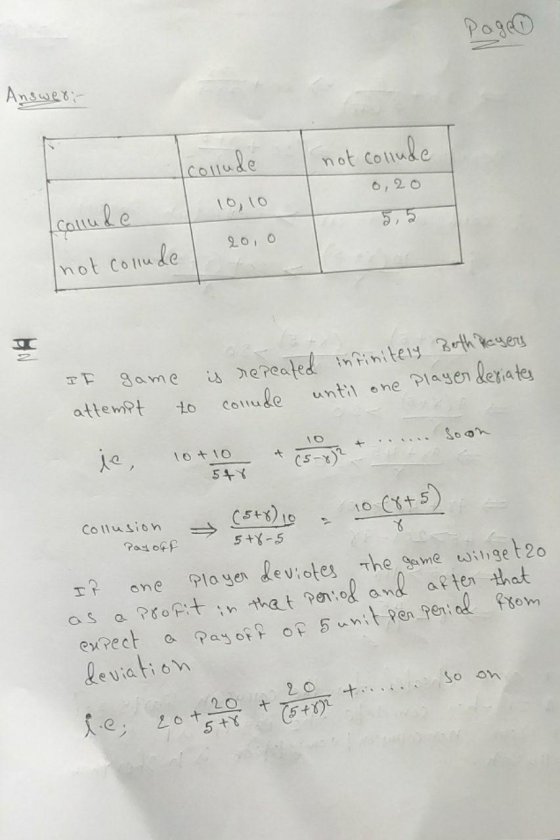
Assume that if a pair of oligopolists fail to collude, their profits are equal to 1 unit each per period of unattempted collusion. Assume that if they collude, their profits are equal to 10 units each per period of successful collusion. Suppose that if one monopolist attempts collusion while the second attempts deviation, that the deviator’s profits are 15 and the attempted colluder’s profits are 0 in such a period. Assume an interest rate of r (where r is a fraction known to the participants).
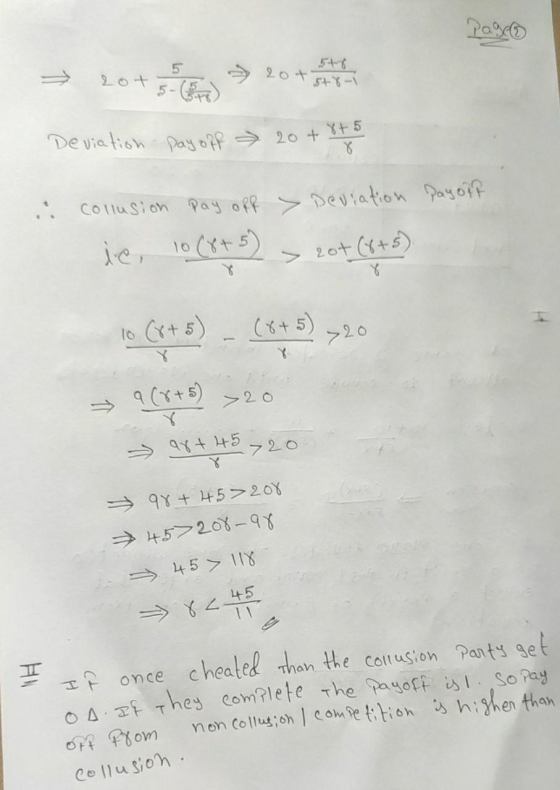
i. Assume in an infinitely repeated game both players attempt to collude until one player deviates. Once this happens both players no longer attempt collusion. Find the values of r such that the above strategies constitute an equilibrium.
ii. Explain why it is still an equilibrium to not attempt collusion once a deviation was recorded. (Hint: what has changed about each players expectations?) This is important in economic theory, because it means that our theory of collusion does not depend on bluffs
Homework Answers
Add Answer to:
Assume that if a pair of oligopolists fail to collude, their
profits are equal to 1...
consider the standard Bertrand model of price competition. There are two firms that produce a homogenous...
 consider the standard Bertrand model of price competition. There
are two firms that produce a homogenous good with the same constant
marginal cost of c.
a) Suppose that the rule for splitting up cunsumers when the
prices are equal assigns all consumers to firm1 when both firms
charge the same price. show that (p1,p2) =(c,c) is a Nash
equilibrium and that no other pair of prices is a Nash
equilibrium.
b) Now, we assume that the Bertrand game in part...
consider the standard Bertrand model of price competition. There
are two firms that produce a homogenous good with the same constant
marginal cost of c.
a) Suppose that the rule for splitting up cunsumers when the
prices are equal assigns all consumers to firm1 when both firms
charge the same price. show that (p1,p2) =(c,c) is a Nash
equilibrium and that no other pair of prices is a Nash
equilibrium.
b) Now, we assume that the Bertrand game in part...
Q4. Suppose a duopoly is characterized by the following profits: if the two firms collude and...
Q4. Suppose a duopoly is characterized by the following profits: if the two firms collude and charge the joint profit-maximizing price, they each earn a profit equal to 1500 in each period; if the two firms charge the Cournot–Nash price, they each earn a profit equal to 1200 in each period; and if one firm defects while the other charges the joint profit-maximizing price, the firm that defects earns 3000 and the other earns 0. [20 marks] a) [3 marks]...
3. There are two firms that compete according to Cournot competition. Firm 1 has a cost...
 3. There are two firms that compete according to Cournot competition. Firm 1 has a cost function G(91) = 5.59+12. Firm 2 has a cost function C(q2) = 2.5q3 + 18. These firms cannot discriminate, so there is just one price that is determined by the aggregate demand. The inverse demand equation is P(Q) = 600 – 0 Where total supply Q-q1+92. (e) Use your best response equations to mathematically solve for the equilibrium quantities qi 9, Q". equilibrium price...
2. (Level A) Suppose the following Prisoner's Dilemma is repeated infinitely: 12 C D D 01...
 2. (Level A) Suppose the following Prisoner's Dilemma is repeated infinitely: 12 C D D 01 1 Let ul be the payoff to player i in period t. Player i (i = 1, 2) maximizes her average discounted sum of payoffs, given by where δ is the common discount factor of both players Suppose the players try to sustain (C, C) in each period by the 2-Period Limited Retaliation Strategy (2-LRS). That is, each player plays the following strategy: Play...
3. Assume that a monopolist produces a good at constant marginal cost MC(q) = 1. Demand...
 3. Assume that a monopolist produces a good at constant marginal cost MC(q) = 1. Demand is given by pºq) = 10 - 2q. There are no other pre-existing distortions in the market. (a) What is the privately optimal quantity and price chosen by the monopolist? For parts (b) and (c), assume that a tax of $t is imposed on every unit of output produced by the monopolist. (b) Derive the optimal quantity and price chosen by the monopolist as...
6. Assume that the AD curve of the economy is given by Y 15-100π + 1, where m is a demand shock (animal spirits, govern...
 6. Assume that the AD curve of the economy is given by Y 15-100π + 1, where m is a demand shock (animal spirits, government spending, or money supply). The AS curve is given by 50(r where u is a supply shock (oil price, productivity). The variable π is the inflation rate, ETIS expected inflation rate, Y is output, and Y is long-run output. For numerical values, Y - Answer each equation using both graphs and math. Plot the above...
usion (24 points) Two firms are playing a repeated Bertrand game infinitely, each with the same marginal cost 100. The market demand function is P-400-Q. The firm who charges the lower price win...
 usion (24 points) Two firms are playing a repeated Bertrand game infinitely, each with the same marginal cost 100. The market demand function is P-400-Q. The firm who charges the lower price wins the whole market. When both firms charge the same price, each gets 1/2 of the total market. I. Coll A. (6 points) What price will they choose in the stage (only one period) Nash equilibrium? What price will they choose if in the stage game (only one...
please answer all questions! it should be no problem with 1st question. Two discount superstores (Ultimate...
 please answer all questions!
it
should be no problem with 1st question.
Two discount superstores (Ultimate Saver and SuperDuper Saver) in a growing urban area are interested in expanding their market share. Both are interested in expanding the size of their store and parking lot to accommodate potential growth in their customer base. The following game depicts the strategic outcomes that result from the game. Growth-related profits of the two discount superstores under two scenarios are reflected in the table...
please answer all questions!
it
should be no problem with 1st question.
Two discount superstores (Ultimate Saver and SuperDuper Saver) in a growing urban area are interested in expanding their market share. Both are interested in expanding the size of their store and parking lot to accommodate potential growth in their customer base. The following game depicts the strategic outcomes that result from the game. Growth-related profits of the two discount superstores under two scenarios are reflected in the table...
i don't understand how to do this can someone please help? 1. (½ point) Assume the...
 i don't understand how to do this can someone please
help?
1. (½ point) Assume the world has only 2 oil suppliers, Saudi Arabia and Iraq, and that they both choose only between a low and high price. Below is a payoff matrix for the two countries. Assume this choice is made once and lasts forever. Will Saudi Arabia choose to set a low or high price? Will Iraq choose to set a low or high price? Saudi Arabia Iraq...
i don't understand how to do this can someone please
help?
1. (½ point) Assume the world has only 2 oil suppliers, Saudi Arabia and Iraq, and that they both choose only between a low and high price. Below is a payoff matrix for the two countries. Assume this choice is made once and lasts forever. Will Saudi Arabia choose to set a low or high price? Will Iraq choose to set a low or high price? Saudi Arabia Iraq...
i will give a thumb up for sure if it helps me :) Please Summarize this...
i will give a thumb up for sure if it helps me :) Please Summarize this article about Communicating competitive information,and Applying Game Theory To Managing Price Competition. Pricing Strategies Course -No longer than 400 words. Like any other type of market research, information about competitors will be most valuable if it is collected and stored in a systematic way. Activities such as shopping the competition should be done thoroughly and periodically. Information from different sources should be merged into...
 consider the standard Bertrand model of price competition. There
are two firms that produce a homogenous good with the same constant
marginal cost of c.
a) Suppose that the rule for splitting up cunsumers when the
prices are equal assigns all consumers to firm1 when both firms
charge the same price. show that (p1,p2) =(c,c) is a Nash
equilibrium and that no other pair of prices is a Nash
equilibrium.
b) Now, we assume that the Bertrand game in part...
consider the standard Bertrand model of price competition. There
are two firms that produce a homogenous good with the same constant
marginal cost of c.
a) Suppose that the rule for splitting up cunsumers when the
prices are equal assigns all consumers to firm1 when both firms
charge the same price. show that (p1,p2) =(c,c) is a Nash
equilibrium and that no other pair of prices is a Nash
equilibrium.
b) Now, we assume that the Bertrand game in part...
 3. There are two firms that compete according to Cournot competition. Firm 1 has a cost function G(91) = 5.59+12. Firm 2 has a cost function C(q2) = 2.5q3 + 18. These firms cannot discriminate, so there is just one price that is determined by the aggregate demand. The inverse demand equation is P(Q) = 600 – 0 Where total supply Q-q1+92. (e) Use your best response equations to mathematically solve for the equilibrium quantities qi 9, Q". equilibrium price...
 2. (Level A) Suppose the following Prisoner's Dilemma is repeated infinitely: 12 C D D 01 1 Let ul be the payoff to player i in period t. Player i (i = 1, 2) maximizes her average discounted sum of payoffs, given by where δ is the common discount factor of both players Suppose the players try to sustain (C, C) in each period by the 2-Period Limited Retaliation Strategy (2-LRS). That is, each player plays the following strategy: Play...
 3. Assume that a monopolist produces a good at constant marginal cost MC(q) = 1. Demand is given by pºq) = 10 - 2q. There are no other pre-existing distortions in the market. (a) What is the privately optimal quantity and price chosen by the monopolist? For parts (b) and (c), assume that a tax of $t is imposed on every unit of output produced by the monopolist. (b) Derive the optimal quantity and price chosen by the monopolist as...
 6. Assume that the AD curve of the economy is given by Y 15-100π + 1, where m is a demand shock (animal spirits, government spending, or money supply). The AS curve is given by 50(r where u is a supply shock (oil price, productivity). The variable π is the inflation rate, ETIS expected inflation rate, Y is output, and Y is long-run output. For numerical values, Y - Answer each equation using both graphs and math. Plot the above...
 usion (24 points) Two firms are playing a repeated Bertrand game infinitely, each with the same marginal cost 100. The market demand function is P-400-Q. The firm who charges the lower price wins the whole market. When both firms charge the same price, each gets 1/2 of the total market. I. Coll A. (6 points) What price will they choose in the stage (only one period) Nash equilibrium? What price will they choose if in the stage game (only one...
 please answer all questions!
it
should be no problem with 1st question.
Two discount superstores (Ultimate Saver and SuperDuper Saver) in a growing urban area are interested in expanding their market share. Both are interested in expanding the size of their store and parking lot to accommodate potential growth in their customer base. The following game depicts the strategic outcomes that result from the game. Growth-related profits of the two discount superstores under two scenarios are reflected in the table...
please answer all questions!
it
should be no problem with 1st question.
Two discount superstores (Ultimate Saver and SuperDuper Saver) in a growing urban area are interested in expanding their market share. Both are interested in expanding the size of their store and parking lot to accommodate potential growth in their customer base. The following game depicts the strategic outcomes that result from the game. Growth-related profits of the two discount superstores under two scenarios are reflected in the table...
 i don't understand how to do this can someone please
help?
1. (½ point) Assume the world has only 2 oil suppliers, Saudi Arabia and Iraq, and that they both choose only between a low and high price. Below is a payoff matrix for the two countries. Assume this choice is made once and lasts forever. Will Saudi Arabia choose to set a low or high price? Will Iraq choose to set a low or high price? Saudi Arabia Iraq...
i don't understand how to do this can someone please
help?
1. (½ point) Assume the world has only 2 oil suppliers, Saudi Arabia and Iraq, and that they both choose only between a low and high price. Below is a payoff matrix for the two countries. Assume this choice is made once and lasts forever. Will Saudi Arabia choose to set a low or high price? Will Iraq choose to set a low or high price? Saudi Arabia Iraq...
Most questions answered within 3 hours.
-
Where is the error in this code sequence?
String s1 = "Hello";
String s2 = "ello";...
asked 11 months ago -
Financial data for Joel de Paris, Inc., for last year
follow:
Joel de Paris, Inc.
Balance...
asked 11 months ago -
Consider this reaction:
Al2(SO4)3 (aq)+ BaCl3
(aq) Al2Cl6 (aq)- +
3BaSO4(s) . What is the...
asked 11 months ago -
Suppose that Savneet is considering increasing her
recent random sample from 20 car rentals to 40...
asked 11 months ago -
Trucks arrive at an unloading terminal at an average rate of 120
per hour.
Trucks arrive...
asked 11 months ago -
Why are methanol and ethanol completely soluble in water while
octanol is not very little soluble....
asked 11 months ago -
A facilities manager at a university reads in a research report
that the mean amount of...
asked 11 months ago -
When the CuSO4 is rehydrated by adding water to the anhydrous
compound, is this an endothermic...
asked 11 months ago -
A ray of sunlight is passing from diamond into crown glass; the
angle of incidence is...
asked 11 months ago -
A block of mass 0.249 kg is placed on top of a light, vertical
spring of...
asked 11 months ago -
how do the kidneys compensate in the presences of acidosis
a) trigger hyperventilate
b) reserve acid...
asked 11 months ago -
Question 501 pts
The rental rate of capital to the firm increases. Which of the
following...
asked 11 months ago