
Homework Answers
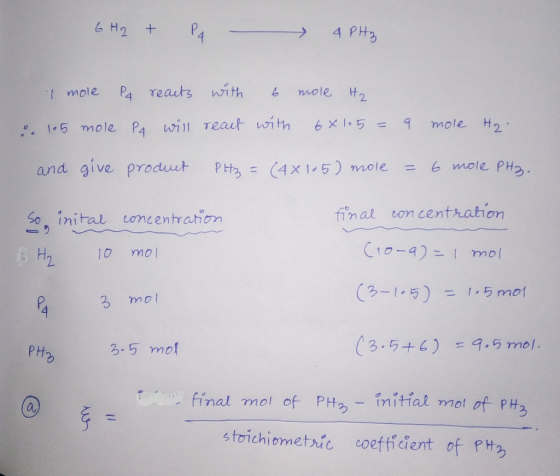
 Hence for this reaction extent
of reaction can not be 3. Maximum value it can attain is 1.67 .
Hence for this reaction extent
of reaction can not be 3. Maximum value it can attain is 1.67 .
Add Answer to:
5 5.6. The following is a reaction with its initial conditions (amounts of each substance): 6H2...
An irreversible reaction A + B products is studied under conditions where the initial concentrations...
An irreversible reaction A + B products is studied under conditions where the initial concentrations of A and B are equal. Under these circumstances, a graph of ln([A]) as a function of time is linear. What is the order in A? (A) Zeroth order B) First order (C) Second order (D) The order in A cannot be determined based on the information given. Doesn't the first order reaction kinetics say that the graph of ln[A] vs t gives a...
The general form of a chemical reaction is aA + bB = cC +dD Where A...
The general form of a chemical reaction is aA + bB = cC +dD Where A and B are reactants in the forward direction and C and D are products in the forward direction. The lower case letters are the stoichiometric coefficients for the balanced equation. The general form of the equilibrium constant equation is then: Keq = [C]c[D]d/[A]a[B]b Part I: Q vs. K Q: reaction quotient can be calculated for a reaction at any concentration values of reactants and...
Consider the following reaction for Questions 1.3 and answer the questions based upon this GU u...
 Consider the following reaction for Questions 1.3 and answer the questions based upon this GU u IIULS reaction: CÓ (g) + 3 H (g) + CH4 (g) + H2O (G) 1. At 25°C, Keq=4.0. What must be the Co] at equilibrium If the equilibrium concentrations of [H.]= 2.0M. (CH) = 5.0M, and (HO) = 3.OM? Answer: 0.469 M The ICE table is a way to keep track of what is happening in the reaction vessel. The initial concentrations if given...
1: Consider the following set of data ccollected for a reaction of the form A -->...
1: Consider the following set of data ccollected for a reaction of the form A --> products. time (seconds) [A] (M) 0 1.000 10 0.641 20 0.472 30 0.373 40 0.309 50 0.263 A: What is the average rate of the reaction for the first 10 seconds? rate = ___ M/s B: What is the average rate of the reaction between 30 and 40 seconds? rate = ___ M/s 2: Consider the dimerization of C4H6: 2 C4H6 --> C8H12 for...
Problem Set 7 Stoichiometry Calculations Name: Date: Lab Section: General Instructions: Complete the following problems, Circle...
 Problem Set 7 Stoichiometry Calculations Name: Date: Lab Section: General Instructions: Complete the following problems, Circle answers and show all work on separate sheet(s) of paper. 5 problems will be chosen randomly for assessing a score on this assignment. Assignment is due at the end of the lab period. 1.) 5.0 g of magnesium metal is burned in excess oxygen to produce magnesium oxide. (a) Write a balanced chemical equation for this reaction with the correct phases of all substances...
Chapter 1 Question#1 (9 points) The following temperatures and weather conditions were reported for a particular...
 Chapter 1 Question#1 (9 points) The following temperatures and weather conditions were reported for a particular summer day Highl-Low T condition 92 City Chicago Dallas-Ft.Worth clear 89 72cloudy clear Honolulu Los Angeles 70 80 New York City90 69 a. How many elements are in the above data set? b. How many variables are in this data set? c. Which variables are categorical, and which are quantitative variables? d. What percentage of the cities had clear weather conditions? rain Question #19...
Create graphs for Figures 1-4 (circled on pages 111 & 114) based on the data given in Tables ...
 Create graphs for Figures 1-4 (circled on pages 111 & 114)
based on the data given in Tables 2 & 4.
Lab # 8 Cellular Respiration and Fermentation I. Goals and Objectives At the completion of this laboratory exercise, students will be able to: A Differentiate between the intermediates and products of fermentation versus acrobic cellular respiration in yeast. Relate rates of fermentation with sugar availability in yeast. Utilize a reduction-oxidation dye to determine the effect of varying yeast concentration...
Create graphs for Figures 1-4 (circled on pages 111 & 114)
based on the data given in Tables 2 & 4.
Lab # 8 Cellular Respiration and Fermentation I. Goals and Objectives At the completion of this laboratory exercise, students will be able to: A Differentiate between the intermediates and products of fermentation versus acrobic cellular respiration in yeast. Relate rates of fermentation with sugar availability in yeast. Utilize a reduction-oxidation dye to determine the effect of varying yeast concentration...
The following questions are from an experiment titled Friedel-Crafts Alkylation for Organic Chemistry II Lab. There...
 The following questions are from an experiment titled
Friedel-Crafts Alkylation for Organic Chemistry II Lab. There are
pictures attached of the lab manual.
2) Is this method a good route for the preparation of
p-sec-butyltoulene? Give reasons for your answer.
3) Why do you use a large excess of toulene. What are its
functions?
4) What is the purpose for adding the hydrochloric acid to the
water in the separatory funnel in step 5? Hint: If no acid is
added,...
The following questions are from an experiment titled
Friedel-Crafts Alkylation for Organic Chemistry II Lab. There are
pictures attached of the lab manual.
2) Is this method a good route for the preparation of
p-sec-butyltoulene? Give reasons for your answer.
3) Why do you use a large excess of toulene. What are its
functions?
4) What is the purpose for adding the hydrochloric acid to the
water in the separatory funnel in step 5? Hint: If no acid is
added,...
Please answer all the blanks (volume if H2 and everything in analysis). TIA! Data 5 1...
 Please answer all the blanks (volume if H2 and
everything in analysis). TIA!
Data 5 1 oong 0.00 10.5ml 2 o.olag 0.00 11.0 Trial 3 o.org 0.00 12.00 o Daag o.albg 0.00 10.0 ml 11.5ml Mass of Mg (g) Initial volume of Syringe (mL) Final volume of Syringe (mL) Volume of H (mL) Barometric pressure (torr) Ambient temperature (°C) Vapor pressure of H2O (torr) 779.314har 23. Oi 21.0 forr TA.314tar 23.0c 179.3 14ton 23.0¢ 779.314 ton 23.0c 779.31472 23.0c 21.0...
Please answer all the blanks (volume if H2 and
everything in analysis). TIA!
Data 5 1 oong 0.00 10.5ml 2 o.olag 0.00 11.0 Trial 3 o.org 0.00 12.00 o Daag o.albg 0.00 10.0 ml 11.5ml Mass of Mg (g) Initial volume of Syringe (mL) Final volume of Syringe (mL) Volume of H (mL) Barometric pressure (torr) Ambient temperature (°C) Vapor pressure of H2O (torr) 779.314har 23. Oi 21.0 forr TA.314tar 23.0c 179.3 14ton 23.0¢ 779.314 ton 23.0c 779.31472 23.0c 21.0...
just one example/demonstration! Data needed to be calculated is in highlighted in green boxes. And I...
 just one example/demonstration!
Data needed to be calculated is in highlighted in green boxes.
And I highlighted in red an equation (not sure if thats what you
use to calculate it) And ignore the lab instructions on completeing
a graph!! I already know how to do that in excel, just curious how
Ln (relative rate) and 1/T in K^-1 is calculated by hand*
here is the rest of that lab leading up to the question as I
know its typically...
just one example/demonstration!
Data needed to be calculated is in highlighted in green boxes.
And I highlighted in red an equation (not sure if thats what you
use to calculate it) And ignore the lab instructions on completeing
a graph!! I already know how to do that in excel, just curious how
Ln (relative rate) and 1/T in K^-1 is calculated by hand*
here is the rest of that lab leading up to the question as I
know its typically...
 Consider the following reaction for Questions 1.3 and answer the questions based upon this GU u IIULS reaction: CÓ (g) + 3 H (g) + CH4 (g) + H2O (G) 1. At 25°C, Keq=4.0. What must be the Co] at equilibrium If the equilibrium concentrations of [H.]= 2.0M. (CH) = 5.0M, and (HO) = 3.OM? Answer: 0.469 M The ICE table is a way to keep track of what is happening in the reaction vessel. The initial concentrations if given...
 Problem Set 7 Stoichiometry Calculations Name: Date: Lab Section: General Instructions: Complete the following problems, Circle answers and show all work on separate sheet(s) of paper. 5 problems will be chosen randomly for assessing a score on this assignment. Assignment is due at the end of the lab period. 1.) 5.0 g of magnesium metal is burned in excess oxygen to produce magnesium oxide. (a) Write a balanced chemical equation for this reaction with the correct phases of all substances...
 Chapter 1 Question#1 (9 points) The following temperatures and weather conditions were reported for a particular summer day Highl-Low T condition 92 City Chicago Dallas-Ft.Worth clear 89 72cloudy clear Honolulu Los Angeles 70 80 New York City90 69 a. How many elements are in the above data set? b. How many variables are in this data set? c. Which variables are categorical, and which are quantitative variables? d. What percentage of the cities had clear weather conditions? rain Question #19...
 Create graphs for Figures 1-4 (circled on pages 111 & 114)
based on the data given in Tables 2 & 4.
Lab # 8 Cellular Respiration and Fermentation I. Goals and Objectives At the completion of this laboratory exercise, students will be able to: A Differentiate between the intermediates and products of fermentation versus acrobic cellular respiration in yeast. Relate rates of fermentation with sugar availability in yeast. Utilize a reduction-oxidation dye to determine the effect of varying yeast concentration...
Create graphs for Figures 1-4 (circled on pages 111 & 114)
based on the data given in Tables 2 & 4.
Lab # 8 Cellular Respiration and Fermentation I. Goals and Objectives At the completion of this laboratory exercise, students will be able to: A Differentiate between the intermediates and products of fermentation versus acrobic cellular respiration in yeast. Relate rates of fermentation with sugar availability in yeast. Utilize a reduction-oxidation dye to determine the effect of varying yeast concentration...
 The following questions are from an experiment titled
Friedel-Crafts Alkylation for Organic Chemistry II Lab. There are
pictures attached of the lab manual.
2) Is this method a good route for the preparation of
p-sec-butyltoulene? Give reasons for your answer.
3) Why do you use a large excess of toulene. What are its
functions?
4) What is the purpose for adding the hydrochloric acid to the
water in the separatory funnel in step 5? Hint: If no acid is
added,...
The following questions are from an experiment titled
Friedel-Crafts Alkylation for Organic Chemistry II Lab. There are
pictures attached of the lab manual.
2) Is this method a good route for the preparation of
p-sec-butyltoulene? Give reasons for your answer.
3) Why do you use a large excess of toulene. What are its
functions?
4) What is the purpose for adding the hydrochloric acid to the
water in the separatory funnel in step 5? Hint: If no acid is
added,...
 Please answer all the blanks (volume if H2 and
everything in analysis). TIA!
Data 5 1 oong 0.00 10.5ml 2 o.olag 0.00 11.0 Trial 3 o.org 0.00 12.00 o Daag o.albg 0.00 10.0 ml 11.5ml Mass of Mg (g) Initial volume of Syringe (mL) Final volume of Syringe (mL) Volume of H (mL) Barometric pressure (torr) Ambient temperature (°C) Vapor pressure of H2O (torr) 779.314har 23. Oi 21.0 forr TA.314tar 23.0c 179.3 14ton 23.0¢ 779.314 ton 23.0c 779.31472 23.0c 21.0...
Please answer all the blanks (volume if H2 and
everything in analysis). TIA!
Data 5 1 oong 0.00 10.5ml 2 o.olag 0.00 11.0 Trial 3 o.org 0.00 12.00 o Daag o.albg 0.00 10.0 ml 11.5ml Mass of Mg (g) Initial volume of Syringe (mL) Final volume of Syringe (mL) Volume of H (mL) Barometric pressure (torr) Ambient temperature (°C) Vapor pressure of H2O (torr) 779.314har 23. Oi 21.0 forr TA.314tar 23.0c 179.3 14ton 23.0¢ 779.314 ton 23.0c 779.31472 23.0c 21.0...
 just one example/demonstration!
Data needed to be calculated is in highlighted in green boxes.
And I highlighted in red an equation (not sure if thats what you
use to calculate it) And ignore the lab instructions on completeing
a graph!! I already know how to do that in excel, just curious how
Ln (relative rate) and 1/T in K^-1 is calculated by hand*
here is the rest of that lab leading up to the question as I
know its typically...
just one example/demonstration!
Data needed to be calculated is in highlighted in green boxes.
And I highlighted in red an equation (not sure if thats what you
use to calculate it) And ignore the lab instructions on completeing
a graph!! I already know how to do that in excel, just curious how
Ln (relative rate) and 1/T in K^-1 is calculated by hand*
here is the rest of that lab leading up to the question as I
know its typically...
Most questions answered within 3 hours.
-
Where is the error in this code sequence?
String s1 = "Hello";
String s2 = "ello";...
asked 10 months ago -
Financial data for Joel de Paris, Inc., for last year
follow:
Joel de Paris, Inc.
Balance...
asked 10 months ago -
Consider this reaction:
Al2(SO4)3 (aq)+ BaCl3
(aq) Al2Cl6 (aq)- +
3BaSO4(s) . What is the...
asked 10 months ago -
Suppose that Savneet is considering increasing her
recent random sample from 20 car rentals to 40...
asked 10 months ago -
Trucks arrive at an unloading terminal at an average rate of 120
per hour.
Trucks arrive...
asked 10 months ago -
Why are methanol and ethanol completely soluble in water while
octanol is not very little soluble....
asked 10 months ago -
A facilities manager at a university reads in a research report
that the mean amount of...
asked 10 months ago -
When the CuSO4 is rehydrated by adding water to the anhydrous
compound, is this an endothermic...
asked 10 months ago -
A ray of sunlight is passing from diamond into crown glass; the
angle of incidence is...
asked 10 months ago -
A block of mass 0.249 kg is placed on top of a light, vertical
spring of...
asked 10 months ago -
how do the kidneys compensate in the presences of acidosis
a) trigger hyperventilate
b) reserve acid...
asked 10 months ago -
Question 501 pts
The rental rate of capital to the firm increases. Which of the
following...
asked 10 months ago