An irreversible reaction A + B products is studied under conditions where the initial concentrations...
An irreversible reaction A + B products is studied under conditions where the initial concentrations of A and B are equal. Under these circumstances, a graph of ln([A]) as a function of time is linear. What is the order in A?
(A) Zeroth order
B) First order
(C) Second order
(D) The order in A cannot be determined based on the information given.
Doesn't the first order reaction kinetics say that the graph of ln[A] vs t gives a straight line if the reaction is in first order? The form of the equation in ln[A] = -kt + ln[A0]. This tells us that the reaction is in first order with k as the rate constant. So why can't the order be determined based on the given information? Please explain how this question defies first order reaction kinetics. Another response that I got was that the graph could have a positive slope, but that wouldn't be possible as the concentration of the reactent must decrease! Please help. Thanks
Note: The correct answer is D not B. I am confused as to why the answer is D and not B. Can someone please explain? The answer is not B. It is D.
Homework Answers

Add Answer to:
An irreversible reaction A + B products is studied under
conditions where the initial concentrations...
Please show work and explain: The reaction A + B → C is studied similarly to...
Please show work and explain: The reaction A + B → C is studied similarly to our study of phenolphthalein fading kinetics. The corresponding rate law is Rate = k[A]m[B]m In this particular experiment, the concentration of A is sufficiently high that the pseudo-order rate law: Rate = k1[B]n can be written, where k1 = k[A]m. If the study establishes that the reaction is first order in B (n = 1) and that the pseudo rate constant k1 has the...
What kind of kinetics is observed in an enzymatic reaction, under conditions where the substrate concentration...
What kind of kinetics is observed in an enzymatic reaction, under conditions where the substrate concentration is much higher with respect to KM ([S] >> KM)? Assume that a monomeric and non-allosteric enzyme is considered. A. Cooperative B. First Order C. Zero Order D. The systerm is at equilibrium and no reaction occures E. Second Order
3) Enzyme kinetics are determined under initial rate conditions, wherein the initial substrate concentrations changes very...
3) Enzyme kinetics are determined under initial rate conditions, wherein the initial substrate concentrations changes very little, because: (A) Products do not accumulate and inhibit the forward reaction (B) Enzymes are unstable under most assay conditions, and rapidly lose activity (C) The substrate concentration does not change appreciably and so does not create an additional variable (D) All of the above (E) Some of the above
1) A stoichiometric reaction is . Initial concentrations of A and B are each 1 M....
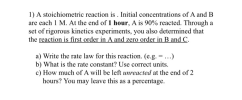 1) A stoichiometric reaction is . Initial concentrations of A and B are each 1 M. At the end of 1 hour, A is 90% reacted. Through a set of rigorous kinetics experiments, you also determined that the reaction is first order in A and zero order in B and C. a) Write the rate law for this reaction. (e.g. = ...) b) What is the rate constant? Use correct units. c) How much of A will be left unreacted...
CHM 1046 Workbook Florida International University 1) The isomerization reaction shown below follows first order kinetics...
 CHM 1046 Workbook Florida International University 1) The isomerization reaction shown below follows first order kinetics at 500 K CH,NC (g) CH CN (g) a) Use the rate constant you determined in example 3 on page 4 to determine the half life of this reaction. o53 t Va- 657メ10 b) Use the half life you just determined to predit how long it will take for the concentration of CH3NC to reach 25% of its original value? Compare the answer you...
The kinetics of the rvaction between NO and H2 was fully studied First the order of...
 The kinetics of the rvaction between NO and H2 was fully studied First the order of the reaction with respect to I112] was determined using the inital rate method- Question 19 Second, the order of the reaction with respect ot [NOI was determined using the graphs of the integrated rate equations Question 20 Thied, a mechanism was peuposed, and must be validated -Question 21. Fourth, Write the rate law- Question 22 19) The fellowing data were oblained for [H21 when...
The integrated rate laws for zero-, first-, and second-order reaction may be arranged such that they...
The integrated rate laws for zero-, first-, and second-order reaction may be arranged such that they resemble the equation for a straight line, y=mx+by=mx+b. Order Integrated Rate Law Graph Slope 0 [A]=−kt+[A]0[A]=−kt+[A]0 [A] vs. t[A] vs. t −k 1 ln[A]=−kt+ln[A]0ln[A]=−kt+ln[A]0 ln[A] vs. tln[A] vs. t −k 2 1[A]= kt+1[A]01[A]= kt+1[A]0 1[A] vs. t1[A] vs. t k Part A The reactant concentration in a zero-order reaction was 8.00×10⁻² MM after 130 ss and 4.00×10⁻² MM after 380 ss . What is...
The integrated rate laws for zero-, first-, and second-order reaction may be arranged such that they...
The integrated rate laws for zero-, first-, and second-order reaction may be arranged such that they resemble the equation for a straight line, y=mx+by=mx+b. Order Integrated Rate Law Graph Slope 0 [A]=−kt+[A]0[A]=−kt+[A]0 [A] vs. t[A] vs. t −k−k 1 ln[A]=−kt+ln[A]0ln[A]=−kt+ln[A]0 ln[A] vs. tln[A] vs. t −k−k 2 1[A]= kt+1[A]01[A]= kt+1[A]0 1[A] vs. t1[A] vs. t kk A.) The reactant concentration in a zero-order reaction was 0.100 MM after 165 ss and 4.00×10⁻² MM after 305 ss . What is the...
B) Consider the series reaction A R S that we studied in lecture, where both reactions...
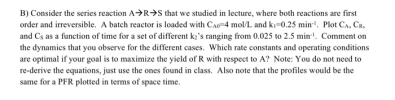 B) Consider the series reaction A R S that we studied in lecture, where both reactions are first order and irreversible. A batch reactor is loaded with Cao=4 mol/L and k1=0.25 min!. Plot CA, CR, and Cs as a function of time for a set of different ka's ranging from 0.025 to 2.5 min!. Comment on the dynamics that you observe for the different cases. Which rate constants and operating conditions are optimal if your goal is to maximize the...
Thanks in advance please just Question A , b and c please this is chemistry based...
 Thanks in advance
please just Question A , b and c
please this is chemistry based on kinetics
there's no other subject
please if you don't know the calculation based on that
question, allow other experts to help out for the solutions
Thanks in advance
Helpful Hints: Arrhenius Equation: k =
Ae–Ea/RT Gas Constant: R = 8.314 J/mol·K
Integrated Rate Laws and Half-Lives:
• Zero order: [A] = –kt + [A]0 t1/2 = [A]0/2k
• First order: ln[A] = –kt...
Thanks in advance
please just Question A , b and c
please this is chemistry based on kinetics
there's no other subject
please if you don't know the calculation based on that
question, allow other experts to help out for the solutions
Thanks in advance
Helpful Hints: Arrhenius Equation: k =
Ae–Ea/RT Gas Constant: R = 8.314 J/mol·K
Integrated Rate Laws and Half-Lives:
• Zero order: [A] = –kt + [A]0 t1/2 = [A]0/2k
• First order: ln[A] = –kt...
 1) A stoichiometric reaction is . Initial concentrations of A and B are each 1 M. At the end of 1 hour, A is 90% reacted. Through a set of rigorous kinetics experiments, you also determined that the reaction is first order in A and zero order in B and C. a) Write the rate law for this reaction. (e.g. = ...) b) What is the rate constant? Use correct units. c) How much of A will be left unreacted...
 CHM 1046 Workbook Florida International University 1) The isomerization reaction shown below follows first order kinetics at 500 K CH,NC (g) CH CN (g) a) Use the rate constant you determined in example 3 on page 4 to determine the half life of this reaction. o53 t Va- 657メ10 b) Use the half life you just determined to predit how long it will take for the concentration of CH3NC to reach 25% of its original value? Compare the answer you...
 The kinetics of the rvaction between NO and H2 was fully studied First the order of the reaction with respect to I112] was determined using the inital rate method- Question 19 Second, the order of the reaction with respect ot [NOI was determined using the graphs of the integrated rate equations Question 20 Thied, a mechanism was peuposed, and must be validated -Question 21. Fourth, Write the rate law- Question 22 19) The fellowing data were oblained for [H21 when...
 B) Consider the series reaction A R S that we studied in lecture, where both reactions are first order and irreversible. A batch reactor is loaded with Cao=4 mol/L and k1=0.25 min!. Plot CA, CR, and Cs as a function of time for a set of different ka's ranging from 0.025 to 2.5 min!. Comment on the dynamics that you observe for the different cases. Which rate constants and operating conditions are optimal if your goal is to maximize the...
 Thanks in advance
please just Question A , b and c
please this is chemistry based on kinetics
there's no other subject
please if you don't know the calculation based on that
question, allow other experts to help out for the solutions
Thanks in advance
Helpful Hints: Arrhenius Equation: k =
Ae–Ea/RT Gas Constant: R = 8.314 J/mol·K
Integrated Rate Laws and Half-Lives:
• Zero order: [A] = –kt + [A]0 t1/2 = [A]0/2k
• First order: ln[A] = –kt...
Thanks in advance
please just Question A , b and c
please this is chemistry based on kinetics
there's no other subject
please if you don't know the calculation based on that
question, allow other experts to help out for the solutions
Thanks in advance
Helpful Hints: Arrhenius Equation: k =
Ae–Ea/RT Gas Constant: R = 8.314 J/mol·K
Integrated Rate Laws and Half-Lives:
• Zero order: [A] = –kt + [A]0 t1/2 = [A]0/2k
• First order: ln[A] = –kt...
Most questions answered within 3 hours.
-
Where is the error in this code sequence?
String s1 = "Hello";
String s2 = "ello";...
asked 10 months ago -
Financial data for Joel de Paris, Inc., for last year
follow:
Joel de Paris, Inc.
Balance...
asked 10 months ago -
Consider this reaction:
Al2(SO4)3 (aq)+ BaCl3
(aq) Al2Cl6 (aq)- +
3BaSO4(s) . What is the...
asked 10 months ago -
Suppose that Savneet is considering increasing her
recent random sample from 20 car rentals to 40...
asked 10 months ago -
Trucks arrive at an unloading terminal at an average rate of 120
per hour.
Trucks arrive...
asked 10 months ago -
Why are methanol and ethanol completely soluble in water while
octanol is not very little soluble....
asked 10 months ago -
A facilities manager at a university reads in a research report
that the mean amount of...
asked 10 months ago -
When the CuSO4 is rehydrated by adding water to the anhydrous
compound, is this an endothermic...
asked 10 months ago -
A ray of sunlight is passing from diamond into crown glass; the
angle of incidence is...
asked 10 months ago -
A block of mass 0.249 kg is placed on top of a light, vertical
spring of...
asked 10 months ago -
how do the kidneys compensate in the presences of acidosis
a) trigger hyperventilate
b) reserve acid...
asked 10 months ago -
Question 501 pts
The rental rate of capital to the firm increases. Which of the
following...
asked 10 months ago