
Homework Answers
Add Answer to:
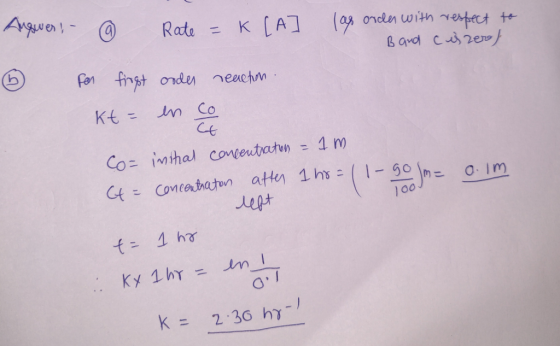
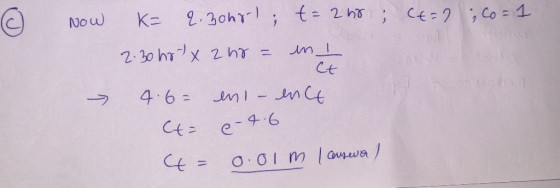
1) A stoichiometric reaction is . Initial concentrations of A and B are each 1 M....
An irreversible reaction A + B products is studied under conditions where the initial concentrations...
An irreversible reaction A + B products is studied under conditions where the initial concentrations of A and B are equal. Under these circumstances, a graph of ln([A]) as a function of time is linear. What is the order in A? (A) Zeroth order B) First order (C) Second order (D) The order in A cannot be determined based on the information given. Doesn't the first order reaction kinetics say that the graph of ln[A] vs t gives a...
For the reaction A+B+C→D+E, the initial reaction rate was measured for various initial concentrations of reactants....
For the reaction A+B+C→D+E, the initial reaction rate was measured for various initial concentrations of reactants. The following data were collected: Trial [A] (M) [B] (M) [C] (M) Initial rate (M/s) 1 0.40 0.40 0.40 1.2×10⁻⁴ 2 0.40 0.40 1.20 3.6×10⁻⁴ 3 0.80 0.40 0.40 4.8×10⁻⁴ 4 0.80 0.80 0.40 4.8×10⁻⁴ Rate law equation The rate of a chemical reaction depends on the concentrations of the reactants. For the general reaction between A and B, aA+bB⇌cC+dD The dependence of the...
For the reaction A+B+C→D+E, the initial reaction rate was measured for various initial concentrations of reactants....
For the reaction A+B+C→D+E, the initial reaction rate was measured for various initial concentrations of reactants. The following data were collected: Trial [A] (M) [B] (M) [C] (M) Initial rate (M/s) 1 0.40 0.40 0.40 1.2×10⁻⁴ 2 0.40 0.40 1.20 3.6×10⁻⁴ 3 0.80 0.40 0.40 4.8×10⁻⁴ 4 0.80 0.80 0.40 4.8×10⁻⁴ Rate law equation The rate of a chemical reaction depends on the concentrations of the reactants. For the general reaction between Aand B, aA+bB⇌cC+dD The dependence of the reaction...
Consider the following reaction: A+B→C+D The initial concentrations of the reactants A and B are 0.220...
Consider the following reaction: A+B→C+D The initial concentrations of the reactants A and B are 0.220 M and 0.320 M, respectively. The rate of reaction is 0.060 M⋅S-1, and the orders of the reaction, with respect to reactants A and B, are 1 and 2, respectively. Determine the rate constant (k) for the reaction using the rate law. Express your answer in M-2⋅S-1 to three significant figures.
For the reaction A+B+C→D+E, the initial reaction rate was measured for various initial concentrations of reactants....
For the reaction A+B+C→D+E, the initial reaction rate was measured for various initial concentrations of reactants. What is the reaction order with respect to B? Also, how do you find the value of the rate constant k for this reaction? Trial [A] (M) [B] (M) [C] (M) Initial rate (M/s) 1 0.30 0.30 0.30 9.0×10⁻⁵ 2 0.30 0.30 0.90 2.7×10⁻⁴ 3 0.60 0.30 0.30 3.6×10⁻⁴ 4 0.60 0.60 0.30 3.6×10⁻⁴
O) For the reaction the liquid phase A+2BC+D Stoichiometric proportion mixture of A and B was...
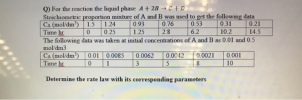 O) For the reaction the liquid phase A+2BC+D Stoichiometric proportion mixture of A and B was used to get the following data CA (moldn')11.5 | 1.24 |093 |076 | 0.53 | 0.31 | 0.21 Time hr The following data was taken at initial concentrations of A and B as 0.01 and 0.5 mol/dm3 CA (mol/dm 0.01 0.0085 0,0062 0.0042 00021 0001 Time hr 0 1 358 10 0 0.25 125 2.8 6.2 10.2 14.5 Determine the rate law with its...
How to calculate unreacted concentration of A at 2hr when rate = k[A]1[B]0 (first order A,...
How to calculate unreacted concentration of A at 2hr when rate = k[A]1[B]0 (first order A, zero order B) ? A + B --> C, 1hr: A 75% reacted
Please show work and explain: The reaction A + B → C is studied similarly to...
Please show work and explain: The reaction A + B → C is studied similarly to our study of phenolphthalein fading kinetics. The corresponding rate law is Rate = k[A]m[B]m In this particular experiment, the concentration of A is sufficiently high that the pseudo-order rate law: Rate = k1[B]n can be written, where k1 = k[A]m. If the study establishes that the reaction is first order in B (n = 1) and that the pseudo rate constant k1 has the...
6. Consider the overall reaction A+B+C. Three experiments were performed at 325°C to determine the rate...
 6. Consider the overall reaction A+B+C. Three experiments were performed at 325°C to determine the rate law by changing the initial concentrations of A and B. The results are tabulated below: Experiment # [A]. (M) [B]. (M) Initial Rate (M/s) 1 1.20 3.00 0.403 2 1.20 6.00 0.285 3 3.60 3.00 1.21 A. Determine the order of the reaction for A and B. You must explain your reasoning or show your work. (12 points) Reaction order of A = Reaction...
Ulemist CHM 4L. Report on Exp. 6 Page 225 Last Name: Post Lab Problem 2 (10...
 Ulemist CHM 4L. Report on Exp. 6 Page 225 Last Name: Post Lab Problem 2 (10 points). Initial concentrations and rates for the balanced reaction: raten (Al M 18). M a +bB products exp.#1: 16 2.0 | 20 exp #2 are collected in three experiments in the Table on the right What are: (a) the orders in A and B hl the overall order of the reaction, and (c) the rate constant? Enter your detailed solution below and answers in...
 O) For the reaction the liquid phase A+2BC+D Stoichiometric proportion mixture of A and B was used to get the following data CA (moldn')11.5 | 1.24 |093 |076 | 0.53 | 0.31 | 0.21 Time hr The following data was taken at initial concentrations of A and B as 0.01 and 0.5 mol/dm3 CA (mol/dm 0.01 0.0085 0,0062 0.0042 00021 0001 Time hr 0 1 358 10 0 0.25 125 2.8 6.2 10.2 14.5 Determine the rate law with its...
 6. Consider the overall reaction A+B+C. Three experiments were performed at 325°C to determine the rate law by changing the initial concentrations of A and B. The results are tabulated below: Experiment # [A]. (M) [B]. (M) Initial Rate (M/s) 1 1.20 3.00 0.403 2 1.20 6.00 0.285 3 3.60 3.00 1.21 A. Determine the order of the reaction for A and B. You must explain your reasoning or show your work. (12 points) Reaction order of A = Reaction...
 Ulemist CHM 4L. Report on Exp. 6 Page 225 Last Name: Post Lab Problem 2 (10 points). Initial concentrations and rates for the balanced reaction: raten (Al M 18). M a +bB products exp.#1: 16 2.0 | 20 exp #2 are collected in three experiments in the Table on the right What are: (a) the orders in A and B hl the overall order of the reaction, and (c) the rate constant? Enter your detailed solution below and answers in...
Most questions answered within 3 hours.
-
Where is the error in this code sequence?
String s1 = "Hello";
String s2 = "ello";...
asked 10 months ago -
Financial data for Joel de Paris, Inc., for last year
follow:
Joel de Paris, Inc.
Balance...
asked 10 months ago -
Consider this reaction:
Al2(SO4)3 (aq)+ BaCl3
(aq) Al2Cl6 (aq)- +
3BaSO4(s) . What is the...
asked 10 months ago -
Suppose that Savneet is considering increasing her
recent random sample from 20 car rentals to 40...
asked 10 months ago -
Trucks arrive at an unloading terminal at an average rate of 120
per hour.
Trucks arrive...
asked 10 months ago -
Why are methanol and ethanol completely soluble in water while
octanol is not very little soluble....
asked 10 months ago -
A facilities manager at a university reads in a research report
that the mean amount of...
asked 10 months ago -
When the CuSO4 is rehydrated by adding water to the anhydrous
compound, is this an endothermic...
asked 10 months ago -
A ray of sunlight is passing from diamond into crown glass; the
angle of incidence is...
asked 10 months ago -
A block of mass 0.249 kg is placed on top of a light, vertical
spring of...
asked 10 months ago -
how do the kidneys compensate in the presences of acidosis
a) trigger hyperventilate
b) reserve acid...
asked 10 months ago -
Question 501 pts
The rental rate of capital to the firm increases. Which of the
following...
asked 10 months ago