1.As product differentiation decreases, ________ increases. markup demand inelasticity marginal cost excess capacity
1.As product differentiation decreases, ________ increases.
| markup |
| demand inelasticity |
| marginal cost |
| excess capacity |
Homework Answers
1. Correct option: Demand inelasticity
Reason: A decrease in product differentiation will leave consumers with less options to chose from. This will reduce their elasticity of demand for goods and make the demand inelastic in nature as the market for that good becomes narrower.
Add Answer to:
1.As product differentiation decreases, ________ increases.
markup
demand inelasticity
marginal cost
excess capacity
As product differentiation decreases, ________ increases. a markup b demand inelasticity c marginal cost d demand...
As product differentiation decreases, ________ increases. a markup b demand inelasticity c marginal cost d demand elasticity e excess capacity A monopolistically competitive firm is inefficient because the firm a is not maximizing its profit. b earns positive economic profit in the long run. c produces an output where average total cost is not minimum. d produces where price is equal to minimum average total cost. e is producing at an output amount that corresponds to marginal cost equal to...
If the demand for a monopolist's product increases, its A. marginal revenue decreases, making it more...
If the demand for a monopolist's product increases, its A. marginal revenue decreases, making it more profitable to hire more workers. B. marginal revenue increases, making it more profitable to hire fewer workers. C. marginal revenue increases, making it more profitable to hire more workers. D. marginal revenue decreases, making it more profitable to hire fewer workers.
Ceteris paribus, when ticket prices fall: Total revenue product increases. Marginal revenue product decreases. Marginal revenue...
Ceteris paribus, when ticket prices fall: Total revenue product increases. Marginal revenue product decreases. Marginal revenue product increases. Marginal revenue product is unaffected.
1. What is the markup for this firm? $_______ 2. What is this firm's excess capacity?
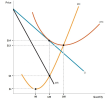 1. What is the markup for this firm? $_______
2. What is this firm's excess capacity?
1. What is the markup for this firm? $_______
2. What is this firm's excess capacity?
When demand is more elastic in an oligopolistic industry the markup over marginal cost is smaller....
When demand is more elastic in an oligopolistic industry the markup over marginal cost is smaller. True / False
1. In the short run, the marginal product of labor increases then decreases because of what?...
1. In the short run, the marginal product of labor increases then decreases because of what? 2. Assume that Al's paint shop operates in a perfectly competitive market and its total cost is given by TC=150+240Q-12Q^2+2Q^3. The level of output that minimizes the average variable cost is? (Explain Answer) A. 0 B. 6 C. 4 D.3 3. The price level at which "Al's paint shop" will decide to shut down is? A. $1,032 B. $200 C. $222 (Answer but need...
A) As price increases, demand increases. B) As price increases, demand decreases. C) As demand increases,...
 A) As price increases, demand increases. B) As price increases, demand decreases. C) As demand increases, profit decreases. D) As price decreases, demand decreases. 2. One way a company can perform "what if budget analysis is by preparing a flexible bu A) True B) False 3. Budgeting often involves both monetary and nonmonetary measures of performance. A) True B) False 4. Which of the following budgets is prepared first? A) Cash budget B) Production budget C) Budgeted balance sheet D)...
(micro economics) Explain why marginal product first increases and then decreases, i.e., explain the law of diminishin...
(micro economics) Explain why marginal product first increases and then decreases, i.e., explain the law of diminishing product.
A factor that decreases marginal cost will decrease average cost, but a factor that decreases average...
A factor that decreases marginal cost will decrease average cost, but a factor that decreases average cost will not necessarily decrease marginal cost . As output increases, average fixed costs decrease. True or false for both parts and why
If the marginal product of labor (MPL) increases when more labor is employed, then A. the...
If the marginal product of labor (MPL) increases when more labor is employed, then A. the marginal cost (MC) increases when output increases. B. the marginal cost (MC) does not change when output increases. C. the marginal cost (MC) decreases when output increases. D. Any of the above answers might be correct depending on how the average variable cost (AVC) changes when output increases.
 1. What is the markup for this firm? $_______
2. What is this firm's excess capacity?
1. What is the markup for this firm? $_______
2. What is this firm's excess capacity?
 A) As price increases, demand increases. B) As price increases, demand decreases. C) As demand increases, profit decreases. D) As price decreases, demand decreases. 2. One way a company can perform "what if budget analysis is by preparing a flexible bu A) True B) False 3. Budgeting often involves both monetary and nonmonetary measures of performance. A) True B) False 4. Which of the following budgets is prepared first? A) Cash budget B) Production budget C) Budgeted balance sheet D)...
Most questions answered within 3 hours.
-
Where is the error in this code sequence?
String s1 = "Hello";
String s2 = "ello";...
asked 10 months ago -
Financial data for Joel de Paris, Inc., for last year
follow:
Joel de Paris, Inc.
Balance...
asked 10 months ago -
Consider this reaction:
Al2(SO4)3 (aq)+ BaCl3
(aq) Al2Cl6 (aq)- +
3BaSO4(s) . What is the...
asked 10 months ago -
Suppose that Savneet is considering increasing her
recent random sample from 20 car rentals to 40...
asked 10 months ago -
Trucks arrive at an unloading terminal at an average rate of 120
per hour.
Trucks arrive...
asked 10 months ago -
Why are methanol and ethanol completely soluble in water while
octanol is not very little soluble....
asked 10 months ago -
A facilities manager at a university reads in a research report
that the mean amount of...
asked 10 months ago -
When the CuSO4 is rehydrated by adding water to the anhydrous
compound, is this an endothermic...
asked 10 months ago -
A ray of sunlight is passing from diamond into crown glass; the
angle of incidence is...
asked 10 months ago -
A block of mass 0.249 kg is placed on top of a light, vertical
spring of...
asked 10 months ago -
how do the kidneys compensate in the presences of acidosis
a) trigger hyperventilate
b) reserve acid...
asked 10 months ago -
Question 501 pts
The rental rate of capital to the firm increases. Which of the
following...
asked 10 months ago