 Figured out the first part and
can't figure out the second - please help and show process!
Figured out the first part and
can't figure out the second - please help and show process!
Homework Answers

Add Answer to:
Figured out the first part and
can't figure out the second - please help and show...
Both parts please. Part A What must the charge (sign and magnitude) of a particle of...
 Both parts please.
Part A What must the charge (sign and magnitude) of a particle of mass 1.46 g be for it to remain stationary when placed in a downward-directed electric field of magnitude 610 N/C? Use 9.81 m/s2 for the magnitude of the acceleration due to gravity. View Available Hint(s) Submit revious Ans X Incorrect; Try Again; 3 attempts remaining Part B What is the magnitude of an electric field in which the electric force on a proton is...
Both parts please.
Part A What must the charge (sign and magnitude) of a particle of mass 1.46 g be for it to remain stationary when placed in a downward-directed electric field of magnitude 610 N/C? Use 9.81 m/s2 for the magnitude of the acceleration due to gravity. View Available Hint(s) Submit revious Ans X Incorrect; Try Again; 3 attempts remaining Part B What is the magnitude of an electric field in which the electric force on a proton is...
Need both parts A and B answered. What must the charge (sign and magnitude) of a...
 Need both parts A and B answered.
What must the charge (sign and magnitude) of a particle of mass 1.45 g be for it to remain stationary when placed in a downward-directed electric field of magnitude 650 N/C Use 9.81 m/s2 for the magnitude of the acceleration due to gravity. View Available Hint(s) Submit Part B What is the magnitude of an electric field in which the electric force on a proton is equal in magnitude to its weight? Use...
Need both parts A and B answered.
What must the charge (sign and magnitude) of a particle of mass 1.45 g be for it to remain stationary when placed in a downward-directed electric field of magnitude 650 N/C Use 9.81 m/s2 for the magnitude of the acceleration due to gravity. View Available Hint(s) Submit Part B What is the magnitude of an electric field in which the electric force on a proton is equal in magnitude to its weight? Use...
Part A What must the charge (sign and magnitude) of a particle of mass 1.41g be...
Part A What must the charge (sign and magnitude) of a particle of mass 1.41g be for it to remain stationary when placed in a downward-directed electric field of magnitude 630 N/C? Use 9.81 m/s^2 for the magnitude of the acceleration due to gravity. Part B What is the magnitude of an electric field in which the electric force on a proton is equal in magnitude to its weight? Use 1.67×10^−27 Kg for the mass of a proton, 1.60×10^−19 C...
What must the charge (sign and magnitude) of a particle of mass 1.46 g be for...
What must the charge (sign and magnitude) of a particle of mass 1.46 g be for it to remain stationary when placed in a downward-directed electric field of magnitude 630 N/C? Use 9.81 m/s^2 for the magnitude of the acceleration due to gravity. What is the magnitude of an electric field in which the electric force on a proton is equal in magnitude to its weight? Use 1.67×10⁻²⁷ kg for the mass of a proton, 1.60×10⁻¹⁹ C for the magnitude...
What is the answer to part B, and what formula should be used? t A Proton...
 What is the answer to part B, and what formula should
be used?
t A Proton between Oppositely Charged Plates 4 of 10 > Constants Part A A uniform electric field exists in the region between two oppositely charged parallel plates 1.70 cm apart. A proton is released from rest at the surface of the positively charged plate and strikes the surface of the opposite plate in a time interval 1.54x10⁻⁶ s Find the magnitude of the electric field Use...
What is the answer to part B, and what formula should
be used?
t A Proton between Oppositely Charged Plates 4 of 10 > Constants Part A A uniform electric field exists in the region between two oppositely charged parallel plates 1.70 cm apart. A proton is released from rest at the surface of the positively charged plate and strikes the surface of the opposite plate in a time interval 1.54x10⁻⁶ s Find the magnitude of the electric field Use...
A uniform electric field exists in the region between two oppositely charged parallel plates 1.56 cm...
 A uniform electric field exists in the region between two
oppositely charged parallel plates 1.56 cm apart. A proton is
released from rest at the surface of the positively charged plate
and strikes the surface of the opposite plate in a time interval
1.54×10^−6 s.
Part A Find the magnitude of the electric field. Use 1.60x10⁻¹⁹ C for the magnitude of the charge on an electron and 1.67x10⁻²⁷ kg for the mass of a proton View Available Hint(s) N/C Submit...
A uniform electric field exists in the region between two
oppositely charged parallel plates 1.56 cm apart. A proton is
released from rest at the surface of the positively charged plate
and strikes the surface of the opposite plate in a time interval
1.54×10^−6 s.
Part A Find the magnitude of the electric field. Use 1.60x10⁻¹⁹ C for the magnitude of the charge on an electron and 1.67x10⁻²⁷ kg for the mass of a proton View Available Hint(s) N/C Submit...
A Proton between Oppositely Charged Plates A uniform electric field exists in the region between two...
 A Proton between Oppositely Charged Plates A uniform electric field exists in the region between two oppositely charged parallel plates 1.55 cm apart. A proton is released from rest at the surface of the positively charged plate and strikes the surface of the opposite plate in a time interval 1.56x10⁻⁶ s. Part A Find the magnitude of the electric field. Use 1.60x10⁻¹⁹ C for the magnitude of the charge on an electron and 1.67x10⁻²⁷ kg for the mass of a...
help What must the charge (sign and magnitude) of a partide of mass 146 g be...
 help
What must the charge (sign and magnitude) of a partide of mass 146 g be for it to remain stationary when placed in a downward directed electric field of magnitude 600 N/C? Use 9.80 m/s for the magnitude of the free fall acceleration. View Available Hint(s)
help
What must the charge (sign and magnitude) of a partide of mass 146 g be for it to remain stationary when placed in a downward directed electric field of magnitude 600 N/C? Use 9.80 m/s for the magnitude of the free fall acceleration. View Available Hint(s)
w = 0.00084 J (I can't figure out the mass of the piece of fruit correctly)...
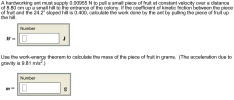 w = 0.00084 J (I can't figure
out the mass of the piece of fruit correctly)
A hardworking ant must supply 0.00955 N to pull a small piece of fruit at constant velocity over a distance of 8.80 cm up a small hill to the entrance of the colony. If the coefficient of kinetic friction between the piece of fruit and the 24.2° sloped hill is 0.400, calculate the work done by the ant by pulling the piece of fruit...
w = 0.00084 J (I can't figure
out the mass of the piece of fruit correctly)
A hardworking ant must supply 0.00955 N to pull a small piece of fruit at constant velocity over a distance of 8.80 cm up a small hill to the entrance of the colony. If the coefficient of kinetic friction between the piece of fruit and the 24.2° sloped hill is 0.400, calculate the work done by the ant by pulling the piece of fruit...
1. In a circuit with a 12.0-volt battery and an equivalent resistance of 10.0 ohm, what...
1. In a circuit with a 12.0-volt battery and an equivalent resistance of 10.0 ohm, what is the total current leaving the battery? 120. A. 1.20 A. 0.833 A. 10.0 A. 2. If a particle with a 3.0 C charge is in an electric field with magnitude 2.0 N/C, the force on the charge will have a magnitude of 1.3 N. 1.3 C2/N. 6.0 N. 0.667 N 3. A proton has a mass of 1.67x10⁻²⁷ kg and a charge of...
 Both parts please.
Part A What must the charge (sign and magnitude) of a particle of mass 1.46 g be for it to remain stationary when placed in a downward-directed electric field of magnitude 610 N/C? Use 9.81 m/s2 for the magnitude of the acceleration due to gravity. View Available Hint(s) Submit revious Ans X Incorrect; Try Again; 3 attempts remaining Part B What is the magnitude of an electric field in which the electric force on a proton is...
Both parts please.
Part A What must the charge (sign and magnitude) of a particle of mass 1.46 g be for it to remain stationary when placed in a downward-directed electric field of magnitude 610 N/C? Use 9.81 m/s2 for the magnitude of the acceleration due to gravity. View Available Hint(s) Submit revious Ans X Incorrect; Try Again; 3 attempts remaining Part B What is the magnitude of an electric field in which the electric force on a proton is...
 Need both parts A and B answered.
What must the charge (sign and magnitude) of a particle of mass 1.45 g be for it to remain stationary when placed in a downward-directed electric field of magnitude 650 N/C Use 9.81 m/s2 for the magnitude of the acceleration due to gravity. View Available Hint(s) Submit Part B What is the magnitude of an electric field in which the electric force on a proton is equal in magnitude to its weight? Use...
Need both parts A and B answered.
What must the charge (sign and magnitude) of a particle of mass 1.45 g be for it to remain stationary when placed in a downward-directed electric field of magnitude 650 N/C Use 9.81 m/s2 for the magnitude of the acceleration due to gravity. View Available Hint(s) Submit Part B What is the magnitude of an electric field in which the electric force on a proton is equal in magnitude to its weight? Use...
 What is the answer to part B, and what formula should
be used?
t A Proton between Oppositely Charged Plates 4 of 10 > Constants Part A A uniform electric field exists in the region between two oppositely charged parallel plates 1.70 cm apart. A proton is released from rest at the surface of the positively charged plate and strikes the surface of the opposite plate in a time interval 1.54x10⁻⁶ s Find the magnitude of the electric field Use...
What is the answer to part B, and what formula should
be used?
t A Proton between Oppositely Charged Plates 4 of 10 > Constants Part A A uniform electric field exists in the region between two oppositely charged parallel plates 1.70 cm apart. A proton is released from rest at the surface of the positively charged plate and strikes the surface of the opposite plate in a time interval 1.54x10⁻⁶ s Find the magnitude of the electric field Use...
 A uniform electric field exists in the region between two
oppositely charged parallel plates 1.56 cm apart. A proton is
released from rest at the surface of the positively charged plate
and strikes the surface of the opposite plate in a time interval
1.54×10^−6 s.
Part A Find the magnitude of the electric field. Use 1.60x10⁻¹⁹ C for the magnitude of the charge on an electron and 1.67x10⁻²⁷ kg for the mass of a proton View Available Hint(s) N/C Submit...
A uniform electric field exists in the region between two
oppositely charged parallel plates 1.56 cm apart. A proton is
released from rest at the surface of the positively charged plate
and strikes the surface of the opposite plate in a time interval
1.54×10^−6 s.
Part A Find the magnitude of the electric field. Use 1.60x10⁻¹⁹ C for the magnitude of the charge on an electron and 1.67x10⁻²⁷ kg for the mass of a proton View Available Hint(s) N/C Submit...
 A Proton between Oppositely Charged Plates A uniform electric field exists in the region between two oppositely charged parallel plates 1.55 cm apart. A proton is released from rest at the surface of the positively charged plate and strikes the surface of the opposite plate in a time interval 1.56x10⁻⁶ s. Part A Find the magnitude of the electric field. Use 1.60x10⁻¹⁹ C for the magnitude of the charge on an electron and 1.67x10⁻²⁷ kg for the mass of a...
 help
What must the charge (sign and magnitude) of a partide of mass 146 g be for it to remain stationary when placed in a downward directed electric field of magnitude 600 N/C? Use 9.80 m/s for the magnitude of the free fall acceleration. View Available Hint(s)
help
What must the charge (sign and magnitude) of a partide of mass 146 g be for it to remain stationary when placed in a downward directed electric field of magnitude 600 N/C? Use 9.80 m/s for the magnitude of the free fall acceleration. View Available Hint(s)
 w = 0.00084 J (I can't figure
out the mass of the piece of fruit correctly)
A hardworking ant must supply 0.00955 N to pull a small piece of fruit at constant velocity over a distance of 8.80 cm up a small hill to the entrance of the colony. If the coefficient of kinetic friction between the piece of fruit and the 24.2° sloped hill is 0.400, calculate the work done by the ant by pulling the piece of fruit...
w = 0.00084 J (I can't figure
out the mass of the piece of fruit correctly)
A hardworking ant must supply 0.00955 N to pull a small piece of fruit at constant velocity over a distance of 8.80 cm up a small hill to the entrance of the colony. If the coefficient of kinetic friction between the piece of fruit and the 24.2° sloped hill is 0.400, calculate the work done by the ant by pulling the piece of fruit...
Most questions answered within 3 hours.
-
Where is the error in this code sequence?
String s1 = "Hello";
String s2 = "ello";...
asked 10 months ago -
Financial data for Joel de Paris, Inc., for last year
follow:
Joel de Paris, Inc.
Balance...
asked 10 months ago -
Consider this reaction:
Al2(SO4)3 (aq)+ BaCl3
(aq) Al2Cl6 (aq)- +
3BaSO4(s) . What is the...
asked 10 months ago -
Suppose that Savneet is considering increasing her
recent random sample from 20 car rentals to 40...
asked 10 months ago -
Trucks arrive at an unloading terminal at an average rate of 120
per hour.
Trucks arrive...
asked 10 months ago -
Why are methanol and ethanol completely soluble in water while
octanol is not very little soluble....
asked 10 months ago -
A facilities manager at a university reads in a research report
that the mean amount of...
asked 10 months ago -
When the CuSO4 is rehydrated by adding water to the anhydrous
compound, is this an endothermic...
asked 10 months ago -
A ray of sunlight is passing from diamond into crown glass; the
angle of incidence is...
asked 10 months ago -
A block of mass 0.249 kg is placed on top of a light, vertical
spring of...
asked 10 months ago -
how do the kidneys compensate in the presences of acidosis
a) trigger hyperventilate
b) reserve acid...
asked 10 months ago -
Question 501 pts
The rental rate of capital to the firm increases. Which of the
following...
asked 10 months ago