
Homework Answers
Add Answer to:
Consider the data below for a liquid chromatography separation of four compounds, A, B, C, and...
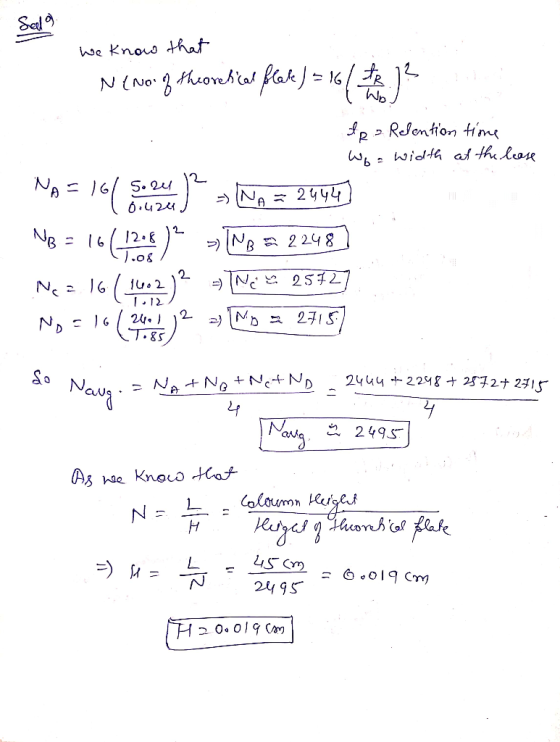
The table contains data for a liquid chromatography separation of four compounds, A, B, C, and...
 The table contains data for a liquid chromatography separation of four compounds, A, B, C, and D, on a 40.0 cm column Retention Compound time (min) Width at the base (min) A 5.17 0.436 B 1.02 13.0 15.0 C 1.10 23.4 1.91 Calculate the number of theoretical plates, N, for each peak. NA NB Nc ND = What is the average number of theoretical plates, Navg, for Navg the column? What is the plate height, H, for the column? Н-...
Consider a separation performed on a 45.0 mm long open tubular column with a 0.50 mm...
 Consider a separation performed on a 45.0 mm long open tubular column with a 0.50 mm diameter, and a 2.0 um thick stationary phase. Compound A eluted at 12.41 min, compound B eluted at 13.34 min, and the unretained solvent eluted at 1.130 min. What are the adjusted retention times, t, and retention factors, k, for compounds A and B? Number Number min Number Number min rB What is the relative retention, a, for this separation? Number roll down to...
Two isotopic compounds are produced in the synthesis of a new therapeutic drug, which must be...
 Two isotopic compounds are produced in the synthesis of a new therapeutic drug, which must be separated by repeated chromatography cycles. In each cycle, the solution containing both compounds passes through a chromatography column with a length L = 45.0 cm containing N theoretical plates. The unadjusted relative retention is y = 1.098. Calculate the number of theoretical plates, N. in the column of length L. The observed resolution is 1.82 after 14 cycles. plates Calculate the height of an...
EXERCISE 6: Two chemical species, A and B are separated by isothermal gas chromatography, using a...
 EXERCISE 6: Two chemical species, A and B are separated by isothermal gas chromatography, using a 2.00 m column having 5000 theoretical plates at a flow rate of 15.0 ml / min. The peak of unabsorbed air appears after 30 s; the peak of A appears after 5 min and that of B after 12 min (a) Calculate the dead volume VM of the column, and the retention volumes Va and VB. (b) Calculate the reduced volumes V’a and V'B...
Check An 5 of 26 > Two isotopic compounds are produced in the synthesis of a...
 Check An 5 of 26 > Two isotopic compounds are produced in the synthesis of a new therapeutic drug, which must be separated by repeated chromatography cycles. In each cycle, the solution containing both compounds passes through a chromatography column with a length L 25.0 cm containing N theoretical plates. The unadjusted relative retention is y = 1.042 Calculate the number of theoretical plates, N, in the column of length L. The observed resolution is 1.84 after 19 cycles N-...
Two isotopic compounds are produced in the synthesis of a new therapeutic drug, which must be...
Two isotopic compounds are produced in the synthesis of a new therapeutic drug, which must be separated by repeated chromatography cycles. In each cycle, the solution containing both compounds passes through a chromatography column of length ?=45.0 cm containing ? theoretical plates. The compounds have an adjusted relative retention, α, of 1.093 and retention factors of 6.09 and 6.66 , respectively. Calculate the number of theoretical plates, ? , in the column of length ? . The observed resolution is...
A student researcher performed a chromatographic separation of caffeine and aspartame. The retention time for caffeine,...
 A student researcher performed a chromatographic separation of caffeine and aspartame. The retention time for caffeine, is, was found to be 218.0 s with a baseline peak width, wc, of 14.4 s. The retention time for aspartame, 1., was 250.5 s with a baseline peak width, w of 21.1 s. The retention time for the unretained solvent methanol was 40.4 s. Calculate the average plate height, H, in micrometers for this separation, given that it was performed on a 27.7...
Two compounds C and D are separated on a column 34 cm long . Given the...
Two compounds C and D are separated on a column 34 cm long . Given the chromatographic data below calculate The column resolution? , the number of theoretical plates ?the height of theoretical plate and what length of column would be required to give a resolution of 1.5? Compound C retention time 18.3 width at base of peak(min) = 2.18 Compound D retention time 17.7, width at base 1.23
A student researcher performed a chromatographic separation of caffeine and aspartame. The retent...
 A student researcher performed a chromatographic separation of caffeine and aspartame. The retention time for caffeine, lc, was found to be 203.8 s with a baseline peak width, wc, of 13.8 s. The retention time for aspartame, ta, was 272.4 s with a baseline peak width, wa, of 21.5 s. The retention time for the unretained solvent methanol was 43.7 s Calculate the average plate height, H, in micrometers for this separation, given that it was performed on a 22.7...
A student researcher performed a chromatographic separation of caffeine and aspartame. The retention time for caffeine,...
A student researcher performed a chromatographic separation of caffeine and aspartame. The retention time for caffeine, tc,was found to be 207.6 s with a baseline peak width, wc, of 16.2 s. The retention time for aspartame, ta, was 253.7 s with a baseline peak width, wa, of 18.7 s. The retention time for the unretained solvent methanol was 40.7 s. Calculate the average plate height, H, in micrometers for this separation, given that it was performed on a 27.3 cmlong...
 The table contains data for a liquid chromatography separation of four compounds, A, B, C, and D, on a 40.0 cm column Retention Compound time (min) Width at the base (min) A 5.17 0.436 B 1.02 13.0 15.0 C 1.10 23.4 1.91 Calculate the number of theoretical plates, N, for each peak. NA NB Nc ND = What is the average number of theoretical plates, Navg, for Navg the column? What is the plate height, H, for the column? Н-...
 Consider a separation performed on a 45.0 mm long open tubular column with a 0.50 mm diameter, and a 2.0 um thick stationary phase. Compound A eluted at 12.41 min, compound B eluted at 13.34 min, and the unretained solvent eluted at 1.130 min. What are the adjusted retention times, t, and retention factors, k, for compounds A and B? Number Number min Number Number min rB What is the relative retention, a, for this separation? Number roll down to...
 Two isotopic compounds are produced in the synthesis of a new therapeutic drug, which must be separated by repeated chromatography cycles. In each cycle, the solution containing both compounds passes through a chromatography column with a length L = 45.0 cm containing N theoretical plates. The unadjusted relative retention is y = 1.098. Calculate the number of theoretical plates, N. in the column of length L. The observed resolution is 1.82 after 14 cycles. plates Calculate the height of an...
 EXERCISE 6: Two chemical species, A and B are separated by isothermal gas chromatography, using a 2.00 m column having 5000 theoretical plates at a flow rate of 15.0 ml / min. The peak of unabsorbed air appears after 30 s; the peak of A appears after 5 min and that of B after 12 min (a) Calculate the dead volume VM of the column, and the retention volumes Va and VB. (b) Calculate the reduced volumes V’a and V'B...
 Check An 5 of 26 > Two isotopic compounds are produced in the synthesis of a new therapeutic drug, which must be separated by repeated chromatography cycles. In each cycle, the solution containing both compounds passes through a chromatography column with a length L 25.0 cm containing N theoretical plates. The unadjusted relative retention is y = 1.042 Calculate the number of theoretical plates, N, in the column of length L. The observed resolution is 1.84 after 19 cycles N-...
 A student researcher performed a chromatographic separation of caffeine and aspartame. The retention time for caffeine, is, was found to be 218.0 s with a baseline peak width, wc, of 14.4 s. The retention time for aspartame, 1., was 250.5 s with a baseline peak width, w of 21.1 s. The retention time for the unretained solvent methanol was 40.4 s. Calculate the average plate height, H, in micrometers for this separation, given that it was performed on a 27.7...
 A student researcher performed a chromatographic separation of caffeine and aspartame. The retention time for caffeine, lc, was found to be 203.8 s with a baseline peak width, wc, of 13.8 s. The retention time for aspartame, ta, was 272.4 s with a baseline peak width, wa, of 21.5 s. The retention time for the unretained solvent methanol was 43.7 s Calculate the average plate height, H, in micrometers for this separation, given that it was performed on a 22.7...
Most questions answered within 3 hours.
-
Where is the error in this code sequence?
String s1 = "Hello";
String s2 = "ello";...
asked 10 months ago -
Financial data for Joel de Paris, Inc., for last year
follow:
Joel de Paris, Inc.
Balance...
asked 10 months ago -
Consider this reaction:
Al2(SO4)3 (aq)+ BaCl3
(aq) Al2Cl6 (aq)- +
3BaSO4(s) . What is the...
asked 10 months ago -
Suppose that Savneet is considering increasing her
recent random sample from 20 car rentals to 40...
asked 10 months ago -
Trucks arrive at an unloading terminal at an average rate of 120
per hour.
Trucks arrive...
asked 10 months ago -
Why are methanol and ethanol completely soluble in water while
octanol is not very little soluble....
asked 10 months ago -
A facilities manager at a university reads in a research report
that the mean amount of...
asked 10 months ago -
When the CuSO4 is rehydrated by adding water to the anhydrous
compound, is this an endothermic...
asked 10 months ago -
A ray of sunlight is passing from diamond into crown glass; the
angle of incidence is...
asked 10 months ago -
A block of mass 0.249 kg is placed on top of a light, vertical
spring of...
asked 10 months ago -
how do the kidneys compensate in the presences of acidosis
a) trigger hyperventilate
b) reserve acid...
asked 10 months ago -
Question 501 pts
The rental rate of capital to the firm increases. Which of the
following...
asked 10 months ago