
Homework Answers
Here we see that maximum height H of all trajectories are same,
H = [Vvertical]^2/2g
Vvertical is same. for all,
time of flight = 2*Vvertical /g = same for all
Answer = All spends equal time in air
Add Answer to:
4. Look at the trajectories below. Which trajectory spends the most time in air? Explain. (Hint:...
Please, this is the question after a physical projection motion lab Look at the trajectories below....
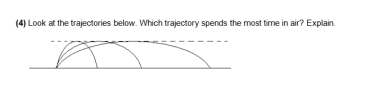 Please, this is the question after a physical projection motion
lab
Look at the trajectories below. Which trajectory spends the most time in air? Explain.
Please, this is the question after a physical projection motion
lab
Look at the trajectories below. Which trajectory spends the most time in air? Explain.
Three objects move and their velocity vs time graphs are shown below The following questions refer...
 Three objects move and their velocity vs time graphs are shown
below
The following questions refer to the velocity vs time graphs
above.
1.Are any of the graphs shown representing objects that are
slowing down?
2.Do any of the objects have a negative acceleration? How can
you tell?
3.Which object’s motion(s) most likely is/are experiencing air
resistance? Explain your reasoning.
4.Sketch what the acceleration vs time graphs would look like
for each of the velocity graphs.
Three objects move and their velocity vs time graphs are shown
below
The following questions refer to the velocity vs time graphs
above.
1.Are any of the graphs shown representing objects that are
slowing down?
2.Do any of the objects have a negative acceleration? How can
you tell?
3.Which object’s motion(s) most likely is/are experiencing air
resistance? Explain your reasoning.
4.Sketch what the acceleration vs time graphs would look like
for each of the velocity graphs.
Take a look at the six position vs time graphs below. Rank these graphs, considering the...
 Take a look at the six position vs time graphs below. Rank these
graphs, considering the following:
Follow Up Questions for Session #2 using Ranking Tasks Part One: Position vs. Time Graphs Take a look at the six position vs. time graphs below. Rank these graphs, considering the following: 10 + Ht A 10 10 t 30 D 10 10 1. In which graph does the object have the greatest (most) displacement from the beginning to the end of the...
Take a look at the six position vs time graphs below. Rank these
graphs, considering the following:
Follow Up Questions for Session #2 using Ranking Tasks Part One: Position vs. Time Graphs Take a look at the six position vs. time graphs below. Rank these graphs, considering the following: 10 + Ht A 10 10 t 30 D 10 10 1. In which graph does the object have the greatest (most) displacement from the beginning to the end of the...
Provide the structure of the organic product(s), which result in the reaction below. (Hint: this is...
 Provide the structure of the organic product(s), which result
in the reaction below. (Hint: this is a substitution product)
PLEASE EXPLAIN!
N . (4 pts) Provide the structure of the organic product(s), which result in the reaction below. (Hint: this is a substitution product) CH3 CI CH,CH OH CH + CH₃ CH₂ ce
Provide the structure of the organic product(s), which result
in the reaction below. (Hint: this is a substitution product)
PLEASE EXPLAIN!
N . (4 pts) Provide the structure of the organic product(s), which result in the reaction below. (Hint: this is a substitution product) CH3 CI CH,CH OH CH + CH₃ CH₂ ce
Explain how to get to the correct answer. Which position-time graph below could be that for...
 Explain how to get to the correct answer.
Which position-time graph below could be that for a cart that is steadily accelerating away from the origin? "Steadily accelerating" means that the acceleration is approximately constant.) Circle your answer. rime time Graph 1 Graph 2 Graph 3 Describe how you would walk to produce the velocity-time graph on the right. (Do not use the word "acceleration." 0 0 2 4 6 8 10 time (s) Draw what the position-time graph should...
Explain how to get to the correct answer.
Which position-time graph below could be that for a cart that is steadily accelerating away from the origin? "Steadily accelerating" means that the acceleration is approximately constant.) Circle your answer. rime time Graph 1 Graph 2 Graph 3 Describe how you would walk to produce the velocity-time graph on the right. (Do not use the word "acceleration." 0 0 2 4 6 8 10 time (s) Draw what the position-time graph should...
9. The figure below shows the trajectory of a ball undergoing projectile motion. The time t-0s...
 9. The figure below shows the trajectory of a ball undergoing projectile motion. The time t-0s corresponds . Its launch velocity, also called are also indicated in the figure which are X0m and y- 0 m. to the moment just as the ball is launched from position the initial velocity, is g. The other two points along the trajectory corresponding the velocity of the ball at the peak ) it strikes the ground (2) at t How do the speeds...
The figure above shows a portion of the trajectory of a ball traveling through the air....
 The figure above shows a portion of the trajectory of a ball traveling through the air. Arrows indicate its momentum at several locations. At these locations, the ball's momentum is: p^vector_B = < 3.13, 2.88, 0 > kg middot m/s p^vector_C = < 2.65 1.02, 0 > kg middot m/s p^vector_D = < 2.34 -0.52, 0 > kg middot m/s p^vector_E = < 2.07, -1.88, 0 > kg middot m/s (a) which of the diagrams below correctly shows the graphical...
Which of the following compounds will only have London dispersion intermolecular attractions? {Hint: look for non-polar...
 Which of the following compounds will only have London dispersion intermolecular attractions? {Hint: look for non-polar molecules). O CO2 O CH3F O CH3OH O OCI2 O Naci QUESTION 4 What is the strongest (most attractive) intermolecular force in CH3F? O hydrogen bonding O London dispersion forces O ion-dipole attraction O jonic bonding O dipole-dipole attraction
Please solve and explain Shown below is an experiment with an electron (q = -1.602e-19 coulombs,...
 Please solve and explain
Shown below is an experiment with an electron (q = -1.602e-19 coulombs, m= 9.109e-31 kg) fired into a magnetic field. The magnetic field is of the strenght B=1.19e-04 Tesla and is directed into the screen. The electron is fired with a velocity V=3.66e+06m/s as shown. trajectory a magnetic field Cinto the screen) electron v Trajectory B a) which path is followed by the electron? trajectory A or trajectory B? meters b) What is the radius of...
Please solve and explain
Shown below is an experiment with an electron (q = -1.602e-19 coulombs, m= 9.109e-31 kg) fired into a magnetic field. The magnetic field is of the strenght B=1.19e-04 Tesla and is directed into the screen. The electron is fired with a velocity V=3.66e+06m/s as shown. trajectory a magnetic field Cinto the screen) electron v Trajectory B a) which path is followed by the electron? trajectory A or trajectory B? meters b) What is the radius of...
Streaking plate, (4 points) Look at the following images. Which is a good streak plate? Explain...
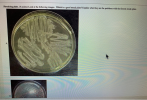 Streaking plate, (4 points) Look at the following images. Which is a good streak plate? Explain what they are the problems with the flawed streak plate.
 Please, this is the question after a physical projection motion
lab
Look at the trajectories below. Which trajectory spends the most time in air? Explain.
Please, this is the question after a physical projection motion
lab
Look at the trajectories below. Which trajectory spends the most time in air? Explain.
 Three objects move and their velocity vs time graphs are shown
below
The following questions refer to the velocity vs time graphs
above.
1.Are any of the graphs shown representing objects that are
slowing down?
2.Do any of the objects have a negative acceleration? How can
you tell?
3.Which object’s motion(s) most likely is/are experiencing air
resistance? Explain your reasoning.
4.Sketch what the acceleration vs time graphs would look like
for each of the velocity graphs.
Three objects move and their velocity vs time graphs are shown
below
The following questions refer to the velocity vs time graphs
above.
1.Are any of the graphs shown representing objects that are
slowing down?
2.Do any of the objects have a negative acceleration? How can
you tell?
3.Which object’s motion(s) most likely is/are experiencing air
resistance? Explain your reasoning.
4.Sketch what the acceleration vs time graphs would look like
for each of the velocity graphs.
 Take a look at the six position vs time graphs below. Rank these
graphs, considering the following:
Follow Up Questions for Session #2 using Ranking Tasks Part One: Position vs. Time Graphs Take a look at the six position vs. time graphs below. Rank these graphs, considering the following: 10 + Ht A 10 10 t 30 D 10 10 1. In which graph does the object have the greatest (most) displacement from the beginning to the end of the...
Take a look at the six position vs time graphs below. Rank these
graphs, considering the following:
Follow Up Questions for Session #2 using Ranking Tasks Part One: Position vs. Time Graphs Take a look at the six position vs. time graphs below. Rank these graphs, considering the following: 10 + Ht A 10 10 t 30 D 10 10 1. In which graph does the object have the greatest (most) displacement from the beginning to the end of the...
 Provide the structure of the organic product(s), which result
in the reaction below. (Hint: this is a substitution product)
PLEASE EXPLAIN!
N . (4 pts) Provide the structure of the organic product(s), which result in the reaction below. (Hint: this is a substitution product) CH3 CI CH,CH OH CH + CH₃ CH₂ ce
Provide the structure of the organic product(s), which result
in the reaction below. (Hint: this is a substitution product)
PLEASE EXPLAIN!
N . (4 pts) Provide the structure of the organic product(s), which result in the reaction below. (Hint: this is a substitution product) CH3 CI CH,CH OH CH + CH₃ CH₂ ce
 Explain how to get to the correct answer.
Which position-time graph below could be that for a cart that is steadily accelerating away from the origin? "Steadily accelerating" means that the acceleration is approximately constant.) Circle your answer. rime time Graph 1 Graph 2 Graph 3 Describe how you would walk to produce the velocity-time graph on the right. (Do not use the word "acceleration." 0 0 2 4 6 8 10 time (s) Draw what the position-time graph should...
Explain how to get to the correct answer.
Which position-time graph below could be that for a cart that is steadily accelerating away from the origin? "Steadily accelerating" means that the acceleration is approximately constant.) Circle your answer. rime time Graph 1 Graph 2 Graph 3 Describe how you would walk to produce the velocity-time graph on the right. (Do not use the word "acceleration." 0 0 2 4 6 8 10 time (s) Draw what the position-time graph should...
 9. The figure below shows the trajectory of a ball undergoing projectile motion. The time t-0s corresponds . Its launch velocity, also called are also indicated in the figure which are X0m and y- 0 m. to the moment just as the ball is launched from position the initial velocity, is g. The other two points along the trajectory corresponding the velocity of the ball at the peak ) it strikes the ground (2) at t How do the speeds...
 The figure above shows a portion of the trajectory of a ball traveling through the air. Arrows indicate its momentum at several locations. At these locations, the ball's momentum is: p^vector_B = < 3.13, 2.88, 0 > kg middot m/s p^vector_C = < 2.65 1.02, 0 > kg middot m/s p^vector_D = < 2.34 -0.52, 0 > kg middot m/s p^vector_E = < 2.07, -1.88, 0 > kg middot m/s (a) which of the diagrams below correctly shows the graphical...
 Which of the following compounds will only have London dispersion intermolecular attractions? {Hint: look for non-polar molecules). O CO2 O CH3F O CH3OH O OCI2 O Naci QUESTION 4 What is the strongest (most attractive) intermolecular force in CH3F? O hydrogen bonding O London dispersion forces O ion-dipole attraction O jonic bonding O dipole-dipole attraction
 Please solve and explain
Shown below is an experiment with an electron (q = -1.602e-19 coulombs, m= 9.109e-31 kg) fired into a magnetic field. The magnetic field is of the strenght B=1.19e-04 Tesla and is directed into the screen. The electron is fired with a velocity V=3.66e+06m/s as shown. trajectory a magnetic field Cinto the screen) electron v Trajectory B a) which path is followed by the electron? trajectory A or trajectory B? meters b) What is the radius of...
Please solve and explain
Shown below is an experiment with an electron (q = -1.602e-19 coulombs, m= 9.109e-31 kg) fired into a magnetic field. The magnetic field is of the strenght B=1.19e-04 Tesla and is directed into the screen. The electron is fired with a velocity V=3.66e+06m/s as shown. trajectory a magnetic field Cinto the screen) electron v Trajectory B a) which path is followed by the electron? trajectory A or trajectory B? meters b) What is the radius of...
 Streaking plate, (4 points) Look at the following images. Which is a good streak plate? Explain what they are the problems with the flawed streak plate.
Most questions answered within 3 hours.
-
Where is the error in this code sequence?
String s1 = "Hello";
String s2 = "ello";...
asked 10 months ago -
Financial data for Joel de Paris, Inc., for last year
follow:
Joel de Paris, Inc.
Balance...
asked 10 months ago -
Consider this reaction:
Al2(SO4)3 (aq)+ BaCl3
(aq) Al2Cl6 (aq)- +
3BaSO4(s) . What is the...
asked 10 months ago -
Suppose that Savneet is considering increasing her
recent random sample from 20 car rentals to 40...
asked 10 months ago -
Trucks arrive at an unloading terminal at an average rate of 120
per hour.
Trucks arrive...
asked 10 months ago -
Why are methanol and ethanol completely soluble in water while
octanol is not very little soluble....
asked 10 months ago -
A facilities manager at a university reads in a research report
that the mean amount of...
asked 10 months ago -
When the CuSO4 is rehydrated by adding water to the anhydrous
compound, is this an endothermic...
asked 10 months ago -
A ray of sunlight is passing from diamond into crown glass; the
angle of incidence is...
asked 10 months ago -
A block of mass 0.249 kg is placed on top of a light, vertical
spring of...
asked 10 months ago -
how do the kidneys compensate in the presences of acidosis
a) trigger hyperventilate
b) reserve acid...
asked 10 months ago -
Question 501 pts
The rental rate of capital to the firm increases. Which of the
following...
asked 10 months ago