Please, this is the question after a physical projection motion lab
Homework Answers
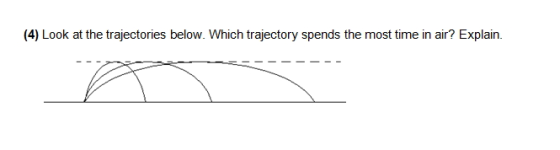
If you consider the vertical component of motion for each of the case, it can be seen that the displacement is equal, and acceleration, which is due to gravity, is also same for each case.
This indicates that the time required in each of the cases will
also be equal.
All the trajectories will spend equal time in the air.
Add Answer to:
Please, this is the question after a physical projection motion
lab
Look at the trajectories below....
4. Look at the trajectories below. Which trajectory spends the most time in air? Explain. (Hint:...
 4. Look at the trajectories below. Which trajectory spends the most time in air? Explain. (Hint: which aspect(s) of these trajectories is(are) consistent?)
4. Determine approximately the law of motion of a particle of mass m in the field...
 4. Determine approximately the law of motion of a particle of mass m in the field Ucx) in the vicinity of turning point of motion E-Ua) where E is total energy. Proceed by expanding U(x) in a Taylor series about x-a. Consider the cases when (a) U(a)#0 and 5. Find the law according to which the period of motion T for a particle of mass nm moving in the field sketched below approaches infinity as ε=um-E goes to zero. The...
3. The diagram below shows the trajectories of three charged particles moving in a uniform magnetic...
 3. The diagram below shows the trajectories of three charged
particles moving in a uniform magnetic field of strength B. The
field points into the plane of the paper. The particles are moving
in the plane of the paper. The direction in which each particle is
moving is shown by the arrows. (a) For each particle, find if the
charge is positive or negative (Q>0 or Q<0). Q1: Q2: Q3: (b)
Assume all particles have the same velocity (v) and...
3. The diagram below shows the trajectories of three charged
particles moving in a uniform magnetic field of strength B. The
field points into the plane of the paper. The particles are moving
in the plane of the paper. The direction in which each particle is
moving is shown by the arrows. (a) For each particle, find if the
charge is positive or negative (Q>0 or Q<0). Q1: Q2: Q3: (b)
Assume all particles have the same velocity (v) and...
please draw the correct one if not in option and explain. HP Question 2 The Fisher projection below is equivalent t...
 please draw the correct one if not in option and explain.
HP Question 2 The Fisher projection below is equivalent to which Haworth structure if the anomer formed is alpha? Cно H- OH но- -H н- Он H- -Он CH-он CH2OH 1) Он Он он Он CH2OH 2) OH Он OH
please draw the correct one if not in option and explain.
HP Question 2 The Fisher projection below is equivalent to which Haworth structure if the anomer formed is alpha? Cно H- OH но- -H н- Он H- -Он CH-он CH2OH 1) Он Он он Он CH2OH 2) OH Он OH
Please complete the tables below based on a lab done verifying Newton’s second law of motion...
 Please complete the tables below based on a lab done verifying
Newton’s second law of motion
The Ealing Air Track is a device which can almost eliminate the frictional force on a surface which air ia forced track. done by having small holes on the surface through e glider floats on a column air and not on the surface of the PROCEDURE 1. Set up the air track as in Figure 1. Raise one end of the air track so...
Please complete the tables below based on a lab done verifying
Newton’s second law of motion
The Ealing Air Track is a device which can almost eliminate the frictional force on a surface which air ia forced track. done by having small holes on the surface through e glider floats on a column air and not on the surface of the PROCEDURE 1. Set up the air track as in Figure 1. Raise one end of the air track so...
Hello, i need help in question 3 and 4 please.. It's for physical chem lab ....
 Hello, i need help in question 3 and 4 please.. It's for physical
chem lab .
Thanks in advance!
easoning Which form of magnesium is most appropriate for measuring the property identified in question 5? Pre-Experiment Questions Part Two Physical chemistry is a quantitative science in which data is modeled. The model is often (but not always) a known equation based on a definition or concept. Modeling is accomplished by graphing the data and fitting the equation using least squares...
Hello, i need help in question 3 and 4 please.. It's for physical
chem lab .
Thanks in advance!
easoning Which form of magnesium is most appropriate for measuring the property identified in question 5? Pre-Experiment Questions Part Two Physical chemistry is a quantitative science in which data is modeled. The model is often (but not always) a known equation based on a definition or concept. Modeling is accomplished by graphing the data and fitting the equation using least squares...
Please help! :) Discussion #3 1. Consider the motion of an object that can be treated...
 Please help! :)
Discussion #3 1. Consider the motion of an object that can be treated as a point particle and is traveling counter-clockwise in a circle of radius R. This motion can (and will for the purposes of these discussion activities) be described and analyzed using a Cartesian (x-y) coordinate system with a spatial origin at the center of the particle's circular trajectory (the physical path its motion traces out in space). (a) Draw a diagram of the position...
Please help! :)
Discussion #3 1. Consider the motion of an object that can be treated as a point particle and is traveling counter-clockwise in a circle of radius R. This motion can (and will for the purposes of these discussion activities) be described and analyzed using a Cartesian (x-y) coordinate system with a spatial origin at the center of the particle's circular trajectory (the physical path its motion traces out in space). (a) Draw a diagram of the position...
Please do 1a 1b 1d and 1E and show work, thank you! 1.) A ball with mass 5.0 kg is launched upwards towards the east into the air with a speed of 15. m/s at an angle of 30 degrees to the ground....
 Please do 1a 1b 1d and 1E and show work, thank you!
1.) A ball with mass 5.0 kg is launched upwards towards the east into the air with a speed of 15. m/s at an angle of 30 degrees to the ground. Note: For this question the motion is fully three-dimensional. Orient your axes so that the positive y-axis points north, the positive X-axis points east, and the positive z-axis points upwards (towards the sky. 1A.) If a gusting...
Please do 1a 1b 1d and 1E and show work, thank you!
1.) A ball with mass 5.0 kg is launched upwards towards the east into the air with a speed of 15. m/s at an angle of 30 degrees to the ground. Note: For this question the motion is fully three-dimensional. Orient your axes so that the positive y-axis points north, the positive X-axis points east, and the positive z-axis points upwards (towards the sky. 1A.) If a gusting...
look back at your dog population from pre-lab question#5. What is the most likely microevolutionary mechanism...
 look
back at your dog population from pre-lab question#5. What is the
most likely microevolutionary mechanism working alone that could
cause this scenario?
genetic screening on them and gather the data from the table are able to do some below # OF DOGS GENOTYPE 45 FIFI FIF2 10 45 F2F2 Since you have the counts of all three genotypes, on Hardy-Weinberg equilibrium) to determine p. use the below equation (not dependent (2 X N(A1A1))+ N(A1A2) p= 2N Once you know...
look
back at your dog population from pre-lab question#5. What is the
most likely microevolutionary mechanism working alone that could
cause this scenario?
genetic screening on them and gather the data from the table are able to do some below # OF DOGS GENOTYPE 45 FIFI FIF2 10 45 F2F2 Since you have the counts of all three genotypes, on Hardy-Weinberg equilibrium) to determine p. use the below equation (not dependent (2 X N(A1A1))+ N(A1A2) p= 2N Once you know...
Three objects move and their velocity vs time graphs are shown below The following questions refer...
 Three objects move and their velocity vs time graphs are shown
below
The following questions refer to the velocity vs time graphs
above.
1.Are any of the graphs shown representing objects that are
slowing down?
2.Do any of the objects have a negative acceleration? How can
you tell?
3.Which object’s motion(s) most likely is/are experiencing air
resistance? Explain your reasoning.
4.Sketch what the acceleration vs time graphs would look like
for each of the velocity graphs.
Three objects move and their velocity vs time graphs are shown
below
The following questions refer to the velocity vs time graphs
above.
1.Are any of the graphs shown representing objects that are
slowing down?
2.Do any of the objects have a negative acceleration? How can
you tell?
3.Which object’s motion(s) most likely is/are experiencing air
resistance? Explain your reasoning.
4.Sketch what the acceleration vs time graphs would look like
for each of the velocity graphs.
 4. Look at the trajectories below. Which trajectory spends the most time in air? Explain. (Hint: which aspect(s) of these trajectories is(are) consistent?)
 4. Determine approximately the law of motion of a particle of mass m in the field Ucx) in the vicinity of turning point of motion E-Ua) where E is total energy. Proceed by expanding U(x) in a Taylor series about x-a. Consider the cases when (a) U(a)#0 and 5. Find the law according to which the period of motion T for a particle of mass nm moving in the field sketched below approaches infinity as ε=um-E goes to zero. The...
 3. The diagram below shows the trajectories of three charged
particles moving in a uniform magnetic field of strength B. The
field points into the plane of the paper. The particles are moving
in the plane of the paper. The direction in which each particle is
moving is shown by the arrows. (a) For each particle, find if the
charge is positive or negative (Q>0 or Q<0). Q1: Q2: Q3: (b)
Assume all particles have the same velocity (v) and...
3. The diagram below shows the trajectories of three charged
particles moving in a uniform magnetic field of strength B. The
field points into the plane of the paper. The particles are moving
in the plane of the paper. The direction in which each particle is
moving is shown by the arrows. (a) For each particle, find if the
charge is positive or negative (Q>0 or Q<0). Q1: Q2: Q3: (b)
Assume all particles have the same velocity (v) and...
 please draw the correct one if not in option and explain.
HP Question 2 The Fisher projection below is equivalent to which Haworth structure if the anomer formed is alpha? Cно H- OH но- -H н- Он H- -Он CH-он CH2OH 1) Он Он он Он CH2OH 2) OH Он OH
please draw the correct one if not in option and explain.
HP Question 2 The Fisher projection below is equivalent to which Haworth structure if the anomer formed is alpha? Cно H- OH но- -H н- Он H- -Он CH-он CH2OH 1) Он Он он Он CH2OH 2) OH Он OH
 Please complete the tables below based on a lab done verifying
Newton’s second law of motion
The Ealing Air Track is a device which can almost eliminate the frictional force on a surface which air ia forced track. done by having small holes on the surface through e glider floats on a column air and not on the surface of the PROCEDURE 1. Set up the air track as in Figure 1. Raise one end of the air track so...
Please complete the tables below based on a lab done verifying
Newton’s second law of motion
The Ealing Air Track is a device which can almost eliminate the frictional force on a surface which air ia forced track. done by having small holes on the surface through e glider floats on a column air and not on the surface of the PROCEDURE 1. Set up the air track as in Figure 1. Raise one end of the air track so...
 Hello, i need help in question 3 and 4 please.. It's for physical
chem lab .
Thanks in advance!
easoning Which form of magnesium is most appropriate for measuring the property identified in question 5? Pre-Experiment Questions Part Two Physical chemistry is a quantitative science in which data is modeled. The model is often (but not always) a known equation based on a definition or concept. Modeling is accomplished by graphing the data and fitting the equation using least squares...
Hello, i need help in question 3 and 4 please.. It's for physical
chem lab .
Thanks in advance!
easoning Which form of magnesium is most appropriate for measuring the property identified in question 5? Pre-Experiment Questions Part Two Physical chemistry is a quantitative science in which data is modeled. The model is often (but not always) a known equation based on a definition or concept. Modeling is accomplished by graphing the data and fitting the equation using least squares...
 Please help! :)
Discussion #3 1. Consider the motion of an object that can be treated as a point particle and is traveling counter-clockwise in a circle of radius R. This motion can (and will for the purposes of these discussion activities) be described and analyzed using a Cartesian (x-y) coordinate system with a spatial origin at the center of the particle's circular trajectory (the physical path its motion traces out in space). (a) Draw a diagram of the position...
Please help! :)
Discussion #3 1. Consider the motion of an object that can be treated as a point particle and is traveling counter-clockwise in a circle of radius R. This motion can (and will for the purposes of these discussion activities) be described and analyzed using a Cartesian (x-y) coordinate system with a spatial origin at the center of the particle's circular trajectory (the physical path its motion traces out in space). (a) Draw a diagram of the position...
 Please do 1a 1b 1d and 1E and show work, thank you!
1.) A ball with mass 5.0 kg is launched upwards towards the east into the air with a speed of 15. m/s at an angle of 30 degrees to the ground. Note: For this question the motion is fully three-dimensional. Orient your axes so that the positive y-axis points north, the positive X-axis points east, and the positive z-axis points upwards (towards the sky. 1A.) If a gusting...
Please do 1a 1b 1d and 1E and show work, thank you!
1.) A ball with mass 5.0 kg is launched upwards towards the east into the air with a speed of 15. m/s at an angle of 30 degrees to the ground. Note: For this question the motion is fully three-dimensional. Orient your axes so that the positive y-axis points north, the positive X-axis points east, and the positive z-axis points upwards (towards the sky. 1A.) If a gusting...
 look
back at your dog population from pre-lab question#5. What is the
most likely microevolutionary mechanism working alone that could
cause this scenario?
genetic screening on them and gather the data from the table are able to do some below # OF DOGS GENOTYPE 45 FIFI FIF2 10 45 F2F2 Since you have the counts of all three genotypes, on Hardy-Weinberg equilibrium) to determine p. use the below equation (not dependent (2 X N(A1A1))+ N(A1A2) p= 2N Once you know...
look
back at your dog population from pre-lab question#5. What is the
most likely microevolutionary mechanism working alone that could
cause this scenario?
genetic screening on them and gather the data from the table are able to do some below # OF DOGS GENOTYPE 45 FIFI FIF2 10 45 F2F2 Since you have the counts of all three genotypes, on Hardy-Weinberg equilibrium) to determine p. use the below equation (not dependent (2 X N(A1A1))+ N(A1A2) p= 2N Once you know...
 Three objects move and their velocity vs time graphs are shown
below
The following questions refer to the velocity vs time graphs
above.
1.Are any of the graphs shown representing objects that are
slowing down?
2.Do any of the objects have a negative acceleration? How can
you tell?
3.Which object’s motion(s) most likely is/are experiencing air
resistance? Explain your reasoning.
4.Sketch what the acceleration vs time graphs would look like
for each of the velocity graphs.
Three objects move and their velocity vs time graphs are shown
below
The following questions refer to the velocity vs time graphs
above.
1.Are any of the graphs shown representing objects that are
slowing down?
2.Do any of the objects have a negative acceleration? How can
you tell?
3.Which object’s motion(s) most likely is/are experiencing air
resistance? Explain your reasoning.
4.Sketch what the acceleration vs time graphs would look like
for each of the velocity graphs.
Most questions answered within 3 hours.
-
Where is the error in this code sequence?
String s1 = "Hello";
String s2 = "ello";...
asked 10 months ago -
Financial data for Joel de Paris, Inc., for last year
follow:
Joel de Paris, Inc.
Balance...
asked 10 months ago -
Consider this reaction:
Al2(SO4)3 (aq)+ BaCl3
(aq) Al2Cl6 (aq)- +
3BaSO4(s) . What is the...
asked 10 months ago -
Suppose that Savneet is considering increasing her
recent random sample from 20 car rentals to 40...
asked 10 months ago -
Trucks arrive at an unloading terminal at an average rate of 120
per hour.
Trucks arrive...
asked 10 months ago -
Why are methanol and ethanol completely soluble in water while
octanol is not very little soluble....
asked 10 months ago -
A facilities manager at a university reads in a research report
that the mean amount of...
asked 10 months ago -
When the CuSO4 is rehydrated by adding water to the anhydrous
compound, is this an endothermic...
asked 10 months ago -
A ray of sunlight is passing from diamond into crown glass; the
angle of incidence is...
asked 10 months ago -
A block of mass 0.249 kg is placed on top of a light, vertical
spring of...
asked 10 months ago -
how do the kidneys compensate in the presences of acidosis
a) trigger hyperventilate
b) reserve acid...
asked 10 months ago -
Question 501 pts
The rental rate of capital to the firm increases. Which of the
following...
asked 10 months ago