

Homework Answers

Add Answer to:
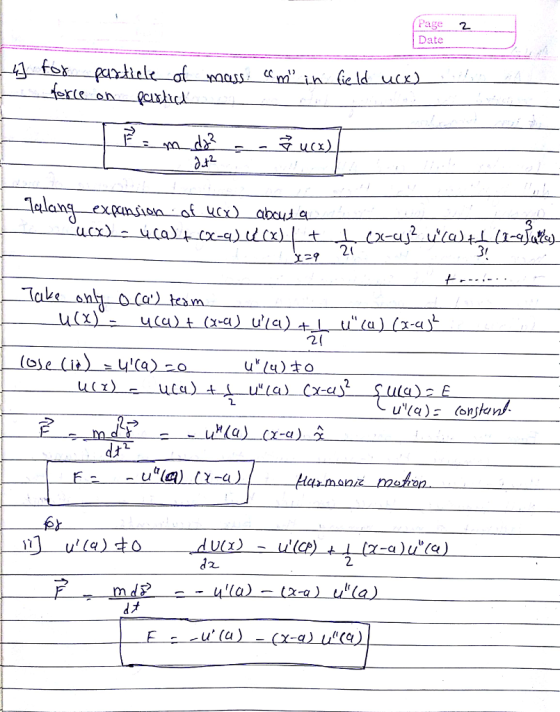
4. Determine approximately the law of motion of a particle of mass m in the field...
Find the law of motion of a particle mass m and zero energy in one dimension...
 Find the law of motion of a particle mass m and zero energy in
one dimension in the field U(x) = -Ax^(4) where A is a positive
constant. Given the inital position x0, compute how much time does
it take for the particle to escape to infinity if the vector of
initial velocity of the particle is pointing away from the origin
x=0. Describe the motion when the vector of inital velocity of the
particle is pointing toward x=0.
3....
Find the law of motion of a particle mass m and zero energy in
one dimension in the field U(x) = -Ax^(4) where A is a positive
constant. Given the inital position x0, compute how much time does
it take for the particle to escape to infinity if the vector of
initial velocity of the particle is pointing away from the origin
x=0. Describe the motion when the vector of inital velocity of the
particle is pointing toward x=0.
3....
Consider the motion of particle mass m and charge q in an electromagnetic field with electric...
Consider the motion of particle mass m and charge q in an electromagnetic field with electric field vector is E and the magnetic field vector is B. The force acting on the particle is given by the Lorentz equation F = qE + qv x B (assuming non-relativistic case, v<) ( a) If there is no electric field and the particle enters the magnetic field in a direction perpendicular to the lines of magnetic flux, show that the trajectory is...
The equations of motion for a particle of mass m and electrical charge q under the...
 The equations of motion for a particle of mass m and electrical charge q under the influence of a uniform magnetic field B perpendicular to the plane of motion are mx" = qBy' and my" = -qBx'. where x and y are the horizontal Cartesian position coordinates of the particle. Suppose that the particle initially satisfies the conditions Solve the initial value problem and sketch out the trajectory of the particle for t Greaterthanorequalto 0.
3. A particle of mass m, charge q, and inital velocity vo is injected into uniform...
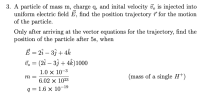 3. A particle of mass m, charge q, and inital velocity vo is injected into uniform electric field E, find the position trajectory for the motion of the particle. Only after arriving at the vector equations for the trajectory, find the position of the particle after 5s, when E - 2i - 3j +4k vo- (2i -3j + 4k)1000 1.0 × 10⁻³ 6.02 x 10²³ q-1.6 x 10⁻¹⁹ (mass of a single H+)
Problem 4*: (Motion along a spiral) A particle of mass m moves in a gravitational field...
 Problem 4*: (Motion along a spiral) A particle of mass m moves in a gravitational field along the spiral z = k0, r = constant, where k is a constant, and z is the vertical direction. Find the Hamiltonian H(z, p) for the particle motion. Find and solve Hamilton's equations of motion. Show in the limit r = 0, 2 = -g.
A particle of mass m is in a potential energy field described by, V(x, y) =...
 A particle of mass m is in a potential energy field described by, V(x, y) = 18kx² +8ky? where k is a positive constant. Initially the particle is resting at the origin (0,0). At time t = 0 the particle receives a kick that imparts to it an initial velocity (vo, 2vo). (a) Find the position of the particle as a function of time, x(t) and y(t). (b) Plot the trajectory for this motion (Lissajous figure) using Vo = 1,...
3. (a) Show that when a particle with mass m and charge q enters a magnetic...
 3. (a) Show that when a particle with mass m and charge q enters a magnetic field having its velocity v perpendicular to the direction of the magnetic field B, it will perform a mv circular path of radius R- qB (b) Using the previous result find an expression for the period T of the circular motion. (c) A charged particle moves into a region of uniform magnetic field, goes through half a circle and then exits that region, as...
1. If a particle moves according to a law of motion S(t)=12-6-7, t 20 Where t...
 1. If a particle moves according to a law of motion S(t)=12-6-7, t 20 Where t is measured in seconds and sin meters, (a) Find the velocity of the particle in terms of t. (b) Find the velocity and the speed at time t=1. (c) When is the particle at rest? (d) When is the particle moving to the right and when is it moving to the left? (e) Find the acceleration of the particle at t. (10pts) 2. Evaluate...
4. A particle of mass m 2 kg moves under the potential energy function U(x.y.z)- (kx...
 4. A particle of mass m 2 kg moves under the potential energy function U(x.y.z)- (kx + 2 k2y2 +3 k3z3) where k 1N. a. Suppose the particle has speed vo3 m/s when it passes through the origin. What will its speed be if and when it passes through the point (1,1.1)? b. Suppose the particle's speed vo at the origin is not known and that the point (1,1,1) is a turning point of the motion (a point where v0)....
3. The Hamiltonian of a particle of mass m and charge q in a static magnetic field may be written 2 where πί Pi-qAi(x). We shall assume that the magnetic field B is uniform, so that AiEijkBjxk is a s...
 3. The Hamiltonian of a particle of mass m and charge q in a static magnetic field may be written 2 where πί Pi-qAi(x). We shall assume that the magnetic field B is uniform, so that AiEijkBjxk is a suitable choice. (a) Find Hamilton's equation of motion for the particle. (Hint: To simplify the algebra, use the chain rule to write9and similarly for p) 8H UT, 0z,, and similarly for Sp use the chain rule to write oz (b) Show...
 Find the law of motion of a particle mass m and zero energy in
one dimension in the field U(x) = -Ax^(4) where A is a positive
constant. Given the inital position x0, compute how much time does
it take for the particle to escape to infinity if the vector of
initial velocity of the particle is pointing away from the origin
x=0. Describe the motion when the vector of inital velocity of the
particle is pointing toward x=0.
3....
Find the law of motion of a particle mass m and zero energy in
one dimension in the field U(x) = -Ax^(4) where A is a positive
constant. Given the inital position x0, compute how much time does
it take for the particle to escape to infinity if the vector of
initial velocity of the particle is pointing away from the origin
x=0. Describe the motion when the vector of inital velocity of the
particle is pointing toward x=0.
3....
 The equations of motion for a particle of mass m and electrical charge q under the influence of a uniform magnetic field B perpendicular to the plane of motion are mx" = qBy' and my" = -qBx'. where x and y are the horizontal Cartesian position coordinates of the particle. Suppose that the particle initially satisfies the conditions Solve the initial value problem and sketch out the trajectory of the particle for t Greaterthanorequalto 0.
 3. A particle of mass m, charge q, and inital velocity vo is injected into uniform electric field E, find the position trajectory for the motion of the particle. Only after arriving at the vector equations for the trajectory, find the position of the particle after 5s, when E - 2i - 3j +4k vo- (2i -3j + 4k)1000 1.0 × 10⁻³ 6.02 x 10²³ q-1.6 x 10⁻¹⁹ (mass of a single H+)
 Problem 4*: (Motion along a spiral) A particle of mass m moves in a gravitational field along the spiral z = k0, r = constant, where k is a constant, and z is the vertical direction. Find the Hamiltonian H(z, p) for the particle motion. Find and solve Hamilton's equations of motion. Show in the limit r = 0, 2 = -g.
 A particle of mass m is in a potential energy field described by, V(x, y) = 18kx² +8ky? where k is a positive constant. Initially the particle is resting at the origin (0,0). At time t = 0 the particle receives a kick that imparts to it an initial velocity (vo, 2vo). (a) Find the position of the particle as a function of time, x(t) and y(t). (b) Plot the trajectory for this motion (Lissajous figure) using Vo = 1,...
 3. (a) Show that when a particle with mass m and charge q enters a magnetic field having its velocity v perpendicular to the direction of the magnetic field B, it will perform a mv circular path of radius R- qB (b) Using the previous result find an expression for the period T of the circular motion. (c) A charged particle moves into a region of uniform magnetic field, goes through half a circle and then exits that region, as...
 1. If a particle moves according to a law of motion S(t)=12-6-7, t 20 Where t is measured in seconds and sin meters, (a) Find the velocity of the particle in terms of t. (b) Find the velocity and the speed at time t=1. (c) When is the particle at rest? (d) When is the particle moving to the right and when is it moving to the left? (e) Find the acceleration of the particle at t. (10pts) 2. Evaluate...
 4. A particle of mass m 2 kg moves under the potential energy function U(x.y.z)- (kx + 2 k2y2 +3 k3z3) where k 1N. a. Suppose the particle has speed vo3 m/s when it passes through the origin. What will its speed be if and when it passes through the point (1,1.1)? b. Suppose the particle's speed vo at the origin is not known and that the point (1,1,1) is a turning point of the motion (a point where v0)....
 3. The Hamiltonian of a particle of mass m and charge q in a static magnetic field may be written 2 where πί Pi-qAi(x). We shall assume that the magnetic field B is uniform, so that AiEijkBjxk is a suitable choice. (a) Find Hamilton's equation of motion for the particle. (Hint: To simplify the algebra, use the chain rule to write9and similarly for p) 8H UT, 0z,, and similarly for Sp use the chain rule to write oz (b) Show...
Most questions answered within 3 hours.
-
Where is the error in this code sequence?
String s1 = "Hello";
String s2 = "ello";...
asked 11 months ago -
Financial data for Joel de Paris, Inc., for last year
follow:
Joel de Paris, Inc.
Balance...
asked 11 months ago -
Consider this reaction:
Al2(SO4)3 (aq)+ BaCl3
(aq) Al2Cl6 (aq)- +
3BaSO4(s) . What is the...
asked 11 months ago -
Suppose that Savneet is considering increasing her
recent random sample from 20 car rentals to 40...
asked 11 months ago -
Trucks arrive at an unloading terminal at an average rate of 120
per hour.
Trucks arrive...
asked 11 months ago -
Why are methanol and ethanol completely soluble in water while
octanol is not very little soluble....
asked 11 months ago -
A facilities manager at a university reads in a research report
that the mean amount of...
asked 11 months ago -
When the CuSO4 is rehydrated by adding water to the anhydrous
compound, is this an endothermic...
asked 11 months ago -
A ray of sunlight is passing from diamond into crown glass; the
angle of incidence is...
asked 11 months ago -
A block of mass 0.249 kg is placed on top of a light, vertical
spring of...
asked 11 months ago -
how do the kidneys compensate in the presences of acidosis
a) trigger hyperventilate
b) reserve acid...
asked 11 months ago -
Question 501 pts
The rental rate of capital to the firm increases. Which of the
following...
asked 11 months ago