
Homework Answers


Add Answer to:
A particle of mass m is in a potential energy field described by, V(x, y) =...
A charged particle of mass m and positive charge q moves in uniform electric and magnetic...
A charged particle of mass m and positive charge q moves in uniform electric and magnetic fields, E pointing in the y direction and B in the z direction. suppose the particle is initially at the origin and is given a kick at time t=0 along the x axis with vx = vxo (positive or negative). a) Write down the equation of motion for the particle and resolve it into its three components. show that the motion remains in the...
1. A particle of mass m moves in three dimensions, and has position r(t)-(x(t), y(t), z(t)) at ti...
 Mechanics. Need help with c) and d)
1. A particle of mass m moves in three dimensions, and has position r(t)-(x(t), y(t), z(t)) at time t. The particle has potential energy V(x, y, 2) so that its Lagrangian is given by where i d/dt, dy/dt, dz/dt (a) Writing q(q2.93)-(r, y, z) and denoting by p (p,P2, ps) their associated canonical momenta, show that the Hamiltonian is given by (show it from first principles rather than using the energy) H(q,p)H(g1, 92,9q3,...
Mechanics. Need help with c) and d)
1. A particle of mass m moves in three dimensions, and has position r(t)-(x(t), y(t), z(t)) at time t. The particle has potential energy V(x, y, 2) so that its Lagrangian is given by where i d/dt, dy/dt, dz/dt (a) Writing q(q2.93)-(r, y, z) and denoting by p (p,P2, ps) their associated canonical momenta, show that the Hamiltonian is given by (show it from first principles rather than using the energy) H(q,p)H(g1, 92,9q3,...
The equations of motion for a particle of mass m and electrical charge q under the...
 The equations of motion for a particle of mass m and electrical charge q under the influence of a uniform magnetic field B perpendicular to the plane of motion are mx" = qBy' and my" = -qBx'. where x and y are the horizontal Cartesian position coordinates of the particle. Suppose that the particle initially satisfies the conditions Solve the initial value problem and sketch out the trajectory of the particle for t Greaterthanorequalto 0.
6. (20pts) Consider a particle of mass m and energy E approaching the step potential V(x)...
 6. (20pts) Consider a particle of mass m and energy E approaching the step potential V(x) = { 0x< V.>0 x > 0 from negative values of x. Consider the case E> Vo. a) Classically, what is the probability of reflection? b) Quantum mechanically, what is the probability of reflection? Express your result in terms of the ratio VIE. What is the probability of reflection if E= 2Vo?
1l] A particle with mass m and energy E is inside a square tube with infinite potential barriers at x-o, x-a, y 0,...
 1l] A particle with mass m and energy E is inside a square tube with infinite potential barriers at x-o, x-a, y 0, y a. The tube is infinitely long in the +z-direction. (a) Solve the Schroedinger equation to derive the allowed wave functions for this particle. Do not try to normalize the wave functions, but make sure they correspond to motion in +2-direction. (b) Determine the allowed energies for such a particle. (c) If we were to probe the...
4. A particle of mass m 2 kg moves under the potential energy function U(x.y.z)- (kx...
 4. A particle of mass m 2 kg moves under the potential energy function U(x.y.z)- (kx + 2 k2y2 +3 k3z3) where k 1N. a. Suppose the particle has speed vo3 m/s when it passes through the origin. What will its speed be if and when it passes through the point (1,1.1)? b. Suppose the particle's speed vo at the origin is not known and that the point (1,1,1) is a turning point of the motion (a point where v0)....
3. A particle of mass m, charge q, and inital velocity vo is injected into uniform...
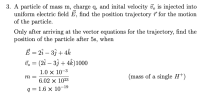 3. A particle of mass m, charge q, and inital velocity vo is injected into uniform electric field E, find the position trajectory for the motion of the particle. Only after arriving at the vector equations for the trajectory, find the position of the particle after 5s, when E - 2i - 3j +4k vo- (2i -3j + 4k)1000 1.0 × 10⁻³ 6.02 x 10²³ q-1.6 x 10⁻¹⁹ (mass of a single H+)
The force acting on a particle of mass m = 2kg is given by the following...
The force acting on a particle of mass m = 2kg is given by the following force equation: F = (v/2) * (x + 4) The particle will pass through the origin with a speed of vo at time t = 0s. Find an expression for the displacement as a function of vo when t = 2s.
Motion of Particle Puntos:5 The motion of a particle moving in a circle in the x-y...
 Motion of Particle Puntos:5 The motion of a particle moving in a circle in the x-y plane is described by the equations: r(t)=9.54, Θ(t)=7.88t here Θ is the polar angle measured counter-clockwise from the x-axis in radians, and r is the distance from the origin in m. Calculate the y-coordinate of the article at the time 2.50 s. Enviar Respuesta Tries 0/5 Calculate the y-component of the velocity at the time 4.00 s? Enviar RespestaTries 0/5 Calculate the magnitude of...
Find the law of motion of a particle mass m and zero energy in one dimension...
 Find the law of motion of a particle mass m and zero energy in
one dimension in the field U(x) = -Ax^(4) where A is a positive
constant. Given the inital position x0, compute how much time does
it take for the particle to escape to infinity if the vector of
initial velocity of the particle is pointing away from the origin
x=0. Describe the motion when the vector of inital velocity of the
particle is pointing toward x=0.
3....
Find the law of motion of a particle mass m and zero energy in
one dimension in the field U(x) = -Ax^(4) where A is a positive
constant. Given the inital position x0, compute how much time does
it take for the particle to escape to infinity if the vector of
initial velocity of the particle is pointing away from the origin
x=0. Describe the motion when the vector of inital velocity of the
particle is pointing toward x=0.
3....
 Mechanics. Need help with c) and d)
1. A particle of mass m moves in three dimensions, and has position r(t)-(x(t), y(t), z(t)) at time t. The particle has potential energy V(x, y, 2) so that its Lagrangian is given by where i d/dt, dy/dt, dz/dt (a) Writing q(q2.93)-(r, y, z) and denoting by p (p,P2, ps) their associated canonical momenta, show that the Hamiltonian is given by (show it from first principles rather than using the energy) H(q,p)H(g1, 92,9q3,...
Mechanics. Need help with c) and d)
1. A particle of mass m moves in three dimensions, and has position r(t)-(x(t), y(t), z(t)) at time t. The particle has potential energy V(x, y, 2) so that its Lagrangian is given by where i d/dt, dy/dt, dz/dt (a) Writing q(q2.93)-(r, y, z) and denoting by p (p,P2, ps) their associated canonical momenta, show that the Hamiltonian is given by (show it from first principles rather than using the energy) H(q,p)H(g1, 92,9q3,...
 The equations of motion for a particle of mass m and electrical charge q under the influence of a uniform magnetic field B perpendicular to the plane of motion are mx" = qBy' and my" = -qBx'. where x and y are the horizontal Cartesian position coordinates of the particle. Suppose that the particle initially satisfies the conditions Solve the initial value problem and sketch out the trajectory of the particle for t Greaterthanorequalto 0.
 6. (20pts) Consider a particle of mass m and energy E approaching the step potential V(x) = { 0x< V.>0 x > 0 from negative values of x. Consider the case E> Vo. a) Classically, what is the probability of reflection? b) Quantum mechanically, what is the probability of reflection? Express your result in terms of the ratio VIE. What is the probability of reflection if E= 2Vo?
 1l] A particle with mass m and energy E is inside a square tube with infinite potential barriers at x-o, x-a, y 0, y a. The tube is infinitely long in the +z-direction. (a) Solve the Schroedinger equation to derive the allowed wave functions for this particle. Do not try to normalize the wave functions, but make sure they correspond to motion in +2-direction. (b) Determine the allowed energies for such a particle. (c) If we were to probe the...
 4. A particle of mass m 2 kg moves under the potential energy function U(x.y.z)- (kx + 2 k2y2 +3 k3z3) where k 1N. a. Suppose the particle has speed vo3 m/s when it passes through the origin. What will its speed be if and when it passes through the point (1,1.1)? b. Suppose the particle's speed vo at the origin is not known and that the point (1,1,1) is a turning point of the motion (a point where v0)....
 3. A particle of mass m, charge q, and inital velocity vo is injected into uniform electric field E, find the position trajectory for the motion of the particle. Only after arriving at the vector equations for the trajectory, find the position of the particle after 5s, when E - 2i - 3j +4k vo- (2i -3j + 4k)1000 1.0 × 10⁻³ 6.02 x 10²³ q-1.6 x 10⁻¹⁹ (mass of a single H+)
 Motion of Particle Puntos:5 The motion of a particle moving in a circle in the x-y plane is described by the equations: r(t)=9.54, Θ(t)=7.88t here Θ is the polar angle measured counter-clockwise from the x-axis in radians, and r is the distance from the origin in m. Calculate the y-coordinate of the article at the time 2.50 s. Enviar Respuesta Tries 0/5 Calculate the y-component of the velocity at the time 4.00 s? Enviar RespestaTries 0/5 Calculate the magnitude of...
 Find the law of motion of a particle mass m and zero energy in
one dimension in the field U(x) = -Ax^(4) where A is a positive
constant. Given the inital position x0, compute how much time does
it take for the particle to escape to infinity if the vector of
initial velocity of the particle is pointing away from the origin
x=0. Describe the motion when the vector of inital velocity of the
particle is pointing toward x=0.
3....
Find the law of motion of a particle mass m and zero energy in
one dimension in the field U(x) = -Ax^(4) where A is a positive
constant. Given the inital position x0, compute how much time does
it take for the particle to escape to infinity if the vector of
initial velocity of the particle is pointing away from the origin
x=0. Describe the motion when the vector of inital velocity of the
particle is pointing toward x=0.
3....
Most questions answered within 3 hours.
-
Where is the error in this code sequence?
String s1 = "Hello";
String s2 = "ello";...
asked 11 months ago -
Financial data for Joel de Paris, Inc., for last year
follow:
Joel de Paris, Inc.
Balance...
asked 11 months ago -
Consider this reaction:
Al2(SO4)3 (aq)+ BaCl3
(aq) Al2Cl6 (aq)- +
3BaSO4(s) . What is the...
asked 11 months ago -
Suppose that Savneet is considering increasing her
recent random sample from 20 car rentals to 40...
asked 11 months ago -
Trucks arrive at an unloading terminal at an average rate of 120
per hour.
Trucks arrive...
asked 11 months ago -
Why are methanol and ethanol completely soluble in water while
octanol is not very little soluble....
asked 11 months ago -
A facilities manager at a university reads in a research report
that the mean amount of...
asked 11 months ago -
When the CuSO4 is rehydrated by adding water to the anhydrous
compound, is this an endothermic...
asked 11 months ago -
A ray of sunlight is passing from diamond into crown glass; the
angle of incidence is...
asked 11 months ago -
A block of mass 0.249 kg is placed on top of a light, vertical
spring of...
asked 11 months ago -
how do the kidneys compensate in the presences of acidosis
a) trigger hyperventilate
b) reserve acid...
asked 11 months ago -
Question 501 pts
The rental rate of capital to the firm increases. Which of the
following...
asked 11 months ago