A charged particle of mass m and positive charge q moves in uniform electric and magnetic...
A charged particle of mass m and positive charge q moves in uniform electric and magnetic fields, E pointing in the y direction and B in the z direction. suppose the particle is initially at the origin and is given a kick at time t=0 along the x axis with vx = vxo (positive or negative).
a) Write down the equation of motion for the particle and resolve it into its three components. show that the motion remains in the plane z=0.
b) prove that there is a unique value of vx = vxo called the drift speed vdr, for which the particle moves undeflected through the fields.
c) Solve the equations of motion to give the particle's velocity as a function of t, for arbitrary values of vxo. [Hint: Make a change of variables of the form ux=vx-vdr, and uy=vy.]
d) Integrate the velocity to find the position as a function of t and sketch the trajectory for various values of vxo.
Homework Answers
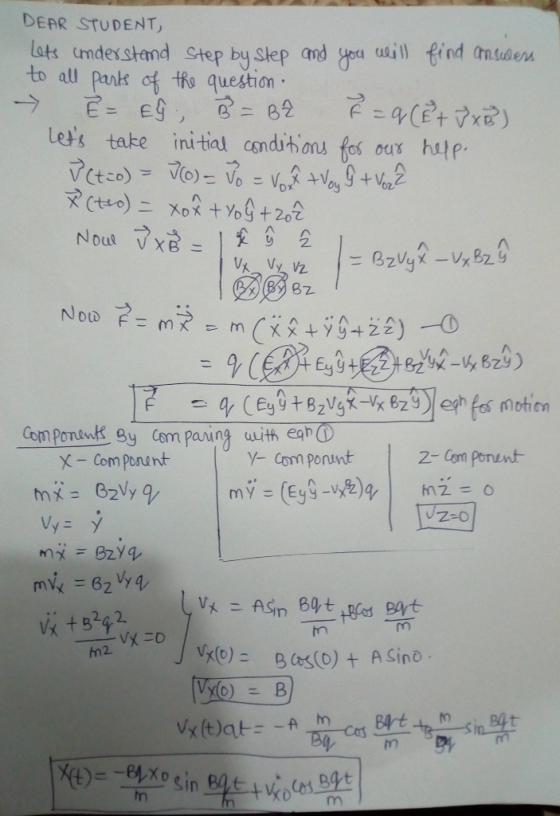
Hope this will help you get through the problem and you may love to appreciate the effort.
Add Answer to:
A charged particle of mass m and positive charge q moves in
uniform electric and magnetic...
2.53A charged particle of mass m and positive charge q moves in uniform electric and magnetic...
 2.53A charged particle of mass m and positive charge q moves in uniform electric and magnetic fields. E and B, both pointing in the z direction. The net force on the particle is F = q (E + v x B). Write down the equation of motion for the particle and resolve it into its three components. Solve the equations and describe the particle's motion.
A 6.60 −μC particle moves through a region of space where an electric field of magnitude...
A 6.60 −μC particle moves through a region of space where an electric field of magnitude 1300 N/C points in the positive x direction, and a magnetic field of magnitude 1.24 T points in the positive z direction. If the net force acting on the particle is 6.25×10⁻³ N in the positive xx direction, find the components of the particle's velocity. Assume the particle's velocity is in the x-y plane. vx, vy, vz =
Consider a charged particle of mass m and positive charge Q, which moves in the presence...
 Consider a charged particle of mass m and positive charge Q, which moves in the presence of a uniform magnetic field, and a uniform E-field, both of which point along the positive z-axis. At t=0, the particle is at the origin: x=y=z=0. (a) Suppose that at t=0, v is 0. Describe the subsequent motion of the charged particle both quantitatively and qualitatively. (b) Now suppose that at t=0, v is non-zero and directed along positive x. Again, describe the subsequent...
A charged particle with mass M and charge q moves in the x – y plane....
 A charged particle with mass M and charge q moves in the x – y plane. There is a magnetic field of magnitude B in the z-direction and an electric field E in the x-direction. (a) Find the Lagrangian in a form where there is an ignorable coordinate. (b) Find the energy function. Is it energy? Is it conserved? Explain why. (c) Find and solve the equations of motion.
A negatively charged particle, with charge q = 5.10×10⁻⁶ C, has a velocity of 416 m/s...
A negatively charged particle, with charge q = 5.10×10⁻⁶ C, has a velocity of 416 m/s in the positive x-direction, moves into a region with a magnetic field and an electric field. The magnetic field, has a magnitude of 1.50 T, and is pointing in the positive y-direction. The electric field, has a magnitude of 4.00×10³ N/C, and points in the positive z-direction. What is the value of the net force on the charged particle? A. 2.36×10⁻² N, negative z-direction...
Problem 22.14 A6.70 - C particle moves through a region of space where an electric field...
 Problem 22.14 A6.70 - C particle moves through a region of space where an electric field of magnitude 1300 N/C points in the positive direction, and a magnetic field of magnitude 1.25 T points in the positive z direction. Part A If the net force acting on the particle is 6.25*10-3N in the positive e direction find the components of the particle's velocity. Assume the particle's velocity is in the 2-y plane Enter your answers numerically separated by commas.
3. A particle with mass m and charge q moves in a uniform magnetic filed of...
 3. A particle with mass m and charge q moves in a uniform magnetic filed of magnitude B that is oriented along the z axis. (a) Neglecting the effects of spin and using the so-called Landau gauge with the vector po- tential given by A = (-By,0,0), show that the Hamiltonian may be written as À = 2m 2 ++øp +29BD2y +(, 2] (1) с (b) Because Pa and Êz commute with Ĥ, the time-independent Schrödinger equation for (x, y,...
A small particle with positive charge q = +4.25 x 10 ° C and mass m...
 A small particle with positive charge q = +4.25 x 10 ° C and mass m = 7.00 x 10 kg is moving in a region of uniform electric and magnetic fields. The magnetic field is B = 4.00 T in the +z-direction, The electric field is also in the +z-direction and has magnitude E = 60.0 N/C. At time t = 0 the particle is on the y-axis at y= +1.00 m and has velocity v = 30.0 m/s...
2. A charged particle moves at an initial velocity v = vi in a constant magnetic...
 2. A charged particle moves at an initial velocity v = vi in a constant magnetic field B = - BK (B > 0), as sketched below. X х X X X X X х X x х х X X х B=-BR х 9v=vi х X х Complete the following tasks: (a) The particle undergoes a circular motion, known as the cyclotron motion, due to the magnetic force. Sketch the trajectory of the particle, if q> 0. Note: You...
A particle with a charge of q = -5.00 nC is moving in a uniform magnetic...
A particle with a charge of q = -5.00 nC is moving in a uniform magnetic field of B⃗ =( -1.27 T ) z^. The magnetic force on the particle is measured to be F⃗ =( −7.60×10⁻⁷ N )y^. Calculate vx, the x component of the velocity of the particle.
 2.53A charged particle of mass m and positive charge q moves in uniform electric and magnetic fields. E and B, both pointing in the z direction. The net force on the particle is F = q (E + v x B). Write down the equation of motion for the particle and resolve it into its three components. Solve the equations and describe the particle's motion.
 Consider a charged particle of mass m and positive charge Q, which moves in the presence of a uniform magnetic field, and a uniform E-field, both of which point along the positive z-axis. At t=0, the particle is at the origin: x=y=z=0. (a) Suppose that at t=0, v is 0. Describe the subsequent motion of the charged particle both quantitatively and qualitatively. (b) Now suppose that at t=0, v is non-zero and directed along positive x. Again, describe the subsequent...
 A charged particle with mass M and charge q moves in the x – y plane. There is a magnetic field of magnitude B in the z-direction and an electric field E in the x-direction. (a) Find the Lagrangian in a form where there is an ignorable coordinate. (b) Find the energy function. Is it energy? Is it conserved? Explain why. (c) Find and solve the equations of motion.
 Problem 22.14 A6.70 - C particle moves through a region of space where an electric field of magnitude 1300 N/C points in the positive direction, and a magnetic field of magnitude 1.25 T points in the positive z direction. Part A If the net force acting on the particle is 6.25*10-3N in the positive e direction find the components of the particle's velocity. Assume the particle's velocity is in the 2-y plane Enter your answers numerically separated by commas.
 3. A particle with mass m and charge q moves in a uniform magnetic filed of magnitude B that is oriented along the z axis. (a) Neglecting the effects of spin and using the so-called Landau gauge with the vector po- tential given by A = (-By,0,0), show that the Hamiltonian may be written as À = 2m 2 ++øp +29BD2y +(, 2] (1) с (b) Because Pa and Êz commute with Ĥ, the time-independent Schrödinger equation for (x, y,...
 A small particle with positive charge q = +4.25 x 10 ° C and mass m = 7.00 x 10 kg is moving in a region of uniform electric and magnetic fields. The magnetic field is B = 4.00 T in the +z-direction, The electric field is also in the +z-direction and has magnitude E = 60.0 N/C. At time t = 0 the particle is on the y-axis at y= +1.00 m and has velocity v = 30.0 m/s...
 2. A charged particle moves at an initial velocity v = vi in a constant magnetic field B = - BK (B > 0), as sketched below. X х X X X X X х X x х х X X х B=-BR х 9v=vi х X х Complete the following tasks: (a) The particle undergoes a circular motion, known as the cyclotron motion, due to the magnetic force. Sketch the trajectory of the particle, if q> 0. Note: You...
Most questions answered within 3 hours.
-
Where is the error in this code sequence?
String s1 = "Hello";
String s2 = "ello";...
asked 11 months ago -
Financial data for Joel de Paris, Inc., for last year
follow:
Joel de Paris, Inc.
Balance...
asked 11 months ago -
Consider this reaction:
Al2(SO4)3 (aq)+ BaCl3
(aq) Al2Cl6 (aq)- +
3BaSO4(s) . What is the...
asked 11 months ago -
Suppose that Savneet is considering increasing her
recent random sample from 20 car rentals to 40...
asked 11 months ago -
Trucks arrive at an unloading terminal at an average rate of 120
per hour.
Trucks arrive...
asked 11 months ago -
Why are methanol and ethanol completely soluble in water while
octanol is not very little soluble....
asked 11 months ago -
A facilities manager at a university reads in a research report
that the mean amount of...
asked 11 months ago -
When the CuSO4 is rehydrated by adding water to the anhydrous
compound, is this an endothermic...
asked 11 months ago -
A ray of sunlight is passing from diamond into crown glass; the
angle of incidence is...
asked 11 months ago -
A block of mass 0.249 kg is placed on top of a light, vertical
spring of...
asked 11 months ago -
how do the kidneys compensate in the presences of acidosis
a) trigger hyperventilate
b) reserve acid...
asked 11 months ago -
Question 501 pts
The rental rate of capital to the firm increases. Which of the
following...
asked 11 months ago