Find the law of motion of a particle mass m and zero energy in
one dimension in the field U(x) = -Ax^(4) where A is a positive
constant. Given the inital position x0, compute how much time does
it take for the particle to escape to infinity if the vector of
initial velocity of the particle is pointing away from the origin
x=0. Describe the motion when the vector of inital velocity of the
particle is pointing toward x=0.
Homework Answers


Add Answer to:
Find the law of motion of a particle mass m and zero energy in
one dimension...
A particle of mass m moves in one dimension along the positive x axis. It is...
 A particle of mass m moves in one dimension along the positive x axis. It is acted on by a constant force directed toward the origin with magnitude B, and an inverse-square law repulsive force with magnitude A/x^2. Find the potential energy function, U(x). Sketch the energy diagram for the system when the maximum kinetic energy is K_0 = 1/2 mv_0^2 Find the equilibrium position, x_0.
4. Determine approximately the law of motion of a particle of mass m in the field...
 4. Determine approximately the law of motion of a particle of mass m in the field Ucx) in the vicinity of turning point of motion E-Ua) where E is total energy. Proceed by expanding U(x) in a Taylor series about x-a. Consider the cases when (a) U(a)#0 and 5. Find the law according to which the period of motion T for a particle of mass nm moving in the field sketched below approaches infinity as ε=um-E goes to zero. The...
A particle of mass m moves in one dimension. Its potential energy is given by U(x)...
 A particle of mass m moves in one dimension. Its potential energy is given by U(x) = -Voe-22/22 where U, and a are constants. (a) Draw an energy diagram showing the potential energy U(). Choose some value for the total mechanical energy E such that -U, < E < 0. Mark the kinetic energy, the potential energy and the total energy for the particle at some point of your choosing. (b) Find the force on the particle as a function...
A particle of mass m is in a potential energy field described by, V(x, y) =...
 A particle of mass m is in a potential energy field described by, V(x, y) = 18kx² +8ky? where k is a positive constant. Initially the particle is resting at the origin (0,0). At time t = 0 the particle receives a kick that imparts to it an initial velocity (vo, 2vo). (a) Find the position of the particle as a function of time, x(t) and y(t). (b) Plot the trajectory for this motion (Lissajous figure) using Vo = 1,...
A particle of mass m is moving in the potential . 1) Determine the force F(x)...
A particle of mass m is moving in the potential . 1) Determine the force F(x) acting on the particle. Sketch the force and the potential in a single diagram, as functions of position, with . Find the physical dimension of constant A. 2) Find all equilibria of the particle on the interval . Determine whether these equilibria are stable or not. 3) If the initial position of x0 = a/2, find all possible values of initial velocity for which...
A particle of mass m moves in one dimension. Let x(t) denote the position of the...
 A particle of mass m moves in one dimension. Let x(t) denote the position of the particle at time t. The particle is subjected to a force which depends only on the position of the particle; when the particle is at position x, the force is -A sin(Bx), where A and B are some positive constants. Fill in the blank so that we end up with the differential equation that describes the motion: x" = Note that x = 0...
A. Consider motion of a particle of mass m and energy E = 0 in the...
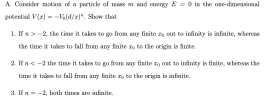 A. Consider motion of a particle of mass m and energy E = 0 in the one-dimensional potential V(x) = -V.(d/x)". Show that 1. If n > —2, the time it takes to go from any finite co out to infinity is infinite, whereas the time it takes to fall from any finite čo to the origin is finite. 2. If n < -2 the time it takes to go from any finite xo out to infinity is finite, whereas...
Understand how to find the equation of motion of a particle undergoing uniform circular motion. Consider...
Understand how to find the equation of motion of a particle undergoing uniform circular motion. Consider a particle--the small red block in the figure--that is constrained to move in a circle of radius R. We can specify its position solely by θ(t), the angle that the vector from the origin to the block makes with our chosen reference axis at time t. Following the standard conventions we measure θ(t) in the counterclockwise direction from the positive x axis. (Figure 1)...
Consider a charged particle of mass m and positive charge Q, which moves in the presence...
 Consider a charged particle of mass m and positive charge Q, which moves in the presence of a uniform magnetic field, and a uniform E-field, both of which point along the positive z-axis. At t=0, the particle is at the origin: x=y=z=0. (a) Suppose that at t=0, v is 0. Describe the subsequent motion of the charged particle both quantitatively and qualitatively. (b) Now suppose that at t=0, v is non-zero and directed along positive x. Again, describe the subsequent...
3. A particle of mass m, charge q, and inital velocity vo is injected into uniform...
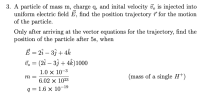 3. A particle of mass m, charge q, and inital velocity vo is injected into uniform electric field E, find the position trajectory for the motion of the particle. Only after arriving at the vector equations for the trajectory, find the position of the particle after 5s, when E - 2i - 3j +4k vo- (2i -3j + 4k)1000 1.0 × 10⁻³ 6.02 x 10²³ q-1.6 x 10⁻¹⁹ (mass of a single H+)
 A particle of mass m moves in one dimension along the positive x axis. It is acted on by a constant force directed toward the origin with magnitude B, and an inverse-square law repulsive force with magnitude A/x^2. Find the potential energy function, U(x). Sketch the energy diagram for the system when the maximum kinetic energy is K_0 = 1/2 mv_0^2 Find the equilibrium position, x_0.
 4. Determine approximately the law of motion of a particle of mass m in the field Ucx) in the vicinity of turning point of motion E-Ua) where E is total energy. Proceed by expanding U(x) in a Taylor series about x-a. Consider the cases when (a) U(a)#0 and 5. Find the law according to which the period of motion T for a particle of mass nm moving in the field sketched below approaches infinity as ε=um-E goes to zero. The...
 A particle of mass m moves in one dimension. Its potential energy is given by U(x) = -Voe-22/22 where U, and a are constants. (a) Draw an energy diagram showing the potential energy U(). Choose some value for the total mechanical energy E such that -U, < E < 0. Mark the kinetic energy, the potential energy and the total energy for the particle at some point of your choosing. (b) Find the force on the particle as a function...
 A particle of mass m is in a potential energy field described by, V(x, y) = 18kx² +8ky? where k is a positive constant. Initially the particle is resting at the origin (0,0). At time t = 0 the particle receives a kick that imparts to it an initial velocity (vo, 2vo). (a) Find the position of the particle as a function of time, x(t) and y(t). (b) Plot the trajectory for this motion (Lissajous figure) using Vo = 1,...
 A particle of mass m moves in one dimension. Let x(t) denote the position of the particle at time t. The particle is subjected to a force which depends only on the position of the particle; when the particle is at position x, the force is -A sin(Bx), where A and B are some positive constants. Fill in the blank so that we end up with the differential equation that describes the motion: x" = Note that x = 0...
 A. Consider motion of a particle of mass m and energy E = 0 in the one-dimensional potential V(x) = -V.(d/x)". Show that 1. If n > —2, the time it takes to go from any finite co out to infinity is infinite, whereas the time it takes to fall from any finite čo to the origin is finite. 2. If n < -2 the time it takes to go from any finite xo out to infinity is finite, whereas...
 Consider a charged particle of mass m and positive charge Q, which moves in the presence of a uniform magnetic field, and a uniform E-field, both of which point along the positive z-axis. At t=0, the particle is at the origin: x=y=z=0. (a) Suppose that at t=0, v is 0. Describe the subsequent motion of the charged particle both quantitatively and qualitatively. (b) Now suppose that at t=0, v is non-zero and directed along positive x. Again, describe the subsequent...
 3. A particle of mass m, charge q, and inital velocity vo is injected into uniform electric field E, find the position trajectory for the motion of the particle. Only after arriving at the vector equations for the trajectory, find the position of the particle after 5s, when E - 2i - 3j +4k vo- (2i -3j + 4k)1000 1.0 × 10⁻³ 6.02 x 10²³ q-1.6 x 10⁻¹⁹ (mass of a single H+)
Most questions answered within 3 hours.
-
Where is the error in this code sequence?
String s1 = "Hello";
String s2 = "ello";...
asked 11 months ago -
Financial data for Joel de Paris, Inc., for last year
follow:
Joel de Paris, Inc.
Balance...
asked 11 months ago -
Consider this reaction:
Al2(SO4)3 (aq)+ BaCl3
(aq) Al2Cl6 (aq)- +
3BaSO4(s) . What is the...
asked 11 months ago -
Suppose that Savneet is considering increasing her
recent random sample from 20 car rentals to 40...
asked 11 months ago -
Trucks arrive at an unloading terminal at an average rate of 120
per hour.
Trucks arrive...
asked 11 months ago -
Why are methanol and ethanol completely soluble in water while
octanol is not very little soluble....
asked 11 months ago -
A facilities manager at a university reads in a research report
that the mean amount of...
asked 11 months ago -
When the CuSO4 is rehydrated by adding water to the anhydrous
compound, is this an endothermic...
asked 11 months ago -
A ray of sunlight is passing from diamond into crown glass; the
angle of incidence is...
asked 11 months ago -
A block of mass 0.249 kg is placed on top of a light, vertical
spring of...
asked 11 months ago -
how do the kidneys compensate in the presences of acidosis
a) trigger hyperventilate
b) reserve acid...
asked 11 months ago -
Question 501 pts
The rental rate of capital to the firm increases. Which of the
following...
asked 11 months ago