3. The diagram below shows the trajectories of three charged particles moving in a uniform magnetic field of strength B. The field points into the plane of the paper. The particles are moving in the plane of the paper. The direction in which each particle is moving is shown by the arrows. (a) For each particle, find if the charge is positive or negative (Q>0 or Q<0). Q1: Q2: Q3: (b) Assume all particles have the same velocity (v) and the same charge charge magnitude |Q|. Which particle will have the greater mass? Explain your answer in a couple of sentences. Derive the formula you used to answer this question. Will the speed of the particles change as they move in the magnetic field? (c) For each of the curves below pick a point in the trajectory and indicate the velocity vector at that point and the direction of the force due to the magnetic field.

Homework Answers
 please like
Add Answer to:
3. The diagram below shows the trajectories of three charged
particles moving in a uniform magnetic...
A bubble chamber is a device used to study the trajectories of elementary particles such as...
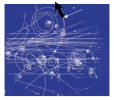 A bubble chamber is a device used to study the trajectories of
elementary particles such as electrons and protons. The image below
shows the trajectories of some typical particles, one of which is
indicated by a white arrow. Suppose this particle is moving in the
direction indicated by the black arrow; the particle follows a
curved path due to the presence of a magnetic field perpendicular
to the plane of the photo.
For this question, we assume that the magnetic...
A bubble chamber is a device used to study the trajectories of
elementary particles such as electrons and protons. The image below
shows the trajectories of some typical particles, one of which is
indicated by a white arrow. Suppose this particle is moving in the
direction indicated by the black arrow; the particle follows a
curved path due to the presence of a magnetic field perpendicular
to the plane of the photo.
For this question, we assume that the magnetic...
Physics problem 15 Two charged particles are moving with different speeds and directions. Charge q,--110. C BECAREFUL OF q1's SIGN) and q2 -3x10¹⁵ C. The diagram indicates their relative location...
 Physics problem
15 Two charged particles are moving with different speeds and directions. Charge q,--110. C BECAREFUL OF q1's SIGN) and q2 -3x10¹⁵ C. The diagram indicates their relative locations, speeds, and trajectories. v, 3000 m/s v2 2000 m/s 41 3 mm 42 4 mm what is the B-field (magnitude and direction) that particle #2 generates at particle #l's location? a) b) What is the magnitude of the magnetic force particle #1 is experiencing? c) What is the direction of...
Physics problem
15 Two charged particles are moving with different speeds and directions. Charge q,--110. C BECAREFUL OF q1's SIGN) and q2 -3x10¹⁵ C. The diagram indicates their relative locations, speeds, and trajectories. v, 3000 m/s v2 2000 m/s 41 3 mm 42 4 mm what is the B-field (magnitude and direction) that particle #2 generates at particle #l's location? a) b) What is the magnitude of the magnetic force particle #1 is experiencing? c) What is the direction of...
1. Which of the following charged particles moving in a static uniform magnetic field feels no...
1. Which of the following charged particles moving in a static uniform magnetic field feels no force? A. an electron with velocity opposite the direction of the magnetic field B. an electron with velocity perpendicular to the magnetic field C. a proton with velocity perpendicular to the magnetic field D. a proton with velocity making a 45 degree angle with the magnetic field 2. An electron enters a region where a uniform magnetic field points in the +z direction. If...
three particles having the same mass and same horizontal velocity enter a region of constant magnetic...
 three particles having the same mass and same horizontal
velocity enter a region of constant magnetic field. ( i know the
answer for if you had q and -4q is out of the screen)
Item 2 Constants PartA Three particles having the same mass and the same horizontal velocity enter a region of constant magnetic field. One particle has a charge q, the other has a charge -2 q and the third particle is neutral. The paths of the particles...
three particles having the same mass and same horizontal
velocity enter a region of constant magnetic field. ( i know the
answer for if you had q and -4q is out of the screen)
Item 2 Constants PartA Three particles having the same mass and the same horizontal velocity enter a region of constant magnetic field. One particle has a charge q, the other has a charge -2 q and the third particle is neutral. The paths of the particles...
In a mass spectrometer, a beam of charged particles of unknown mass are injected into a...
 In a mass spectrometer, a beam of charged particles of unknown mass are injected into a region of space where a magnetic field is directed perpendicular to the particles' velocity Typically, the velocity of the particle beam has already been determined through the use of a velocity selector. In this simulation, the beam is comprised of a pair of singly ionized isotopes of the same element. V=5000 m/s 4000 sdoo 6000 Isotopes 2cc Ne. Ne C. Unknown B=5.0 mm Show...
3) A charged particle is moving with velocity of V in a magnetic field of B,...
 3) A charged particle is moving with velocity of V in a magnetic field of B, which one of the followings is correct: A) The direction of force F on the charge is parallel to magnetic field B B) The direction of force F on the charge is parallel to velocity direction V C) The force is maximized when velocity direction and magnetic field are parallel D) The force F is perpendicular (normal) to both velocity V and magnetic field...
A charged particle moving through a magnetic field at night angles to the field with a...
 A charged particle moving through a magnetic field at night angles to the field with a speed of 24.7 m/s experiences a magnetic force of 2.78 x 10 N. Determine the magnetic force on an identical particle when it travels through the same magnetic field with a speed of 5.44 m/s at an angle of 31.20 relative to the magnetic field. x How does the magnetic force acting on a charged particle moving through a magnetic field depend on the...
The figure shows three particles with identical charge magnitudes and masses moving through a uniform magnetic...
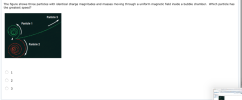 The figure shows three particles with identical charge magnitudes and masses moving through a uniform magnetic field inside a bubble chamber. Which particle has the greatest speed? Particle 3 Particle 1 Particle 2 2
The force on a charged particle moving in a magnetic field can be computed as the...
The force on a charged particle moving in a magnetic field can be computed as the vector sum of the forces due to each separate component of the magnetic field. As an example, a particle with charge q is moving with speed v in the? y-direction. It is moving in a uniform magnetic field Part A What is the x-component of the force F? exerted on the particle by the magnetic field? Part B What is the y-component of the force...
A charged particle moves along the x-axis through a region with a uniform magnetic field that...
A charged particle moves along the x-axis through a region with a uniform magnetic field that is oriented to lie in the x-y plane. Part a) Assume that the particle has a net charge of +669 μC and is moving with a velocity of 464 m/s in the +x direction at a particular instant. In that region of space, there is a uniform magnetic field of 1.91T directed in the x-y plane at an angle of +29.8 ∘ relative to...
 A bubble chamber is a device used to study the trajectories of
elementary particles such as electrons and protons. The image below
shows the trajectories of some typical particles, one of which is
indicated by a white arrow. Suppose this particle is moving in the
direction indicated by the black arrow; the particle follows a
curved path due to the presence of a magnetic field perpendicular
to the plane of the photo.
For this question, we assume that the magnetic...
A bubble chamber is a device used to study the trajectories of
elementary particles such as electrons and protons. The image below
shows the trajectories of some typical particles, one of which is
indicated by a white arrow. Suppose this particle is moving in the
direction indicated by the black arrow; the particle follows a
curved path due to the presence of a magnetic field perpendicular
to the plane of the photo.
For this question, we assume that the magnetic...
 Physics problem
15 Two charged particles are moving with different speeds and directions. Charge q,--110. C BECAREFUL OF q1's SIGN) and q2 -3x10¹⁵ C. The diagram indicates their relative locations, speeds, and trajectories. v, 3000 m/s v2 2000 m/s 41 3 mm 42 4 mm what is the B-field (magnitude and direction) that particle #2 generates at particle #l's location? a) b) What is the magnitude of the magnetic force particle #1 is experiencing? c) What is the direction of...
Physics problem
15 Two charged particles are moving with different speeds and directions. Charge q,--110. C BECAREFUL OF q1's SIGN) and q2 -3x10¹⁵ C. The diagram indicates their relative locations, speeds, and trajectories. v, 3000 m/s v2 2000 m/s 41 3 mm 42 4 mm what is the B-field (magnitude and direction) that particle #2 generates at particle #l's location? a) b) What is the magnitude of the magnetic force particle #1 is experiencing? c) What is the direction of...
 three particles having the same mass and same horizontal
velocity enter a region of constant magnetic field. ( i know the
answer for if you had q and -4q is out of the screen)
Item 2 Constants PartA Three particles having the same mass and the same horizontal velocity enter a region of constant magnetic field. One particle has a charge q, the other has a charge -2 q and the third particle is neutral. The paths of the particles...
three particles having the same mass and same horizontal
velocity enter a region of constant magnetic field. ( i know the
answer for if you had q and -4q is out of the screen)
Item 2 Constants PartA Three particles having the same mass and the same horizontal velocity enter a region of constant magnetic field. One particle has a charge q, the other has a charge -2 q and the third particle is neutral. The paths of the particles...
 In a mass spectrometer, a beam of charged particles of unknown mass are injected into a region of space where a magnetic field is directed perpendicular to the particles' velocity Typically, the velocity of the particle beam has already been determined through the use of a velocity selector. In this simulation, the beam is comprised of a pair of singly ionized isotopes of the same element. V=5000 m/s 4000 sdoo 6000 Isotopes 2cc Ne. Ne C. Unknown B=5.0 mm Show...
 3) A charged particle is moving with velocity of V in a magnetic field of B, which one of the followings is correct: A) The direction of force F on the charge is parallel to magnetic field B B) The direction of force F on the charge is parallel to velocity direction V C) The force is maximized when velocity direction and magnetic field are parallel D) The force F is perpendicular (normal) to both velocity V and magnetic field...
 A charged particle moving through a magnetic field at night angles to the field with a speed of 24.7 m/s experiences a magnetic force of 2.78 x 10 N. Determine the magnetic force on an identical particle when it travels through the same magnetic field with a speed of 5.44 m/s at an angle of 31.20 relative to the magnetic field. x How does the magnetic force acting on a charged particle moving through a magnetic field depend on the...
 The figure shows three particles with identical charge magnitudes and masses moving through a uniform magnetic field inside a bubble chamber. Which particle has the greatest speed? Particle 3 Particle 1 Particle 2 2
Most questions answered within 3 hours.
-
Where is the error in this code sequence?
String s1 = "Hello";
String s2 = "ello";...
asked 11 months ago -
Financial data for Joel de Paris, Inc., for last year
follow:
Joel de Paris, Inc.
Balance...
asked 11 months ago -
Consider this reaction:
Al2(SO4)3 (aq)+ BaCl3
(aq) Al2Cl6 (aq)- +
3BaSO4(s) . What is the...
asked 11 months ago -
Suppose that Savneet is considering increasing her
recent random sample from 20 car rentals to 40...
asked 11 months ago -
Trucks arrive at an unloading terminal at an average rate of 120
per hour.
Trucks arrive...
asked 11 months ago -
Why are methanol and ethanol completely soluble in water while
octanol is not very little soluble....
asked 11 months ago -
A facilities manager at a university reads in a research report
that the mean amount of...
asked 11 months ago -
When the CuSO4 is rehydrated by adding water to the anhydrous
compound, is this an endothermic...
asked 11 months ago -
A ray of sunlight is passing from diamond into crown glass; the
angle of incidence is...
asked 11 months ago -
A block of mass 0.249 kg is placed on top of a light, vertical
spring of...
asked 11 months ago -
how do the kidneys compensate in the presences of acidosis
a) trigger hyperventilate
b) reserve acid...
asked 11 months ago -
Question 501 pts
The rental rate of capital to the firm increases. Which of the
following...
asked 11 months ago