please answer these questions 1: Which of the following is true for the reaction of (1R,...
please answer these questions
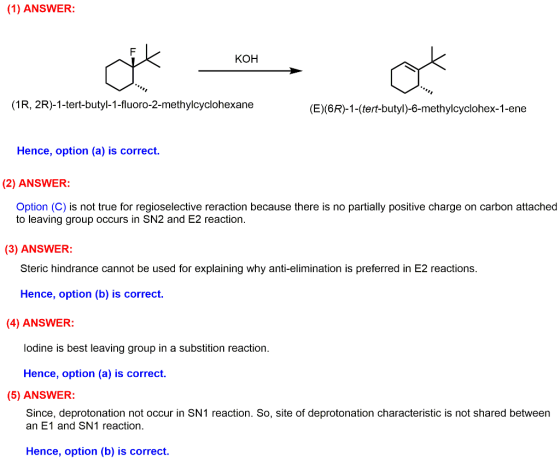
1: Which of the following is true for the reaction of (1R, 2R)-1-tert-butyl-1-fluoro-2-methylcyclohexane with potassium hydroxide?
a: The product is (E)(6R)-1-tert-butyl-6-methyl-1-cyclohexene
b: The product is (Z)(6R)-1-tert-butyl-6-methyl-1-cyclohexene
c: The product is (Z)(6S)-1-tert-butyl-6-methyl-1-cyclohexene
d: The product is (E)(6S)-1-tert-butyl-6-methyl-1-cyclohexene
2: Which of the following is not true for regioselective reactions?
a: Generally, the selectivity lies to toward the Saytzeff product in elimination reactions.
b: In a regioselective reaction, there is one product that predominates.
c: The transition states of SN2 and E2 reactions each have a partial positive charge on the carbon attached to the leaving group.
d: The intermediate states of SN1 and E2 reactions each have a partial positive charge on the carbon attached to the leaving group
3: Which of the following cannot be used to explain why anti-elimination is preferred in E2 reactions?
a: None of these are correct.
b: Steric hindrance
c: Newman projections
d: Orbital overlap
4: Which of the following would be the best leaving group in a substitution reaction?
a: I
b: Br
c: F
d: Cl
5: Which of the following is not a characteristic shared between an E1 and SN1 reaction?
a: Neutral nucleophile
b: Site of deprotonation
c: First-order reaction
d: Substitution of substrate
Homework Answers
Add Answer to:
please answer these questions
1: Which of the following is true for the reaction of (1R,...
Questions 2-10 please!! 1) A substitution reaction is: [2] a) A reaction during which an OH...
 Questions 2-10 please!!
1) A substitution reaction is: [2] a) A reaction during which an OH group of a molecule is replaced by a halogen. b) A reaction during which water is the leaving group. c) A reaction during which a functional group of a molecule is replaced by an electrophile. d) A reaction during which a functional group of a molecule is replaced by another functional group. V 12 2) Substitution reactions are classified either as electrophilic or nucleophilic...
Questions 2-10 please!!
1) A substitution reaction is: [2] a) A reaction during which an OH group of a molecule is replaced by a halogen. b) A reaction during which water is the leaving group. c) A reaction during which a functional group of a molecule is replaced by an electrophile. d) A reaction during which a functional group of a molecule is replaced by another functional group. V 12 2) Substitution reactions are classified either as electrophilic or nucleophilic...
1.1 In which of the following solvents would the reaction of 1-bromobutane with sodium azide,NaN3, proceed...
 1.1 In which of the following solvents would the reaction of
1-bromobutane with sodium azide,NaN3, proceed the fastest?
a.aceticacid
b.ethanol
c.water
d.acetonitrile
1.2 Which of the following solvents is the best choice for the
reaction of 1-chlorohexane with sodium bromide?
a.dimethylsulfoxide
b.water
c.hexane
d.toluene,PhCH3
1.3 Which of the following is most likely to undergo
rearrangement during reaction with methanol?
1.4 Name which energy diagrams represents the course of an
exothermic SN1, SN2,E1, or E2 reaction?
1.5 Which of the following...
1.1 In which of the following solvents would the reaction of
1-bromobutane with sodium azide,NaN3, proceed the fastest?
a.aceticacid
b.ethanol
c.water
d.acetonitrile
1.2 Which of the following solvents is the best choice for the
reaction of 1-chlorohexane with sodium bromide?
a.dimethylsulfoxide
b.water
c.hexane
d.toluene,PhCH3
1.3 Which of the following is most likely to undergo
rearrangement during reaction with methanol?
1.4 Name which energy diagrams represents the course of an
exothermic SN1, SN2,E1, or E2 reaction?
1.5 Which of the following...
For the following reaction, please answer the following questions: A) Which type of substitution reaction would...
 For the following reaction, please answer the following
questions:
A) Which type of substitution reaction would it take place, SN1
or SN2?
B) Does it have a good leaving group? How do you know?
C) What is the intermediate?
D) Show electron move using arrows.
E) Show product structure. Indicate stereochemistry of the
product comparing to the reactant.
OH + I-
For the following reaction, please answer the following
questions:
A) Which type of substitution reaction would it take place, SN1
or SN2?
B) Does it have a good leaving group? How do you know?
C) What is the intermediate?
D) Show electron move using arrows.
E) Show product structure. Indicate stereochemistry of the
product comparing to the reactant.
OH + I-
8) Draw a mechanism with all the proper arrows for the reaction from this experiment. Introduction...
 8) Draw a mechanism with all the proper arrows for the reaction
from this experiment.
Introduction Alkyl halides can be prepared from alcohols by reactions with hydrogen halides (HCI, HBr, or HI) via nucleophilic substitution. In this type of reaction, the nucleophile displaces a leaving group from a carbon atom of an organic substrate (here the alcohol once protonated). Both electrons of the new bond to the carbon are provided by the nucleophile while the leaving group departs with both...
8) Draw a mechanism with all the proper arrows for the reaction
from this experiment.
Introduction Alkyl halides can be prepared from alcohols by reactions with hydrogen halides (HCI, HBr, or HI) via nucleophilic substitution. In this type of reaction, the nucleophile displaces a leaving group from a carbon atom of an organic substrate (here the alcohol once protonated). Both electrons of the new bond to the carbon are provided by the nucleophile while the leaving group departs with both...
[Review Topics) (References) Give an IUPAC name for the compound below. Accepted names for branched alkyl...
 [Review Topics) (References) Give an IUPAC name for the compound below. Accepted names for branched alkyl groups are isopropyl, isobutyl, sec-butyl, and tert-butyl. CH2CH3 CH3CH2CH2CCH2CH3 Submit Answer Retry Entire Group 9 more group attempts remaining The two reactants shown below are combined to bring about a nucleophilic substitution reaction. Br NaOCCH, . CH3CH2CHCH 1. none h. HBr 1.H20 e. "CCH3 f. Br j. Nat 9. HOCCH3 k. "OCCH3 Which letter designates the electrophilic carbon at which substitution occurs? (If no...
o. Reactions. Please complete the following reaction schemes with the appropriate alkyl halide, reagent os NaOH...
 o. Reactions. Please complete the following reaction schemes with the appropriate alkyl halide, reagent os NaOH Br NaCN SN27 elimination product(s) substitution product(s) SN1 кон elimination product(s) circle the major product substitution productis) SN1 t-butoxide NaOMe SN2? elimination product(s) circle the major product substitution product(s) | SNI NaF SN2? elimination product(s) substitution product(s) NaOH H2O E2] Br SN2? major elimination product depict correct stereochem (hint: antiperiplanar) substitution product(s) Br SN1 or SN2? H20 H20 all elimination product(s) watch for rearrangements...
1) State which of the electrophiles given below will react preferentially by i) SN1, ii) by...
 1) State which of the electrophiles given below will react
preferentially by i) SN1, ii) by SN2, or iii) capable of reacting
by either of the two mechanisms depending on the given conditions.
How can you affect those conditions to favour SN1 or SN2? Reason
your predictions based on the structures of the compounds. Br-CH3,
Br-CH2CH3, Br-CH(CH3)2, Br-C(CH3)3, Br-CH2-C5H6; C5H6 = phenyl
Introduction Alkyl halides can be prepared from alcohols by reactions with hydrogen halides (HCI, HBr, or HI) via...
1) State which of the electrophiles given below will react
preferentially by i) SN1, ii) by SN2, or iii) capable of reacting
by either of the two mechanisms depending on the given conditions.
How can you affect those conditions to favour SN1 or SN2? Reason
your predictions based on the structures of the compounds. Br-CH3,
Br-CH2CH3, Br-CH(CH3)2, Br-C(CH3)3, Br-CH2-C5H6; C5H6 = phenyl
Introduction Alkyl halides can be prepared from alcohols by reactions with hydrogen halides (HCI, HBr, or HI) via...
Consider the following substitution reaction: OH H2SO4 CHBОН + - Нао 1. (1 point) What type...
 Consider the following substitution reaction: OH H2SO4 CHBОН + - Нао 1. (1 point) What type of substitution reaction is this? Answer: SN1 2. (2 points) Assume that you are performing the above reaction in the lab. You are using 5 g of tert-butanol (FW: 74.123), 20 mL of concentrated sulfuric acid (FW: 98.079, d-1.84 g/mL), and 200 mL of methanol (FW: 32.04, d 0.792 g/mL). You obtained 5 mL of methyl tert-butyl ether (FW: 88.150, d 0.7404 g/mL). Determine...
Please explain how you got your answer also Which of the following describes the most stable...
 Please explain how you got your answer also
Which of the following describes the most stable conformation of trans-1- tert-butyl-3-methylcyclohexane? A) Both groups are equatorial. B) Both groups are axial. C) The tert-butyl group is equatorial and the methyl group is axial. D) The tert-butyl group is axial and the methyl group is equatorial. E) none of the above
Please explain how you got your answer also
Which of the following describes the most stable conformation of trans-1- tert-butyl-3-methylcyclohexane? A) Both groups are equatorial. B) Both groups are axial. C) The tert-butyl group is equatorial and the methyl group is axial. D) The tert-butyl group is axial and the methyl group is equatorial. E) none of the above
Consider the SN2 reaction of butyl bromide with hydroxide ion , Assuming no other changes, what...
Consider the SN2 reaction of butyl bromide with hydroxide ion , Assuming no other changes, what effect on the reaction rate would result from simultaneously doubling the concentrations of both butyl bromide and hydroxyl ion No effect (B)It would double the rate (C)it would increase the rate six times (D) It would increase the rate four times. 2. Which alky halide would you expect to undergo SN1 hydrolysis most rapidly? (A) (CH3)3C-I (B) (CH3)3C-Br (C) (CH3)3C-Cl (D) (CH3)3C-F 3....
 Questions 2-10 please!!
1) A substitution reaction is: [2] a) A reaction during which an OH group of a molecule is replaced by a halogen. b) A reaction during which water is the leaving group. c) A reaction during which a functional group of a molecule is replaced by an electrophile. d) A reaction during which a functional group of a molecule is replaced by another functional group. V 12 2) Substitution reactions are classified either as electrophilic or nucleophilic...
Questions 2-10 please!!
1) A substitution reaction is: [2] a) A reaction during which an OH group of a molecule is replaced by a halogen. b) A reaction during which water is the leaving group. c) A reaction during which a functional group of a molecule is replaced by an electrophile. d) A reaction during which a functional group of a molecule is replaced by another functional group. V 12 2) Substitution reactions are classified either as electrophilic or nucleophilic...
 1.1 In which of the following solvents would the reaction of
1-bromobutane with sodium azide,NaN3, proceed the fastest?
a.aceticacid
b.ethanol
c.water
d.acetonitrile
1.2 Which of the following solvents is the best choice for the
reaction of 1-chlorohexane with sodium bromide?
a.dimethylsulfoxide
b.water
c.hexane
d.toluene,PhCH3
1.3 Which of the following is most likely to undergo
rearrangement during reaction with methanol?
1.4 Name which energy diagrams represents the course of an
exothermic SN1, SN2,E1, or E2 reaction?
1.5 Which of the following...
1.1 In which of the following solvents would the reaction of
1-bromobutane with sodium azide,NaN3, proceed the fastest?
a.aceticacid
b.ethanol
c.water
d.acetonitrile
1.2 Which of the following solvents is the best choice for the
reaction of 1-chlorohexane with sodium bromide?
a.dimethylsulfoxide
b.water
c.hexane
d.toluene,PhCH3
1.3 Which of the following is most likely to undergo
rearrangement during reaction with methanol?
1.4 Name which energy diagrams represents the course of an
exothermic SN1, SN2,E1, or E2 reaction?
1.5 Which of the following...
 For the following reaction, please answer the following
questions:
A) Which type of substitution reaction would it take place, SN1
or SN2?
B) Does it have a good leaving group? How do you know?
C) What is the intermediate?
D) Show electron move using arrows.
E) Show product structure. Indicate stereochemistry of the
product comparing to the reactant.
OH + I-
For the following reaction, please answer the following
questions:
A) Which type of substitution reaction would it take place, SN1
or SN2?
B) Does it have a good leaving group? How do you know?
C) What is the intermediate?
D) Show electron move using arrows.
E) Show product structure. Indicate stereochemistry of the
product comparing to the reactant.
OH + I-
 8) Draw a mechanism with all the proper arrows for the reaction
from this experiment.
Introduction Alkyl halides can be prepared from alcohols by reactions with hydrogen halides (HCI, HBr, or HI) via nucleophilic substitution. In this type of reaction, the nucleophile displaces a leaving group from a carbon atom of an organic substrate (here the alcohol once protonated). Both electrons of the new bond to the carbon are provided by the nucleophile while the leaving group departs with both...
8) Draw a mechanism with all the proper arrows for the reaction
from this experiment.
Introduction Alkyl halides can be prepared from alcohols by reactions with hydrogen halides (HCI, HBr, or HI) via nucleophilic substitution. In this type of reaction, the nucleophile displaces a leaving group from a carbon atom of an organic substrate (here the alcohol once protonated). Both electrons of the new bond to the carbon are provided by the nucleophile while the leaving group departs with both...
 [Review Topics) (References) Give an IUPAC name for the compound below. Accepted names for branched alkyl groups are isopropyl, isobutyl, sec-butyl, and tert-butyl. CH2CH3 CH3CH2CH2CCH2CH3 Submit Answer Retry Entire Group 9 more group attempts remaining The two reactants shown below are combined to bring about a nucleophilic substitution reaction. Br NaOCCH, . CH3CH2CHCH 1. none h. HBr 1.H20 e. "CCH3 f. Br j. Nat 9. HOCCH3 k. "OCCH3 Which letter designates the electrophilic carbon at which substitution occurs? (If no...
 o. Reactions. Please complete the following reaction schemes with the appropriate alkyl halide, reagent os NaOH Br NaCN SN27 elimination product(s) substitution product(s) SN1 кон elimination product(s) circle the major product substitution productis) SN1 t-butoxide NaOMe SN2? elimination product(s) circle the major product substitution product(s) | SNI NaF SN2? elimination product(s) substitution product(s) NaOH H2O E2] Br SN2? major elimination product depict correct stereochem (hint: antiperiplanar) substitution product(s) Br SN1 or SN2? H20 H20 all elimination product(s) watch for rearrangements...
 1) State which of the electrophiles given below will react
preferentially by i) SN1, ii) by SN2, or iii) capable of reacting
by either of the two mechanisms depending on the given conditions.
How can you affect those conditions to favour SN1 or SN2? Reason
your predictions based on the structures of the compounds. Br-CH3,
Br-CH2CH3, Br-CH(CH3)2, Br-C(CH3)3, Br-CH2-C5H6; C5H6 = phenyl
Introduction Alkyl halides can be prepared from alcohols by reactions with hydrogen halides (HCI, HBr, or HI) via...
1) State which of the electrophiles given below will react
preferentially by i) SN1, ii) by SN2, or iii) capable of reacting
by either of the two mechanisms depending on the given conditions.
How can you affect those conditions to favour SN1 or SN2? Reason
your predictions based on the structures of the compounds. Br-CH3,
Br-CH2CH3, Br-CH(CH3)2, Br-C(CH3)3, Br-CH2-C5H6; C5H6 = phenyl
Introduction Alkyl halides can be prepared from alcohols by reactions with hydrogen halides (HCI, HBr, or HI) via...
 Consider the following substitution reaction: OH H2SO4 CHBОН + - Нао 1. (1 point) What type of substitution reaction is this? Answer: SN1 2. (2 points) Assume that you are performing the above reaction in the lab. You are using 5 g of tert-butanol (FW: 74.123), 20 mL of concentrated sulfuric acid (FW: 98.079, d-1.84 g/mL), and 200 mL of methanol (FW: 32.04, d 0.792 g/mL). You obtained 5 mL of methyl tert-butyl ether (FW: 88.150, d 0.7404 g/mL). Determine...
 Please explain how you got your answer also
Which of the following describes the most stable conformation of trans-1- tert-butyl-3-methylcyclohexane? A) Both groups are equatorial. B) Both groups are axial. C) The tert-butyl group is equatorial and the methyl group is axial. D) The tert-butyl group is axial and the methyl group is equatorial. E) none of the above
Please explain how you got your answer also
Which of the following describes the most stable conformation of trans-1- tert-butyl-3-methylcyclohexane? A) Both groups are equatorial. B) Both groups are axial. C) The tert-butyl group is equatorial and the methyl group is axial. D) The tert-butyl group is axial and the methyl group is equatorial. E) none of the above
Most questions answered within 3 hours.
-
Where is the error in this code sequence?
String s1 = "Hello";
String s2 = "ello";...
asked 10 months ago -
Financial data for Joel de Paris, Inc., for last year
follow:
Joel de Paris, Inc.
Balance...
asked 10 months ago -
Consider this reaction:
Al2(SO4)3 (aq)+ BaCl3
(aq) Al2Cl6 (aq)- +
3BaSO4(s) . What is the...
asked 10 months ago -
Suppose that Savneet is considering increasing her
recent random sample from 20 car rentals to 40...
asked 10 months ago -
Trucks arrive at an unloading terminal at an average rate of 120
per hour.
Trucks arrive...
asked 10 months ago -
Why are methanol and ethanol completely soluble in water while
octanol is not very little soluble....
asked 10 months ago -
A facilities manager at a university reads in a research report
that the mean amount of...
asked 10 months ago -
When the CuSO4 is rehydrated by adding water to the anhydrous
compound, is this an endothermic...
asked 10 months ago -
A ray of sunlight is passing from diamond into crown glass; the
angle of incidence is...
asked 10 months ago -
A block of mass 0.249 kg is placed on top of a light, vertical
spring of...
asked 10 months ago -
how do the kidneys compensate in the presences of acidosis
a) trigger hyperventilate
b) reserve acid...
asked 10 months ago -
Question 501 pts
The rental rate of capital to the firm increases. Which of the
following...
asked 10 months ago