For the following reaction, please answer the following questions:
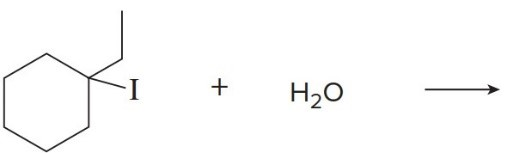
A) Which type of substitution reaction would it take place, SN1 or SN2?
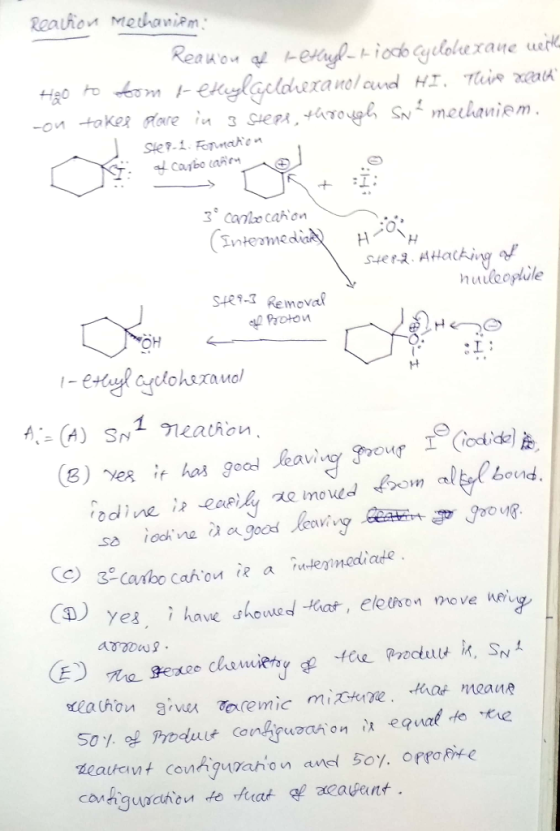
B) Does it have a good leaving group? How do you know?
C) What is the intermediate?
D) Show electron move using arrows.
E) Show product structure. Indicate stereochemistry of the product comparing to the reactant.
Homework Answers
Add Answer to:
For the following reaction, please answer the following
questions:
A) Which type of substitution reaction would...
Questions 2-10 please!! 1) A substitution reaction is: [2] a) A reaction during which an OH...
 Questions 2-10 please!!
1) A substitution reaction is: [2] a) A reaction during which an OH group of a molecule is replaced by a halogen. b) A reaction during which water is the leaving group. c) A reaction during which a functional group of a molecule is replaced by an electrophile. d) A reaction during which a functional group of a molecule is replaced by another functional group. V 12 2) Substitution reactions are classified either as electrophilic or nucleophilic...
Questions 2-10 please!!
1) A substitution reaction is: [2] a) A reaction during which an OH group of a molecule is replaced by a halogen. b) A reaction during which water is the leaving group. c) A reaction during which a functional group of a molecule is replaced by an electrophile. d) A reaction during which a functional group of a molecule is replaced by another functional group. V 12 2) Substitution reactions are classified either as electrophilic or nucleophilic...
please answer these questions 1: Which of the following is true for the reaction of (1R,...
please answer these questions 1: Which of the following is true for the reaction of (1R, 2R)-1-tert-butyl-1-fluoro-2-methylcyclohexane with potassium hydroxide? a: The product is (E)(6R)-1-tert-butyl-6-methyl-1-cyclohexene b: The product is (Z)(6R)-1-tert-butyl-6-methyl-1-cyclohexene c: The product is (Z)(6S)-1-tert-butyl-6-methyl-1-cyclohexene d: The product is (E)(6S)-1-tert-butyl-6-methyl-1-cyclohexene 2: Which of the following is not true for regioselective reactions? a: Generally, the selectivity lies to toward the Saytzeff product in elimination reactions. b: In a regioselective reaction, there is one product that predominates. c: The transition states of...
PLEASE ANSWER ALL QUESTIONS Question 5 The reaction below occurs via SN2 and E2 reaction mechanisms....
 PLEASE ANSWER ALL QUESTIONS
Question 5 The reaction below occurs via SN2 and E2 reaction mechanisms. The question only requires you to address the E2 reaction only. For the E2 reaction: Use Newman projections to show the relationship between the leaving group and the beta-hydrogen on the carbon labeled with the asterisk ("). 1. If the leaving group and the beta-hydrogen on the carbon labeled with the asterisk (1) are not in the correct orientation, show the result of the...
PLEASE ANSWER ALL QUESTIONS
Question 5 The reaction below occurs via SN2 and E2 reaction mechanisms. The question only requires you to address the E2 reaction only. For the E2 reaction: Use Newman projections to show the relationship between the leaving group and the beta-hydrogen on the carbon labeled with the asterisk ("). 1. If the leaving group and the beta-hydrogen on the carbon labeled with the asterisk (1) are not in the correct orientation, show the result of the...
2. List the trend of relative reactivity of compounds in: SN2 & SN1. Indicate which favors...
 2. List the trend of relative reactivity of compounds in: SN2 & SN1. Indicate which favors 1°, 2° or 3° carbon. 3. What makes a good leaving group, or poor leaving group in a substitution reaction? List examples. 4. What makes a good nucleophile or poor nucleophile group in a substitution reaction? List examples. Be able to identify the nucleophile in a reaction. 5. What makes a good solvent for an SN2 reaction? List examples. Assign R & S to...
5. For the following reaction: a) draw the substitution product. Br. но CH, b) Draw the...
 5. For the following reaction: a) draw the substitution product. Br. но CH, b) Draw the full mechanism of the reaction above, showing an SN2 pathway. Include all relevant electrons and curved arrows showing electron movement, AND draw the transition state. c) Draw the full mechanism of the reaction above, showing an Sn1 pathway. Include all relevant electrons and curved arrows showing electron movement, AND all intermediates in the reaction. d) Draw the energy diagrams of the Sw2 pathway and...
multiple choice questions! 11. What type of reaction would you predict the following to undergo? Ans....
 multiple choice questions!
11. What type of reaction would you predict the following to undergo? Ans. li + NH3 CH3CN ► ? (A) SN1 (B) E1 (C) E2 (D) SN2 12. Which of the following factors will NOT promote an SN1 reaction? Ans. (A) a polar, protic solvent (B) a 3º substrate (C) a strong nucleophile (D) a good leaving group 13. Which one of the following compounds can show cis/trans- isomerism? Ans. (A) 1,1-dimethylcyclopentane (B) 1-ethyl-2-methylcyclobutane (C) 1,1,4-trimethylcyclohexane (D)...
multiple choice questions!
11. What type of reaction would you predict the following to undergo? Ans. li + NH3 CH3CN ► ? (A) SN1 (B) E1 (C) E2 (D) SN2 12. Which of the following factors will NOT promote an SN1 reaction? Ans. (A) a polar, protic solvent (B) a 3º substrate (C) a strong nucleophile (D) a good leaving group 13. Which one of the following compounds can show cis/trans- isomerism? Ans. (A) 1,1-dimethylcyclopentane (B) 1-ethyl-2-methylcyclobutane (C) 1,1,4-trimethylcyclohexane (D)...
1 The reaction between (R)-3-chloro-3 methylhexane and methanol, which also serves as solvent for the reaction,...
 1 The reaction between (R)-3-chloro-3 methylhexane and methanol, which also serves as solvent for the reaction, gives a mixture of substitution and elimination products. нснен, CH,OH products + CH Draw the stereochemically correct structure(s) for the substitution product(s). (4 pt.) A B Draw all potential regio-isomeric elimination products. (4 pt) C Use curved arrows to show in a stepwise manner the electron flow for the substitution reaction. Stereochemistry counts! (4 pt.) D Use curved arrows to show in a stepwise...
Choose the best answer for the main type of reaction shown below: For an SN2 reaction, the BEST scenario would be: Selec...
 Choose the best answer for the main type of reaction shown
below:
For an SN2 reaction, the BEST scenario would be:
Select the term that best identifies relationship between the
two molecules shown.
Choose the best answer for the main type of reaction shown below: (1 mark) EtOH a) b) 2° alkylhalide, Syl reaction, one product 2° haloalkane, Syl reaction, racemic products 2º haloalkane, Sn1/E1 reactions, racemic products and alkene products 2º haloalkane, Sn2 reaction, one product 2° alkylhalide, Sn2...
Choose the best answer for the main type of reaction shown
below:
For an SN2 reaction, the BEST scenario would be:
Select the term that best identifies relationship between the
two molecules shown.
Choose the best answer for the main type of reaction shown below: (1 mark) EtOH a) b) 2° alkylhalide, Syl reaction, one product 2° haloalkane, Syl reaction, racemic products 2º haloalkane, Sn1/E1 reactions, racemic products and alkene products 2º haloalkane, Sn2 reaction, one product 2° alkylhalide, Sn2...
Write the major substitution product(s), and state whether SN1 or SN2. Clearly shows all stereochemistry. Please check...
 Write the major substitution product(s), and state whether SN1 or
SN2. Clearly shows all stereochemistry. Please check the ones I
already have.
1. Write the major substitution product(s), and state whether Syl or S2. Clearly show all stereochemistry. Assume stoichiometric amount used (ie, 1 equiv) unless otherwise indicated. CH,Br + CH-0 SN2 becauic strong nudleophile primary carbon H-C=C-CHBr + -C=C-H SN 2 becaure primary carbon NH Excess H,C-CH2-Br+ NH3 SN2 because it's a primary courbon OTS (NO Matter ip it's...
Write the major substitution product(s), and state whether SN1 or
SN2. Clearly shows all stereochemistry. Please check the ones I
already have.
1. Write the major substitution product(s), and state whether Syl or S2. Clearly show all stereochemistry. Assume stoichiometric amount used (ie, 1 equiv) unless otherwise indicated. CH,Br + CH-0 SN2 becauic strong nudleophile primary carbon H-C=C-CHBr + -C=C-H SN 2 becaure primary carbon NH Excess H,C-CH2-Br+ NH3 SN2 because it's a primary courbon OTS (NO Matter ip it's...
1. For the following Alkyl halide indicate which position will react under SN1 reaction conditions and...
 1. For the following Alkyl halide indicate which position will react under SN1 reaction conditions and under SN2 reaction conditions. Explain your answer. mer 2. Draw the complete mechanism and the products for of the following SN1 reaction paying close attention to stereochemistry. H3C CI CH OH CH2CH3 општироотип солио 3. Provide the product/s for the following reactions. Indicate if the reactions proceed via an SN1, or SN2 mechanism. Indicate proper stereochemistry if it is applicable. Show the mechanisms NaCN...
 Questions 2-10 please!!
1) A substitution reaction is: [2] a) A reaction during which an OH group of a molecule is replaced by a halogen. b) A reaction during which water is the leaving group. c) A reaction during which a functional group of a molecule is replaced by an electrophile. d) A reaction during which a functional group of a molecule is replaced by another functional group. V 12 2) Substitution reactions are classified either as electrophilic or nucleophilic...
Questions 2-10 please!!
1) A substitution reaction is: [2] a) A reaction during which an OH group of a molecule is replaced by a halogen. b) A reaction during which water is the leaving group. c) A reaction during which a functional group of a molecule is replaced by an electrophile. d) A reaction during which a functional group of a molecule is replaced by another functional group. V 12 2) Substitution reactions are classified either as electrophilic or nucleophilic...
 PLEASE ANSWER ALL QUESTIONS
Question 5 The reaction below occurs via SN2 and E2 reaction mechanisms. The question only requires you to address the E2 reaction only. For the E2 reaction: Use Newman projections to show the relationship between the leaving group and the beta-hydrogen on the carbon labeled with the asterisk ("). 1. If the leaving group and the beta-hydrogen on the carbon labeled with the asterisk (1) are not in the correct orientation, show the result of the...
PLEASE ANSWER ALL QUESTIONS
Question 5 The reaction below occurs via SN2 and E2 reaction mechanisms. The question only requires you to address the E2 reaction only. For the E2 reaction: Use Newman projections to show the relationship between the leaving group and the beta-hydrogen on the carbon labeled with the asterisk ("). 1. If the leaving group and the beta-hydrogen on the carbon labeled with the asterisk (1) are not in the correct orientation, show the result of the...
 2. List the trend of relative reactivity of compounds in: SN2 & SN1. Indicate which favors 1°, 2° or 3° carbon. 3. What makes a good leaving group, or poor leaving group in a substitution reaction? List examples. 4. What makes a good nucleophile or poor nucleophile group in a substitution reaction? List examples. Be able to identify the nucleophile in a reaction. 5. What makes a good solvent for an SN2 reaction? List examples. Assign R & S to...
 5. For the following reaction: a) draw the substitution product. Br. но CH, b) Draw the full mechanism of the reaction above, showing an SN2 pathway. Include all relevant electrons and curved arrows showing electron movement, AND draw the transition state. c) Draw the full mechanism of the reaction above, showing an Sn1 pathway. Include all relevant electrons and curved arrows showing electron movement, AND all intermediates in the reaction. d) Draw the energy diagrams of the Sw2 pathway and...
 multiple choice questions!
11. What type of reaction would you predict the following to undergo? Ans. li + NH3 CH3CN ► ? (A) SN1 (B) E1 (C) E2 (D) SN2 12. Which of the following factors will NOT promote an SN1 reaction? Ans. (A) a polar, protic solvent (B) a 3º substrate (C) a strong nucleophile (D) a good leaving group 13. Which one of the following compounds can show cis/trans- isomerism? Ans. (A) 1,1-dimethylcyclopentane (B) 1-ethyl-2-methylcyclobutane (C) 1,1,4-trimethylcyclohexane (D)...
multiple choice questions!
11. What type of reaction would you predict the following to undergo? Ans. li + NH3 CH3CN ► ? (A) SN1 (B) E1 (C) E2 (D) SN2 12. Which of the following factors will NOT promote an SN1 reaction? Ans. (A) a polar, protic solvent (B) a 3º substrate (C) a strong nucleophile (D) a good leaving group 13. Which one of the following compounds can show cis/trans- isomerism? Ans. (A) 1,1-dimethylcyclopentane (B) 1-ethyl-2-methylcyclobutane (C) 1,1,4-trimethylcyclohexane (D)...
 1 The reaction between (R)-3-chloro-3 methylhexane and methanol, which also serves as solvent for the reaction, gives a mixture of substitution and elimination products. нснен, CH,OH products + CH Draw the stereochemically correct structure(s) for the substitution product(s). (4 pt.) A B Draw all potential regio-isomeric elimination products. (4 pt) C Use curved arrows to show in a stepwise manner the electron flow for the substitution reaction. Stereochemistry counts! (4 pt.) D Use curved arrows to show in a stepwise...
 Choose the best answer for the main type of reaction shown
below:
For an SN2 reaction, the BEST scenario would be:
Select the term that best identifies relationship between the
two molecules shown.
Choose the best answer for the main type of reaction shown below: (1 mark) EtOH a) b) 2° alkylhalide, Syl reaction, one product 2° haloalkane, Syl reaction, racemic products 2º haloalkane, Sn1/E1 reactions, racemic products and alkene products 2º haloalkane, Sn2 reaction, one product 2° alkylhalide, Sn2...
Choose the best answer for the main type of reaction shown
below:
For an SN2 reaction, the BEST scenario would be:
Select the term that best identifies relationship between the
two molecules shown.
Choose the best answer for the main type of reaction shown below: (1 mark) EtOH a) b) 2° alkylhalide, Syl reaction, one product 2° haloalkane, Syl reaction, racemic products 2º haloalkane, Sn1/E1 reactions, racemic products and alkene products 2º haloalkane, Sn2 reaction, one product 2° alkylhalide, Sn2...
 Write the major substitution product(s), and state whether SN1 or
SN2. Clearly shows all stereochemistry. Please check the ones I
already have.
1. Write the major substitution product(s), and state whether Syl or S2. Clearly show all stereochemistry. Assume stoichiometric amount used (ie, 1 equiv) unless otherwise indicated. CH,Br + CH-0 SN2 becauic strong nudleophile primary carbon H-C=C-CHBr + -C=C-H SN 2 becaure primary carbon NH Excess H,C-CH2-Br+ NH3 SN2 because it's a primary courbon OTS (NO Matter ip it's...
Write the major substitution product(s), and state whether SN1 or
SN2. Clearly shows all stereochemistry. Please check the ones I
already have.
1. Write the major substitution product(s), and state whether Syl or S2. Clearly show all stereochemistry. Assume stoichiometric amount used (ie, 1 equiv) unless otherwise indicated. CH,Br + CH-0 SN2 becauic strong nudleophile primary carbon H-C=C-CHBr + -C=C-H SN 2 becaure primary carbon NH Excess H,C-CH2-Br+ NH3 SN2 because it's a primary courbon OTS (NO Matter ip it's...
 1. For the following Alkyl halide indicate which position will react under SN1 reaction conditions and under SN2 reaction conditions. Explain your answer. mer 2. Draw the complete mechanism and the products for of the following SN1 reaction paying close attention to stereochemistry. H3C CI CH OH CH2CH3 општироотип солио 3. Provide the product/s for the following reactions. Indicate if the reactions proceed via an SN1, or SN2 mechanism. Indicate proper stereochemistry if it is applicable. Show the mechanisms NaCN...
Most questions answered within 3 hours.
-
Where is the error in this code sequence?
String s1 = "Hello";
String s2 = "ello";...
asked 10 months ago -
Financial data for Joel de Paris, Inc., for last year
follow:
Joel de Paris, Inc.
Balance...
asked 10 months ago -
Consider this reaction:
Al2(SO4)3 (aq)+ BaCl3
(aq) Al2Cl6 (aq)- +
3BaSO4(s) . What is the...
asked 10 months ago -
Suppose that Savneet is considering increasing her
recent random sample from 20 car rentals to 40...
asked 10 months ago -
Trucks arrive at an unloading terminal at an average rate of 120
per hour.
Trucks arrive...
asked 10 months ago -
Why are methanol and ethanol completely soluble in water while
octanol is not very little soluble....
asked 10 months ago -
A facilities manager at a university reads in a research report
that the mean amount of...
asked 10 months ago -
When the CuSO4 is rehydrated by adding water to the anhydrous
compound, is this an endothermic...
asked 10 months ago -
A ray of sunlight is passing from diamond into crown glass; the
angle of incidence is...
asked 10 months ago -
A block of mass 0.249 kg is placed on top of a light, vertical
spring of...
asked 10 months ago -
how do the kidneys compensate in the presences of acidosis
a) trigger hyperventilate
b) reserve acid...
asked 10 months ago -
Question 501 pts
The rental rate of capital to the firm increases. Which of the
following...
asked 10 months ago