
Homework Answers
Add Answer to:
7-46 Predict the dehydrohalogenation product(s) that result when the following alkyl halides are beated in asshole...
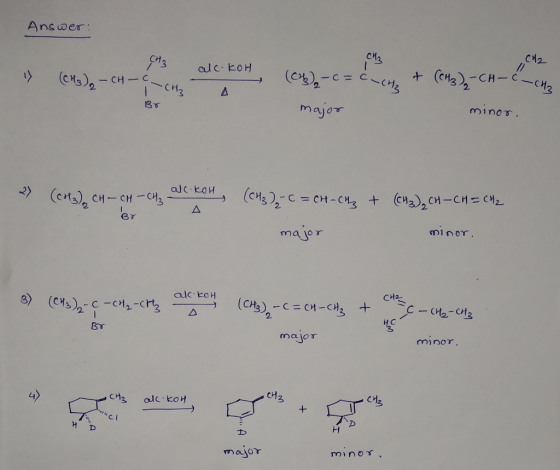
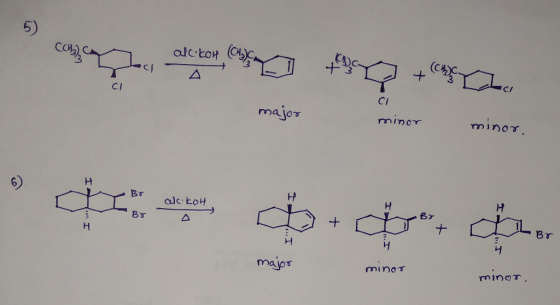
Predict the dehydrohalogenation product(s) that result when the following alkyl halides are heated in alcoholic KOH...
 Predict the dehydrohalogenation product(s) that result when the following alkyl halides are heated in alcoholic KOH When more than one product is formed, predict the major and minor products. (a) (CH)2CH-C(CH)2 7-46 (b) (CH),CH—ҪH-СH, T (c) (CH)C-CH-CH, Br Br (e) (f) Br (d) (CH) C CH3 Br Н HD Br
PROBLEM 17.8 Predict the major product that is obtained when each of the following alkyl halides...
 PROBLEM 17.8 Predict the major product that is obtained when each of the following alkyl halides is treated with potassium tert-butoxid Explain your reasoning. (b) ОСН, Br CH–CHI
Give the major product obtained when each of the following alkyl halides undergoes an E2 reaction:...
 Give the major product obtained when each of the following alkyl halides undergoes an E2 reaction: Br Br b. What stereoisomer would be obtained in greater yield when each of the following alkyl halides undergoes an E2 reaction: a. CH,CHCH CH b CH,CHCH-CH CH3Cl ICH2Cl 12CH3 c. Br Cl CI
Predict the products formed in the following reactions. Predict the product(s) formed in the following reactions....
 Predict the products formed in the following reactions.
Predict the product(s) formed in the following reactions. If there is no reaction, write “No Rxn" as the answer for the major product and leave the minor product box blank. If there is no minor product in the reaction, then leave the minor product box blank. If there are multiple products, make sure the products are in the appropriate box. (24 points, 4 points each) Note: Do not over complicate some questions...
Predict the products formed in the following reactions.
Predict the product(s) formed in the following reactions. If there is no reaction, write “No Rxn" as the answer for the major product and leave the minor product box blank. If there is no minor product in the reaction, then leave the minor product box blank. If there are multiple products, make sure the products are in the appropriate box. (24 points, 4 points each) Note: Do not over complicate some questions...
List the alkenes that would be formed when cach of the following alkyl halides is subiected...
 List the alkenes that would be formed when cach of the following alkyl halides is subiected to dehydrohalogenation with potassium ethoxide in ethanol and use Zaitsevs rule to predict the major product of each reaction: (a) 2-bromo-3-methylbutane and (b) 2-bromo-2,3-dimethylbutane.
Dehydrohalogenation - 30 and 2° alkyl halides are converted to alkenes by treatment of strong base....
 Dehydrohalogenation - 30 and 2° alkyl halides are converted to alkenes by treatment of strong base. Dehydrohalogenation occurs through a concerted reaction mechanism. КОН ethanol Major Product Mechanism Zaitsev's rule - Dehydration - 30 and 2° alcohols are converted to alkenes by treatment with an acid catalyst. Acid catalyzed dehydration. H2SO4, H,0 THF, 50°C Major Product Mechanism Cyelopropane via Carbene generation-treatment of chloroform (CHCI) with base leads (KOH) to the formation of a Dichlorocarbene: HSC C: CI-C-H + KOH HC...
1. Rank the alkyl halides in each group in order of increasing E2 reactivity. a. Br...
 1. Rank the alkyl halides in each group in order of increasing E2 reactivity. a. Br Br Br I П III b. Cн, Br Нас CI CH3 П III Rank the alkyl halides in each group of problem one in order of increasing El reactivity. 2. Which elimination reaction in each pair is faster? (I or II) 3. а. сн, Нас. Он Он II. b. HO DMSO он (CH),CCI (CH),CCI П. I. Н.о What alkenes are formed from each alkyl...
y) Predict the products of the following alkyl halide reactions. (Hint: are the alkyl halides 1,2,...
 y) Predict the products of the following alkyl halide reactions. (Hint: are the alkyl halides 1,2, or type of nucleophile or base are we using?) (11 pts) wide NaOCH-CH3 CH,CH,OH cl" Η OH сн. кон
predict the major organic product formed in the following reaction alkyl halide nucleophile CH, e) H...
 predict the major organic product formed in the following
reaction
alkyl halide nucleophile CH, e) H Br KOBu" HOBu Br Н CH Br CH,CH,OH two products formed 8 + CHI h) Br NaOCH H
predict the major organic product formed in the following
reaction
alkyl halide nucleophile CH, e) H Br KOBu" HOBu Br Н CH Br CH,CH,OH two products formed 8 + CHI h) Br NaOCH H
CH3 (4) 1. Which of the following alkyl halides would you expect to be most reactive...
 CH3 (4) 1. Which of the following alkyl halides would you expect to be most reactive in a unimolecular reaction? a) C&H, CH, CH, CH, BY b) CH 1 CH CH Br C) CH11CCH, Br d) C6H CH2 CH CHỊ CHỊ CH3 CHỊ e) C&H, CCH Br CHE (4) 2. What would you expect to be the chief organic product(s) when tert-butyl bromide reacts with sodium acetylide, i.e., CH3 + - CH2-C-Br + Na :CECH — ? CH a) I...
 Predict the dehydrohalogenation product(s) that result when the following alkyl halides are heated in alcoholic KOH When more than one product is formed, predict the major and minor products. (a) (CH)2CH-C(CH)2 7-46 (b) (CH),CH—ҪH-СH, T (c) (CH)C-CH-CH, Br Br (e) (f) Br (d) (CH) C CH3 Br Н HD Br
 PROBLEM 17.8 Predict the major product that is obtained when each of the following alkyl halides is treated with potassium tert-butoxid Explain your reasoning. (b) ОСН, Br CH–CHI
 Give the major product obtained when each of the following alkyl halides undergoes an E2 reaction: Br Br b. What stereoisomer would be obtained in greater yield when each of the following alkyl halides undergoes an E2 reaction: a. CH,CHCH CH b CH,CHCH-CH CH3Cl ICH2Cl 12CH3 c. Br Cl CI
 Predict the products formed in the following reactions.
Predict the product(s) formed in the following reactions. If there is no reaction, write “No Rxn" as the answer for the major product and leave the minor product box blank. If there is no minor product in the reaction, then leave the minor product box blank. If there are multiple products, make sure the products are in the appropriate box. (24 points, 4 points each) Note: Do not over complicate some questions...
Predict the products formed in the following reactions.
Predict the product(s) formed in the following reactions. If there is no reaction, write “No Rxn" as the answer for the major product and leave the minor product box blank. If there is no minor product in the reaction, then leave the minor product box blank. If there are multiple products, make sure the products are in the appropriate box. (24 points, 4 points each) Note: Do not over complicate some questions...
 List the alkenes that would be formed when cach of the following alkyl halides is subiected to dehydrohalogenation with potassium ethoxide in ethanol and use Zaitsevs rule to predict the major product of each reaction: (a) 2-bromo-3-methylbutane and (b) 2-bromo-2,3-dimethylbutane.
 Dehydrohalogenation - 30 and 2° alkyl halides are converted to alkenes by treatment of strong base. Dehydrohalogenation occurs through a concerted reaction mechanism. КОН ethanol Major Product Mechanism Zaitsev's rule - Dehydration - 30 and 2° alcohols are converted to alkenes by treatment with an acid catalyst. Acid catalyzed dehydration. H2SO4, H,0 THF, 50°C Major Product Mechanism Cyelopropane via Carbene generation-treatment of chloroform (CHCI) with base leads (KOH) to the formation of a Dichlorocarbene: HSC C: CI-C-H + KOH HC...
 1. Rank the alkyl halides in each group in order of increasing E2 reactivity. a. Br Br Br I П III b. Cн, Br Нас CI CH3 П III Rank the alkyl halides in each group of problem one in order of increasing El reactivity. 2. Which elimination reaction in each pair is faster? (I or II) 3. а. сн, Нас. Он Он II. b. HO DMSO он (CH),CCI (CH),CCI П. I. Н.о What alkenes are formed from each alkyl...
 y) Predict the products of the following alkyl halide reactions. (Hint: are the alkyl halides 1,2, or type of nucleophile or base are we using?) (11 pts) wide NaOCH-CH3 CH,CH,OH cl" Η OH сн. кон
 predict the major organic product formed in the following
reaction
alkyl halide nucleophile CH, e) H Br KOBu" HOBu Br Н CH Br CH,CH,OH two products formed 8 + CHI h) Br NaOCH H
predict the major organic product formed in the following
reaction
alkyl halide nucleophile CH, e) H Br KOBu" HOBu Br Н CH Br CH,CH,OH two products formed 8 + CHI h) Br NaOCH H
 CH3 (4) 1. Which of the following alkyl halides would you expect to be most reactive in a unimolecular reaction? a) C&H, CH, CH, CH, BY b) CH 1 CH CH Br C) CH11CCH, Br d) C6H CH2 CH CHỊ CHỊ CH3 CHỊ e) C&H, CCH Br CHE (4) 2. What would you expect to be the chief organic product(s) when tert-butyl bromide reacts with sodium acetylide, i.e., CH3 + - CH2-C-Br + Na :CECH — ? CH a) I...
Most questions answered within 3 hours.
-
Where is the error in this code sequence?
String s1 = "Hello";
String s2 = "ello";...
asked 10 months ago -
Financial data for Joel de Paris, Inc., for last year
follow:
Joel de Paris, Inc.
Balance...
asked 10 months ago -
Consider this reaction:
Al2(SO4)3 (aq)+ BaCl3
(aq) Al2Cl6 (aq)- +
3BaSO4(s) . What is the...
asked 10 months ago -
Suppose that Savneet is considering increasing her
recent random sample from 20 car rentals to 40...
asked 10 months ago -
Trucks arrive at an unloading terminal at an average rate of 120
per hour.
Trucks arrive...
asked 10 months ago -
Why are methanol and ethanol completely soluble in water while
octanol is not very little soluble....
asked 10 months ago -
A facilities manager at a university reads in a research report
that the mean amount of...
asked 10 months ago -
When the CuSO4 is rehydrated by adding water to the anhydrous
compound, is this an endothermic...
asked 10 months ago -
A ray of sunlight is passing from diamond into crown glass; the
angle of incidence is...
asked 10 months ago -
A block of mass 0.249 kg is placed on top of a light, vertical
spring of...
asked 10 months ago -
how do the kidneys compensate in the presences of acidosis
a) trigger hyperventilate
b) reserve acid...
asked 10 months ago -
Question 501 pts
The rental rate of capital to the firm increases. Which of the
following...
asked 10 months ago