
Homework Answers
Add Answer to:
Answer the following Questions 1. Which of the following would you predict to be more soluble...
which of the following is the structure of 2-ethylbenzamide 3. (20 points) The following alcohol undergo...
 which of the following is the structure of
2-ethylbenzamide
3. (20 points) The following alcohol undergo chromic acid test. Complete the blank for each alcohol Color after reaction is test positive or negative? Class of Alcohol CH₂ - CHCH, CH, CH, ан,— —днан, Color after reaction is test positive or negative? Class of Alcohol Color after reaction is test positive or negative? Class of Alcohol at CH2OH & CH₂ CH3 6th c Color after reaction is test positive or negative?...
which of the following is the structure of
2-ethylbenzamide
3. (20 points) The following alcohol undergo chromic acid test. Complete the blank for each alcohol Color after reaction is test positive or negative? Class of Alcohol CH₂ - CHCH, CH, CH, ан,— —днан, Color after reaction is test positive or negative? Class of Alcohol Color after reaction is test positive or negative? Class of Alcohol at CH2OH & CH₂ CH3 6th c Color after reaction is test positive or negative?...
3. Which of the following alcohols is least soluble in water ? a. 1-pentanol c. 1-hexanol...
 3. Which of the following alcohols is least soluble in water ? a. 1-pentanol c. 1-hexanol b. 1-octanol d. 2-propanol
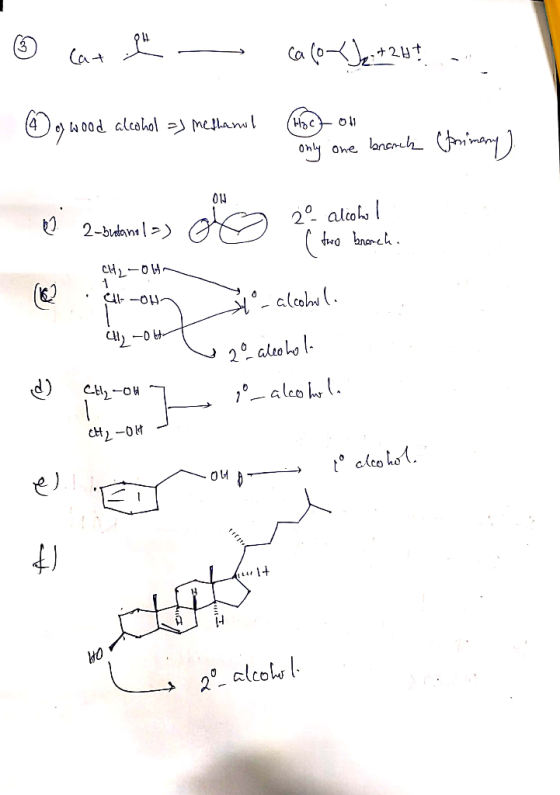
Describe the classification of alcohols; describe the boiling points and solubility of alcohols, phenols, and ethers....
 Describe the classification of alcohols; describe the boiling points and solubility of alcohols, phenols, and ethers. Classify each of the following alcohols as primary (1 degree), secondary (2 degree) or tertiary (3 degree); Classify each of the following alcohols as primary (1 degree)j, secondary (2 degree), or tertiary (3 degree): Predict the compound with the higher boiling point in each of the following pairs: a. ethane or methanol b. diethyl ether or 1-butanol c. 1-butanol or pentane Predict the compound...
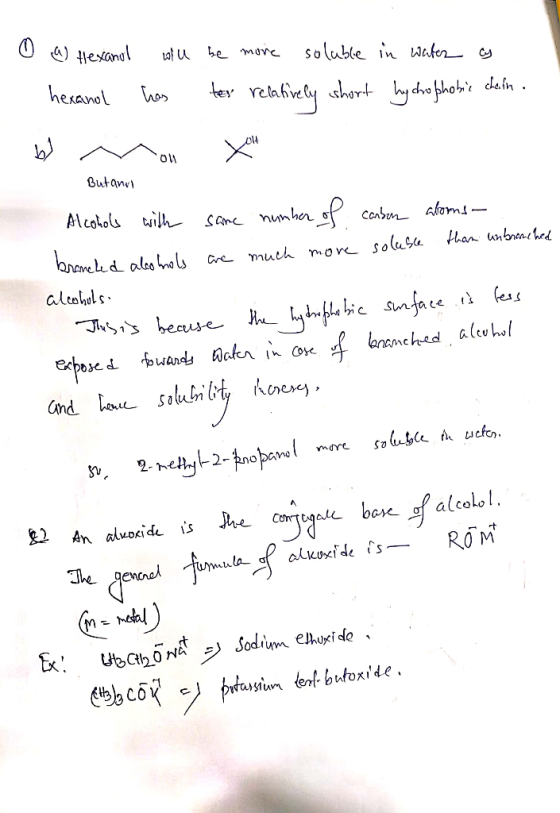
1. Draw the structures of the following alcohols: ethanol 2-propanol cyclohexanol 2-methyl-2-propanol Classify each of the...
 1. Draw the structures of the following alcohols: ethanol 2-propanol cyclohexanol 2-methyl-2-propanol Classify each of the alcohols in question 1 as primary, secondary, or tertiary. ethanol 2-methyl-2-propanol 2. 2-propanol cyclohexanol 3. Which alcohol would you expect to be more soluble in water, 1-butanol or 2-methyl-2- propanol? Why? (Hint: draw both alcohols examine their structures).
Which of the following alcohols would have the lowest solubility in water? A) 1-hexanol B) isopropyl...
Which of the following alcohols would have the lowest solubility in water? A) 1-hexanol B) isopropyl alcohol (2-propanol) C) 1-butanol D) ethanol
i believe its 3,3-dimethyt-2-butanol 0r 4 methylbeNzyl alcohol based on the data provided. if not which...
 i believe its 3,3-dimethyt-2-butanol 0r 4 methylbeNzyl alcohol
based on the data provided. if not which alcohol would it be for
the unknown compunds.
#3 Unknown Al Data unknown Melting point of solid ("C) (leave blank if liquid at RT): 57 degrees Celsius Boiling point of liquid (C) (leave blank if solid at RT) 0-H Stretch alcohol The results from sodium fusion and follow up ion tests (578) Predicted color Nitrogen test absent Nitrogen red brown precipitate Sulfur test black...
i believe its 3,3-dimethyt-2-butanol 0r 4 methylbeNzyl alcohol
based on the data provided. if not which alcohol would it be for
the unknown compunds.
#3 Unknown Al Data unknown Melting point of solid ("C) (leave blank if liquid at RT): 57 degrees Celsius Boiling point of liquid (C) (leave blank if solid at RT) 0-H Stretch alcohol The results from sodium fusion and follow up ion tests (578) Predicted color Nitrogen test absent Nitrogen red brown precipitate Sulfur test black...
Draw the structure of each compound 1. Draw the structure of each compound: (a) cis-1,2-Cyclohexanediol (b)...
 Draw the structure of each compound
1. Draw the structure of each compound: (a) cis-1,2-Cyclohexanediol (b) Isobutanol (c) 2,4,6-Trinitrophenol (d) (R)-2,2-Dimethyl-3-heptanol (e) Ethylene glycol (0) (s)-2-Methyl-1-butanol 2. Acid-catalyzed hydration of 3,3-dimethyl-1-butene produces 2,3-dimethyl-2-butanol. Show a mechanism for this reaction 3. Acid-catalyzed hydration of 1-methylcyclohexene yields two alcohols. The major product does not undergo oxidation, while the minor product will undergo oxidation. Explain. 4. Using 2-propanol as your only source of carbon, show how you would prepare 2-methyl- 2-pentanol. 5. Identify...
Draw the structure of each compound
1. Draw the structure of each compound: (a) cis-1,2-Cyclohexanediol (b) Isobutanol (c) 2,4,6-Trinitrophenol (d) (R)-2,2-Dimethyl-3-heptanol (e) Ethylene glycol (0) (s)-2-Methyl-1-butanol 2. Acid-catalyzed hydration of 3,3-dimethyl-1-butene produces 2,3-dimethyl-2-butanol. Show a mechanism for this reaction 3. Acid-catalyzed hydration of 1-methylcyclohexene yields two alcohols. The major product does not undergo oxidation, while the minor product will undergo oxidation. Explain. 4. Using 2-propanol as your only source of carbon, show how you would prepare 2-methyl- 2-pentanol. 5. Identify...
Part 2 Multiple Choice. Select the best answer for each of the questions below: 1. Which...
 Part 2 Multiple Choice. Select the best answer for each of the questions below: 1. Which of these molecules is not an electrophile? a) CH4 b) CH3+ c) H* d) BF3 2. Which of these molecules is not a nucleophile ? a) NH3 b) OH c) CN d) H* 3. Water behaves as: a) a nucleophile b) an electrophile c) both d) neither 4. The SN2 reaction has how many steps? a) 1 b) 2 c) 3 d) 4 5....
multiple choise 9 questions answer all please is very important to me 1.Which of the following...
multiple choise 9 questions answer all please is very important to me 1.Which of the following alcohols performs a re-re-carbocation when dehydrated? a. isopropanol b. sec-butanol c. 2-methyl cyclobutanol d. cyclobutanol 2.What is the major organic product of the reaction between toluene + HNO3 / H2SO4? a. p-methyl aniline b. p- nitrotoluene c. phenylamine d. nitrobenzene 3.Which of the following compounds will react more quickly in a Friedel-Crafts alkylation, with t-butyl chloride / AlCl 3? a. toluene b. iodobenzene c....
For O. Chem lab titled: "Perfumes: The Synthesis of Nerolin". Please answer questions 16 (a-c) and...
 For O. Chem lab titled: "Perfumes: The Synthesis of Nerolin".
Please answer questions 16 (a-c) and 17.
Nerolin chemically is called either 2-ethoxynaphthalene or ethy! S-naphthy! ether and can be prepared by the following Williamson synthesis of ethers. OH O-CH.CH - 1-CH.CH KOH alcohol +H.O+KI Waphthal Ethyl iodide Nerolin The potassium hydroxide, acting as a base, removes the slightly acidic proton from 6-naphthol and converts it into the nucleophile potassium B-naphthoxide, which attacks ethyl iodide and displaces the iodide ion....
For O. Chem lab titled: "Perfumes: The Synthesis of Nerolin".
Please answer questions 16 (a-c) and 17.
Nerolin chemically is called either 2-ethoxynaphthalene or ethy! S-naphthy! ether and can be prepared by the following Williamson synthesis of ethers. OH O-CH.CH - 1-CH.CH KOH alcohol +H.O+KI Waphthal Ethyl iodide Nerolin The potassium hydroxide, acting as a base, removes the slightly acidic proton from 6-naphthol and converts it into the nucleophile potassium B-naphthoxide, which attacks ethyl iodide and displaces the iodide ion....
 which of the following is the structure of
2-ethylbenzamide
3. (20 points) The following alcohol undergo chromic acid test. Complete the blank for each alcohol Color after reaction is test positive or negative? Class of Alcohol CH₂ - CHCH, CH, CH, ан,— —днан, Color after reaction is test positive or negative? Class of Alcohol Color after reaction is test positive or negative? Class of Alcohol at CH2OH & CH₂ CH3 6th c Color after reaction is test positive or negative?...
which of the following is the structure of
2-ethylbenzamide
3. (20 points) The following alcohol undergo chromic acid test. Complete the blank for each alcohol Color after reaction is test positive or negative? Class of Alcohol CH₂ - CHCH, CH, CH, ан,— —днан, Color after reaction is test positive or negative? Class of Alcohol Color after reaction is test positive or negative? Class of Alcohol at CH2OH & CH₂ CH3 6th c Color after reaction is test positive or negative?...
 3. Which of the following alcohols is least soluble in water ? a. 1-pentanol c. 1-hexanol b. 1-octanol d. 2-propanol
 Describe the classification of alcohols; describe the boiling points and solubility of alcohols, phenols, and ethers. Classify each of the following alcohols as primary (1 degree), secondary (2 degree) or tertiary (3 degree); Classify each of the following alcohols as primary (1 degree)j, secondary (2 degree), or tertiary (3 degree): Predict the compound with the higher boiling point in each of the following pairs: a. ethane or methanol b. diethyl ether or 1-butanol c. 1-butanol or pentane Predict the compound...
 1. Draw the structures of the following alcohols: ethanol 2-propanol cyclohexanol 2-methyl-2-propanol Classify each of the alcohols in question 1 as primary, secondary, or tertiary. ethanol 2-methyl-2-propanol 2. 2-propanol cyclohexanol 3. Which alcohol would you expect to be more soluble in water, 1-butanol or 2-methyl-2- propanol? Why? (Hint: draw both alcohols examine their structures).
 i believe its 3,3-dimethyt-2-butanol 0r 4 methylbeNzyl alcohol
based on the data provided. if not which alcohol would it be for
the unknown compunds.
#3 Unknown Al Data unknown Melting point of solid ("C) (leave blank if liquid at RT): 57 degrees Celsius Boiling point of liquid (C) (leave blank if solid at RT) 0-H Stretch alcohol The results from sodium fusion and follow up ion tests (578) Predicted color Nitrogen test absent Nitrogen red brown precipitate Sulfur test black...
i believe its 3,3-dimethyt-2-butanol 0r 4 methylbeNzyl alcohol
based on the data provided. if not which alcohol would it be for
the unknown compunds.
#3 Unknown Al Data unknown Melting point of solid ("C) (leave blank if liquid at RT): 57 degrees Celsius Boiling point of liquid (C) (leave blank if solid at RT) 0-H Stretch alcohol The results from sodium fusion and follow up ion tests (578) Predicted color Nitrogen test absent Nitrogen red brown precipitate Sulfur test black...
 Draw the structure of each compound
1. Draw the structure of each compound: (a) cis-1,2-Cyclohexanediol (b) Isobutanol (c) 2,4,6-Trinitrophenol (d) (R)-2,2-Dimethyl-3-heptanol (e) Ethylene glycol (0) (s)-2-Methyl-1-butanol 2. Acid-catalyzed hydration of 3,3-dimethyl-1-butene produces 2,3-dimethyl-2-butanol. Show a mechanism for this reaction 3. Acid-catalyzed hydration of 1-methylcyclohexene yields two alcohols. The major product does not undergo oxidation, while the minor product will undergo oxidation. Explain. 4. Using 2-propanol as your only source of carbon, show how you would prepare 2-methyl- 2-pentanol. 5. Identify...
Draw the structure of each compound
1. Draw the structure of each compound: (a) cis-1,2-Cyclohexanediol (b) Isobutanol (c) 2,4,6-Trinitrophenol (d) (R)-2,2-Dimethyl-3-heptanol (e) Ethylene glycol (0) (s)-2-Methyl-1-butanol 2. Acid-catalyzed hydration of 3,3-dimethyl-1-butene produces 2,3-dimethyl-2-butanol. Show a mechanism for this reaction 3. Acid-catalyzed hydration of 1-methylcyclohexene yields two alcohols. The major product does not undergo oxidation, while the minor product will undergo oxidation. Explain. 4. Using 2-propanol as your only source of carbon, show how you would prepare 2-methyl- 2-pentanol. 5. Identify...
 Part 2 Multiple Choice. Select the best answer for each of the questions below: 1. Which of these molecules is not an electrophile? a) CH4 b) CH3+ c) H* d) BF3 2. Which of these molecules is not a nucleophile ? a) NH3 b) OH c) CN d) H* 3. Water behaves as: a) a nucleophile b) an electrophile c) both d) neither 4. The SN2 reaction has how many steps? a) 1 b) 2 c) 3 d) 4 5....
 For O. Chem lab titled: "Perfumes: The Synthesis of Nerolin".
Please answer questions 16 (a-c) and 17.
Nerolin chemically is called either 2-ethoxynaphthalene or ethy! S-naphthy! ether and can be prepared by the following Williamson synthesis of ethers. OH O-CH.CH - 1-CH.CH KOH alcohol +H.O+KI Waphthal Ethyl iodide Nerolin The potassium hydroxide, acting as a base, removes the slightly acidic proton from 6-naphthol and converts it into the nucleophile potassium B-naphthoxide, which attacks ethyl iodide and displaces the iodide ion....
For O. Chem lab titled: "Perfumes: The Synthesis of Nerolin".
Please answer questions 16 (a-c) and 17.
Nerolin chemically is called either 2-ethoxynaphthalene or ethy! S-naphthy! ether and can be prepared by the following Williamson synthesis of ethers. OH O-CH.CH - 1-CH.CH KOH alcohol +H.O+KI Waphthal Ethyl iodide Nerolin The potassium hydroxide, acting as a base, removes the slightly acidic proton from 6-naphthol and converts it into the nucleophile potassium B-naphthoxide, which attacks ethyl iodide and displaces the iodide ion....
Most questions answered within 3 hours.
-
Where is the error in this code sequence?
String s1 = "Hello";
String s2 = "ello";...
asked 11 months ago -
Financial data for Joel de Paris, Inc., for last year
follow:
Joel de Paris, Inc.
Balance...
asked 11 months ago -
Consider this reaction:
Al2(SO4)3 (aq)+ BaCl3
(aq) Al2Cl6 (aq)- +
3BaSO4(s) . What is the...
asked 11 months ago -
Suppose that Savneet is considering increasing her
recent random sample from 20 car rentals to 40...
asked 11 months ago -
Trucks arrive at an unloading terminal at an average rate of 120
per hour.
Trucks arrive...
asked 11 months ago -
Why are methanol and ethanol completely soluble in water while
octanol is not very little soluble....
asked 11 months ago -
A facilities manager at a university reads in a research report
that the mean amount of...
asked 11 months ago -
When the CuSO4 is rehydrated by adding water to the anhydrous
compound, is this an endothermic...
asked 11 months ago -
A ray of sunlight is passing from diamond into crown glass; the
angle of incidence is...
asked 11 months ago -
A block of mass 0.249 kg is placed on top of a light, vertical
spring of...
asked 11 months ago -
how do the kidneys compensate in the presences of acidosis
a) trigger hyperventilate
b) reserve acid...
asked 11 months ago -
Question 501 pts
The rental rate of capital to the firm increases. Which of the
following...
asked 11 months ago