
Homework Answers
Background:
 All metals above hydrogen in the activity series react with acid to
form salt and hydrogen gas. This type of reaction is called
displacement reaction where a metal displaces hydrogen and forms a
compound with the negatively charged ion or radical (anion) of an
acid (for example chloride (Cl-), sulfate
(SO42-), nitrate(NO3-), etc.)
All metals above hydrogen in the activity series react with acid to
form salt and hydrogen gas. This type of reaction is called
displacement reaction where a metal displaces hydrogen and forms a
compound with the negatively charged ion or radical (anion) of an
acid (for example chloride (Cl-), sulfate
(SO42-), nitrate(NO3-), etc.)
The
formula of a compound depends on the valency of the metal and
anion. It can be derived from the criss-cross method as shown
below:
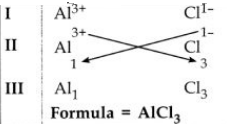
If the compound formed is soluble in water, it exists in the form
of ions, for example, like all nitrates sodium nitrate is soluble
in water and exists as Na+(aq) and
NO3-(aq) ions {aq represents the state of the
substance, it can be solid (s), liquid (l), gaseous (g) or aqueous
(aq)}. To know whether a substance is soluble or not, one can refer
to solubility charts given in basic chemistry books. It will
contain information such as all nitrates and compounds of alkali
metals are soluble, chlorides are generally soluble in water
(except Ag+, Hg22+, and
Pb2+) and also shows insoluble compounds such as
sulfides, carbonates, and hydroxides with exceptions if any)
Now coming to the parts of the question:
1. Balanced Molecular Equation
In the present case, magnesium (Mg) is a reactive metal and will displace hydrogen from hydrochloric acid to form magnesium chloride. The formula for magnesium chloride can be derived from the criss-cross method as described above. Magnesium has 2+ valency and chloride has 1- valency. So the formula for magnesium chloride will be MgCl2. Further, it is soluble in water, so the state symbol (aq) will be added in its subscript.
The balanced chemical equation will be:
Mg(s) + 2 HCl(aq)
MgCl2(aq) + H2(g)
Note: Since each atom on either side of the arrow must be balanced i.e. same in number, HCl(aq) is multiplied by 2 to make H and Cl atoms equal on both sides.
2. Total ionic equation
As mentioned in the background, the soluble substances ( i.e. those having the subscript (aq) in the chemical equation exist as ions) can be written in ionic form. So writing the ionic form of the chemical equation below:
Mg(s) + 2H+(aq)
+2Cl-(aq)
Mg2+(aq) +2Cl-(aq)
+H2(g)
Note: The number of atoms must be kept the same while writing the total ionic equation
3. Net ionic equation
Now the ions whose state does not change on either side of the arrow are called spectator ions. They can be canceled just as one does in algebraic equations. Remember to consider the number of atoms while canceling out.
In the present case, 2Cl-(aq) ions on both sides of the arrow cancel each other out. The net ionic equation can be written without them as follows:
Mg(s) +
2H+(aq)
Mg2+(aq) +H2(g).
Note: The net ionic equation should not only have the same number of atoms on both sides of the arrow but must also have equal charges on reactants' and products' side.
Add Answer to:
NOW you should try these steps on the reaction between magnesium metal and hydrochloric acid. 1....
2. For the reaction between magnesium metal and hydrochloric acid (aq) producing magnesium chloride (aq) and...
 2. For the reaction between magnesium metal and hydrochloric acid (aq) producing magnesium chloride (aq) and hydrogen gas (a) write an equation or this reaction (b) balance the equation from Part (a). (c) classify the reaction. 3. For the reaction between aqueous silver nitrate and aqueous potassium chromate producing the precipitate (solid) silver chromate and aqueous potassium nitrate solution (a) Write a balanced equation for this reaction. (b) Write an ionic equation for this reaction. (c) Write the net ionic...
A solid magnesium undergoes a single replacement reaction with aqueous hydrochloric acid to produce hydrogen gas(and...
A solid magnesium undergoes a single replacement reaction with aqueous hydrochloric acid to produce hydrogen gas(and another product). Write a balanced Chemical equation for this reaction. How many milli liters of hydrogen gas (at 25゚C and 1atm) Can be produced from the reaction between 0.0411 g of magnesium and 15.0mL of 2.98 M hydrochloric acid?
Hydrogen gas production Hydrogen gas will be produced by reacting magnesium metal with aqueous hydrochloric acid....
Hydrogen gas production Hydrogen gas will be produced by reacting magnesium metal with aqueous hydrochloric acid. The products are hydrogen gas and magnesium chloride. The hydrogen gas will be collected in the gas collection apparatus, and the magnesium chloride salt will dissolve in the aqueous solution. Write a balanced equation for this reaction.
Write balanced molecular and net ionic equations for the reaction of: magnesium metal with a solution...
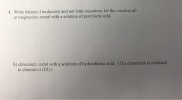 Write balanced molecular and net ionic equations for the reaction of: magnesium metal with a solution of perchloric acid. chromium metal with a solution of hydrochloric acid. (The chromium is oxidized to chromium (III).)
Reactions observed in a lab were Magnesium metal + hydrochloric acid, Aluminium + Hydrochloric acid, and...
 Reactions observed in a lab were Magnesium metal + hydrochloric
acid, Aluminium + Hydrochloric acid, and sulfur + Hydrochloric
acid.
One question states, if there is a correlation between
reactivity of the elements tested and their position in the
periodic table, the answer is yes.
The photo consists of questions that follow this idea.
What happens to the reactivity as you go move left to right across the periodic table? Explain in terms of atomic size and ionization potential. What...
Reactions observed in a lab were Magnesium metal + hydrochloric
acid, Aluminium + Hydrochloric acid, and sulfur + Hydrochloric
acid.
One question states, if there is a correlation between
reactivity of the elements tested and their position in the
periodic table, the answer is yes.
The photo consists of questions that follow this idea.
What happens to the reactivity as you go move left to right across the periodic table? Explain in terms of atomic size and ionization potential. What...
1) Write the net ionic equation for Magnesium (s) + Hydrochloric Acid (aq) (Mg+ (s) +...
1) Write the net ionic equation for Magnesium (s) + Hydrochloric Acid (aq) (Mg+ (s) + 2HCl (aq)) 2) this reaction is exothermic, ∆H (enthalpy) is negative. Looking at the balanced equation, would ∆S (entropy) be negative or positive for this reaction? explain please.
3.0 PROCEDURE: For each reaction, you should write a total molecular reaction, a total ionic reaction...
 3.0 PROCEDURE: For each reaction, you should write a total molecular reaction, a total ionic reaction and then remove any spectator ions to produce a final net ionic reaction. In order to simplify your task each reaction has its driving force listed. In more advanced General Chemistry courses, you will be expected to find the driving force yourself (based on the rules given above), but for our purposes it is best for you to simply "experience the steps of producing...
Write a balanced chemical equation for each reaction. If no reaction occurred, write "N.R."): Magnesium and...
 Write a balanced chemical equation for each reaction. If no reaction occurred, write "N.R."): Magnesium and hydrochloric acid: Zine and hydrochloric acid: Copper and hydrochloric acid: 3. Metals reacting with a non-metal (oxygen); metal oxides reacting with water Write a balanced chemical equation for each reaction. Magnesium and oxygen: Calcium and oxygen What happened when magnesium oxide and calcium oxide were added to water containing phenol phthalein indicator? What differences, if any, did you observe? Turns basic Water turns Pince...
14. The reaction of magnesium metal with hydrochloric acid produces hydrogen gas as a product. I...
 14. The reaction of magnesium metal with hydrochloric acid produces hydrogen gas as a product. I would like to collect 125 mL of hydrogen gas from the experiment. The temperature of the lab is 23.5°C and the pressure is 762 mmHg. How many grams of magnesium metal should I use if the hydrochloric acid is kept in excess? Mg(s) + 2 HCl(aq) MgCl2(aq) + H2(g)
Activity 3: Single-Replacement Reaction What gasses could be produced from hydrochloric acid (HCl)? Which gas was...
Activity 3: Single-Replacement Reaction What gasses could be produced from hydrochloric acid (HCl)? Which gas was produced? Write a balanced equation for the reaction of magnesium with hydrochloric acid. Why did you need to tilt the splint at a 45-degree angle? a. Write a balanced equation for the reaction initiated by the burning splint. b. Classify the reaction initiated by the burning splint.
 2. For the reaction between magnesium metal and hydrochloric acid (aq) producing magnesium chloride (aq) and hydrogen gas (a) write an equation or this reaction (b) balance the equation from Part (a). (c) classify the reaction. 3. For the reaction between aqueous silver nitrate and aqueous potassium chromate producing the precipitate (solid) silver chromate and aqueous potassium nitrate solution (a) Write a balanced equation for this reaction. (b) Write an ionic equation for this reaction. (c) Write the net ionic...
 Write balanced molecular and net ionic equations for the reaction of: magnesium metal with a solution of perchloric acid. chromium metal with a solution of hydrochloric acid. (The chromium is oxidized to chromium (III).)
 Reactions observed in a lab were Magnesium metal + hydrochloric
acid, Aluminium + Hydrochloric acid, and sulfur + Hydrochloric
acid.
One question states, if there is a correlation between
reactivity of the elements tested and their position in the
periodic table, the answer is yes.
The photo consists of questions that follow this idea.
What happens to the reactivity as you go move left to right across the periodic table? Explain in terms of atomic size and ionization potential. What...
Reactions observed in a lab were Magnesium metal + hydrochloric
acid, Aluminium + Hydrochloric acid, and sulfur + Hydrochloric
acid.
One question states, if there is a correlation between
reactivity of the elements tested and their position in the
periodic table, the answer is yes.
The photo consists of questions that follow this idea.
What happens to the reactivity as you go move left to right across the periodic table? Explain in terms of atomic size and ionization potential. What...
 3.0 PROCEDURE: For each reaction, you should write a total molecular reaction, a total ionic reaction and then remove any spectator ions to produce a final net ionic reaction. In order to simplify your task each reaction has its driving force listed. In more advanced General Chemistry courses, you will be expected to find the driving force yourself (based on the rules given above), but for our purposes it is best for you to simply "experience the steps of producing...
 Write a balanced chemical equation for each reaction. If no reaction occurred, write "N.R."): Magnesium and hydrochloric acid: Zine and hydrochloric acid: Copper and hydrochloric acid: 3. Metals reacting with a non-metal (oxygen); metal oxides reacting with water Write a balanced chemical equation for each reaction. Magnesium and oxygen: Calcium and oxygen What happened when magnesium oxide and calcium oxide were added to water containing phenol phthalein indicator? What differences, if any, did you observe? Turns basic Water turns Pince...
 14. The reaction of magnesium metal with hydrochloric acid produces hydrogen gas as a product. I would like to collect 125 mL of hydrogen gas from the experiment. The temperature of the lab is 23.5°C and the pressure is 762 mmHg. How many grams of magnesium metal should I use if the hydrochloric acid is kept in excess? Mg(s) + 2 HCl(aq) MgCl2(aq) + H2(g)
Most questions answered within 3 hours.
-
Where is the error in this code sequence?
String s1 = "Hello";
String s2 = "ello";...
asked 10 months ago -
Financial data for Joel de Paris, Inc., for last year
follow:
Joel de Paris, Inc.
Balance...
asked 10 months ago -
Consider this reaction:
Al2(SO4)3 (aq)+ BaCl3
(aq) Al2Cl6 (aq)- +
3BaSO4(s) . What is the...
asked 10 months ago -
Suppose that Savneet is considering increasing her
recent random sample from 20 car rentals to 40...
asked 10 months ago -
Trucks arrive at an unloading terminal at an average rate of 120
per hour.
Trucks arrive...
asked 10 months ago -
Why are methanol and ethanol completely soluble in water while
octanol is not very little soluble....
asked 10 months ago -
A facilities manager at a university reads in a research report
that the mean amount of...
asked 10 months ago -
When the CuSO4 is rehydrated by adding water to the anhydrous
compound, is this an endothermic...
asked 10 months ago -
A ray of sunlight is passing from diamond into crown glass; the
angle of incidence is...
asked 10 months ago -
A block of mass 0.249 kg is placed on top of a light, vertical
spring of...
asked 10 months ago -
how do the kidneys compensate in the presences of acidosis
a) trigger hyperventilate
b) reserve acid...
asked 10 months ago -
Question 501 pts
The rental rate of capital to the firm increases. Which of the
following...
asked 10 months ago