Consider the following game: there are two players, an incumbent (denoted I) and a potential entrant...
Consider the following game: there are two players, an incumbent (denoted
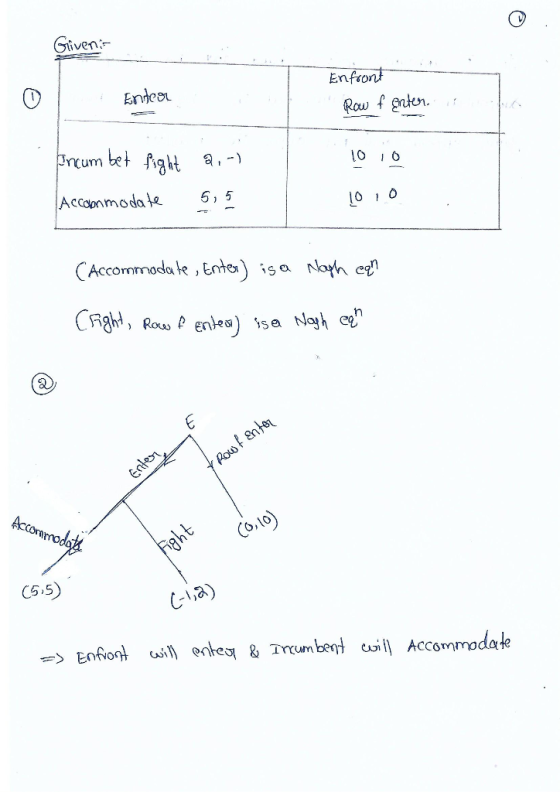
I) and a potential entrant (denoted E) to the market. The entrant has two actions: it can either enter the market in which the incumbent operates, or not enter. The incumbent has two actions: it can either fight the entrant, or accommodate. The payoffs are as follows: if E enters and I fights, E gets -1 and I gets 2. If E does not enter, I gets 10 for any of its two actions, and E gets 0. If E enters and I accommodates, then both get the payoff 5.
-
Suppose that both players act simultaneously. Depict the game with the help of a game matrix. Find the Nash equilibria (in pure strategies).
-
Now suppose that E moves first, and then the I follows. Depict this sequential game with the help of a game tree. What is the equilibrium of the game? (remember from the lecture that we have to apply ”backward reasoning” - start from the end and move to the start of the game).
-
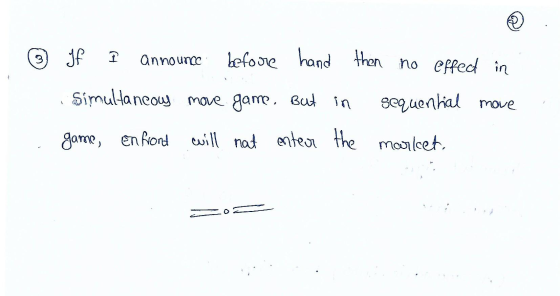
Suppose that before the game starts, I announces: ”If E enters, than I always fight”. Does it convince E in a simultaneous move game? Does it convince E in the sequential game? Why?
Homework Answers
Add Answer to:
Consider the following game: there are two players, an incumbent
(denoted
I) and a potential entrant...
Consider the following two-stage game between an incumbent firm, I, and a potential entrant, E. The...
Consider the following two-stage game between an incumbent firm, I, and a potential entrant, E. The strategy sets of E and I each have two possible actions. The strategy set of E, denoted SE = {enter, stay out} while the strategy set of I, denoted SI = {fight if the entrant enters, accommodate if the entrant enters} where ‘accommodate’ means ‘do not fight’. If E stays out, I’s profit if $50 million and E’s profit is $5 million. If E...
• An incumbent sells steel and faces a potential entrant. • Inverse demand curve for steel...
• An incumbent sells steel and faces a potential entrant. • Inverse demand curve for steel sales is given by by P = 400 – Q, where Q is the total amount sold by both firms. • The marginal cost to transport one customer is MC = 100 • The entrant incurs fixed costs of F. (a) What are the Cournot prices and quantities in the market, assuming the entrant enters? (b) What are the Stackelberg prices and quantities in...
Question 1: An incumbent sells steel and faces a potential entrant. Inverse demand curve for steel...
 Question 1: An incumbent sells steel and faces a potential entrant. Inverse demand curve for steel sales is given by by P = 400-Q, where Q is the total amount sold by both firms. The marginal cost to produce one unit of steel is MC = 100 The entrant incurs fixed costs of F. (a) What are the Cournot prices and quantities in the market, assuming the entrant enters? (b) What are the Stackelberg prices and quantities in the market,...
8. Consider a sequential entry game between an incumbent firm (Firm 1) and a potential entrant...
8. Consider a sequential entry game between an incumbent firm (Firm 1) and a potential entrant (Firm 2). Firm 1 moves first and must choose whether to lobby the government to pass a new safety regulation or lobby the government to reject a new safety regulation. Firm 1 is sufficiently powerful that it gets its way with the regulators. Firm 2 moves second and must choose whether to enter this market and compete with Firm 1 or stay out of...
Problem VI: Consider the following dynamic game: An entrant chooses whether to enter the market or...
Problem VI: Consider the following dynamic game: An entrant chooses whether to enter the market or stay out. If he chooses to stay out he will get $0, while the incumbent gets $20. If he enters the market, the entrant and the incumbent play the following simultaneous pricing game: they both choose whether to price high or low. If they both price low, they each get $5. If they both price high, they each get $10. If one prices low...
An incumbent monopolist (M) faces a potential entrant (E). E has to decide whether to enter...
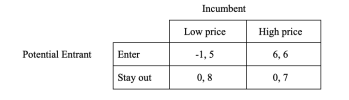 An incumbent monopolist (M) faces a potential entrant (E). E has
to decide whether to enter or stay out. Following the action taken
by E, I has to decide whether to charge a low price or a high
price. The possible outcomes of these decisions are described in
the following payoff matrix.
a) Suppose M threatens to set a low price if E should enter.
Will E believe the threat? Construct a game tree to help explain
your answer. Then...
An incumbent monopolist (M) faces a potential entrant (E). E has
to decide whether to enter or stay out. Following the action taken
by E, I has to decide whether to charge a low price or a high
price. The possible outcomes of these decisions are described in
the following payoff matrix.
a) Suppose M threatens to set a low price if E should enter.
Will E believe the threat? Construct a game tree to help explain
your answer. Then...
3. (15 points) Consider a sequential game with two players with three-moves, in which player 1...
 3. (15 points) Consider a sequential game with two players with three-moves, in which player 1 moves twice: Player 1 chooses Enter or Erit, and if she chooses Exit the game ends with payoffs of 2 to player 2 and 0 to player 1. • Player 2 observes player l's choice and will have a choice between Fight or Help if player 1 chose Enter. Choosing Help ends the game with payoffs of 1 to both players. • Finally, player...
There are two incumbent firms, F1,F2 and also a potential entrant, F3. The steps of the...
There are two incumbent firms, F1,F2 and also a potential entrant, F3. The steps of the game are: 1. F1 and F2 simultaneously choose outputs q1 ∈ R+ and q2 ∈ R+ respectively. 2. F3 observes q1,q2 and then chooses whether to enter the industry. If she does not, then q3 = 0 and she gets a payoff of zero, but... 3. if she has entered the industry, F3 chooses her own output level, q3 ∈ R+. Inverse demand is...
3. Find the Bayesian-Nash Equilibrium for the following Entry game." Two firms in same product market Incumbent cho...
 3. Find the Bayesian-Nash Equilibrium for the following Entry game." Two firms in same product market Incumbent chooses Build (B) or Don't Build (D) capacity Entrant chooses Enter E or Stay Out S Incumbent has two types, which affect cost of building capacity a = high cost type, and θι low cost type-o, has a higher capacity cost than θ Prior probability of 0h is p. Idea is incumbent earns a higher profit if entrant stays out. So may want...
There are two incumbent firms, F1,F2 and also a potential entrant, F3. The steps of the game are: 1. F1 and F2 simultane...
There are two incumbent firms, F1,F2 and also a potential entrant, F3. The steps of the game are: 1. F1 and F2 simultaneously choose outputs q1 ∈ R+ and q2 ∈ R+ respectively. 2. F3 observes q1, q2 and then chooses whether to enter the industry. If she does not, then q3 = 0 and she gets a payoff of zero, but. . . 3. if she has entered the industry, F3 chooses her own output level, q3 ∈ R+....
 Question 1: An incumbent sells steel and faces a potential entrant. Inverse demand curve for steel sales is given by by P = 400-Q, where Q is the total amount sold by both firms. The marginal cost to produce one unit of steel is MC = 100 The entrant incurs fixed costs of F. (a) What are the Cournot prices and quantities in the market, assuming the entrant enters? (b) What are the Stackelberg prices and quantities in the market,...
 An incumbent monopolist (M) faces a potential entrant (E). E has
to decide whether to enter or stay out. Following the action taken
by E, I has to decide whether to charge a low price or a high
price. The possible outcomes of these decisions are described in
the following payoff matrix.
a) Suppose M threatens to set a low price if E should enter.
Will E believe the threat? Construct a game tree to help explain
your answer. Then...
An incumbent monopolist (M) faces a potential entrant (E). E has
to decide whether to enter or stay out. Following the action taken
by E, I has to decide whether to charge a low price or a high
price. The possible outcomes of these decisions are described in
the following payoff matrix.
a) Suppose M threatens to set a low price if E should enter.
Will E believe the threat? Construct a game tree to help explain
your answer. Then...
 3. (15 points) Consider a sequential game with two players with three-moves, in which player 1 moves twice: Player 1 chooses Enter or Erit, and if she chooses Exit the game ends with payoffs of 2 to player 2 and 0 to player 1. • Player 2 observes player l's choice and will have a choice between Fight or Help if player 1 chose Enter. Choosing Help ends the game with payoffs of 1 to both players. • Finally, player...
 3. Find the Bayesian-Nash Equilibrium for the following Entry game." Two firms in same product market Incumbent chooses Build (B) or Don't Build (D) capacity Entrant chooses Enter E or Stay Out S Incumbent has two types, which affect cost of building capacity a = high cost type, and θι low cost type-o, has a higher capacity cost than θ Prior probability of 0h is p. Idea is incumbent earns a higher profit if entrant stays out. So may want...
Most questions answered within 3 hours.
-
Where is the error in this code sequence?
String s1 = "Hello";
String s2 = "ello";...
asked 11 months ago -
Financial data for Joel de Paris, Inc., for last year
follow:
Joel de Paris, Inc.
Balance...
asked 11 months ago -
Consider this reaction:
Al2(SO4)3 (aq)+ BaCl3
(aq) Al2Cl6 (aq)- +
3BaSO4(s) . What is the...
asked 11 months ago -
Suppose that Savneet is considering increasing her
recent random sample from 20 car rentals to 40...
asked 11 months ago -
Trucks arrive at an unloading terminal at an average rate of 120
per hour.
Trucks arrive...
asked 11 months ago -
Why are methanol and ethanol completely soluble in water while
octanol is not very little soluble....
asked 11 months ago -
A facilities manager at a university reads in a research report
that the mean amount of...
asked 11 months ago -
When the CuSO4 is rehydrated by adding water to the anhydrous
compound, is this an endothermic...
asked 11 months ago -
A ray of sunlight is passing from diamond into crown glass; the
angle of incidence is...
asked 11 months ago -
A block of mass 0.249 kg is placed on top of a light, vertical
spring of...
asked 11 months ago -
how do the kidneys compensate in the presences of acidosis
a) trigger hyperventilate
b) reserve acid...
asked 11 months ago -
Question 501 pts
The rental rate of capital to the firm increases. Which of the
following...
asked 11 months ago