Consider the following two-stage game between an incumbent firm, I, and a potential entrant, E. The...
Consider the following two-stage game between an incumbent firm,
I, and a potential entrant, E. The strategy sets of E and I each
have two possible actions. The strategy set of E, denoted SE =
{enter, stay out} while the strategy set of I, denoted SI = {fight
if the entrant enters, accommodate if the entrant enters} where
‘accommodate’ means ‘do not fight’. If E stays out, I’s profit if
$50 million and E’s profit is $5 million. If E enters and I
accommodates E’s entry, both would have a profit of $20 million. If
E enters and I fights, the profit for each firm would be $1
million.
a) Use a decision tree to depict this game.
b) Identify the two Nash equilibrium pairs of
strategies.
c) Explain why only one of the Nash equilibrium pairs
of strategies is sensible, and explain why the second one is not
sensible.
Homework Answers

Add Answer to:
Consider the following two-stage game between an incumbent firm,
I, and a potential entrant, E. The...
Consider the following game: there are two players, an incumbent (denoted I) and a potential entrant...
Consider the following game: there are two players, an incumbent (denoted I) and a potential entrant (denoted E) to the market. The entrant has two actions: it can either enter the market in which the incumbent operates, or not enter. The incumbent has two actions: it can either fight the entrant, or accommodate. The payoffs are as follows: if E enters and I fights, E gets -1 and I gets 2. If E does not enter, I gets 10 for...
8. Consider a sequential entry game between an incumbent firm (Firm 1) and a potential entrant...
8. Consider a sequential entry game between an incumbent firm (Firm 1) and a potential entrant (Firm 2). Firm 1 moves first and must choose whether to lobby the government to pass a new safety regulation or lobby the government to reject a new safety regulation. Firm 1 is sufficiently powerful that it gets its way with the regulators. Firm 2 moves second and must choose whether to enter this market and compete with Firm 1 or stay out of...
3. Find the Bayesian-Nash Equilibrium for the following Entry game." Two firms in same product market Incumbent cho...
 3. Find the Bayesian-Nash Equilibrium for the following Entry game." Two firms in same product market Incumbent chooses Build (B) or Don't Build (D) capacity Entrant chooses Enter E or Stay Out S Incumbent has two types, which affect cost of building capacity a = high cost type, and θι low cost type-o, has a higher capacity cost than θ Prior probability of 0h is p. Idea is incumbent earns a higher profit if entrant stays out. So may want...
An incumbent monopolist (M) faces a potential entrant (E). E has to decide whether to enter...
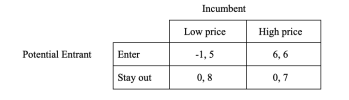 An incumbent monopolist (M) faces a potential entrant (E). E has
to decide whether to enter or stay out. Following the action taken
by E, I has to decide whether to charge a low price or a high
price. The possible outcomes of these decisions are described in
the following payoff matrix.
a) Suppose M threatens to set a low price if E should enter.
Will E believe the threat? Construct a game tree to help explain
your answer. Then...
An incumbent monopolist (M) faces a potential entrant (E). E has
to decide whether to enter or stay out. Following the action taken
by E, I has to decide whether to charge a low price or a high
price. The possible outcomes of these decisions are described in
the following payoff matrix.
a) Suppose M threatens to set a low price if E should enter.
Will E believe the threat? Construct a game tree to help explain
your answer. Then...
The table below shows a game played between two firms, Firm A and Firm B. In...
The table below shows a game played between two firms, Firm A and Firm B. In this game, each firm must decide how much output (Q) to produce: 2 units or 3 units. The profit for each firm is given in the table as (Profit for Firm A, Profit for Firm B). Firm B Q=2 Q=3 Firm A Q=2 (10, 10) (8, 12) Q=3 (12, 8) (6, 6) What is the dominant strategy for each firm? Explain. What is the...
11. The table below shows a game played between two firms, Firm A and Firm B....
 11. The table below shows a game played between two firms, Firm A and Firm B. In this game, each firm must decide how much output (Q) to produce: 2 units or 3 units. The profit for each firm is given in the table as (Profit for Firm A, Profit for Firm B). Firm B Q=2 Q=3 Q=2 / (10, 10) (8, 12) Firm A Q=3 (12,8) L (6,6) a. What is the dominant strategy for each firm? Explain. b....
2. Suppos e there are two firms in an oligopoly, Firm A both firms charge a...
 2. Suppos e there are two firms in an oligopoly, Firm A both firms charge a low price, each earns and Firm B. If $2 million in profit. If both firms charge a high price, each earns $3 million in profit. If one firm charges a high price and one charges a low price, customers flock to the firm with the low price, and that firm earns $4 million in profit while the firm with the high price earns $1...
Consider two firms 1 and 2 engaging into the following one-shot game: if firm 1 advertises...
Consider two firms 1 and 2 engaging into the following one-shot game: if firm 1 advertises and firm 2 does not, firm 1 will make $20 million in profits and firm 2 will make $6 million. If firm 2 advertises and firm 1 does not, firm 1 will make $2 million and firm 2 will make $6 million. If firm 1 advertises and firm 2 advertises, each firm earns $10 million. If neither firm advertises, firm 2 will make $8...
QUESTION 15 Consider the following simultaneous-move game: Two firms, Firm 1 (raw player) and Firm 2...
 QUESTION 15 Consider the following simultaneous-move game: Two firms, Firm 1 (raw player) and Firm 2 (column player), decide whether to enter (E) or not enter (N) some market. If neither enters, then both make 0. If both enter, the market is oversaturated and so both earn a loss of 5. However, if only one enters, then the entrant earns monopoly profit of 10. Which of the following matrices is the correct representation of the static game? 0.10 10.0 0.0...
Consider the following two-period repeated game. The stage game is the following: payoff S H C...
Consider the following two-period repeated game. The stage game is the following: payoff S H C S 3,3 0,1 0,0 H 1,0 1,1 6,0 C 0,0 0,6 5,5 (a) Find all pure-strategy Nash equilibria if the stage game is played only once. (b) Now consider the two-period game. Suppose the discount factor δ = 1 for both players. Find a subgame perfect equilibrium in which each player receives a total payoff of at least 8. (c) For what other values...
 3. Find the Bayesian-Nash Equilibrium for the following Entry game." Two firms in same product market Incumbent chooses Build (B) or Don't Build (D) capacity Entrant chooses Enter E or Stay Out S Incumbent has two types, which affect cost of building capacity a = high cost type, and θι low cost type-o, has a higher capacity cost than θ Prior probability of 0h is p. Idea is incumbent earns a higher profit if entrant stays out. So may want...
 An incumbent monopolist (M) faces a potential entrant (E). E has
to decide whether to enter or stay out. Following the action taken
by E, I has to decide whether to charge a low price or a high
price. The possible outcomes of these decisions are described in
the following payoff matrix.
a) Suppose M threatens to set a low price if E should enter.
Will E believe the threat? Construct a game tree to help explain
your answer. Then...
An incumbent monopolist (M) faces a potential entrant (E). E has
to decide whether to enter or stay out. Following the action taken
by E, I has to decide whether to charge a low price or a high
price. The possible outcomes of these decisions are described in
the following payoff matrix.
a) Suppose M threatens to set a low price if E should enter.
Will E believe the threat? Construct a game tree to help explain
your answer. Then...
 11. The table below shows a game played between two firms, Firm A and Firm B. In this game, each firm must decide how much output (Q) to produce: 2 units or 3 units. The profit for each firm is given in the table as (Profit for Firm A, Profit for Firm B). Firm B Q=2 Q=3 Q=2 / (10, 10) (8, 12) Firm A Q=3 (12,8) L (6,6) a. What is the dominant strategy for each firm? Explain. b....
 2. Suppos e there are two firms in an oligopoly, Firm A both firms charge a low price, each earns and Firm B. If $2 million in profit. If both firms charge a high price, each earns $3 million in profit. If one firm charges a high price and one charges a low price, customers flock to the firm with the low price, and that firm earns $4 million in profit while the firm with the high price earns $1...
 QUESTION 15 Consider the following simultaneous-move game: Two firms, Firm 1 (raw player) and Firm 2 (column player), decide whether to enter (E) or not enter (N) some market. If neither enters, then both make 0. If both enter, the market is oversaturated and so both earn a loss of 5. However, if only one enters, then the entrant earns monopoly profit of 10. Which of the following matrices is the correct representation of the static game? 0.10 10.0 0.0...
Most questions answered within 3 hours.
-
Where is the error in this code sequence?
String s1 = "Hello";
String s2 = "ello";...
asked 11 months ago -
Financial data for Joel de Paris, Inc., for last year
follow:
Joel de Paris, Inc.
Balance...
asked 11 months ago -
Consider this reaction:
Al2(SO4)3 (aq)+ BaCl3
(aq) Al2Cl6 (aq)- +
3BaSO4(s) . What is the...
asked 11 months ago -
Suppose that Savneet is considering increasing her
recent random sample from 20 car rentals to 40...
asked 11 months ago -
Trucks arrive at an unloading terminal at an average rate of 120
per hour.
Trucks arrive...
asked 11 months ago -
Why are methanol and ethanol completely soluble in water while
octanol is not very little soluble....
asked 11 months ago -
A facilities manager at a university reads in a research report
that the mean amount of...
asked 11 months ago -
When the CuSO4 is rehydrated by adding water to the anhydrous
compound, is this an endothermic...
asked 11 months ago -
A ray of sunlight is passing from diamond into crown glass; the
angle of incidence is...
asked 11 months ago -
A block of mass 0.249 kg is placed on top of a light, vertical
spring of...
asked 11 months ago -
how do the kidneys compensate in the presences of acidosis
a) trigger hyperventilate
b) reserve acid...
asked 11 months ago -
Question 501 pts
The rental rate of capital to the firm increases. Which of the
following...
asked 11 months ago