![Consider two consecutive first order reactions A k B the [A],to, [B]. = a[A]. (9) What is the concentration of B intems of th](http://img.homeworklib.com/questions/019d6ad0-6fd1-11ea-a55b-db38e111999a.png?x-oss-process=image/resize,w_560)
Homework Answers
Add Answer to:
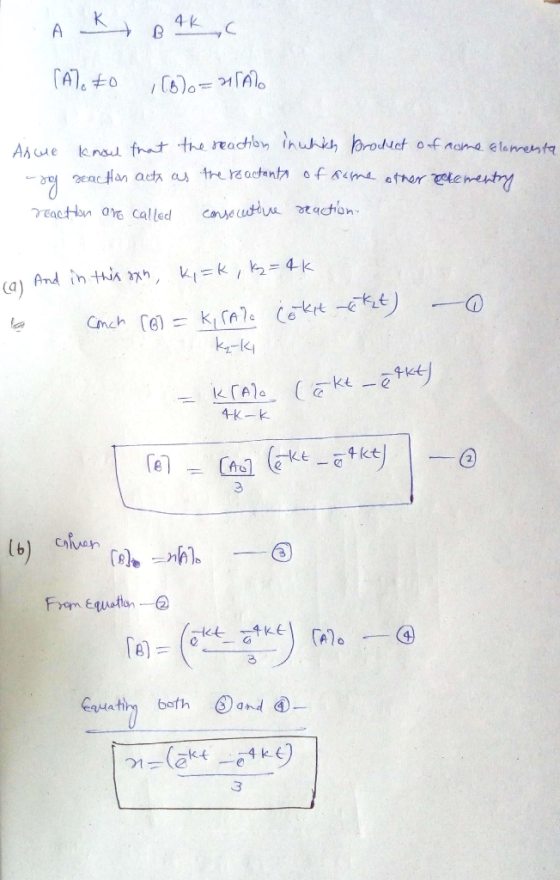
Consider two consecutive first order reactions A k B the [A],to, [B]. = a[A]. (9) What...
Consider a reaction that is composed of two consecutive elementary reactions: A --ka--> I ---kb---> P...
Consider a reaction that is composed of two consecutive elementary reactions: A --ka--> I ---kb---> P With ka = 0.120 min-1, and kb = 0.012 min-1. Assume that the intermediate I is the compound of interest to you. At what time is the concentration of I the greatest, ie. after what time should you stop the reaction to obtain a maximum of I?
9. For second-order reactions the slope of a plot of 1A versus time is b. KTA...
 9. For second-order reactions the slope of a plot of 1A versus time is b. KTA kt ch 10. If the reaction 2A + 3D products is first order in A and second-order in D. then the rate law will have the form rate- a. K[ALDI KADC KIAFDd. KIAD 11. In the first-order reaction products, the initial concentration of AIN 1.56 M and the concentration is 0.869 M after 48.0 min. What is the value of the route constant, k....
Compounds A and B are unstable and each decomposes by a first-order process. At 398 K,...
 Compounds A and B are unstable and each decomposes by a first-order process. At 398 K, the rate constant for the decomposition of A is 3.6 X 10⁻⁵ s-1. Separate containers of A and B were prepared, with initial concentrations of 0.120 M A and 0.240 M B. After 5 hrs, it was found that the concentration of A was three times the concentration of B wwww What was the concentration of A after 5 hrs? 2) 1) What is...
Problem 10 For a 2 step consecutive reaction: k: The concentration of B, [B], as a...
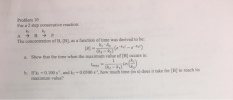 Problem 10 For a 2 step consecutive reaction: k: The concentration of B, [B], as a function of time was derived to be: [B] = (k2-k1) a. Show that the time when the maximum value of [B] occurs is: tmax = (ka-ki) Ln (k2 b. If ki = 0.100 s., and k2 = 0.0500 s., how much time (in s) does it take for [B] to reach its maximum value?
For the consecutive reactions A ‹ B‹C, k1=0.35/h, k2=0.13/h, CA0=4 lbmol/ft concentration of B is maximum.and...
For the consecutive reactions A ‹ B‹C, k1=0.35/h, k2=0.13/h, CA0=4 lbmol/ft concentration of B is maximum.and CB0=0, CC0=0. Find the time when the concentration of B is maximum. 7.2 hrs b. 6.5 hrs c. 4.6 hrs d. 3.9 hrs Based from the preceding problem, what is the maximum concentration of B in lbmols/ft3 if the reactor used is a single CSTR? a. 1.85 b. 2.01 c. 1.22 d. 2.32
first order reaction First-Order Reactions (35) Azomethane decomposes into nitrogen and ethane at high temperatures according...
 first order reaction
First-Order Reactions (35) Azomethane decomposes into nitrogen and ethane at high temperatures according to the following equation: (CH3)2N2(g) — N2(g) + C2H6(g) The following data are obtained in an experiment: Time (h) [(CH3)2N2] 1.00 0.905 2.00 0.741 3.00 0.607 4.00 0.497 (a) By plotting the data, show that the reaction is first-order. (b) From the graph, determine k. (c) Using k, find the time in hours) that it takes decrease the concentration to 0.100 M. (d) Calculate...
first order reaction
First-Order Reactions (35) Azomethane decomposes into nitrogen and ethane at high temperatures according to the following equation: (CH3)2N2(g) — N2(g) + C2H6(g) The following data are obtained in an experiment: Time (h) [(CH3)2N2] 1.00 0.905 2.00 0.741 3.00 0.607 4.00 0.497 (a) By plotting the data, show that the reaction is first-order. (b) From the graph, determine k. (c) Using k, find the time in hours) that it takes decrease the concentration to 0.100 M. (d) Calculate...
1. A reaction is second order in[A] and second-order in [B]: Rate,=K[A]^2[B]^2. what are the units...
1. A reaction is second order in[A] and second-order in [B]: Rate,=K[A]^2[B]^2. what are the units of k for this reaction? If the concentration of air decreases by a factor of 2 and the concentration of b increases by a factor of 5 what happens to the rate? 2. for the forward reaction 2NO+Cl2=>2NOCl. determine the rate(m/s)for experiment #4 given [NO]°(M)=0.40M and [Cl2]°z(M)=0?20M. Rate? 3.The following data were collected over time for the forward reaction 2NO2=>2NO+O2 ( 1/[NO2]=100 at 0...
What data should be plotted to show that experimental concentration data fits a first-order reaction? ln(k)...
What data should be plotted to show that experimental concentration data fits a first-order reaction? ln(k) vs. Ea ln[reactant] vs. time ln(k) vs. 1/T 1/[reactant] vs. time [reactant] vs. time
A first-order reaction A⟶BA⟶B has the rate constant k=k= 2.8×10⁻³ s−1s−1 . If the initial concentration...
A first-order reaction A⟶BA⟶B has the rate constant k=k= 2.8×10⁻³ s−1s−1 . If the initial concentration of AA is 1.5×10⁻² MM, what is the rate of the reaction at t=t= 690 ss ? Express your answer to two significant figures and include the appropriate units.
Consider the following reactions: A ⇌ B, K₁=6.95 A ⇌ C, K₂=2.00 What is K for...
Consider the following reactions: A ⇌ B, K₁=6.95 A ⇌ C, K₂=2.00 What is K for the reaction C ⇌ B?
 9. For second-order reactions the slope of a plot of 1A versus time is b. KTA kt ch 10. If the reaction 2A + 3D products is first order in A and second-order in D. then the rate law will have the form rate- a. K[ALDI KADC KIAFDd. KIAD 11. In the first-order reaction products, the initial concentration of AIN 1.56 M and the concentration is 0.869 M after 48.0 min. What is the value of the route constant, k....
 Compounds A and B are unstable and each decomposes by a first-order process. At 398 K, the rate constant for the decomposition of A is 3.6 X 10⁻⁵ s-1. Separate containers of A and B were prepared, with initial concentrations of 0.120 M A and 0.240 M B. After 5 hrs, it was found that the concentration of A was three times the concentration of B wwww What was the concentration of A after 5 hrs? 2) 1) What is...
 Problem 10 For a 2 step consecutive reaction: k: The concentration of B, [B], as a function of time was derived to be: [B] = (k2-k1) a. Show that the time when the maximum value of [B] occurs is: tmax = (ka-ki) Ln (k2 b. If ki = 0.100 s., and k2 = 0.0500 s., how much time (in s) does it take for [B] to reach its maximum value?
 first order reaction
First-Order Reactions (35) Azomethane decomposes into nitrogen and ethane at high temperatures according to the following equation: (CH3)2N2(g) — N2(g) + C2H6(g) The following data are obtained in an experiment: Time (h) [(CH3)2N2] 1.00 0.905 2.00 0.741 3.00 0.607 4.00 0.497 (a) By plotting the data, show that the reaction is first-order. (b) From the graph, determine k. (c) Using k, find the time in hours) that it takes decrease the concentration to 0.100 M. (d) Calculate...
first order reaction
First-Order Reactions (35) Azomethane decomposes into nitrogen and ethane at high temperatures according to the following equation: (CH3)2N2(g) — N2(g) + C2H6(g) The following data are obtained in an experiment: Time (h) [(CH3)2N2] 1.00 0.905 2.00 0.741 3.00 0.607 4.00 0.497 (a) By plotting the data, show that the reaction is first-order. (b) From the graph, determine k. (c) Using k, find the time in hours) that it takes decrease the concentration to 0.100 M. (d) Calculate...
Most questions answered within 3 hours.
-
Where is the error in this code sequence?
String s1 = "Hello";
String s2 = "ello";...
asked 10 months ago -
Financial data for Joel de Paris, Inc., for last year
follow:
Joel de Paris, Inc.
Balance...
asked 10 months ago -
Consider this reaction:
Al2(SO4)3 (aq)+ BaCl3
(aq) Al2Cl6 (aq)- +
3BaSO4(s) . What is the...
asked 10 months ago -
Suppose that Savneet is considering increasing her
recent random sample from 20 car rentals to 40...
asked 10 months ago -
Trucks arrive at an unloading terminal at an average rate of 120
per hour.
Trucks arrive...
asked 10 months ago -
Why are methanol and ethanol completely soluble in water while
octanol is not very little soluble....
asked 10 months ago -
A facilities manager at a university reads in a research report
that the mean amount of...
asked 10 months ago -
When the CuSO4 is rehydrated by adding water to the anhydrous
compound, is this an endothermic...
asked 10 months ago -
A ray of sunlight is passing from diamond into crown glass; the
angle of incidence is...
asked 10 months ago -
A block of mass 0.249 kg is placed on top of a light, vertical
spring of...
asked 10 months ago -
how do the kidneys compensate in the presences of acidosis
a) trigger hyperventilate
b) reserve acid...
asked 10 months ago -
Question 501 pts
The rental rate of capital to the firm increases. Which of the
following...
asked 10 months ago